Login


SUMMARY
This guide compares the 15 best employee engagement software tools for 2026, grouped by what you need them for: survey and listening platforms, recognition and rewards tools, and unified people platforms. Each pick covers features, pros and cons linked to G2 reviews, pricing and who it fits, from SMB to enterprise, so you can shortlist in minutes.
Top 15 Best Employee Engagement Software at a Glance
Employee engagement is in trouble. Gallup’s 2026 State of the Global Workplace report puts global engagement at 20% in 2025, a slide that costs the world economy an estimated $10 trillion in lost productivity. In the US, engagement fell to 31% in 2024, a 10-year low. For an employer, those numbers surface as attrition, missed targets, and people who have quietly checked out.
I built this as a comparison piece, not an explainer. Below are the 15 employee engagement tools I rate highest for 2026, plus a bonus, grouped by use case rather than ranked on one leaderboard, because a survey-first team and a recognition-first team need different things. The table below helps with fast scanning of the info, which is further aided by each tool explanation below.
| Tool | Best for | Pricing | Free trial | G2 |
|---|---|---|---|---|
| Keka | Engagement + HR + US payroll | Custom | Yes | 4.4 |
| Culture Amp | Data-driven engagement (mid-market/enterprise) | Custom | No (demo only) | 4.5 |
| Microsoft Viva Glint | Microsoft 365 enterprises | $2/user/mo (billed annually) | No (demo only) | 4.6 |
| Qualtrics EmployeeXM | Enterprise experience management | Custom | No (demo only) | 4.4 |
| Lattice | Performance + engagement (scaling) | Custom (per user) | No (demo only) | 4.6 |
| 15Five | Manager-led engagement | From $4/user/mo (billed annually) | No (demo only) | 4.6 |
| Workday Peakon | Continuous listening, retention | Custom (via Workday) | No (demo only) | 4.6 |
| Workhuman | Enterprise social recognition | Custom | No (demo only) | 4.7 |
| Bonusly | SMB / mid-market peer recognition | Per employee / mo | Yes | 4.7 |
| Nectar | Affordable recognition (SMB) | Custom | No (demo only) | 4.7 |
| Awardco | Reward choice and breadth | Custom | No (demo only) | 4.9 |
| Motivosity | Connection and gratitude culture | Custom | No (demo only) | 4.7 |
| Workleap | SMB and remote pulse surveys | From $4,999/yr + $32/manager/mo | No (demo only) | 4.3 |
| WorkTango | Surveys + recognition unified | Custom | No (demo only) | 4.7 |
| Leapsome | Performance + engagement + learning | Custom (per user) | Yes | 4.8 |
| GaggleAMP (bonus) | Employee advocacy | Custom | No (demo only) | 4.4 |
How I Chose the Best Employee Engagement Software?
I judged each tool on five things: the depth of its listening (surveys, pulse, and eNPS), its recognition and rewards, its analytics and action (whether it predicts turnover and nudges managers, or only reports), its integrations with your HRIS and comms stack, and its fit by company size and budget.
I also split the field by segment, because a tool that shines at 60 people can creak at 6,000. I call out where each pick sits, SMB, mid-market, or enterprise, so you are not comparing a lightweight pulse tool against an enterprise analytics suite as if they solve the same problem. I demoed each platform, read current G2 reviews, watched product walkthroughs and checked Reddit threads where HR teams compare notes, so the read below reflects what buyers say.
Top 15 Employee Engagement Software in 2026: The Breakdown
I cover each tool the same way: a short overview, space for a screenshot or walkthrough, key features, pros and cons linked to the G2 reviews they are drawn from, a Best for / Not for line, and pricing. The 15 ranked picks are followed by one bonus tool.
1. Keka (4.4/5 G2)
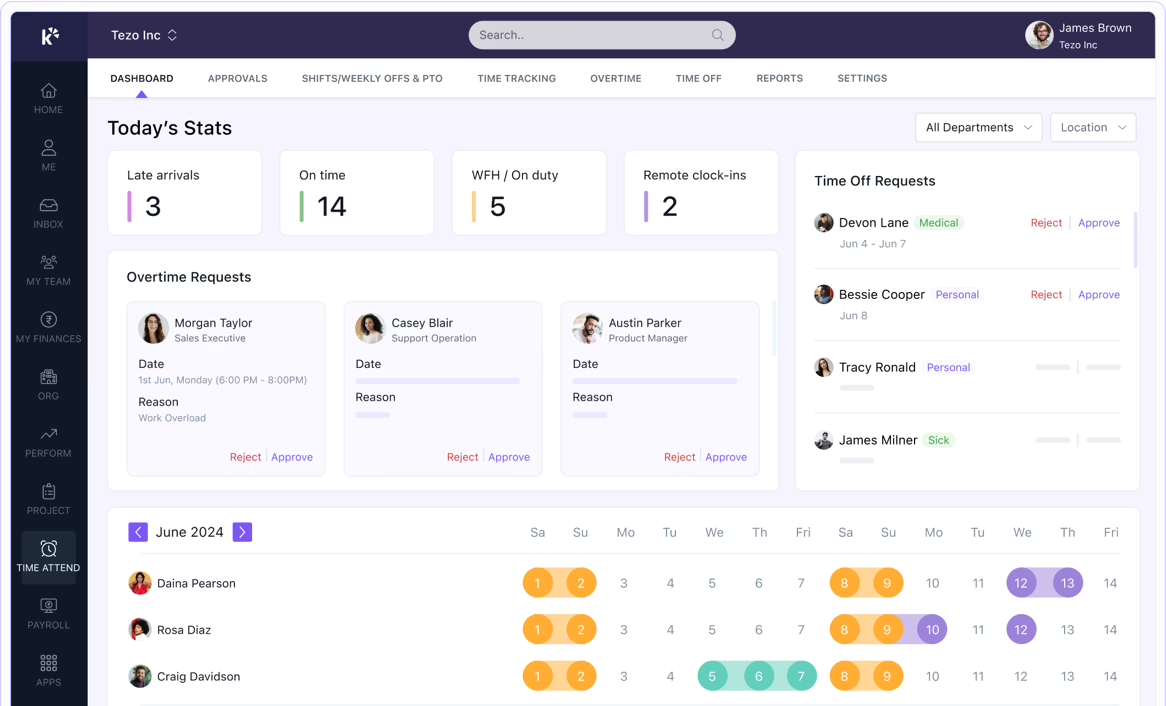
Keka is an all-in-one HR, payroll, and PSA platform used by 12,500+ organizations across 150+ countries, and engagement runs inside the same system, not as a separate tool. For a US employer, that means surveys, continuous feedback, and recognition sit on the same employee record as native payroll across all 50 states, so what you learn about a team connects directly to what you do about it.
Key features
-
Engagement and pulse surveys with continuous feedback and 360 reviews
-
Native US payroll (all 50 states, W-2, 1099) on the same platform
-
Continuous feedback, 1:1s and recognition through employee experience management
-
PSA for service businesses, linking engagement to project teams
| Pros | Cons |
|---|---|
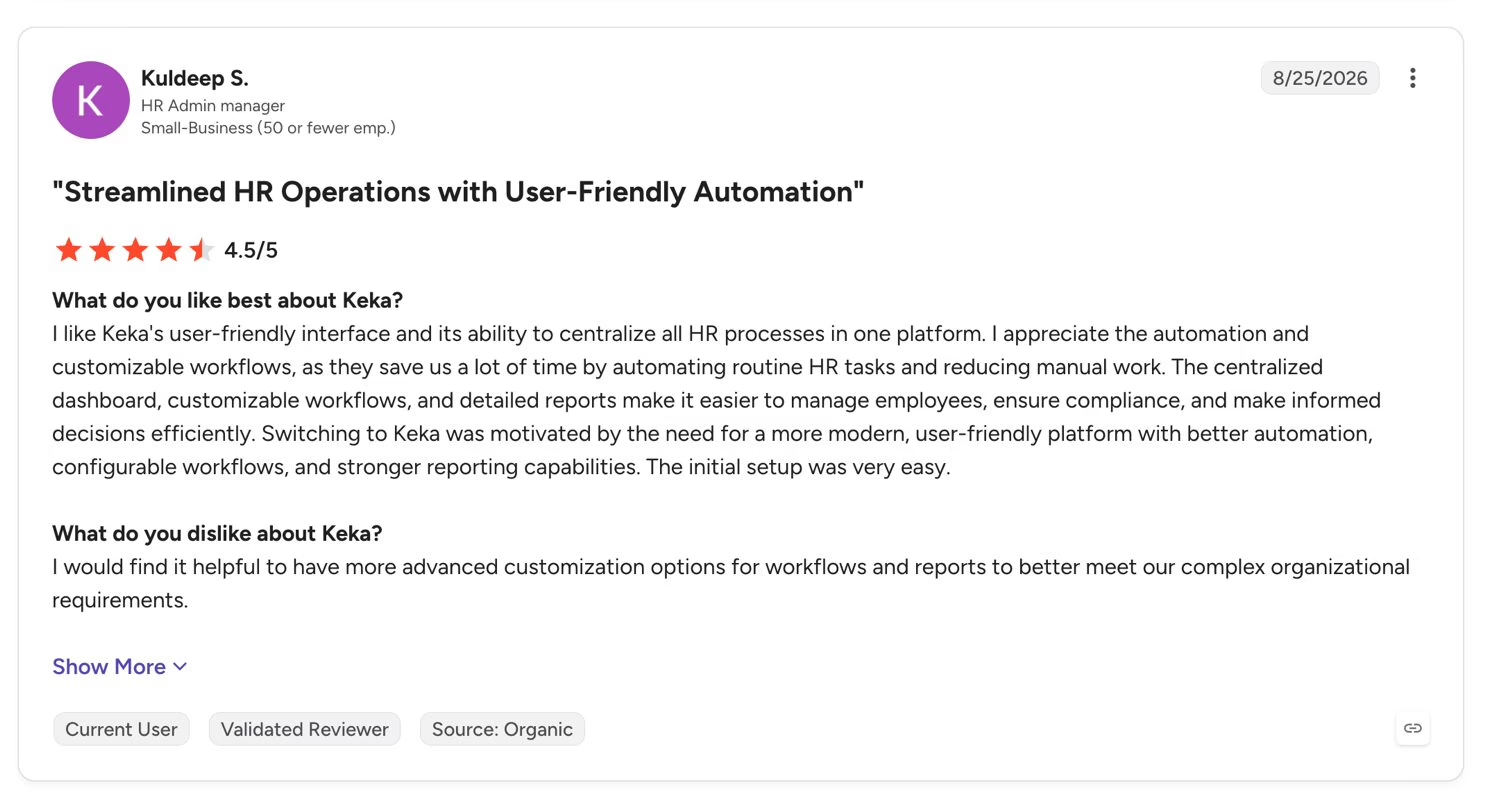
| Engagement, HR and US payroll run on one platform, with a consumer-grade interface. Highly praised trait in the review. | Companies operating across multiple countries may need to configure workflows around their different workforce and compliance requirements. |
Best for: US companies that want engagement embedded in their people-ops stack alongside HR and payroll.
Pricing: Custom pricing with a free trial. Check out the demo.
Here’s what users on G2 have to say about Keka:
2. Culture Amp (4.5/5 G2)
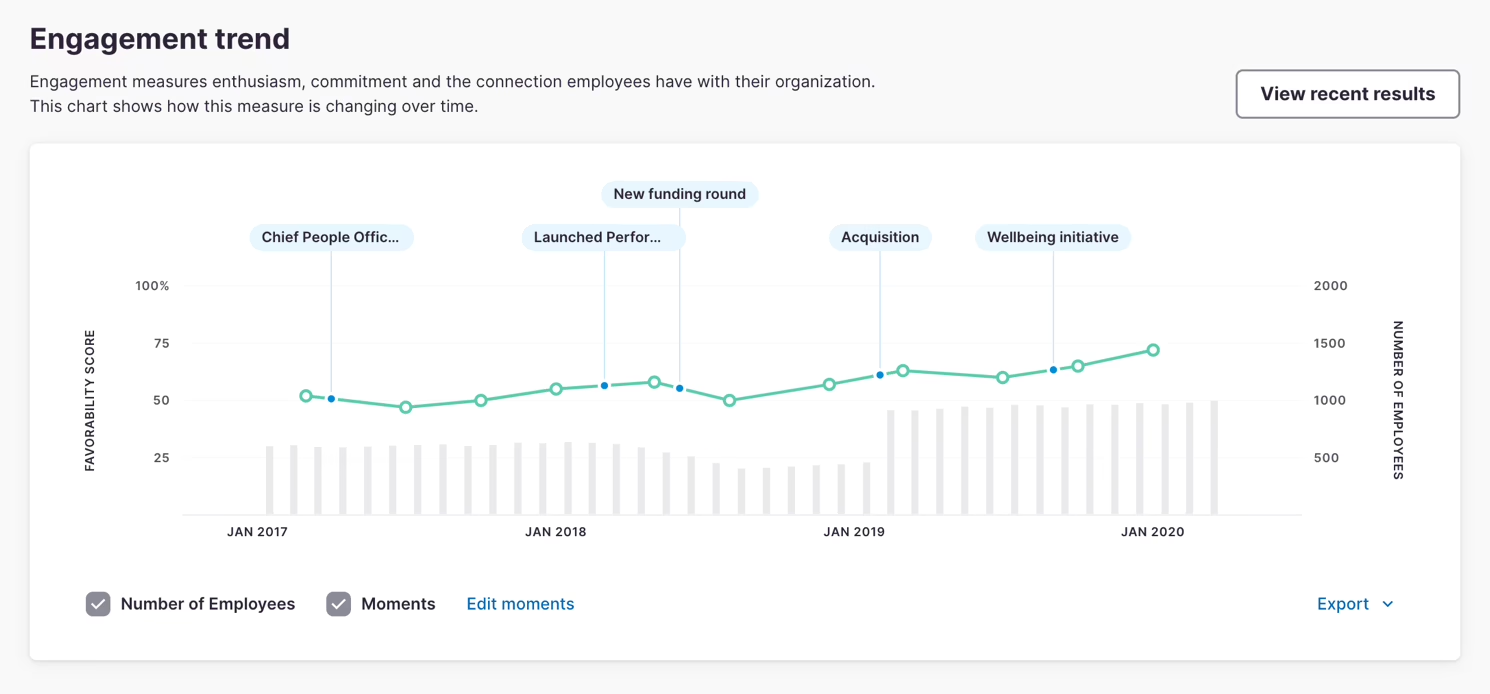
Culture Amp is one of the most established engagement platforms, built around science-backed surveys and benchmark data you compare against your industry. It pairs engagement, performance, and development, and its analytics turn raw survey results into clear drivers you can act on. Mid-market and enterprise teams choose it when they want rigor and benchmarking rather than a quick pulse-survey tool.
Key features
-
Pulse and lifecycle surveys with industry benchmark data
-
Engagement driver analysis and eNPS tracking
-
Performance reviews and development goals in the same suite
-
People analytics dashboards for HR and leadership
| Pros | Cons |
|---|---|
|
• Deep, validated survey science; strong benchmarks; good analytics. |
• Some users have requested regular touchpoints from a Customer Success Manager for feedback. |
Best for: mid-market and enterprise teams that want data-driven engagement with benchmarks.
Not for: very small teams on a tight budget.
Pricing: custom and quote-based, by size and modules.
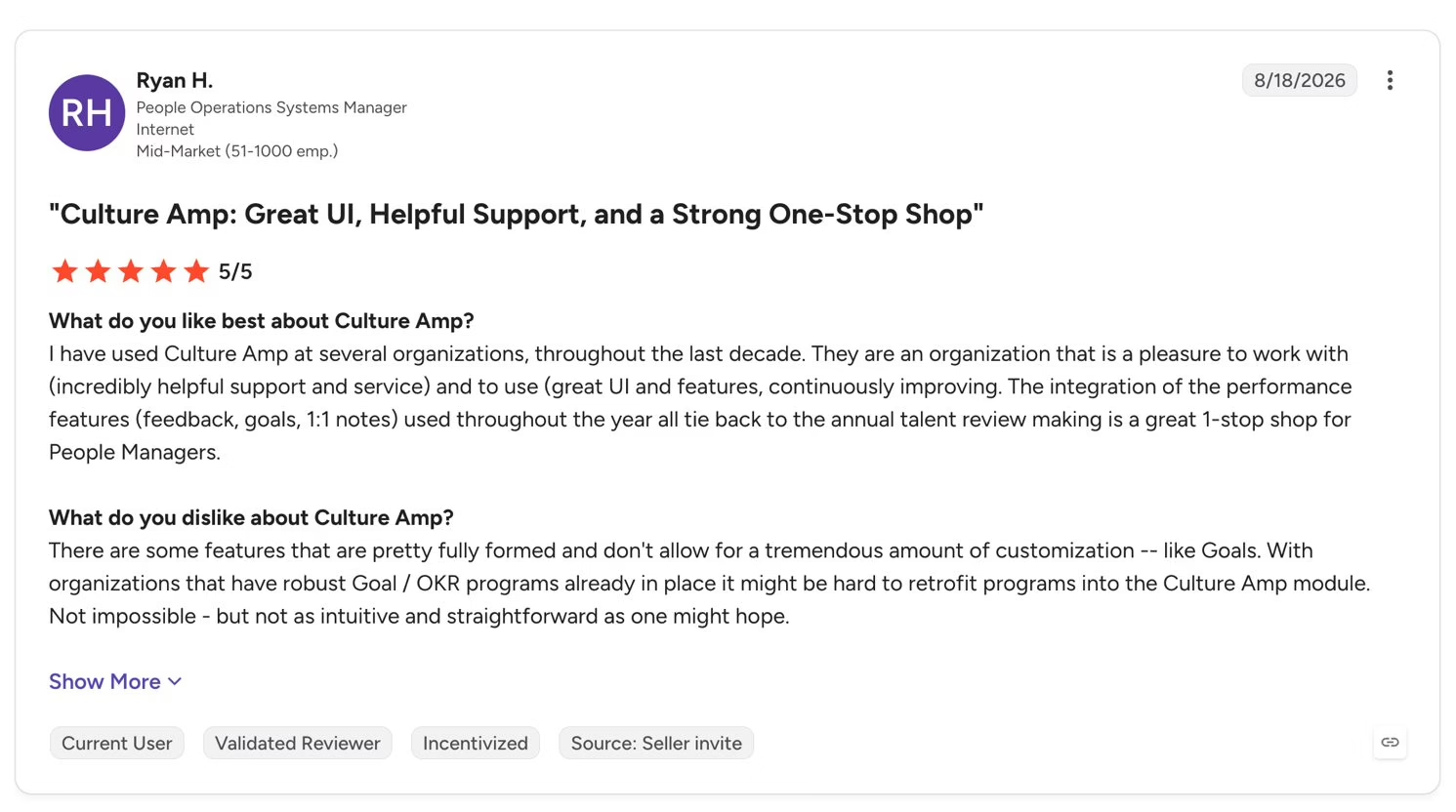
Here’s how Culture Amp rates with its own users on G2:
3. Microsoft Viva Glint (4.6/5 G2)
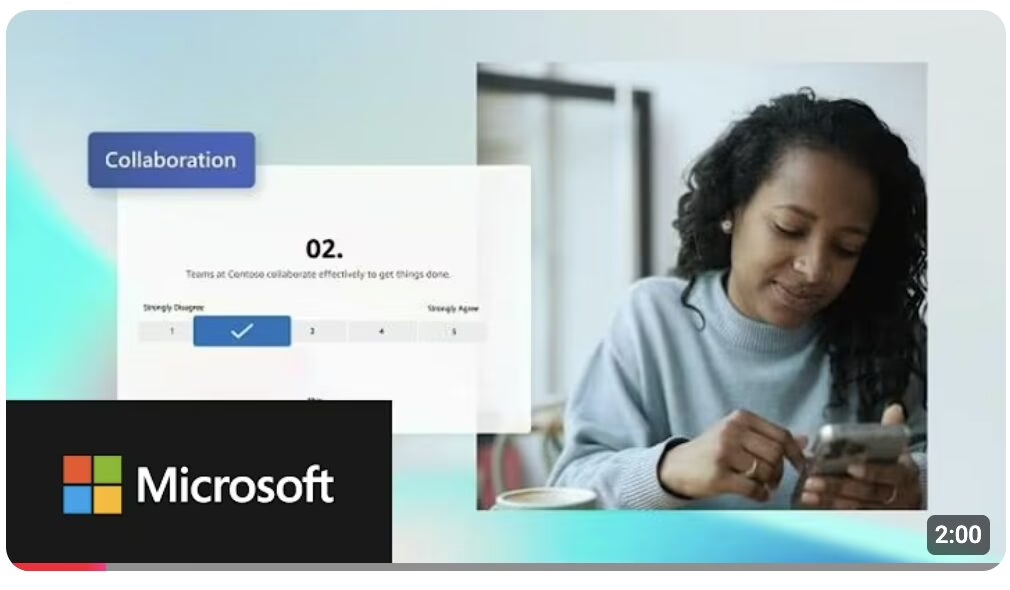
Microsoft Viva Glint is the engagement module inside Microsoft Viva, so it fits organizations already running on Microsoft 365. It centers on real-time engagement analytics and manager action workflows that turn survey results into next steps inside the tools people use every day. For enterprises standardized on Microsoft, it removes the friction of adding yet another separate system.
Key features
-
Real-time engagement dashboards and anonymous feedback
-
Manager action workflows built into Microsoft 365
-
Lifecycle and pulse surveys from onboarding to exit
-
Integration with Teams and the wider Viva suite
| Pros | Cons |
|---|---|
|
• Fits Microsoft shops cleanly; strong real-time analytics; 360-degree feedback surveys. |
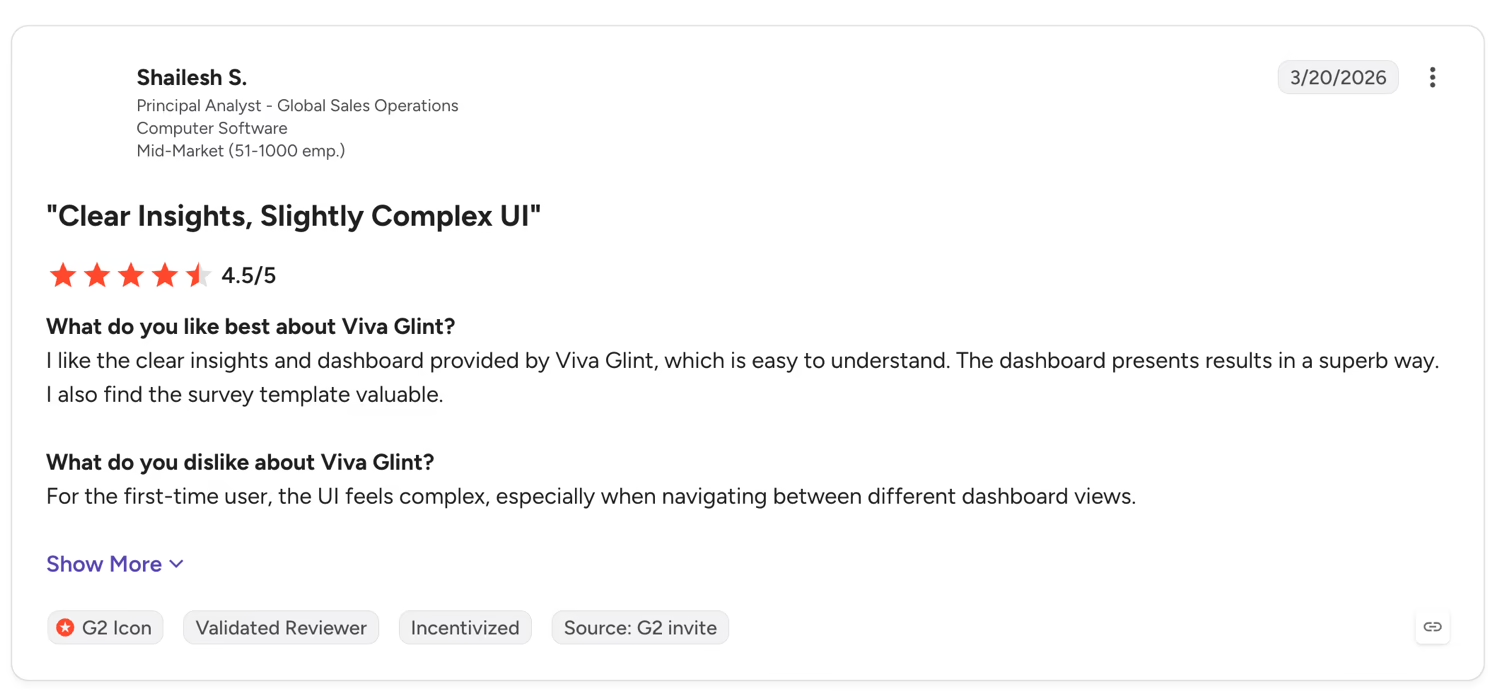
• Can be a bit complex for first-time users. |
Best for: enterprises standardized on Microsoft 365.
Not for: teams outside the Microsoft stack.
Pricing: $2 per user per month, paid yearly, via Microsoft Viva licensing (50-seat minimum).
Here’s how Microsoft Viva Glint rates with its own users on G2:
4. Qualtrics EmployeeXM (4.4/5 G2)
Qualtrics EmployeeXM is an enterprise experience-management platform where engagement is one part of a wider listening system. Its strength is prediction: turnover-risk modeling and driver analysis that help large organizations act on experience data at scale. It suits enterprises with dedicated people-analytics teams, and it carries the complexity and cost that come with that depth.
Key features
-
Turnover-risk prediction and engagement driver analysis
-
People analytics across the full employee experience
-
Highly configurable surveys and dashboards
-
Enterprise integrations and role-based access
| Pros | Cons |
|---|---|
|
• Powerful analytics and prediction; enterprise-grade; highly configurable. |
• Companies with small HR vendors end up doing a lot of data work manually. |
Best for: large enterprises with dedicated people-analytics teams.
Not for: SMBs and lean mid-market teams.
Pricing: custom, enterprise contracts. There is no public free trial, only a demo; request a quote for your team.
Here’s how Qualtrics EmployeeXM rates with its own users on G2:

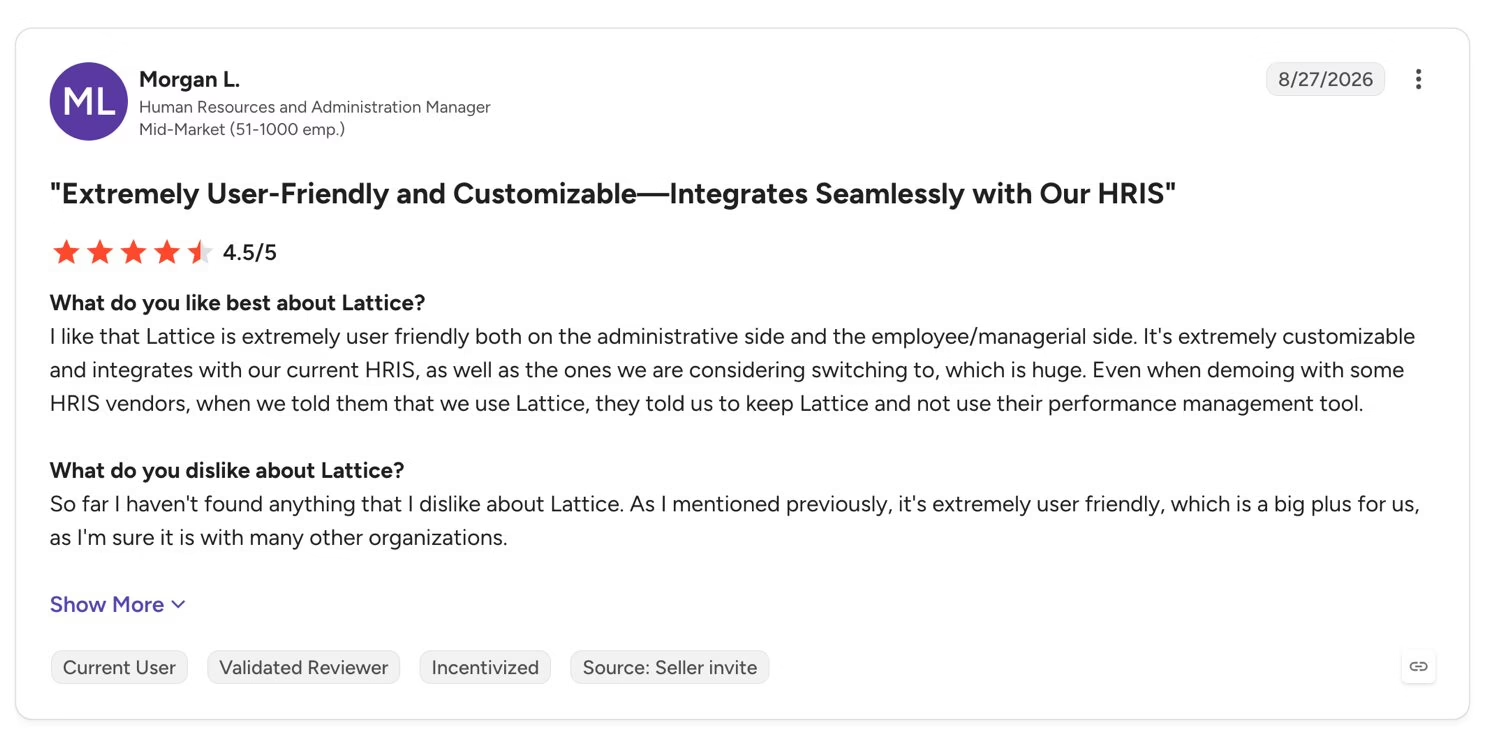
5. Lattice (4.6/5 G2)
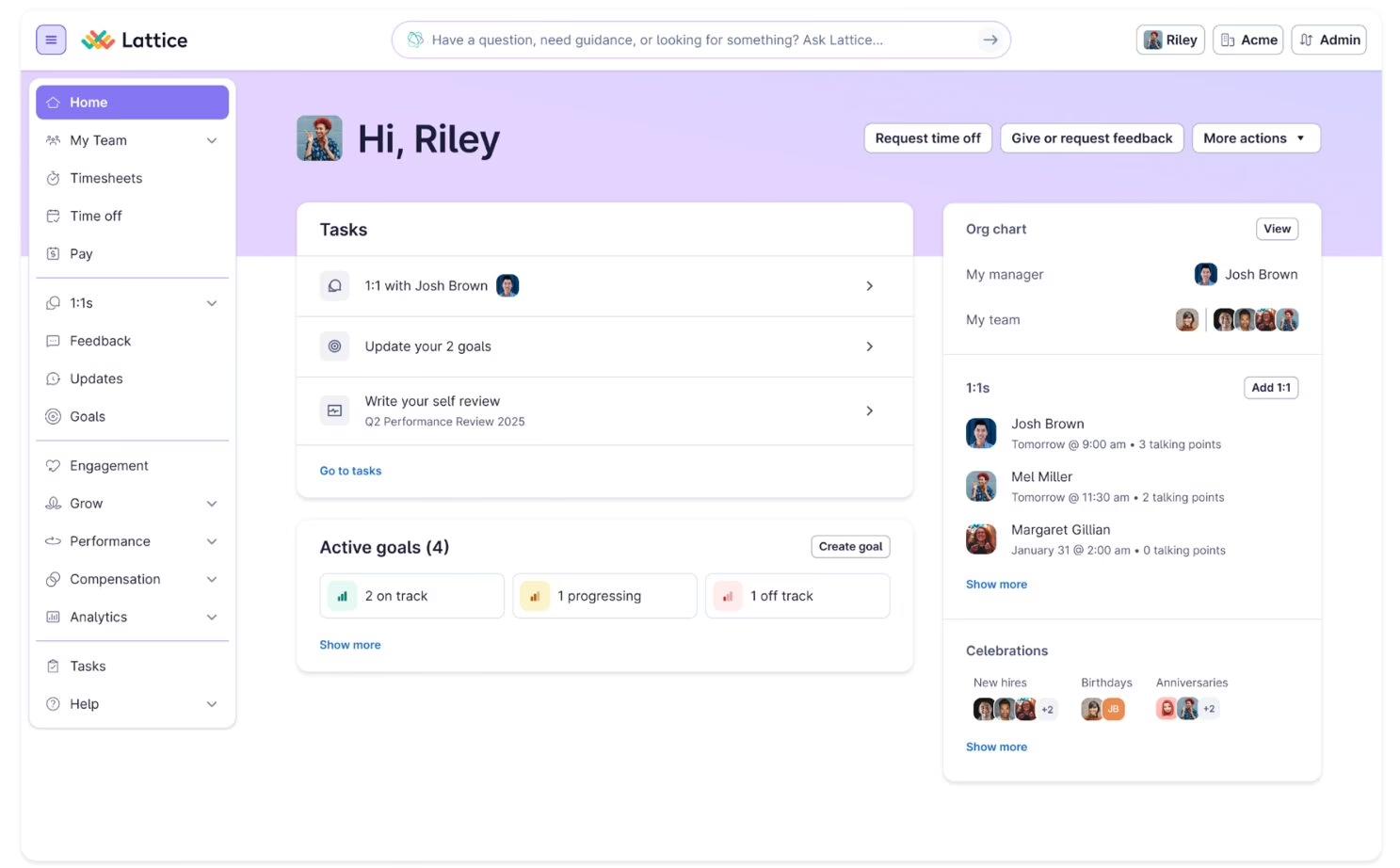
Lattice connects performance management and engagement in one place, which suits growing companies that want the two to inform each other. Engagement surveys and eNPS sit next to goals, reviews, and 1:1s, so a dip in engagement links straight to the performance conversation. Scaling mid-market teams pick it for that join, not for deep survey science.
Key features
-
Engagement surveys and eNPS tied to performance
-
Continuous feedback, goals and 1:1 tools
-
Review cycles and career development tracks
-
HRIS and Slack or Teams integrations
| Pros | Cons |
|---|---|
|
• Performance and engagement in one; user-friendly both on the administrative side and the employee/managerial side. |
• Many have been vocal about the review workflows. |
Best for: growing mid-market companies linking performance and engagement.
Not for: teams wanting deep survey science only.
Pricing: custom, per seat per month. There is no public free trial, only a free product tour.
Here’s how Lattice rates with its own users on G2:
6. 15Five (4.6/5 G2)
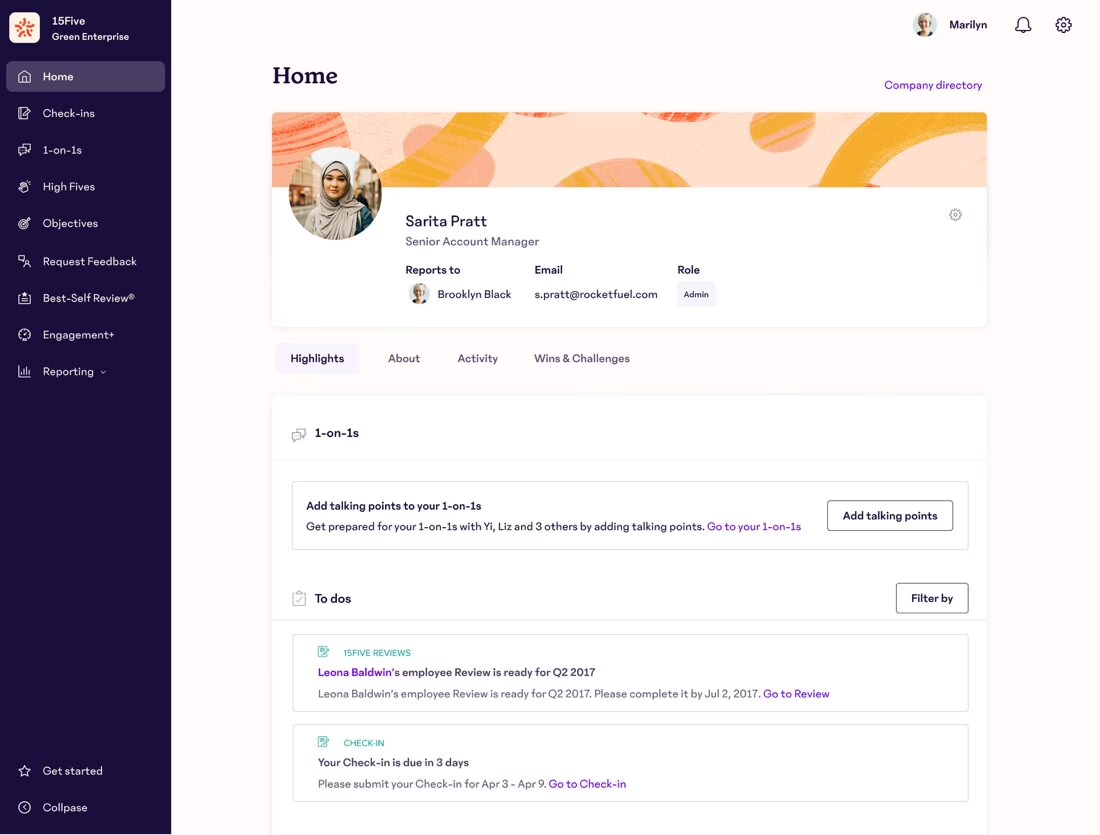
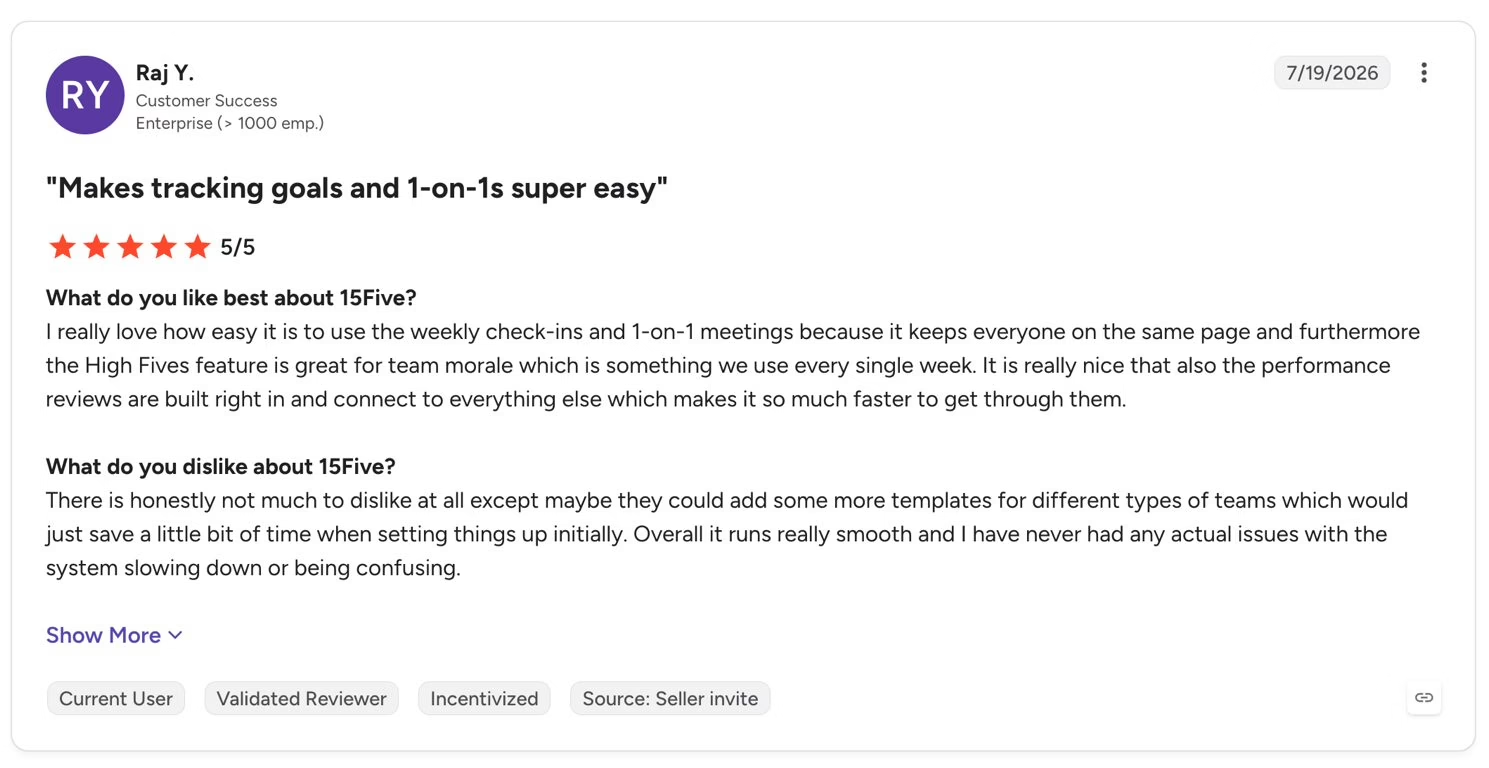
15Five builds engagement around managers, pairing continuous feedback and engagement measurement with manager enablement. The premise is simple: engagement improves when managers improve, so it bundles weekly check-ins, recognition, and burnout signals with coaching tools. It fits manager-led teams that want engagement and development together, and it rewards organizations that get managers to adopt it.
Key features
-
Weekly check-ins, engagement surveys, and burnout detection
-
Manager enablement and coaching tools
-
Peer recognition (High Fives) and goals
-
Continuous feedback and 1:1 agendas
| Pros | Cons |
|---|---|
|
• Strong manager focus; burnout detection; practical and lightweight. |
• Less enterprise analytics depth; many have reported a less flexible module for tracking OKRs. |
Best for: manager-led teams wanting engagement plus coaching.
Not for: enterprises after heavy, standalone analytics.
Pricing:
-
Engage: $4 per user per month (billed annually)
-
Perform: $11 per user per month (billed annually)
-
Total Platform: $16 per user per month (billed annually)
Here’s how 15Five rates with its own users on G2:
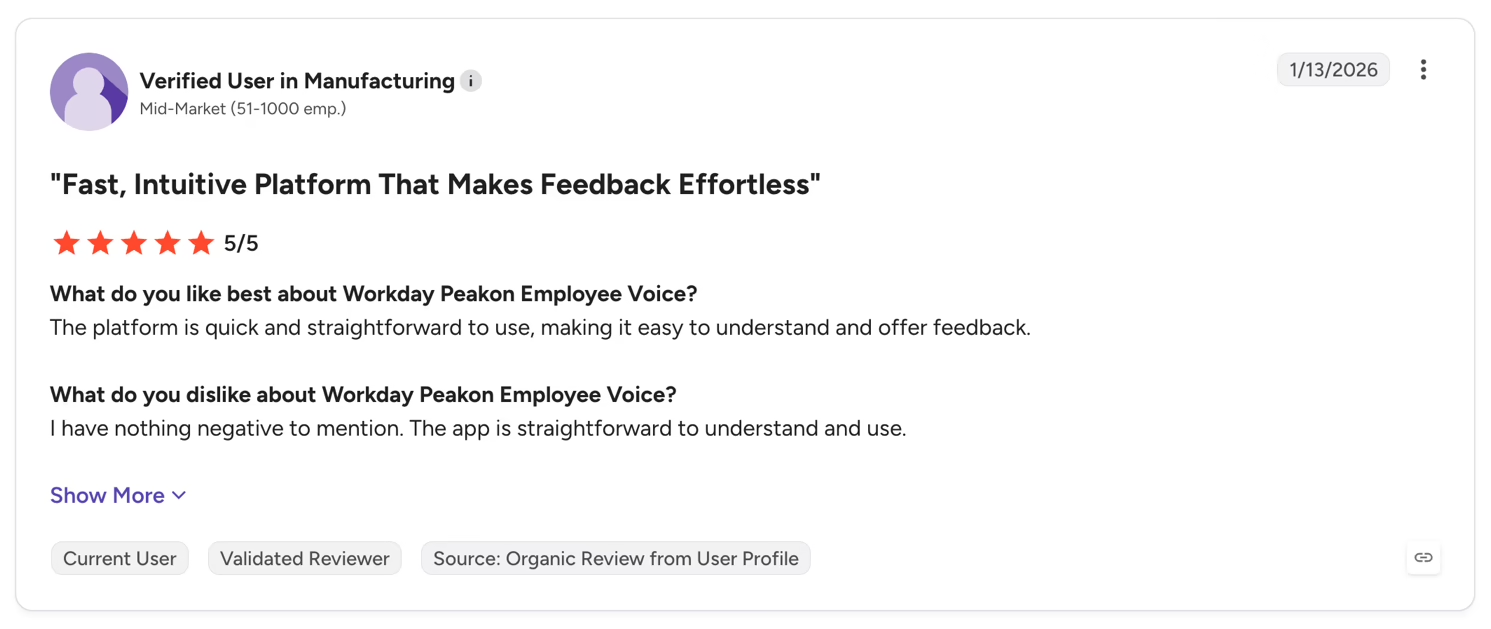
7. Workday Peakon Employee Voice (4.6/5 G2)
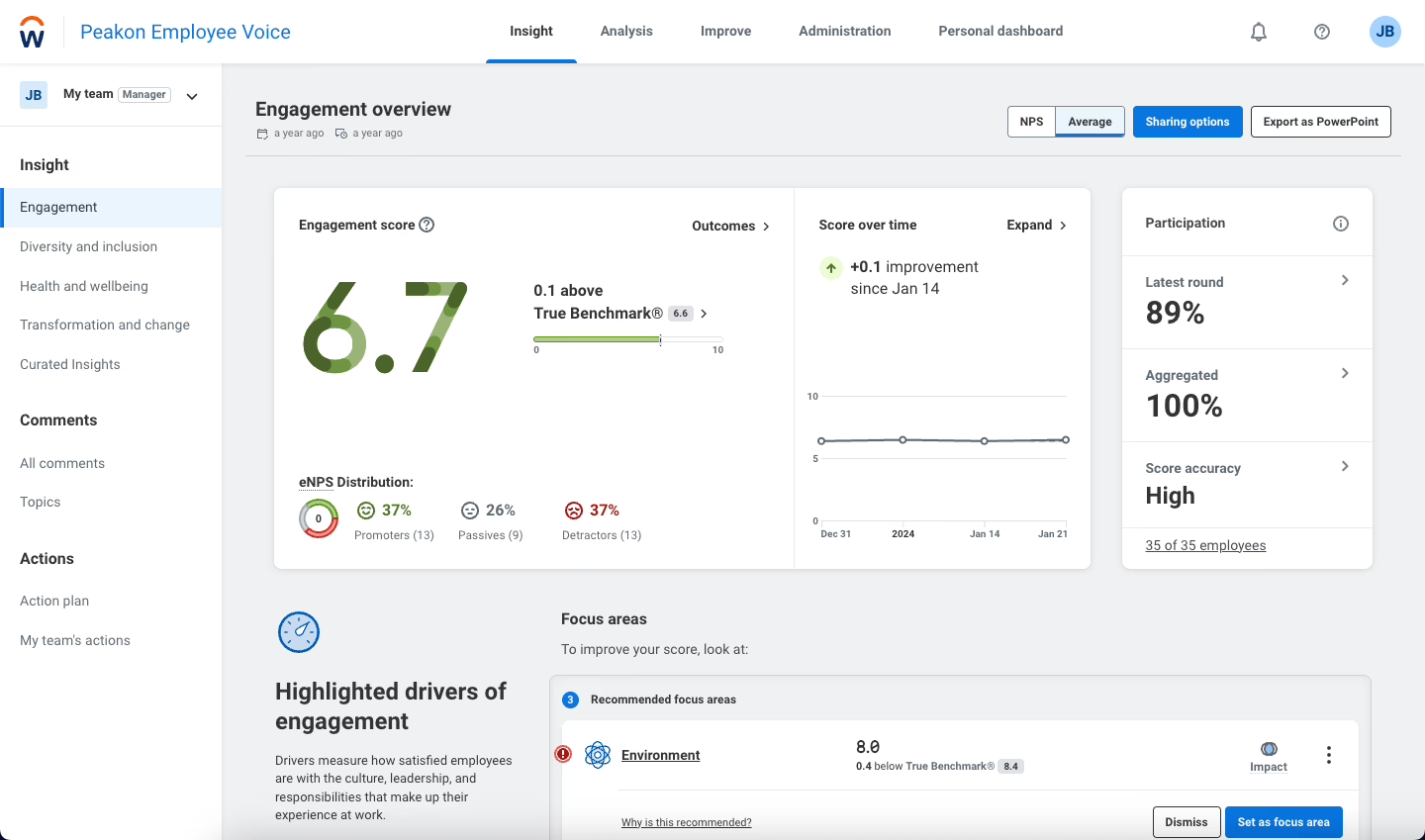
Workday Peakon Employee Voice is a continuous-listening platform strong on turnover-risk prediction and anonymous feedback, and a natural fit for Workday customers. It runs frequent pulse surveys and surfaces the drivers most likely to affect retention. Retention-focused enterprises choose it to catch disengagement early, and it delivers its best value inside the wider Workday ecosystem.
Key features
-
Continuous pulse listening with anonymous feedback
-
Turnover-risk prediction and driver analysis
-
Confidential two-way conversations with employees
-
Native fit with Workday HCM
| Pros | Cons |
|---|---|
|
• Excellent continuous listening; strong retention analytics; straightforward to use. |
• Best value inside the Workday ecosystem, the setup in the beginning can be complicated. |
Best for: Workday customers and retention-focused enterprises.
Not for: small teams.
Pricing: custom, often bundled via Workday.
Here’s how Workday Peakon Employee Voice rates with its own users on G2:
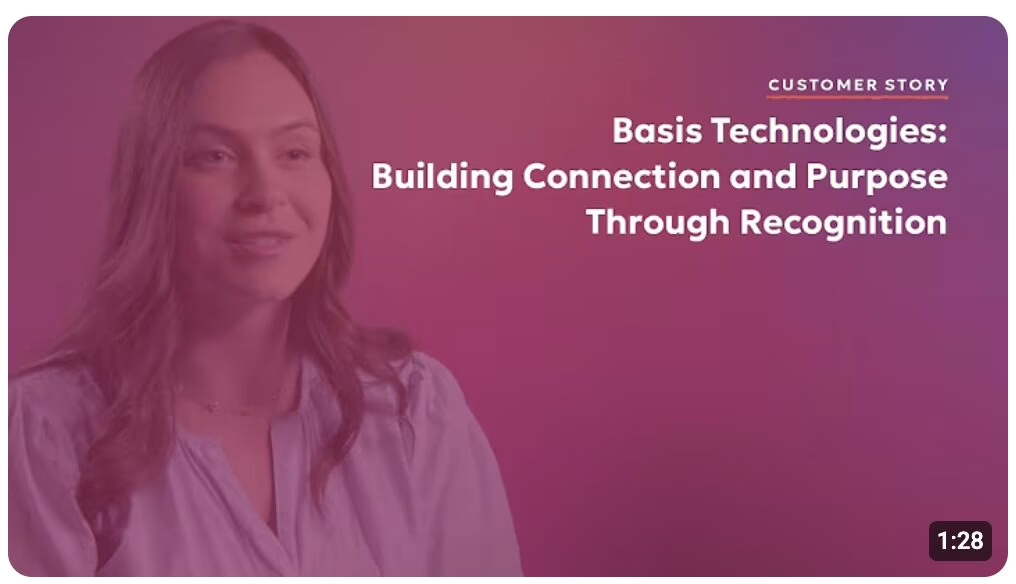
8. Workhuman (4.7/5 G2)
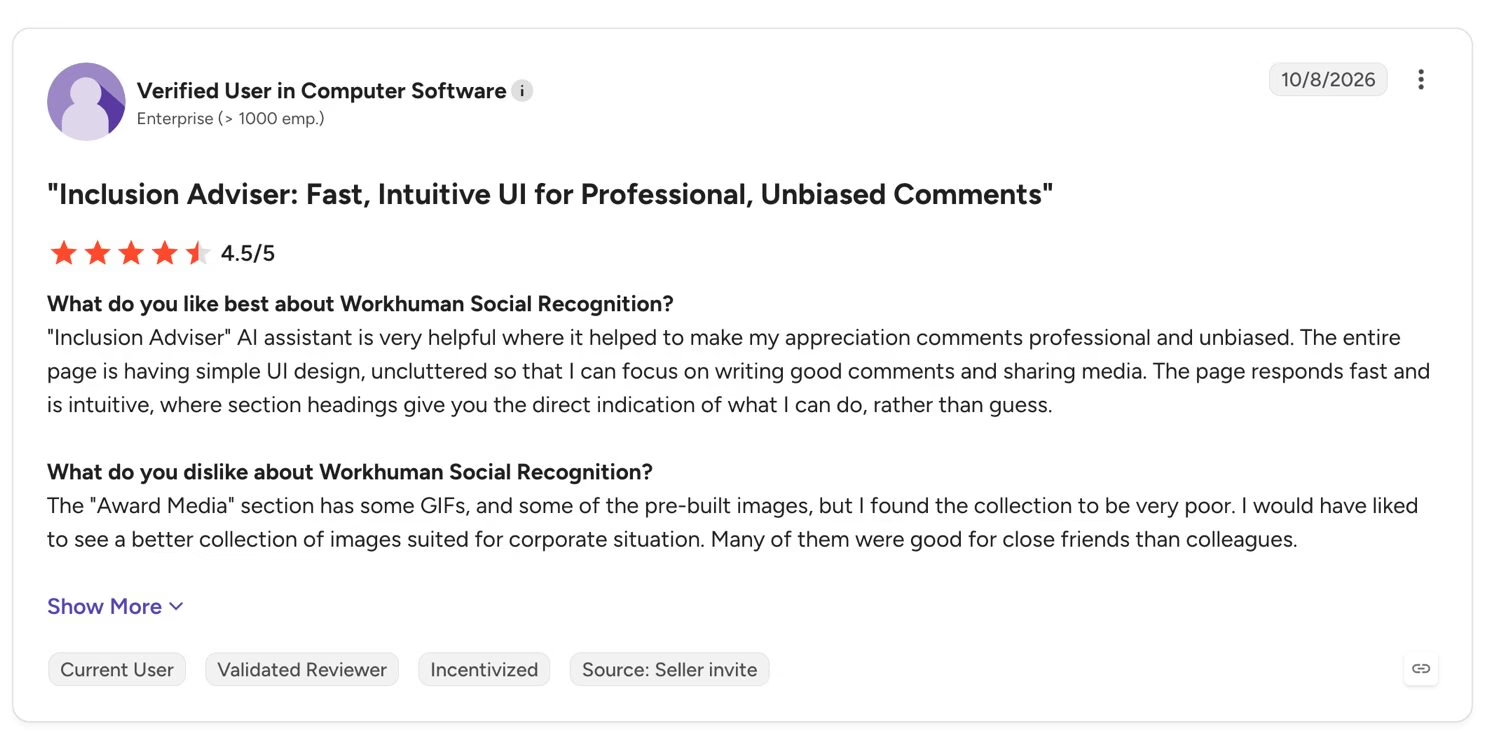
Workhuman is a social recognition platform built for scale, where recognition and rewards run across a global, multi-language workforce. It treats recognition as the primary engagement driver, with budgeting controls and DEI measurement built in. Large enterprises choose it to make recognition the center of their engagement strategy rather than a side feature.
Key features
-
Social recognition with recognition and rewards budgeting
-
A rewards marketplace spanning 180+ countries
-
Multi-language, global deployment
-
DEI and recognition analytics
| Pros | Cons |
|---|---|
|
• Recognition marketplace spanning 180+ countries; Inclusion Adviser AI assistant is an advantage. |
• Some features, like notifications for a comment on a recognition, should be made live. |
Best for: large enterprises making recognition the center of engagement.
Not for: survey-first SMBs.
Pricing: custom, enterprise.
Here’s how Workhuman rates with its own users on G2:
9. Bonusly (4.7/5 G2)
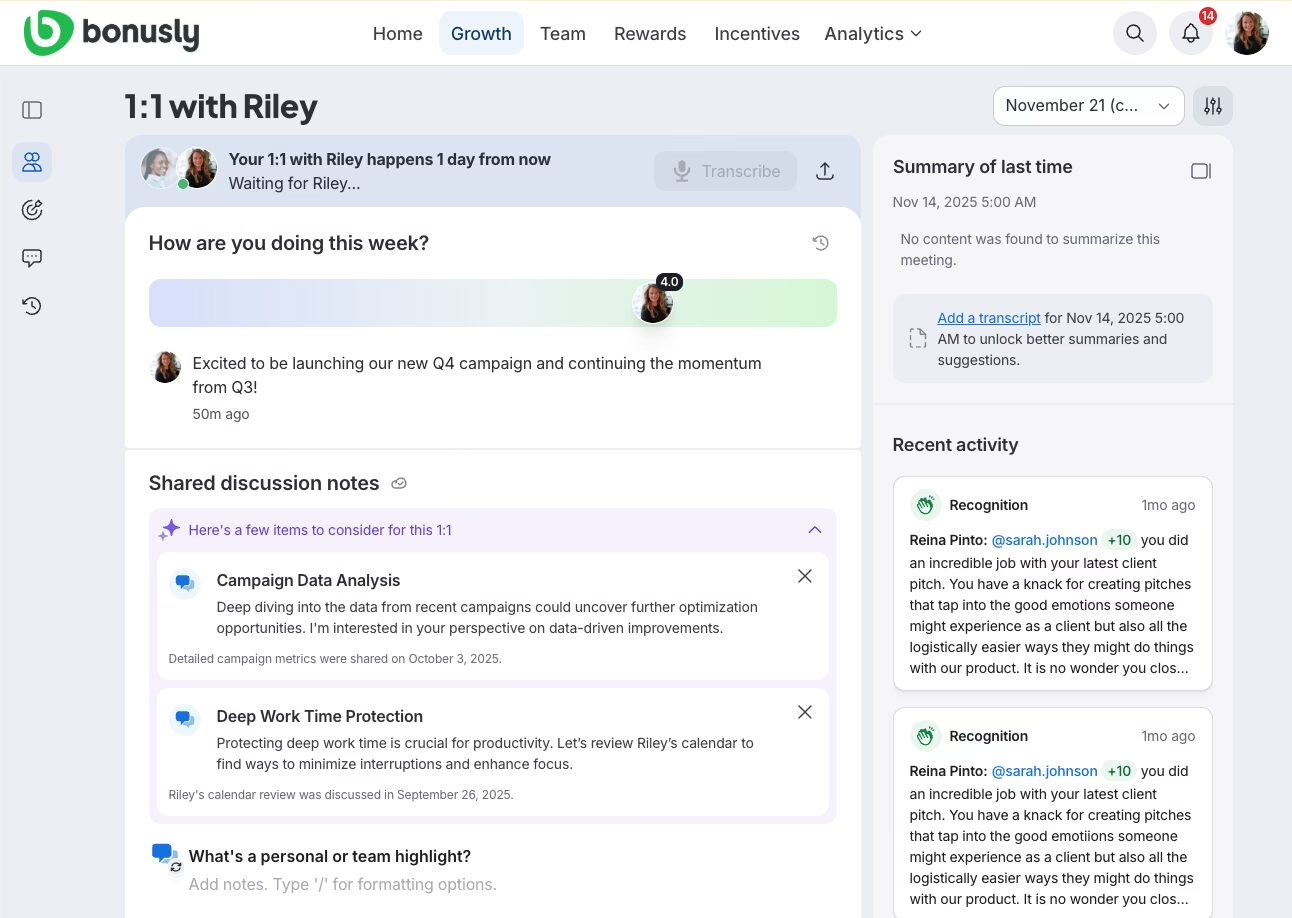
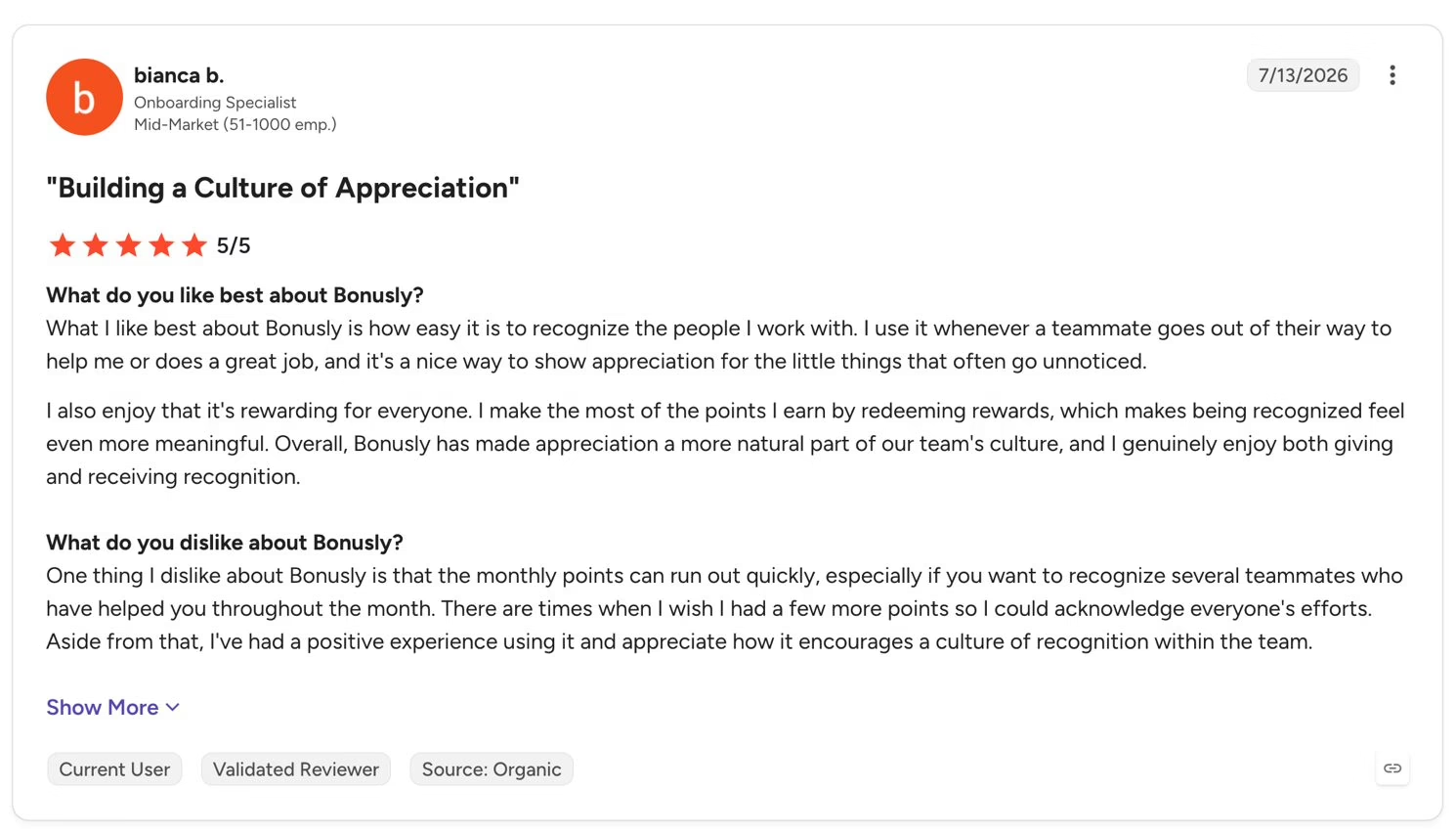
Bonusly is a peer-recognition and rewards platform that is genuinely quick to set up, which is the line reviewers return to most. Employees give small, frequent recognition tied to a rewards catalog, and it connects cleanly to common HRIS and chat tools. SMB and mid-market teams pick it for high adoption without a heavy rollout.
Key features
-
Peer recognition with a rewards catalog
-
HRIS and chat integrations, mobile access
-
Automated rewards for milestones and anniversaries
-
Lightweight engagement reporting
| Pros | Cons |
|---|---|
|
• Easy to set up, people appreciate peer-2-peer approach |
• The monthly point allowance runs out fast. |
Best for: SMB and mid-market teams wanting simple peer recognition.
Not for: teams needing deep survey analytics.
Pricing: per employee per month, published in tiers. A free trial is available.
Here’s how Bonusly rates with its own users on G2:
10. Nectar (4.7/5 G2)
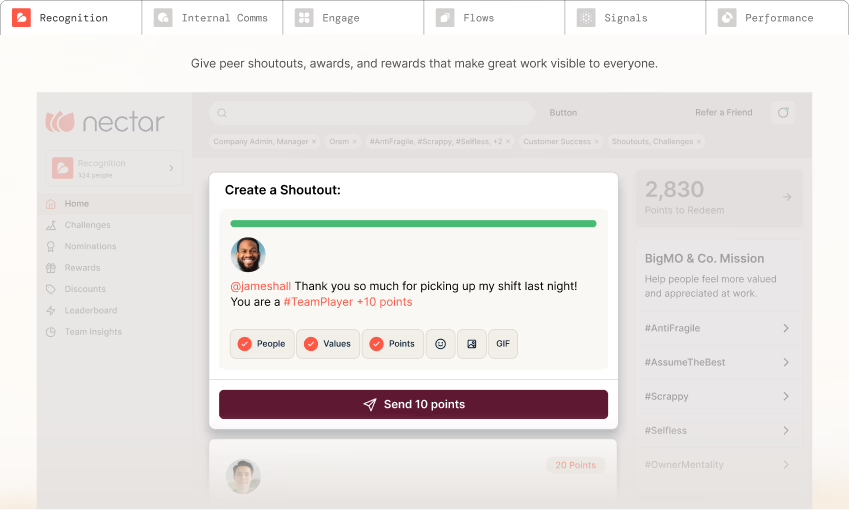
Nectar is an affordable recognition and rewards platform aimed at small and mid-size teams. It combines peer recognition, rewards, and basic wellness challenges, with HRIS integration and a mobile app that keeps it usable for distributed teams. Budget-conscious SMBs choose it for straightforward recognition without the analytics weight of an enterprise suite.
Key features
-
Peer recognition, rewards and challenges
-
HRIS integration and mobile accessibility
-
Rewards catalog including gift cards and swag
-
Automated milestone and anniversary recognition
| Pros | Cons |
|---|---|
|
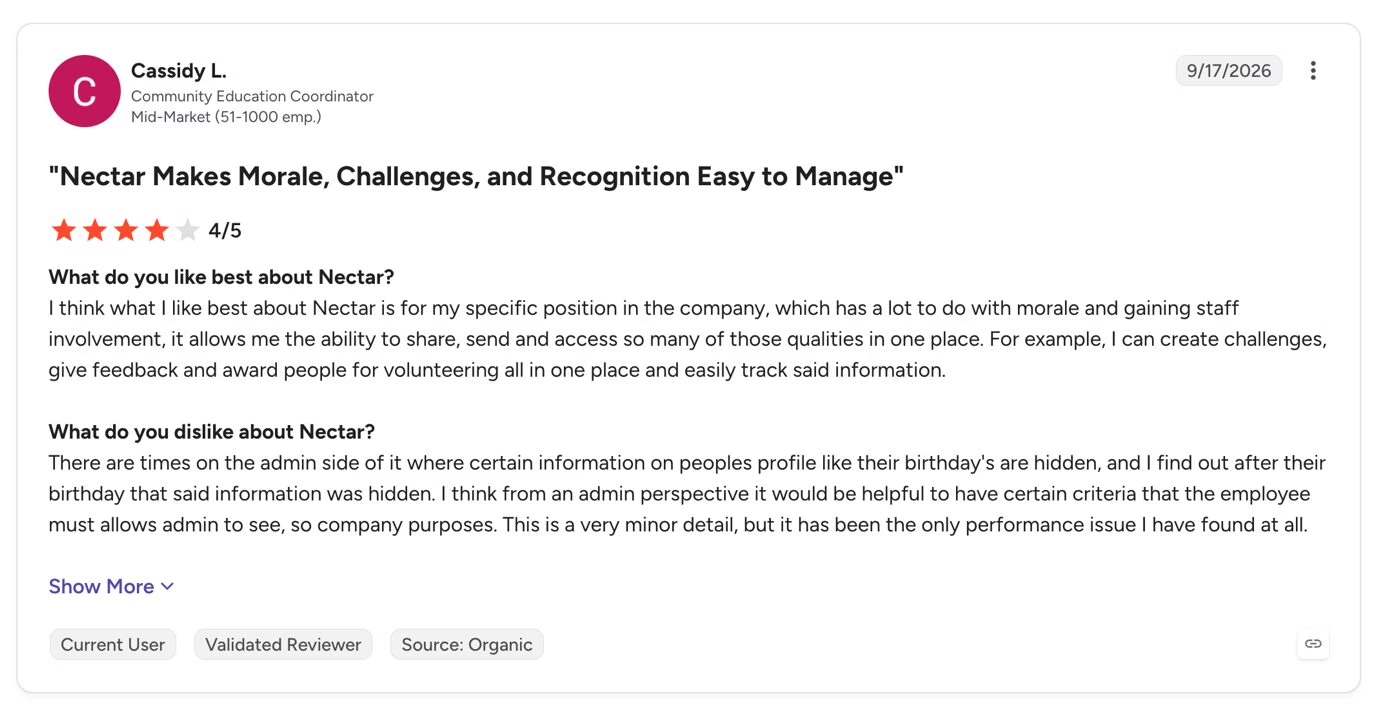
• Very affordable; easy to run; real-time notifications and posts. |
• Lighter analytics; catalog options can be very limited by region. |
Best for: budget-conscious SMBs wanting recognition.
Not for: enterprises needing predictive analytics.
Pricing: custom and quote-based. There is no public free trial, only a demo.
Here’s how Nectar rates with its own users on G2:
11. Awardco (4.9/5 G2)
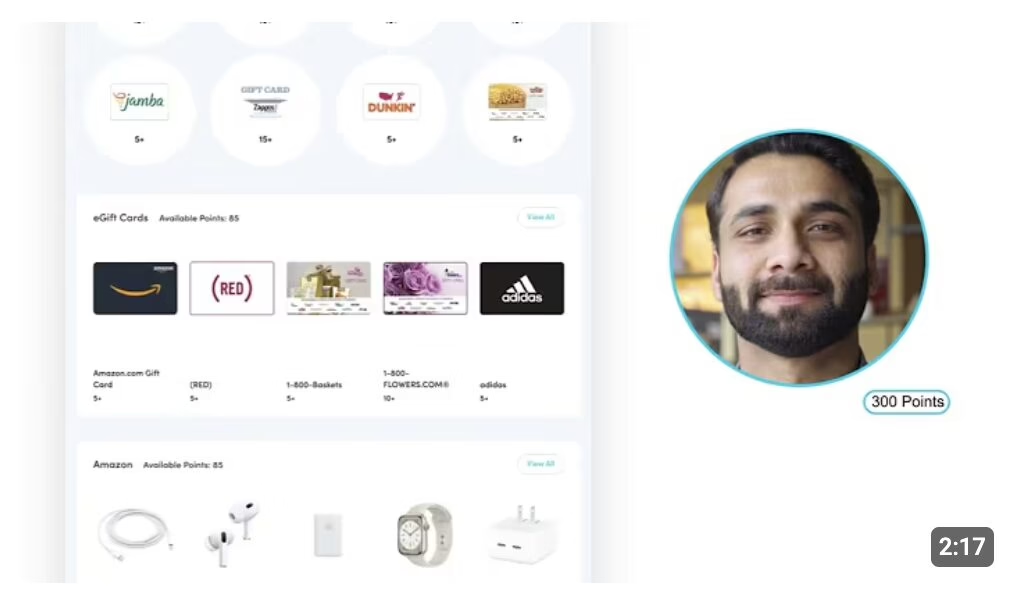
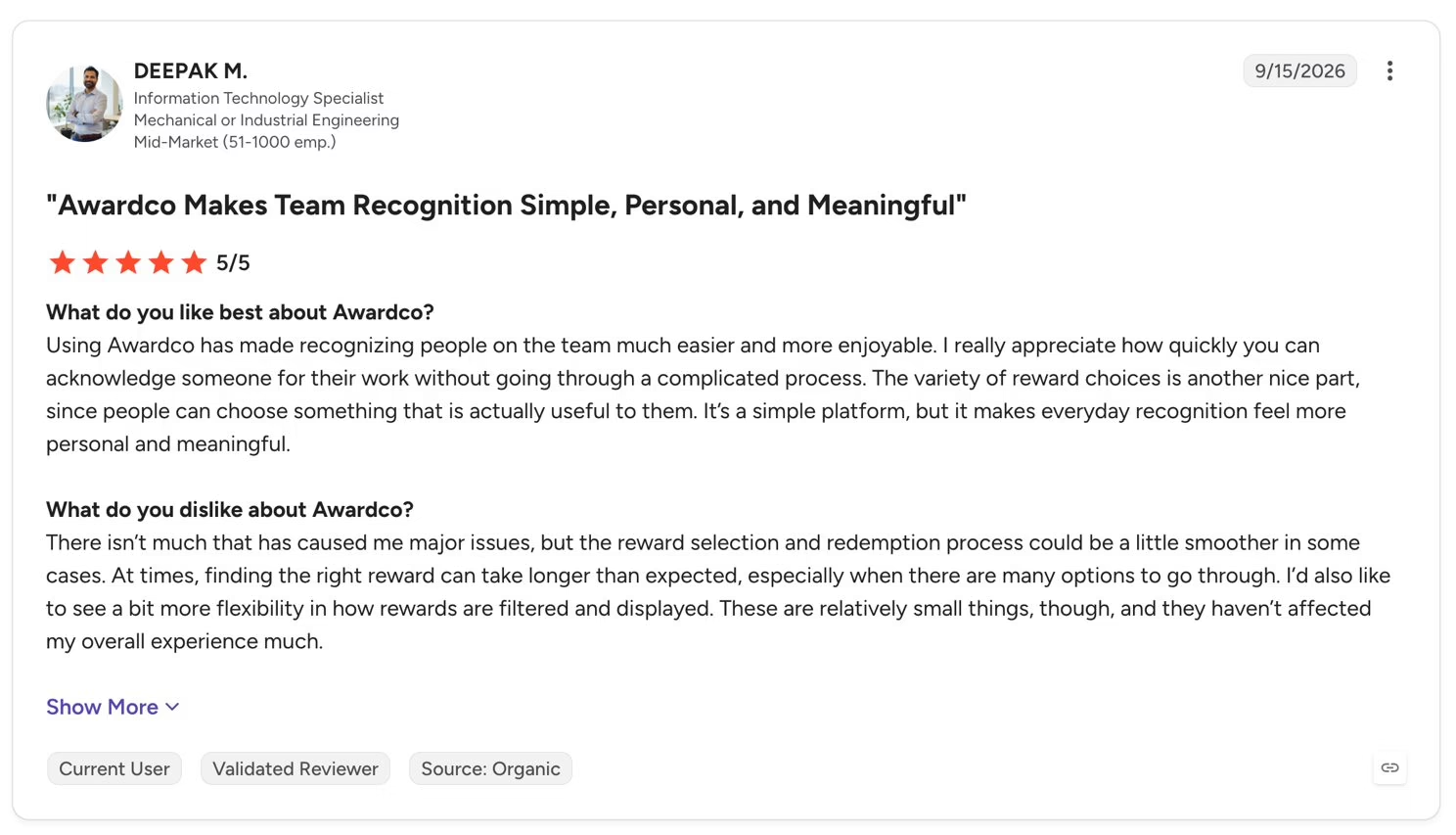
Awardco is a recognition and rewards platform known for the sheer breadth of its reward options, built on an Amazon integration that opens a very large redemption catalog. It pairs recognition with rewards budgeting and hands-on implementation support. Companies pick it when reward choice is the priority and recognition matters more than survey analytics.
Key features
-
Recognition with an Amazon-powered rewards catalog
-
Over 10 million reward options across the catalog
-
Recognition and rewards budgeting controls
-
Onboarding and implementation support
| Pros | Cons |
|---|---|
|
• 10M+ reward options via Amazon; smooth implementation; easy redirection to reward sites like Amazon. |
• Pricing is said to be a bit steep. |
Best for: companies prioritizing reward choice and breadth.
Not for: survey-first buyers.
Pricing: custom and quote-based. There is no public free trial, only a demo.
Here’s how Awardco rates with its own users on G2:
12. Motivosity (4.7/5 G2)
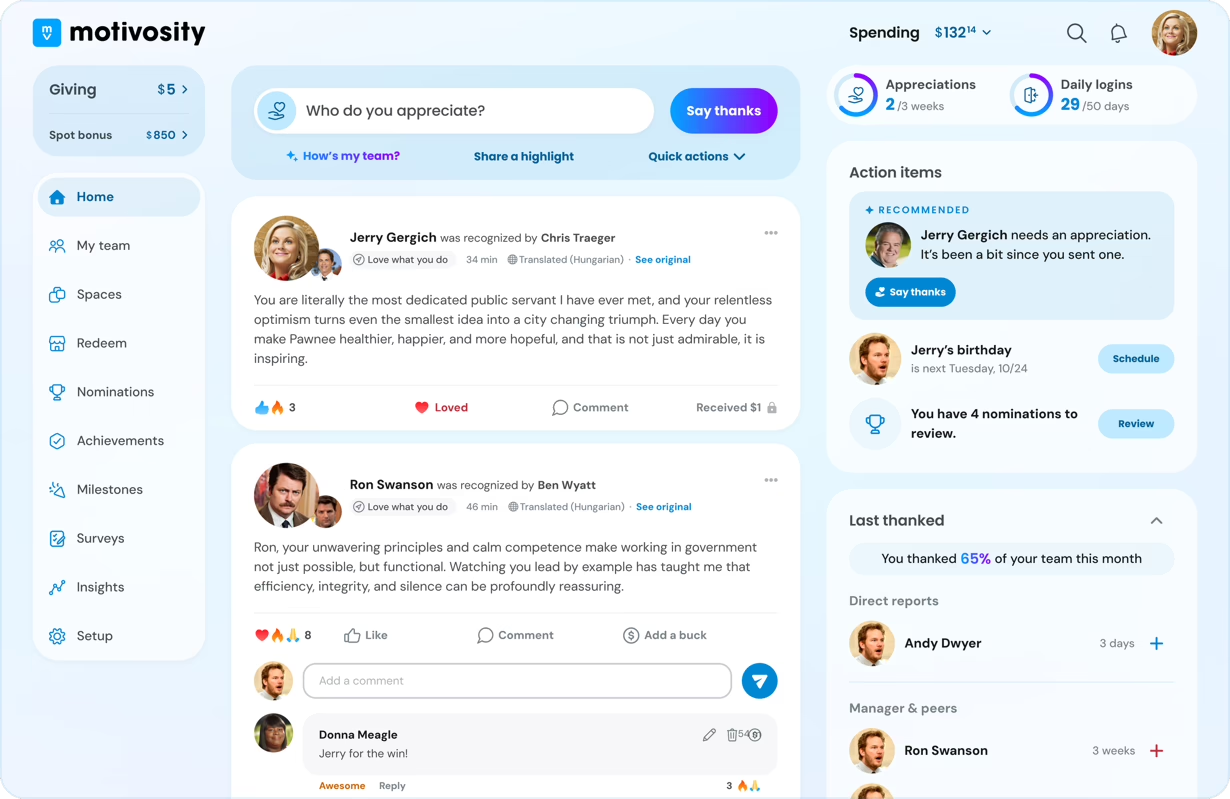
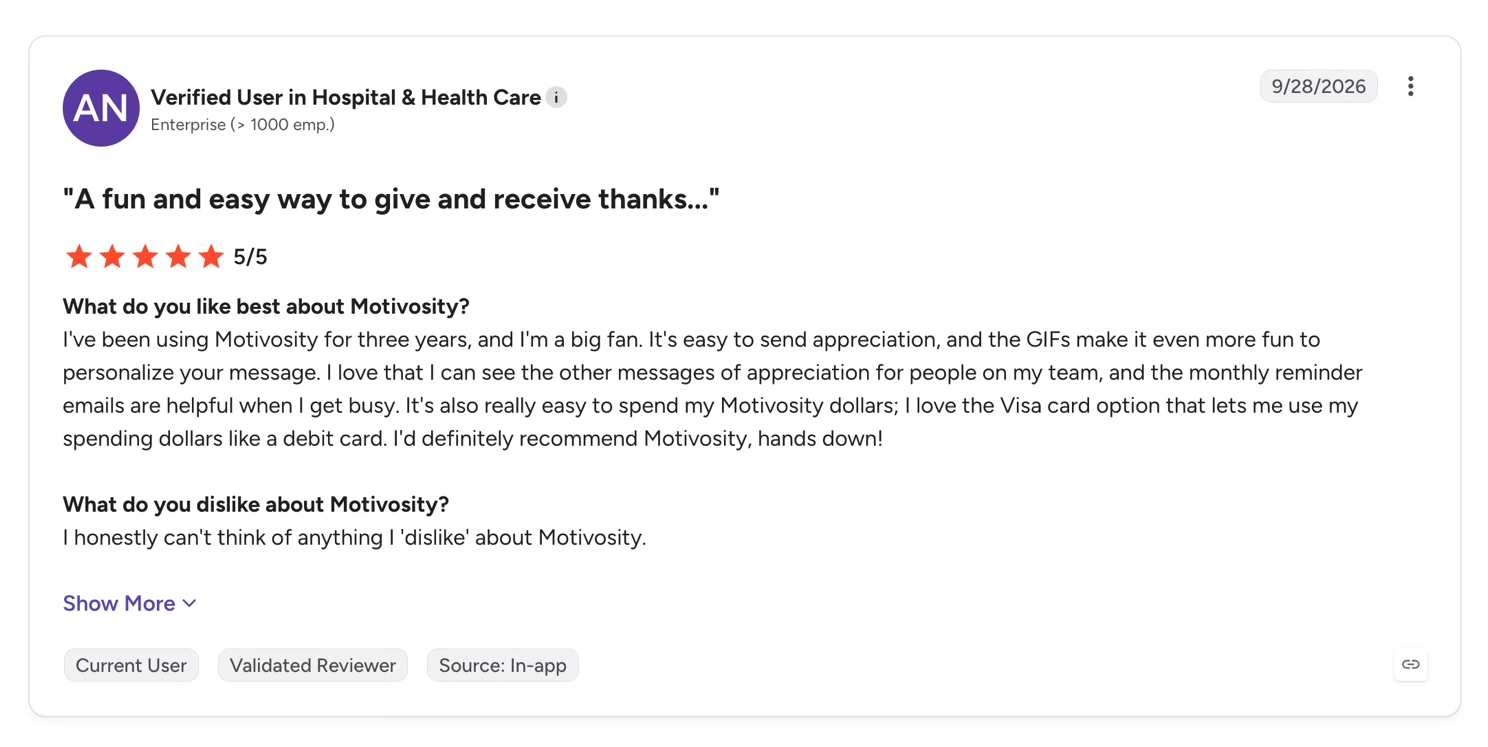
Motivosity focuses on connection and gratitude, building engagement from peer appreciation and manager recognition rather than heavy surveys. Its mobile-first design keeps recognition flowing day to day, which works especially well for frontline and distributed teams. Organizations pick it to make a gratitude culture visible, not to run deep analytics.
Key features
-
Peer appreciation and manager recognition
-
Mobile-first design and recognition budgeting
-
ThanksMatters card and rewards
-
Lightweight pulse and eNPS surveys
| Pros | Cons |
|---|---|
|
• Builds a visible gratitude culture; easy for employees, with multiple payout options. |
• Light on analytics and survey depth; lack of multimedia support in gratitude board. |
Best for: teams building a connection and gratitude culture.
Not for: analytics-heavy enterprises.
Pricing: custom and quote-based. There is no free plan, only a demo.
Here’s how Motivosity rates with its own users on G2:
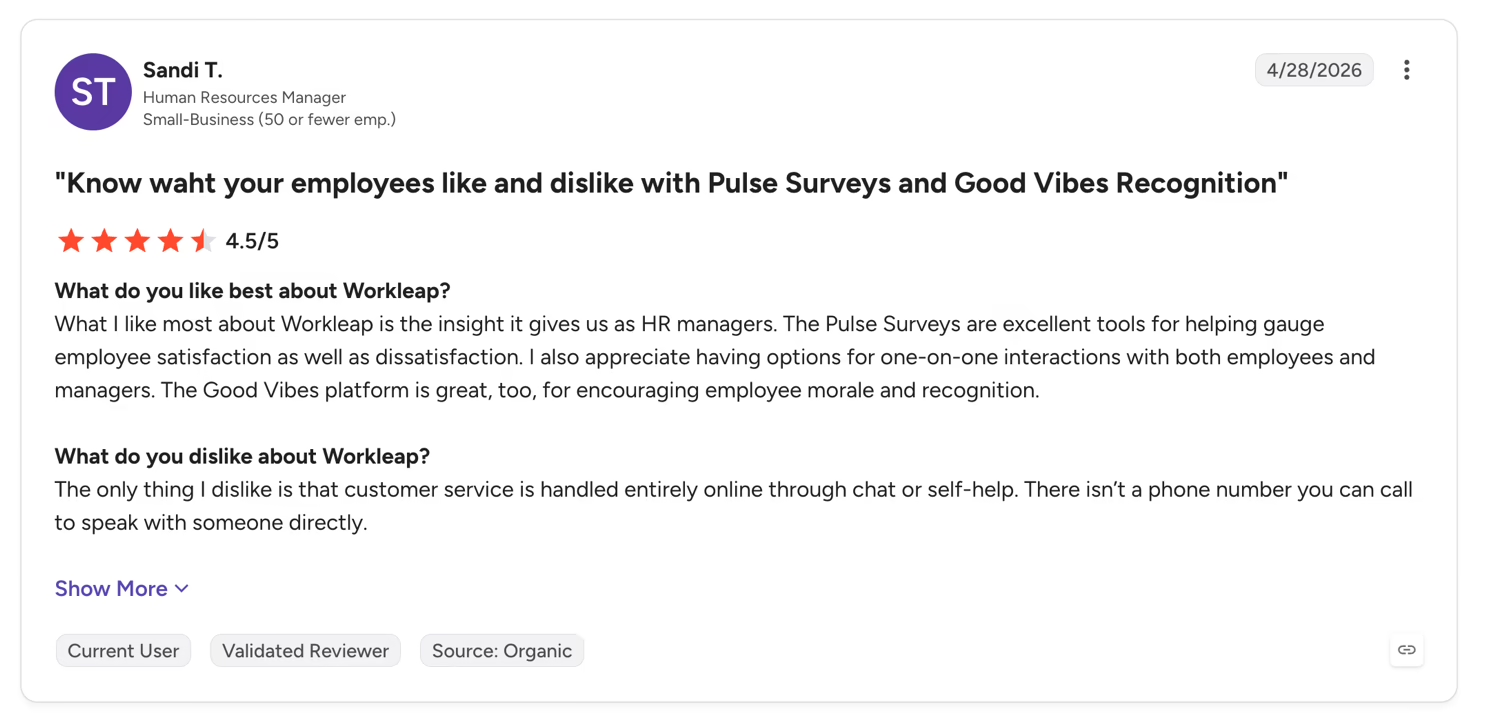
13. Workleap (4.3/5 G2)
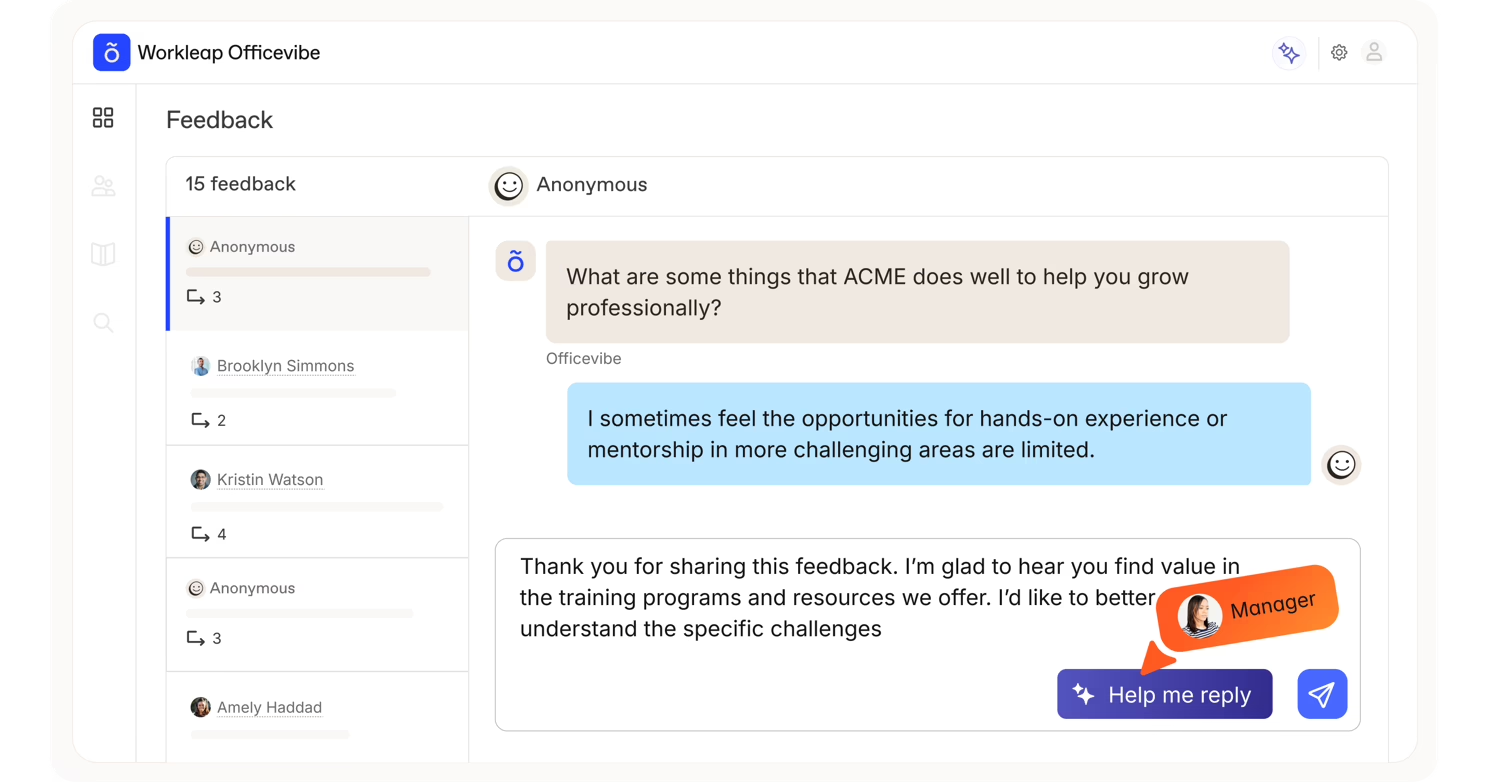
Workleap is a pulse-survey and feedback platform built for simplicity, which makes it a common SMB and remote-team pick. Frequent pulse surveys, anonymous feedback, and manager tools work well across time zones. It trades enterprise depth for ease of use.
Key features
-
Pulse surveys and anonymous feedback
-
Manager tools and hybrid workplace engagement
-
Employee eNPS and sentiment tracking
-
Slack and Teams integration
| Pros | Cons |
|---|---|
|
• Simple and affordable; good for remote teams; pulse surveys to gauge immediate employee satisfaction. |
• Less depth than enterprise suites; only chat and self-help support. |
Best for: SMBs and remote teams wanting easy pulse surveys.
Not for: enterprises needing predictive analytics.
Pricing: Standard from $4,999/year and Pro from $11,999/year, each plus $32 per manager per month (billed annually); custom for 250+ employees. There is no free plan.
Here’s how Workleap rates with its own users on G2:
14. WorkTango (4.7/5 G2)
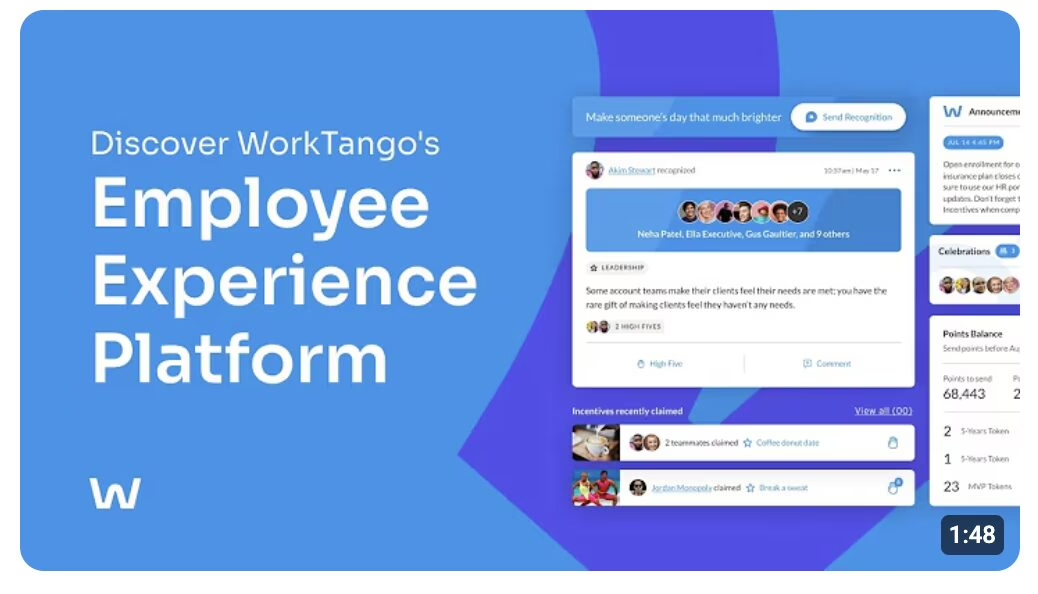
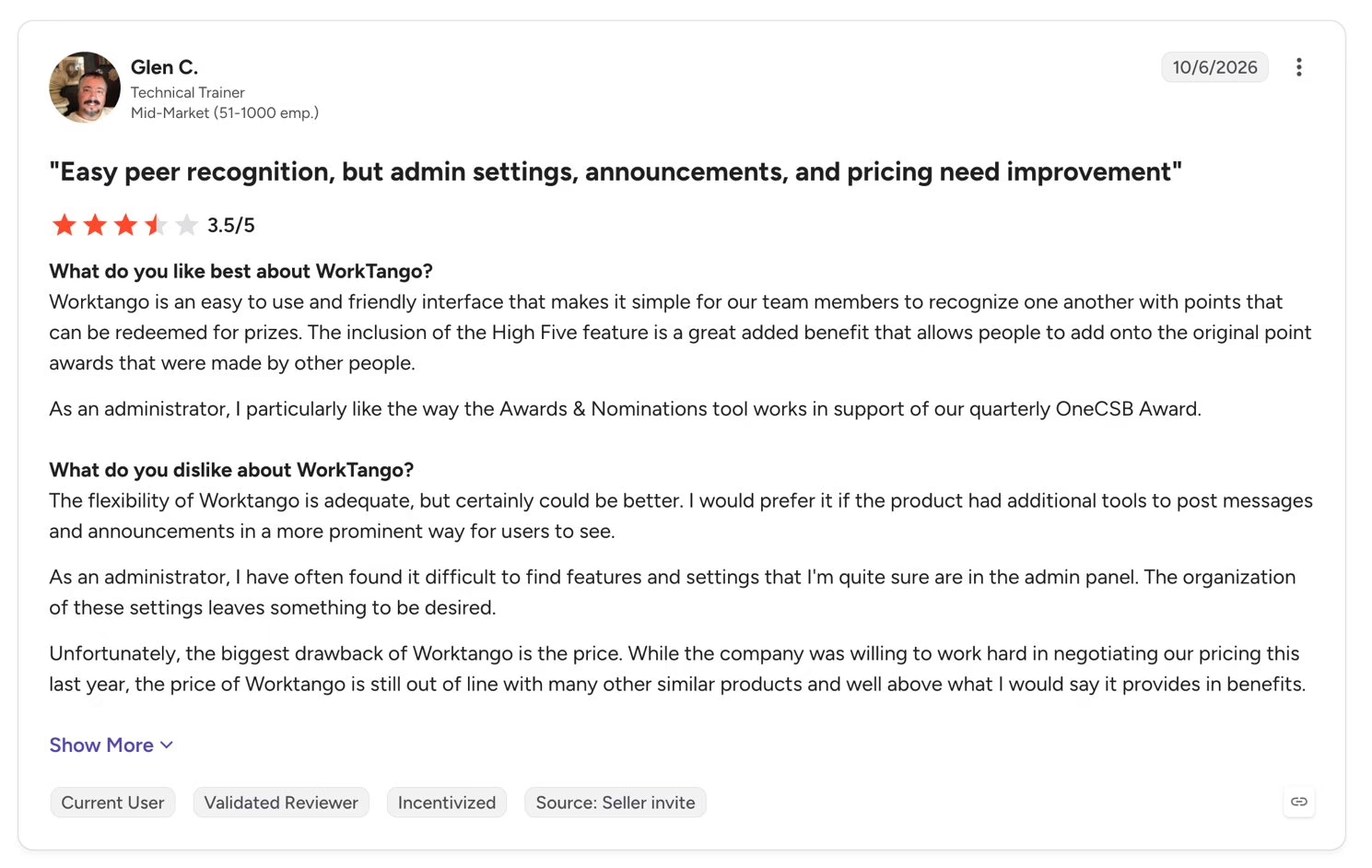
WorkTango unifies employee voice and recognition in one platform, so surveys and rewards are not two separate tools to reconcile. That combination suits teams that want to listen and act in the same place, with pulse surveys feeding recognition and action plans. Mid-market teams choose it for balance rather than the deepest tool in any single lane.
Key features
-
Pulse surveys and templates with recognition
-
Engagement analytics and action planning
-
Rewards catalog and incentives
-
Manager dashboards and reporting
| Pros | Cons |
|---|---|
|
• Surveys and recognition in one; good balance; easily integrates with third-party tools like Slack. |
• Limited topics for recognition. |
Best for: mid-market teams wanting voice and recognition unified.
Not for: buyers needing the deepest tool in one lane.
Pricing: custom and quote-based. There is no public free trial, only a demo.
Here’s how WorkTango rates with its own users on G2:
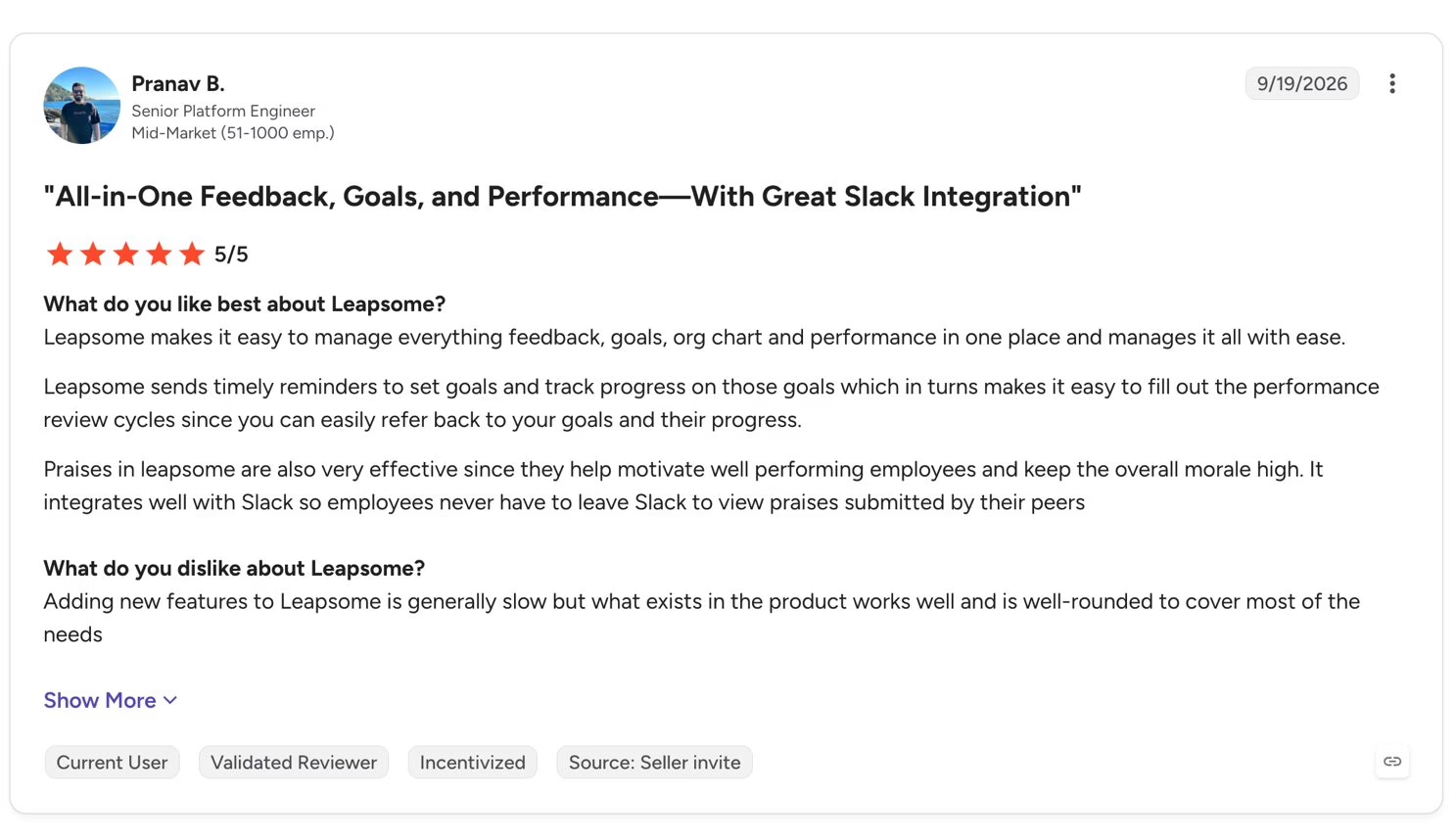
15. Leapsome (4.8/5 G2)
Leapsome connects performance, engagement, and learning, and it is popular with growing global teams that want the three to reinforce each other. Engagement surveys and continuous feedback sit beside goals and development, so insight turns into a growth plan. It fits scaling companies that treat engagement as one part of a connected people system.
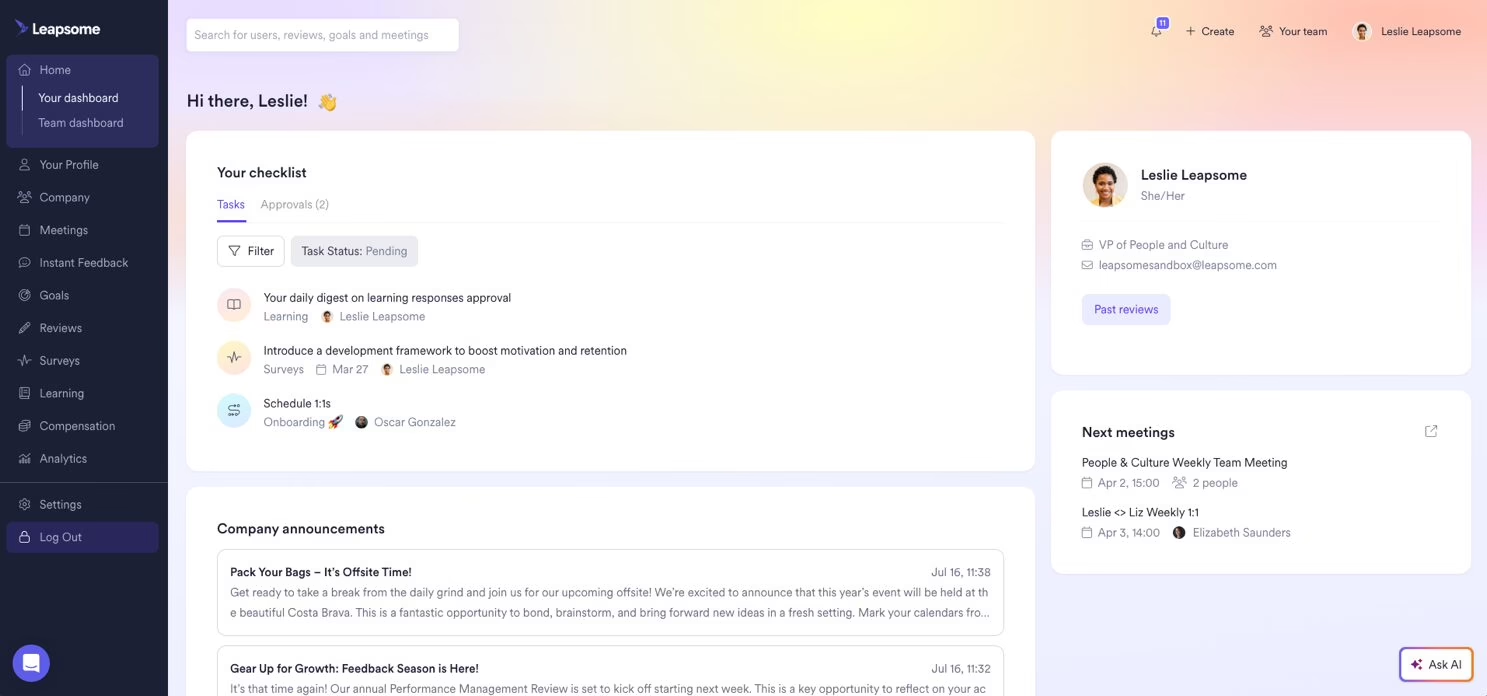
Key features
-
Engagement surveys and continuous feedback
-
Performance and learning in the same platform
-
Goals, OKRs and review cycles
-
Competency frameworks and development paths
| Pros | Cons |
|---|---|
|
• Connected performance, engagement, and learning; clean UX with AI and self-assessment features. |
• Customization of specific user reviews can require a bit more tweaking. |
Best for: growing global teams linking engagement to growth.
Not for: survey-only buyers.
Pricing: custom, per user per month. A free trial is available; confirm the current terms with Leapsome.
Here’s how Leapsome rates with its own users on G2:
Bonus: GaggleAMP (4.4/5 G2)
GaggleAMP is an employee advocacy platform, a little adjacent to the rest of this list, which is the point of the bonus slot. It turns engaged employees into a social amplification channel, so it is less about measuring engagement and more about putting existing engagement to work for employer brand and reach.
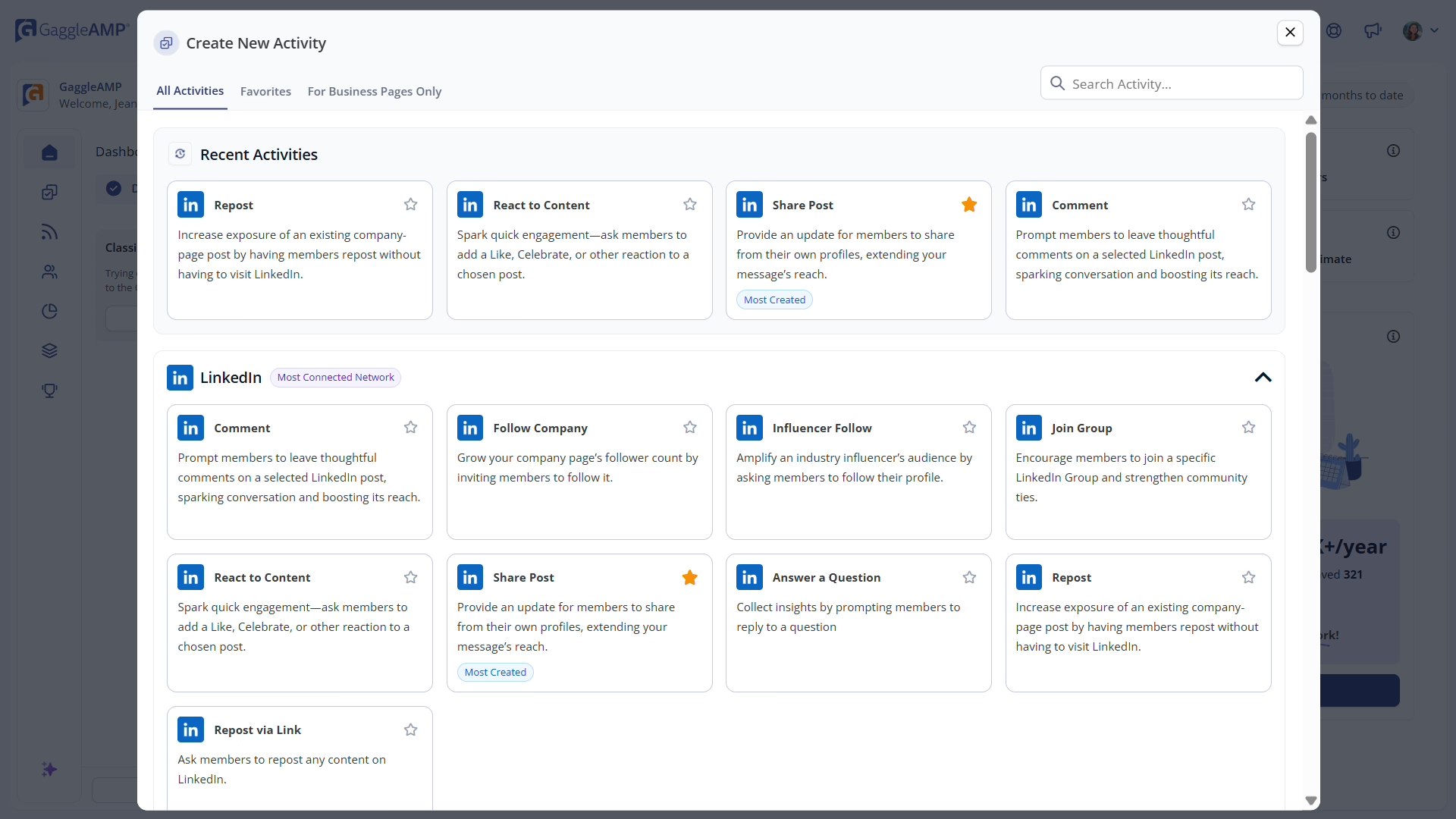
Key features
-
Employee advocacy and social amplification
-
Gamification to drive participation
-
Content scheduling and approval workflows
-
Reach and engagement analytics
| Pros | Cons |
|---|---|
|
• Turns engagement into reach; gamified participation; multiple training resources. |
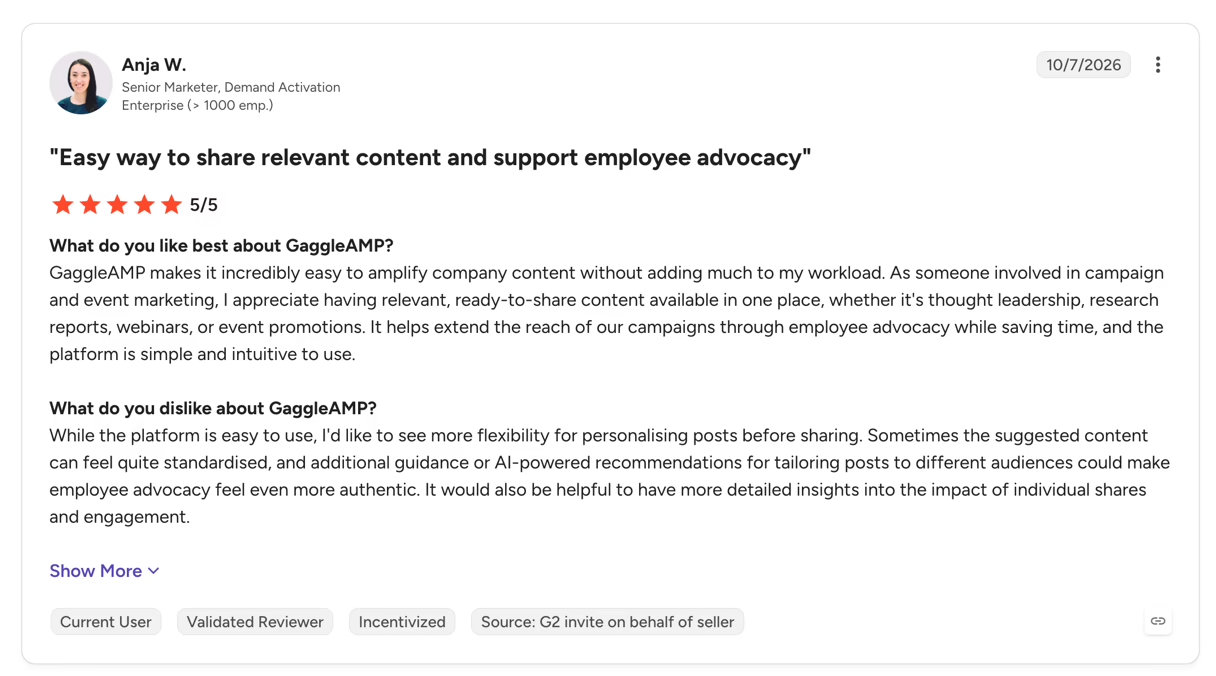
• Advocacy, not engagement measurement; some flexibility for personalization is missing. |
Best for: already-engaged teams building advocacy.
Not for: measuring or improving engagement itself.
Pricing: custom and quote-based. There is no public free trial, only a demo.
Here’s how GaggleAMP rates with its own users on G2:
How to Choose Employee Engagement Software
I work through five questions, in order, to narrow fifteen tools to a shortlist of two or three.
-
Start with your primary goal. Survey-first, recognition-first, or a unified platform. A listening problem and a recognition problem need different tools, so naming the one you are actually solving stops you buying a survey suite when you need recognition, or the reverse.
-
Narrow by your integrations. List the HRIS, chat, and SSO your stack runs on, and check depth, not just a logo. The tool has to write back to your HRIS and sit inside Slack or Teams, or adoption quietly dies.
-
Match it to your size and scale. SMB, mid-market, and enterprise fit differently, and a tool that shines at 60 people can creak at 6,000, or the reverse. If you operate globally, confirm multi-language and multi-region support before you commit.
-
Plan the budget honestly. Pricing runs from per-employee recognition tools to per-user survey platforms to custom enterprise suites. A free plan can prove value, but read what it excludes, since the analytics you actually need often sit a tier up.
-
Think about rollout and adoption. The best platform fails if no one uses it. Ask about the typical rollout timeline, who owns onboarding, and the adoption benchmarks to aim for, because an engagement tool with low engagement is just an expense.
Engagement Features Most Tools Overlook
Most engagement tools do the obvious things well and the hard things barely at all. These four capabilities separate a survey tool from a platform that actually moves retention, and I check every shortlist against them.
Frontline and Deskless Worker Engagement
Around 80% of the global workforce does not sit at a desk, yet most engagement tools assume an email inbox. Frontline engagement needs mobile-first design, SMS surveys, and kiosk access, so manufacturing, retail, and healthcare teams can take part. If a tool cannot reach a deskless worker, it is not measuring your whole workforce.
Burnout Detection and Wellbeing Features
Engagement and burnout are not the same signal, and the better platforms watch for both. Burnout risk shows up in workload patterns and sentiment dips before it shows up in attrition, so look for tools that flag it early rather than report it late. This is where engagement overlaps with employee wellness software, and the overlap is worth using.
DEI Measurement in Engagement Platforms
An average engagement score can hide a real problem, because it averages across groups that are having very different experiences. DEI measurement cuts the data by demographic to surface inclusion and belonging gaps, which is the difference between a number that looks fine and one that tells the truth.
Stay Interviews and Exit Interview Automation
By the time someone resigns, the engagement data is history. Stay interviews are the proactive version, structured retention conversations before a person is at the door, and automated exit interviews capture clean, structured data on the way out. Together they turn engagement from a quarterly survey into a continuous retention practice.
Finalizing the best Employee Engagement Software in 2026
For me, the decision comes down to the framework above: I steer survey-first teams to Culture Amp, Qualtrics, or Workday Peakon; recognition-first teams to Workhuman, Bonusly, or Nectar; and teams that want one connected system to a unified platform.
That last group is where I think Keka fits best. For enterprise buyers who want engagement embedded in their people operations stack, on the same platform as HR and US payroll, rather than bolted on as one more tool to reconcile, the unified approach is the one that compounds.
If that is the setup you are after, book a Keka demo and see what engagement looks like when it is not a silo.