


 Login
Login


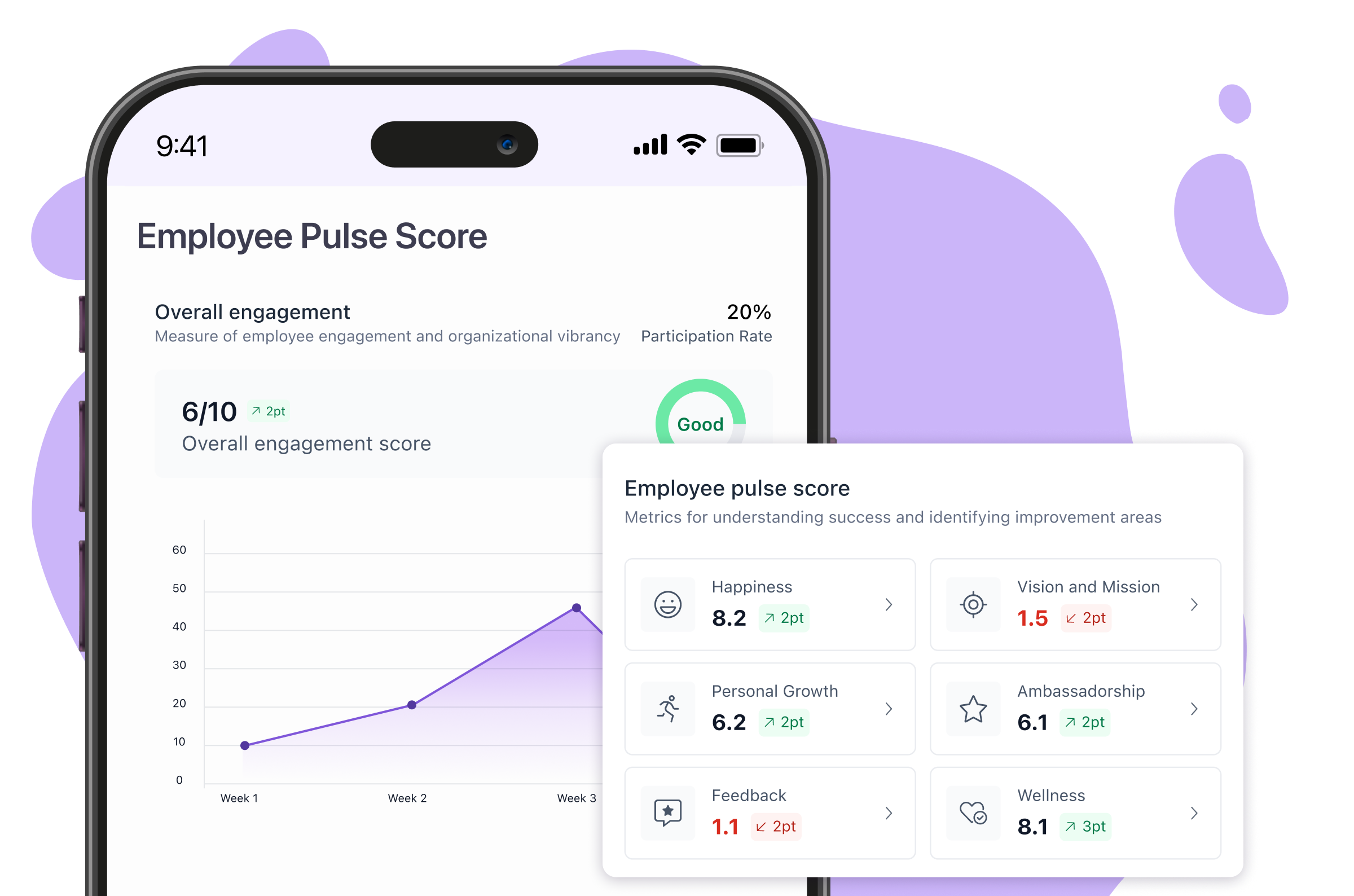
Do employees hold back feedback because they doubt whether surveys are anonymous? Employee survey software ensures confidentiality, giving staff the confidence to share openly while HR gets clear insights.
1. Keka
Keka’s survey software helps companies capture employee feedback in real time and turn it into insights that matter. It supports pulse surveys, 360° feedback, onboarding, exit feedback, and role-based permissions so responses stay anonymous and meaningful. Keka also includes event-based surveys to trigger feedback at key moments like promotions or exits, so you catch sentiment exactly when it counts.


Key Features of Keka Employee Survey Software:
- Survey templates and quick launch: Use ready-made templates or design custom surveys for onboarding, exit, or pulse feedback.
- Central survey hub: Manage all survey types, such as pulse, DE&I, and 360°, from one dashboard.
- Event-based triggers: Send surveys automatically at milestones like joining, promotions, or exits.
- Survey analytics: Track sentiment trends and break down results by team, gender, or compensation.
- Roles and permissions: Control access levels and protect employee anonymity.
- Feedback anonymity: Encourage honest responses without fear of consequences.
- Actionable insights: Receive alerts and recommendations when feedback shows issues.
- Real-time reports: Monitor dashboards that update instantly as responses come in.
Pros and Cons of Keka Employee Survey Software:
| Pros | Cons |
|---|---|
| Event-based surveys let HR capture feedback during onboarding, promotions, and exits. | Advanced analytics and custom breakdowns may need setup support. |
| Role-based permissions keep responses anonymous while still giving managers the insights they need. | Smaller companies that run surveys infrequently may not use the full feature set. |
| Survey analytics link results with HR data, such as compensation or department. | |
| Templates for onboarding, exit, DE&I, and pulse surveys reduce HR effort. |
Ideal For: Organizations of all sizes that want to listen regularly to employees, not just during annual reviews, and need surveys to be integrated with HR systems.
Pricing:
- Foundation: $9/employee/month
- Strength: $16/employee/month
- Growth: $22/employee/month
Expert’s Opinion:
Keka is the best employee survey software for organizations that want feedback to drive meaningful change. It combines survey templates, event triggers, and analytics so HR teams can capture sentiment at the right moments and act quickly. The platform makes employee listening simple, structured, and impactful, and ensures feedback always leads to action.
2. CultureMonkey
CultureMonkey is an enterprise employee engagement platform built for global organizations that need engagement, pulse, lifecycle, onboarding, and exit surveys running in one system. It pairs survey data with manager-assigned action planning, so results land as owned tasks on a Kanban board instead of stopping at an HR dashboard. Delivery spans email, Slack, Teams, WhatsApp, text messages, QR codes, and kiosk mode in 100+ languages, and AskCooper AI reads open-text responses for themes, sentiment, and early disengagement signals. It also syncs natively with Keka, alongside Workday, SAP SuccessFactors, BambooHR, ADP, and Oracle HCM.
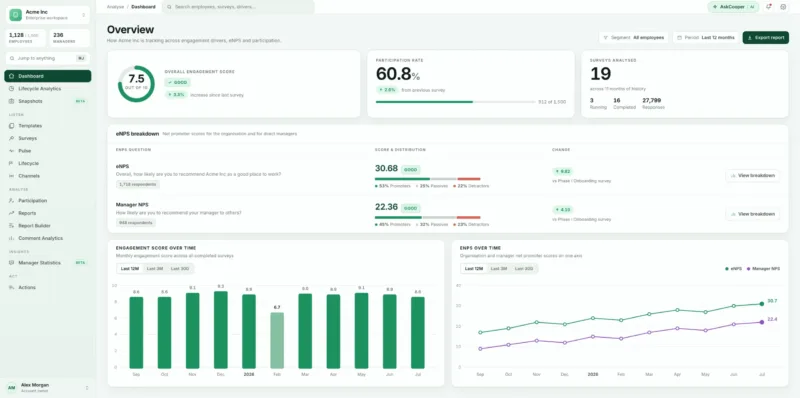
Key Features of CultureMonkey Employee Survey Software:
- Full lifecycle survey set: Run engagement, pulse, onboarding, lifecycle, and exit surveys from a single platform with 50+ research-backed templates.
- Multi-channel delivery: Reach employees through email, Slack, Teams, WhatsApp, text messages, QR codes, and kiosk mode, so shift and deskless staff are not left out of the sample.
- 100+ languages with AI translation: Survey and respond in local languages, including translated analysis of open-text comments, not just translated questions.
- Manager-assigned action planning: Convert findings into owned actions with assignees, deadlines, and Kanban-board progress tracking, then confirm impact with follow-up pulses.
- AskCooper AI: An AI copilot that summarizes open-text sentiment, detects recurring themes, and surfaces predictive engagement signals without manual coding.
- Anonymity architecture: Choose between aggregate, threshold, and fully anonymous models, with configurable minimum response thresholds and admin override controls.
- Major native HRIS integrations: Sync employee data automatically with Keka, Workday, SAP SuccessFactors, BambooHR, ADP, Oracle HCM, Darwinbox, Zoho People, and Rippling.
- People Science benchmarking: Compare results against a dataset of 10M+ anonymized responses spanning 15+ industries and 4 global regions, supported by an in-house People Science team.
Pros and Cons of CultureMonkey Employee Survey Software:
| Pros | Cons |
|---|---|
| Multi-channel delivery reaches frontline and deskless employees who never open a work email. | Sales-led pricing with no published per-user rate, so buyers running short evaluation cycles need to engage sales early. |
| Action planning assigns owners and deadlines, so survey results turn into tracked work rather than reports. | Best fit for organizations of 500+ employees and less suited to small teams under 100. |
| 100+ languages with translated open-text analysis makes multi-country rollouts practical. | No free trial, so evaluation starts with a demo rather than a self-serve account. |
| Anonymity is configurable at the threshold level with admin controls, not just a policy statement. | |
| Native HRIS sync, including Keka, keeps org hierarchy and demographics current without manual uploads. |
Ideal For: Enterprise organizations with global, multilingual, or frontline-distributed workforces (500+ employees, particularly in manufacturing, retail, hospitality, healthcare, and logistics) that want listening and action planning in one platform.
Pricing:
Custom pricing, quoted by workforce size and modules. No published per-user rate and no free trial; access starts with a demo.
Expert’s Opinion:
CultureMonkey is the strongest option on this list for organizations where a meaningful share of the workforce does not sit at a desk. Most engagement platforms assume an email inbox and a laptop, which quietly removes shift workers, plant floors, and store teams from the response set; multi-channel delivery across WhatsApp, text messages, QR codes, and kiosk mode closes that gap, and 100+ language support keeps the data comparable across regions. What separates it from a survey tool is what happens after the results land: actions are assigned to named managers with deadlines and tracked to completion, and follow-up pulses confirm whether anything actually changed. Add SOC 2 Type II, ISO 27001, and GDPR compliance, a 5-week structured launch, and native sync with HR systems including Keka, and it fits enterprises that want employee listening to produce measurable change rather than another quarterly deck.
3. Qualtrics EmployeeXM
Qualtrics EmployeeXM is designed to give organizations deep insights into employee experience. It focuses on listening at scale, combining advanced survey design with powerful analytics to reveal engagement drivers and performance barriers.

Key Features of Qualtrics EmployeeXM:
- Advanced survey design: Build flexible surveys with logic, branching, and custom flows.
- Engagement tracking: Measure sentiment with pulse surveys and lifecycle surveys.
- Analytics and dashboards: Identify trends, drivers, and risks with AI-driven insights.
- Action planning tools: Help managers respond to survey results with guided steps.
Pros and Cons of Qualtrics EmployeeXM:
| Pros | Cons |
|---|---|
| Survey design tools allow highly complex and tailored questionnaires. | Implementation requires training and dedicated resources. |
| AI analytics reveal root causes behind employee engagement scores. | Smaller organizations may find the platform too feature-heavy. |
| Lifecycle surveys capture feedback at onboarding, promotion, and exit. | Action planning tools can feel generic without proper customization. |
| Multi-language support makes it suitable for global teams. | Reporting can be overwhelming without a clear HR strategy. |
Ideal For: Large and global organizations that want advanced survey design, predictive analytics, and continuous listening at scale.
Pricing: Qualtrics follows a custom pricing model, generally positioned at the enterprise level.
Expert’s Opinion:
Qualtrics EmployeeXM is a powerful choice for enterprises that want to move beyond surface-level feedback. Its AI-driven insights and advanced survey design give leaders the ability to connect employee sentiment with business outcomes. It is most valuable for organizations with the resources to configure and act on their deep analytics.
4. Culture Amp
Culture Amp combines surveys with analytics and performance tools to help organizations build a culture of continuous listening. Its survey library covers engagement, DE&I, onboarding, and exit, backed by research-based templates.

Key Features of Culture Amp Employee Survey Software:
- Engagement surveys: Measure sentiment across different stages of the employee lifecycle.
- Research-backed templates: Use ready-made surveys for DE&I, onboarding, and pulse programs.
- Feedback tools: Collect input directly from employees and managers.
- Analytics dashboards: Highlight engagement drivers and track progress over time.
Pros and Cons of Culture Amp Employee Survey Software:
| Pros | Cons |
|---|---|
| Templates are backed by research and tested across industries. | Review setup can feel complex when running multiple survey types. |
| Connects survey results with performance and retention metrics. | Best suited for companies that have a dedicated HR or People team. |
| Dashboards make it easy for managers to act on feedback. | Benchmarking is limited to larger datasets. |
| Broad coverage across DE&I, onboarding, pulse, and exit surveys. | It may feel too broad for companies wanting only lightweight surveys. |
Ideal For: Mid-sized and large companies that want survey results connected with performance and culture insights.
Pricing: Culture Amp offers subscription-based pricing tailored to modules and workforce size.
Expert’s Opinion:
Culture Amp works well for organizations that want employee surveys to be part of a wider culture strategy. Its research-backed templates and dashboards help HR teams capture meaningful insights and act on them quickly. While best suited for companies that have the resources to interpret and act on results, it provides a strong foundation for building engagement and inclusion.
5. Glint
Glint, now part of LinkedIn, is focused on employee engagement surveys and people success analytics. It combines real-time feedback with organizational insights to help leaders improve engagement, retention, and culture.

Key Features of Glint Employee Survey Software:
- Engagement surveys: Measure employee sentiment through customizable surveys.
- Pulse surveys: Capture real-time data to track engagement shifts.
- People success analytics: Link survey data with retention and performance outcomes.
- Manager dashboards: Provide leaders with team-level engagement insights.
Pros and Cons of Glint Employee Survey Software:
| Pros | Cons |
|---|---|
| Strong integration with LinkedIn Learning for development follow-up. | Works best for companies already in the Microsoft/LinkedIn ecosystem. |
| Real-time pulse surveys provide up-to-date engagement insights. | Less flexibility for organizations that want highly custom survey logic. |
| People success analytics link engagement data to turnover and performance. | Smaller firms may find the depth unnecessary. |
| Manager dashboards help leaders take action quickly. | Requires ongoing effort to maintain feedback momentum. |
Ideal For: Mid-sized to large companies that want engagement data connected with employee development and retention insights.
Pricing: Glint uses a subscription-based pricing model, generally positioned for mid-market and enterprise organizations.
Expert’s Opinion:
Glint works well for companies that want to combine engagement surveys with development tools. Its integration with LinkedIn Learning makes it practical for turning insights into action. It is most effective for organizations already invested in the Microsoft ecosystem, but may feel less flexible for companies that want highly customized survey workflows.
6. Lattice
Lattice is a performance and people management platform that also includes employee survey tools. It emphasizes continuous listening with surveys that connect directly to goals, performance reviews, and engagement.

Key Features of Lattice Employee Survey Software:
- Engagement surveys: Track employee sentiment at regular intervals.
- Pulse surveys: Capture quick insights between formal cycles.
- Feedback tools: Gather peer and manager input alongside engagement surveys.
- Analytics: Identify trends and connect results with goals and performance data.
Pros and Cons of Lattice Employee Survey Software:
| Pros | Cons |
|---|---|
| Ties surveys to performance and goals for a connected approach. | It may feel process-heavy for companies that only want surveys. |
| Pulse surveys provide quick reads on sentiment. | Set up requires clear HR frameworks to be effective. |
| Strong analytics highlight engagement drivers. | Limited flexibility for companies that want standalone survey tools. |
| Feedback collection aligns with Lattice’s performance review system. | Works best when all Lattice modules are in use. |
Ideal For: Mid-sized and large companies that already use Lattice for performance and want surveys integrated into the same workflow.
Pricing:
- Talent Management: $11/seat/month
Expert’s Opinion:
Lattice is a good fit for companies that want engagement surveys closely tied to goals and performance reviews. Its connected approach creates a fuller picture of employee sentiment and outcomes. However, it may feel more complex for companies that only need a standalone survey solution.
7. Workday Peakon Employee Voice
Workday Peakon Employee Voice specializes in continuous listening and real-time employee feedback. It helps organizations gather ongoing sentiment data and connect results with workforce planning and performance.

Key Features of Workday Peakon Employee Voice:
- Continuous listening: Collect real-time feedback with pulse surveys.
- Engagement analytics: Identify key drivers of sentiment and turnover.
- Manager dashboards: Provide team-level insights and action suggestions.
- Workday integration: Connect survey data with HCM, payroll, and performance systems.
Pros and Cons of Workday Peakon Employee Voice:
| Pros | Cons |
|---|---|
| Continuous listening captures sentiment shifts as they happen. | Action planning can feel generic without customization. |
| Analytics link engagement data to turnover and workforce planning. | Works best as part of the Workday ecosystem, limiting standalone adoption. |
| Dashboards provide managers with actionable insights. | Implementation is resource-intensive for new users. |
| Integration with Workday connects surveys to HR and payroll data. | Smaller organizations may not fully benefit from enterprise-level analytics. |
Ideal For: Large organizations, especially those already using Workday HCM, that want continuous listening and real-time engagement analytics.
Pricing: Workday Peakon Employee Voice is priced as part of the Workday suite, tailored to modules and company size.
Expert’s Opinion:
Workday Peakon Employee Voice suits organizations that want ongoing visibility into employee sentiment. Its dashboards and analytics give leaders tools to act quickly on engagement risks. It is most effective for companies already in the Workday ecosystem, but may feel less relevant for smaller firms or those focused on periodic surveys.
8. Officevibe
Officevibe focuses on employee engagement through pulse surveys, anonymous feedback, and recognition tools. It helps organizations track how employees feel on a regular basis instead of relying only on annual surveys. The platform also equips managers with dashboards and reports to identify morale issues and improve team culture.

Key Features of Officevibe Employee Survey Software:
- Pulse surveys: Run frequent, short surveys to measure sentiment over time.
- Anonymous feedback: Allow employees to share concerns without being identified.
- Recognition tools: Provide ways for peers to recognize and appreciate each other.
- Manager dashboards: Give leaders visibility into team strengths and challenges.
Pros and Cons of Officevibe Employee Survey Software:
| Pros | Cons |
|---|---|
| Pulse surveys provide frequent insights into employee sentiment without requiring long questionnaires. | Survey customization options are limited compared to enterprise survey tools. |
| Anonymous feedback encourages employees to share concerns openly and honestly. | Action planning features are basic and may require manual follow-up by HR. |
| Recognition tools let employees celebrate each other and strengthen team culture. | Integrations are fewer, which may limit use in complex HR tech stacks. |
| Manager dashboards give leaders a clear view of team morale and problem areas. | Reports highlight issues but often lack deeper analysis or benchmarking. |
Ideal For: Organizations that want continuous insights into employee morale and culture without building complex survey programs.
Pricing:
- Performance: $5/user/month
Expert’s Opinion:
Officevibe is a good fit for companies that value regular feedback and recognition in their culture. Its pulse surveys and dashboards give managers a simple way to track morale. While it may not offer the same customization or enterprise-level analytics as larger platforms, it delivers consistent feedback that helps improve day-to-day engagement.
9. QRCodeStack
QRCodeStack is a dynamic QR code generator that helps HR teams use QR codes for employee surveys, webinars, recruitment events, LinkedIn campaigns, and other engagement activities. It allows businesses to create branded and editable QR codes that can be updated after they have been printed or shared, while also tracking scan activity across campaigns.


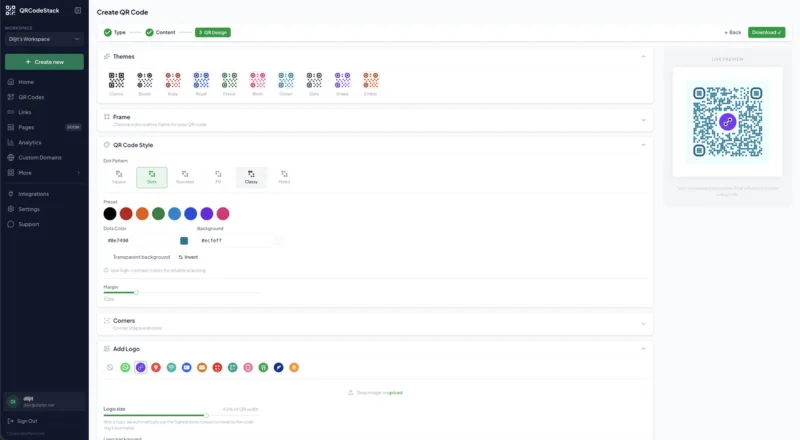
Key Features of QRCodeStack QR Code Software:
- Dynamic QR codes: Create editable QR codes that allow HR teams to change the destination without replacing the existing code.
- Lead generation: Connect QR codes with forms to collect information such as names and email addresses from employees or candidates.
- Scan tracking: Track QR code interactions and gain insights into when, where, and how codes are being scanned.
- Retargeting integrations: Send QR code interaction signals to advertising platforms such as Meta, Google, TikTok, and LinkedIn to build audiences for follow-up campaigns.
- Multiple QR code types: Create QR codes for surveys, URLs, forms, events, social media profiles, and other use cases.
| Pros | Cons |
|---|---|
| Dynamic QR codes can be updated without creating or printing a new code. | Some advanced marketing integrations may require additional setup. |
| Scan tracking provides insights into QR code campaign engagement. | It is primarily a QR code platform rather than a dedicated employee survey system. |
| Lead forms can help HR teams collect candidate or employee information. | Some features may be more useful for teams running active digital campaigns. |
| Supports multiple QR code types and branded QR code customization. | Organizations looking for advanced employee-survey analytics may still need dedicated survey software. |
| Retargeting integrations help connect QR campaigns with digital advertising. |
Ideal For: HR and recruitment teams that want to combine QR codes with employee surveys, candidate engagement, webinars, recruitment events, and digital re targeting campaigns.
Pricing:
Plans start from $5/month.
Expert’s Opinion:
QRCodeStack can be useful for HR teams that want to connect offline and online employee or recruitment campaigns. Its dynamic QR codes, scan tracking, lead forms, and advertising integrations allow teams to do more than simply share a survey or registration link. It can be particularly useful for organizations that want to track engagement and continue communicating with people who interact with their QR campaigns.
10. SurveyMonkey
SurveyMonkey is a widely used survey platform that many organizations rely on for employee feedback. It offers flexible survey design, advanced logic, and a library of templates that cover engagement, onboarding, and exit surveys. While not built solely for HR, its adaptability makes it a popular choice for companies that want both employee and general-purpose survey capabilities in one tool.

Key Features of SurveyMonkey Employee Survey Software:
- Survey design tools: Create custom surveys with multiple question types and branching logic.
- Survey templates: Access pre-built surveys for engagement, onboarding, and exit feedback.
- Data analysis tools: Review results in dashboards and export data for deeper insights.
- Scalability: Manage surveys across large employee populations without performance issues.
Pros and Cons of SurveyMonkey Employee Survey Software:
| Pros | Cons |
|---|---|
| Flexible design allows organizations to tailor surveys to their needs. | Lacks built-in HR-specific features like action planning or peer recognition. |
| A large template library helps save time in survey creation. | Ensuring anonymity for employee surveys may require extra setup. |
| Scales well for large employee groups and multiple surveys. | Benchmarking against industry standards is limited. |
| Results are easy to export and integrate with other tools. | Analytics are not as specialized as dedicated employee survey platforms. |
Ideal For: Companies that want maximum flexibility in survey design and already use general survey platforms for multiple purposes.
Pricing:
- Team Advantage: $30/user/month
- Team Premier: $92/user/month
- Enterpirse: Contact Sales
Expert’s Opinion:
SurveyMonkey works well for organizations that need highly customizable surveys and value flexibility. It provides breadth in design and scalability, making it useful across industries. However, since it is not built specifically for HR, companies may need to supplement it with additional tools to handle engagement or action planning.
11. 15Five
15Five combines employee engagement surveys with performance and goal-tracking features. It emphasizes regular check-ins and continuous feedback, giving managers tools to understand how employees feel and align their work with company objectives.

Key Features of 15Five Employee Survey Software:
- Engagement surveys: Collect structured feedback across the workforce.
- Weekly check-ins: Capture employee progress and challenges on a recurring basis.
- Recognition tools: Allow peers and managers to share appreciation.
- Goal alignment: Connect survey results to OKRs and company priorities.
Pros and Cons of 15Five Employee Survey Software:
| Pros | Cons |
|---|---|
| Weekly check-ins keep communication open between employees and managers. | Survey cadence may feel too frequent for some organizations. |
| Recognition tools help reinforce a positive culture. | Lacks deep benchmarking compared to research-driven platforms. |
| Goal alignment ties survey results to measurable outcomes. | Customization of survey templates is somewhat limited. |
| Blends formal surveys with informal check-ins for balance. | Smaller teams may not need the full breadth of features. |
Ideal For: Organizations that want a balance of structured surveys and continuous feedback within one platform.
Pricing: Subscription-based, with costs depending on the number of users and modules.
Expert’s Opinion:
15Five is well-suited for companies that want employee surveys to feed directly into goal alignment and performance management. Its check-ins make feedback consistent and visible, while recognition features build trust. Companies with simpler needs, however, may find the platform more detailed than necessary.
12. TINYpulse
TINYpulse focuses on short, frequent surveys that capture employee sentiment in real time. Its design is lightweight, making it easy for teams to give feedback without survey fatigue. The platform also includes peer recognition features that help strengthen workplace culture and morale.

Key Features of TINYpulse Employee Survey Software:
- Pulse surveys: Run lightweight, frequent surveys to measure team morale.
- Anonymous feedback: Encourage employees to share openly without concern.
- Peer recognition: Allow colleagues to celebrate each other with simple tools.
- Analytics dashboards: Provide managers with trends and participation data.
Pros and Cons of TINYpulse Employee Survey Software:
| Pros | Cons |
|---|---|
| Lightweight pulse surveys make feedback quick and easy. | Limited advanced analytics compared to enterprise tools. |
| Anonymous feedback increases participation and honesty. | Action planning support is minimal, leaving HR to design next steps. |
| Peer recognition builds team culture. | Benchmarking options are limited to TINYpulse’s own datasets. |
| A simple interface requires little training for employees. | Best for culture checks, less suited for deep engagement analysis. |
Ideal For: Small to mid-sized companies that want simple, frequent checks on morale without heavy systems.
Pricing: Subscription-based, generally affordable compared to larger platforms.
Expert’s Opinion:
TINYpulse is effective for organizations that want to capture honest feedback and keep a regular pulse on morale. Its simplicity and recognition features make it engaging for employees. It is best for teams focused on culture and sentiment tracking rather than advanced engagement analytics.
13. Leapsome
Leapsome is an AI-powered, holistic HR platform that combines the core features of an HRIS with a full suite of people enablement tools, including surveys, performance reviews, goal setting, learning, and compensation management. Unlike standalone survey tools, Leapsome connects employee listening directly to the rest of the HR workflow, so teams can act on results through objective-setting, training courses, and performance assessments within the same platform.

Key Features of Leapsome Employee Survey Software:
- AI-powered survey analysis: Leapsome AI analyzes results and generates detailed action plans in seconds, without requiring manual interpretation.
- Employee sentiment analysis: Natural Language Processing interprets open-ended responses and visually graphs sentiment metrics for deeper insight.
- Multiple survey types: Run engagement surveys, pulse surveys, 360-degree feedback, and onboarding or exit surveys from one platform.
- Customizable templates: Access a built-in library of expert-developed survey and question templates, or build your own.
- Granular analytics and heatmaps: View results by team, department, or demographic, and track scores question by question.
- Connected HR workflows: Survey results sync seamlessly with performance reviews, goal setting, learning, and development tools.
- Automated survey cycles: Schedule recurring surveys to run automatically, reducing manual setup for HR teams.
- Built-in HRIS: All survey and people data sits within a native HRIS, giving HR teams one source of truth across the employee lifecycle.
Pros and Cons of Leapsome Employee Survey Software:
| Pros | Cons |
|---|---|
| Consolidates core HR capabilities and employee enablement tools for surveys, real-time feedback, and more in one platform. | Some HRIS features are still in development. |
| Industry-leading AI capabilities that help summarize, analyze, and strategize based on survey results. | Slight learning curve due to the breadth of features. |
| Built-in library of expert-developed survey and question templates. | |
| Automated survey cycles possible, reducing manual effort for HR teams. | |
| Award-winning global setup and support. |
Ideal For: Teams looking for an intuitive, comprehensive HR and people enablement platform. Its ease of use, flexibility, and range of features make it a strong fit for smaller, fast-growing businesses and larger enterprises alike.
Pricing: Flexible pricing starts at US$3/user/month.
Expert’s Opinion
Leapsome stands apart from most employee survey tools because it is built on a native HRIS, meaning survey data doesn’t just connect to performance reviews and development tools, it connects to the core people record. Engagement insights feed directly into goals, learning paths, and compensation workflows within the same platform, so HR teams can act on what employees share across the full employee lifecycle. Its AI capabilities surface patterns in open-ended responses and generate recommendations automatically, removing the manual work that slows most teams down. For organizations that want employee listening to sit at the center of their people strategy, not at the edge of it, Leapsome is one of the few tools built to make that possible.
Top 13 Employee Survey Tools: A Comparison Table
A good employee survey platform helps companies capture feedback in real time and turn insights into measurable action. The tools below were reviewed on usability, analytics depth, scalability, and overall value.
| Tool | Key Features | Best For | G2 Rating | Free Trial |
|---|---|---|---|---|
| Keka |
| Organizations of all sizes that run frequent surveys and want them integrated with HR systems. | 4.5/5 | Yes |
| Culture Monkey |
| Enterprise organizations with global, multilingual, or frontline-distributed workforces (500+ employees, particularly in manufacturing, retail, hospitality, healthcare, and logistics) that want listening and action planning in one platform. | No | 4.5/5 |
| Qualtrics EmployeeXM |
| Large and global enterprises that run advanced survey programs with predictive analytics. | 4.4/5 | No |
| Culture Amp |
| Mid-sized and large companies that want to link survey results with performance and culture initiatives. | 4.5/5 | Yes |
| Glint |
| Enterprises focused on engagement data linked with retention and employee development. | 5/5 | No |
| Lattice |
| Mid-sized and large firms that are already using Lattice for performance and goals. | 4.4/5 | Yes |
| Workday Peakon Employee Voice |
| Large enterprises using Workday HCM and tracking real-time engagement trends. | 4.6/5 | No |
| Officevibe |
| Organizations tracking morale continuously with simple surveys and recognition tools. | 4.3/5 | Yes |
| QRCodeStack |
| Businesses, marketers, and teams that want to create, manage, and track QR codes for marketing, feedback, events, and business use cases. | 4.4/5 | Yes |
| SurveyMonkey |
| Companies that need a flexible survey design for both employee and general feedback. | 4.4/5 | Yes |
| 15Five |
| Companies aligning surveys with continuous check-ins and goal tracking. | 4.6/5 | Yes |
| TINYpulse |
| Small to mid-sized firms running frequent, lightweight surveys for morale checks. | 4.4/5 | Yes |
| Leapsome |
| Teams looking for a comprehensive HR and people enablement platform, suitable for fast-growing businesses and larger enterprises. | 4.8/5 | Yes |
Which Employee Survey Tool is Best for You?
The best survey tool for you depends on how your company listens to employees, the depth of insights you want, and whether results connect with HR and culture initiatives. Here’s how the best employee engagement survey software compares:
1. Quick Pulse and Morale Checks
For organizations that want lightweight tools to capture sentiment frequently without a heavy setup.
- Officevibe: Runs short pulse surveys with anonymous feedback and recognition tools to keep morale visible.
- TINYpulse: Sends quick anonymous surveys with peer recognition features to track culture health regularly.
- SurveyMonkey: Builds flexible surveys with templates for engagement, onboarding, and exit that also adapt beyond HR.
- QRCodeStack: Lets organizations create QR codes that employees can scan to quickly access and submit feedback or surveys.
2. Continuous Feedback and Check-Ins
For companies that replace once-a-year reviews with ongoing listening and feedback loops.
- Keka: Runs pulse, onboarding, exit, and event-based surveys in one hub with instant analytics and HR integration.
- 15Five: Combines structured surveys with weekly check-ins and recognition tools to keep feedback consistent.
- Workday Peakon Employee Voice: Collects continuous sentiment data with dashboards that connect results to workforce planning.
3. Culture and Engagement Programs
For HR teams running structured engagement, DE&I, onboarding, and exit surveys to build culture.
- Culture Amp: Provides research-backed templates for engagement, DE&I, and lifecycle surveys with dashboards for action.
- Glint: Tracks engagement trends and links survey results with retention and development through LinkedIn Learning.
- Keka: Hosts a central survey hub with role-based permissions and anonymity controls that strengthen a feedback culture.
- CultureMonkey: Helps organizations run employee engagement and pulse surveys, analyze workforce sentiment, and turn feedback into actionable insights to improve workplace culture and employee experience.
4. Enterprise Analytics and Scale
For enterprises needing advanced survey design, predictive analytics, and global rollouts.
- Qualtrics EmployeeXM: Delivers advanced survey logic, lifecycle coverage, and AI-driven insights that highlight engagement drivers.
- Lattice: Integrates surveys with performance reviews and goals to give leaders a connected view of engagement outcomes.
- SAP SuccessFactors: Embeds surveys into its HCM suite and connects results with performance, pay, and workforce planning.
Top Picks for Employee Survey Software
| Best For | Software | Why It Stands Out |
|---|---|---|
| Quick Pulse and Morale Checks | Officevibe | Makes it easy for managers to track morale through short surveys and anonymous feedback while keeping recognition visible. |
| TINYpulse | Focuses on lightweight feedback that captures sentiment regularly without overwhelming employees. | |
| SurveyMonkey | Offers unmatched flexibility for companies that want custom survey design beyond HR-specific needs. | |
| QRCodeStack | Lets organizations create QR codes that employees can scan to quickly access and submit feedback or surveys. | |
| Continuous Feedback and Check-Ins | Keka | Stands out for event-based surveys that capture feedback at key moments like onboarding, promotions, and exits. |
| 15Five | Keeps feedback consistent through weekly check-ins that double as surveys and recognition touchpoints. | |
| Workday Peakon Employee Voice | Provides real-time listening at scale, turning engagement data into workforce planning insights. | |
| Culture and Engagement Programs | Culture Amp | Brings research-backed templates that let HR teams build structured programs around engagement and DE&I. |
| Glint | Connects survey results directly with retention risks and development needs for stronger people strategies. | |
| CultureMonkey | Helps organizations run employee engagement and pulse surveys, analyze employee sentiment, and turn feedback into actionable insights to strengthen workplace culture. | |
| Enterprise Analytics and Scale | Qualtrics EmployeeXM | Leads in advanced survey logic and AI insights, giving global firms predictive visibility into engagement. |
| Lattice | Distinguishes itself by linking surveys with performance reviews and goal alignment for a connected view. | |
| SAP SuccessFactors | Best suited for enterprises already on SAP, embedding survey results into performance and pay systems. |
How to Choose the Right Employee Survey Tool in 2026
Choosing survey software is not just about features. It is about how well the platform fits your culture, scale, and ability to act on feedback. These are the key factors to consider:
- Survey frequency: Some tools excel at quick pulse surveys, while others handle detailed lifecycle programs. Think about whether your priority is weekly morale checks or structured cycles for onboarding, promotions, and exits.
- Depth of insights: Basic dashboards may show response trends, but advanced platforms use AI to uncover drivers of engagement and retention. Decide if you need surface-level reports or deeper analytics that predict risks.
- Integration with HR systems: Standalone tools are fine for lightweight feedback, but integrated systems connect survey results to payroll, reviews, or performance. This reduces silos and makes it easier to act on insights.
- Ease of use: Adoption depends on how intuitive the platform feels for employees and managers. A complex survey design is wasted if people find it hard to respond or if managers struggle to interpret results.
- Scalability: Startups may need simple surveys, while global enterprises require multi-language support, role-based permissions, and compliance features. Check if the platform can grow with you.
- Action planning: Feedback has no value if it stays in reports. Look for tools that guide managers with alerts, recommendations, or structured action plans after each survey.
- Data security and anonymity: Employees only give honest feedback when they feel safe. Strong anonymity settings and clear role permissions are essential to build trust.
- Trial runs: Pilots help you test real workflows before full rollout. This avoids investing in a tool that looks good in demos but does not fit your culture.
Conclusion
Employee surveys are essential for building engagement and trust. They give employees a safe way to share concerns and help leaders spot issues before they grow. Without structured listening, feedback stays informal and invisible, leaving teams disengaged and decisions uninformed.
Among the tools discussed, Keka stands out because it captures feedback at the right moments through pulse, onboarding, and exit surveys. Its event-based triggers, analytics, and HR integration turn survey responses into action. This makes it practical for companies that want employee listening to be continuous, structured, and directly linked to people’s decisions.


