Login


10 Main HR Challenges In The Retail Sector With Solutions


PRODUCTS
 Payroll Suite
 HR Suite
 Talent Suite
 Project Services Suite
Meet the platform tailored to your business
Core system of record
One platform for the entire employee journey
How Srijan Technologies streamlined timesheets management with Keka
Read customer story
BY INDUSTRY
BY COMPANY SIZE
LEARN
EXPLORE KEKA
Navigate every labor law, wage regulation, and statutory requirement across all 28 states and 8 union territories without the legal headaches.
Learn More
Retail's unique pain high turnover, inconsistent hours, thin margins, on-the-floor training, and holiday pressure demands different HR playbook. Discover how to hire and retain people for roles that feel disposable, run tight payroll amid schedule chaos, and keep morale up during Black Friday madness.
The retail sector accounts for 10% of the total GDP of India. It ranks 4th largest in the world according to its size and by 2025, it is predicted to reach 96.43 trillion. (IKON Research) With an industry growing at such a high rate, challenges are bound to follow.
In India, retail has changed a lot in the past few years, thanks to new store formats and a young working population. But, the arrival of global companies in retail is making it tough for Indian firms.
Historically, HR in the Indian retail sector treated employees as just an employee number of ID and not as individuals. Lately, due to increased competition, the scenario has changed and efforts are being made to retain and engage employees in this sector too.
Human resources are crucial in retail for surpassing challenges. An organization’s success relies on effective HR strategies and people management. The retail sector has its own set of unique HR challenges that impact both the sector as a whole and the majority of the brands operating within it.
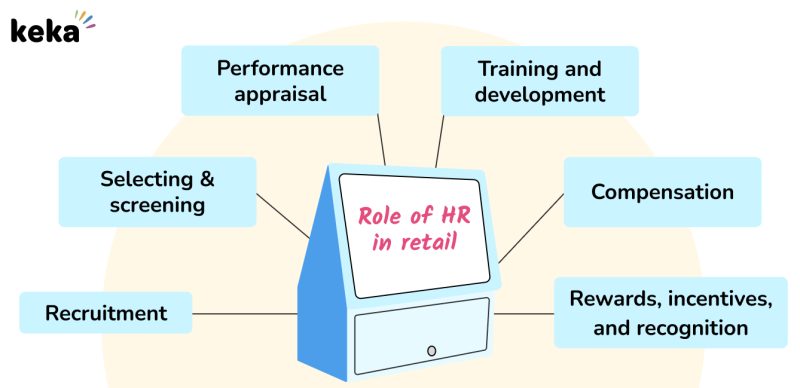
The HR is responsible for a variety of functions in the retail sector. Some examples are:
Intense competition in organized retail brings in challenges. Let us look at these challenges one by one and what HR can do to solve them.
A retailer is an individual or a company that buys goods in large quantities and then breaks them down into smaller portions to sell to individual customers. India has over a million retail outlets, but the retail industry here still lacks modernization. To thrive in the Indian market, companies need to think smarter.
The following are the five major challenges experienced by the retail sector in the country:
The major hurdle for organized retail is the extremely expensive real estate prices. This makes up a significant portion of their overall expenses. This can significantly impact profitability, as even rental costs can be prohibitively high, making survival for the organization challenging.
Besides real estate, there are other operational costs to consider. Retail has a wide range of operations such as staff, basic infrastructure, electricity, taxes, and various incidental expenses. These costs add further to the financial burden.
Organized retail needs both long-term and short-term funds to sustain itself. This causes extensive financial challenges. Long-term funds are necessary for building infrastructure and acquiring equipment. Meanwhile, short-term funds are required for inventory, hiring staff, and maintenance.
Retailers often struggle to find and retain skilled manpower in sufficient numbers and quality. Finding educated candidates in the retail sector can be a challenge. Sourcing the right quantity and quality of skilled human resources is an ongoing challenge for the retail sector.
Both organized and unorganized retail sectors in India face stiff competition from large MNCs. These multinational corporations possess substantial financial and other resources, giving them a competitive edge over local retailers. Examples are ITC, Sony, Amazon, Nestle, Accenture, etc.
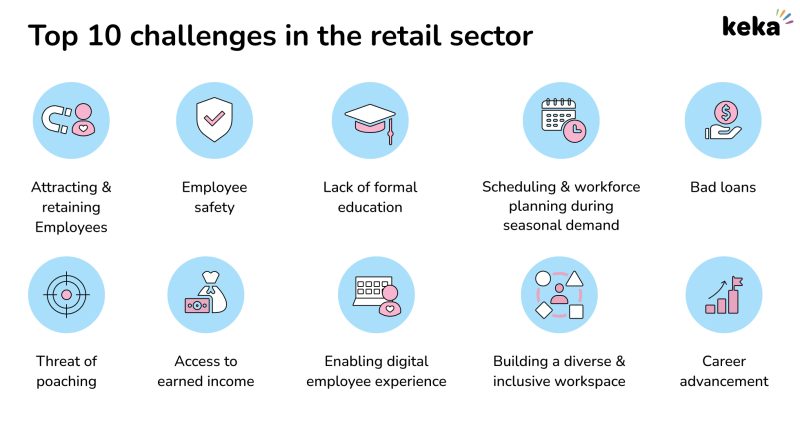
HR professionals in the retail sector face some unique challenges when it comes to attracting and keeping talented, motivated employees. Let’s discuss some of these common issues in retail HR and explore ways to overcome them.
The growth of digital life has caused a reduction in physical retail stores. The digital world is definitely cheaper than the physical world which requires human labor in the real world. This has caused turnover costs in the retail sector to skyrocket.
High turnover in the retail sector is linked to various expenses like recruitment, training, lost sales, service quality, and many other factors. Hence, it becomes very important to retain good talent once identified.
Some challenges in attracting and retaining employees in retail are:
The talent problem in retail is real. There’s a significant disconnect between what executives think their employees need and what employees believe their companies should do to help them. In the following sections, we’ll discover how HR can help bridge this gap.
It is crucial for retail store owners and HR to make sure the store is safe for both customers and employees. Sales associates are expected to recognize and adhere to health and safety requirements set by HR and the law. These rules are in place to prevent any health or safety risks.
Here are key factors for HR to consider for ensuring employee safety in a retail store:
You need skilled and talented staff to manage daily operations and meet diverse customer needs. In India, formal vocational institutes for employee training are scarce. Hence, most retail employers have to rely on in-house training or smaller external institutes to meet their training requirements.
Considering the expansion of the retail sector, some business schools are now offering innovative retail management courses. You can find various short-term retail management programs at institutions like the Indian Retail School.
Examples of formal retail education partnerships with retail brands:
In India, retailers can gain a competitive edge by implementing proactive training strategies due to the scarcity of resources and skills.
Even in the best of times, managing your workforce effectively during seasonal demand can be quite challenging. HR has to create and tailor employee models for different regions, stores, and departments, and adjust them based on seasonal demand. They also need to align labor budgets, forecasts, and schedules to boost revenue and avoid unnecessary expenses.
But in today’s retail landscape, apart from the above, there are newer challenges making workforce planning even more complex. Employees are now seeking more flexibility in their schedules. Additionally, the growing customer demand for services like omnichannel delivery means you have to account for new types of work.
Retail managers are already spending hours each week creating schedules and planning out their workforce. HR needs to avoid using outdated and error-prone systems to deal with this complex problem.
In the retail sector, a major issue is the presence of bad loans because many workers in this industry borrow money from both their companies and banks. It’s crucial for HR to keep a close eye on these loans to ensure everything stays in balance.
In retail HR, there are two key risks to consider with employee loans:
In retail HR, employee poaching is a significant issue, especially in both organized and unorganized retail. Skilled workers are in short supply, making it tempting for competitors to lure employees with higher salaries.
The mismatch between the number of available workers and the industry’s needs is causing a high employee turnover rate and driving up operational costs. On top of this, emerging retail chains are hiring employees from established players like Shopper’s Stop, BigBazaar, and Spencer’s for their backend operations.
Furthermore, the growing attrition rate among key retail players in the Indian market is a rising concern for the poaching problem.
In the retail sector, a key HR challenge is motivating employees to contribute effectively to business outcomes through the right compensation strategy. This includes fair monetary and indirect benefits. To encourage active engagement, some firms adopt profit-sharing.
In India, front-line employee compensation is often conservative, while store managers receive competitive plans. To ensure stability and foster employee ownership, HR can design a program that offers lower guaranteed pay but includes robust bonuses tied to store profitability.
This approach can also extend to support functions like merchandising, distribution, and accounting. Such an approach can be done with rewards depending on store performance.
The digital workplace plays a crucial role in enhancing the digital employee experience (DEX). It serves as a framework to understand what employees receive and how it’s delivered. The advantage of the digital workplace is that it’s firmly rooted in the everyday digital tools and processes employees use.
In the retail sector, enabling DEX is a challenge because employee experience has not been a priority in this sector until recently. So, how can HR try to transform the digital employee experience? Here 5 ways:
Diversity and inclusion pose significant challenges for HR in the retail sector. Ongoing training to foster inclusion is essential but resource-intensive. Here are five reasons why building a diverse and inclusive workspace in retail is crucial but poses as a challenge.
In the retail sector, most employees do not have a clear path to career advancement. Fostering both personal and organizational growth makes it essential for HR to implement effective goal management and training programs.
Offering training opportunities such as communication skills, personality development, packing techniques, and technical skills can further facilitate their career development. These measures not only benefit individuals but also contribute to the overall growth of the company.
Furthermore, providing career growth chances can solve the problem of attracting top talent. It helps brand your company positively in a competitive job market with a scarcity of experienced and skilled individuals. Demonstrating a promising future for employees gives you a competitive edge in recruitment.
Retail companies can promise career advancement by:
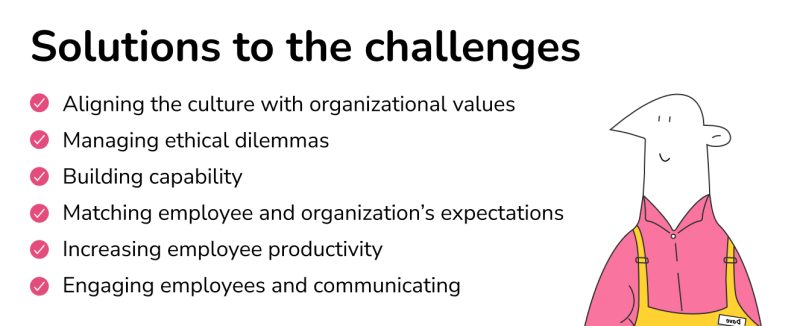
Human Resources (HR) management plays a pivotal role in the retail sector, where the success of a business heavily relies on its workforce. Let’s explore how HR can meet the above problems head-on, ultimately contributing to the success of retail organizations in an ever-evolving marketplace.
This involves making sure that the company’s culture reflects its core values and mission. It ensures that employees’ behaviors and attitudes align with what the organization stands for.
Imagine a retail company that prides itself on providing exceptional customer service. To align culture with values, the HR department could implement training programs. These programs should emphasize the importance of customer satisfaction. Employees who go the extra mile to help customers can be rewarded for upholding the brand’s culture.
Ethical dilemmas in retail HR may include issues like employee theft, fraud, or conflicts of interest. HR needs to address these dilemmas while upholding ethical standards.
If an HR manager discovers that an employee is stealing merchandise, they must address the issue promptly. This may involve conducting a fair investigation, ensuring due process, and, if necessary, terminating the employee.
Building capability includes developing employees’ skills and competencies to meet current and future business needs. This ensures that employees are well-equipped to handle their roles effectively.
This process includes the role of HR to turn young individuals working in retail stores to uphold managerial roles and develop leadership qualities. They can invest further by encouraging employees to sign up for retail management courses for the company’s benefit.
It’s crucial that employees understand what the company expects from them and vice versa. This alignment can reduce misunderstandings and improve job satisfaction.
A retail HR department can create clear job descriptions and performance expectations. Employees can then have a better understanding of what is expected of them, leading to improved job performance and satisfaction.
Improving employee productivity involves finding ways to help employees work more efficiently and effectively, ultimately benefiting the organization.
Let’s say a retail store experiences long customer checkout lines during peak hours. HR can implement a better scheduling system for employees to ensure adequate staffing during these times. This can reduce wait times for customers and improve overall productivity.
Employee engagement refers to keeping employees motivated and connected to their work. Effective communication is vital for achieving this.
HR can conduct regular feedback sessions with employees, listen to their concerns, and implement their suggestions when possible. This two-way communication fosters a sense of involvement and engagement among the staff.
The common functions performed by HR in the retail industry are:
Human resources management in the retail industry establishes criteria within the organization to assess employee performance. HRM provides objectives that must be agreed on both by employer and employee to promote cooperation. The new-age retail organizations need to structure tasks, assign duties, and administer management, and employees. HRM looks into these activities while managing attrition and retention rates.
The steps involved in the process of HRM in retail management are mentioned below:
The key recruitment challenges in the retail sector are as follows:
Subscribe to keep up with the latest strategic finance content.
Request a demo