Login


Payroll Outsourcing Companies in India: Top 11 Providers for 2026


PRODUCTS
 Payroll Suite
 HR Suite
 Talent Suite
 Project Services Suite

Meet the platform tailored to your business
Core system of record
One platform for the entire employee journey

BY INDUSTRY
BY COMPANY SIZE
LEARN
EXPLORE KEKA
India runs payroll under 28 sets of state rules, and getting PF, ESI, PT or TDS wrong is expensive. This guide compares 11 payroll outsourcing companies in India on pricing, compliance coverage, features and the company sizes they suit best.
Running payroll in India is a bit like filing taxes in 28 different countries at once. Every state has its own Professional Tax slabs. PF and ESI rules update without warning. TDS calculations change with every Union Budget. And if you get any of it wrong, the penalties hit fast.
That’s why a growing number of Indian businesses are hiring payroll outsourcing companies to take the load off their HR teams.
But with dozens of providers in the market, finding the best company for your specific needs takes more than a Google search.
Some vendors are built for MNCs running payroll across 30 countries. Others are priced for 50-person teams that just need someone to get PF and TDS right every month.
This guide breaks down 12 of them, what they actually do well, where they fall short, and how to pick the right one.
Running payroll across multiple states? Keka automates PF, TDS, ESI, and PT so your HR team doesn’t have to.
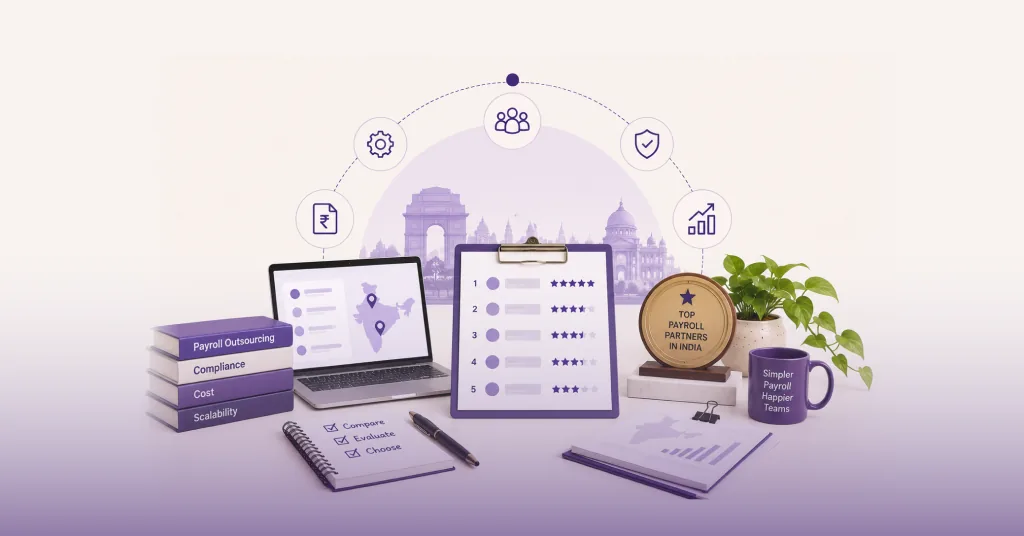
Before you dive in, this table breaks down all 15 payroll outsourcing companies in India at a glance:
| Company | Best For | Company Size | Pricing |
|---|---|---|---|
| Keka HR | Mid-market running payroll in-house | 50-5,000+ | Contact for pricing; free trial available |
| Quikchex | SMEs wanting payroll + HRMS bundled | 50-1,000 | From ₹7,500/mo + ₹75/emp |
| Paysquare | Payroll + accounting under one vendor | 100-2,000 | Custom quote |
| ADP India | MNCs needing global payroll consolidation | 500+ | Custom quote |
| PeopleStrong | Large enterprises with complex hierarchies | 1,000-5,000+ | Custom quote |
| ZingHR | Enterprise HCM with payroll integration | 500+ | Custom quote |
| Adecco India | Enterprises bundling staffing + payroll | 500+ | Custom quote |
| Paybooks | Growing businesses needing fast go-live | 100-1,000 | Custom quote; 30-day free trial |
| MYND | Gig, blue-collar, and mixed workforces | 200+ | Pay-as-you-consume |
| Ramco Systems | Aviation, manufacturing, MNCs | 5,000+ | Custom quote |
| Neeyamo | Multinationals across 30+ countries | 200+ | Custom quote |
A payroll outsourcing company in India typically handles five core functions on your behalf:
This is where the process starts. Your outsourcing partner collects and verifies all the data that feeds into salary calculations: attendance records, loss-of-pay deductions, overtime hours, salary arrears, and statutory bonus computations. Getting inputs wrong at this stage means every downstream calculation is off.
Gross pay gets broken down into net take-home based on the employee’s salary structure, after accounting for PF contributions, ESI deductions, Professional Tax, and income tax (TDS). The provider runs these calculations using the latest rates and slabs, which change more often than most companies can track internally.
This covers TDS returns, PF ECR filings, ESI challans, and other compliance-related submissions to government portals. This ensures on-time filings every cycle, so your company isn’t chasing deadlines or facing late-filing penalties.
Employees get access to their salary breakdowns, tax computation sheets, and downloadable documents like Form 16 through self-service portals. This takes a significant chunk of routine HR queries off your team’s plate, since employees can pull their own payslips and tax documents without emailing HR every month.
The provider flags regulatory changes, assists with audit preparation, and advises on tricky scenarios such as mid-year CTC revisions or multi-state tax obligations. This is the layer that separates a payroll processor from a payroll partner.
A good outsourcing partner integrates directly with your biometric devices, attendance systems, or HRMS to pull leave records, shift logs, overtime hours, and LOP days automatically. Without this, someone on your team is manually reconciling attendance with payroll every month.
That’s a lot of ground for any in-house HR team to cover on its own, month after month, without errors piling up. And for a growing number of Indian businesses, the cost of getting it wrong has made outsourcing the easier call.
India has dozens of payroll service providers, from global payroll giants serving multinationals to India-built platforms designed specifically for domestic compliance. Here are the 12 best payroll outsourcing companies in India,

Source: Keka HR
Keka payroll services take over your payroll function end-to-end. Their team coordinates directly with your HR and finance teams, handles the reconciliation, and closes every cycle cleanly. You get the output. They own everything before it. Trusted by 12,000+ businesses globally, the service covers payroll processing, statutory compliance, and employee lifecycle operations from onboarding to exit.
The scope goes beyond payroll. Compensation changes, transfers, document generation, employee helpdesk queries, and leave/attendance/expense administration are all handled by Keka’s team on your behalf. Your HR team makes people decisions. Keka handles the process work.
“Payroll used to be chaotic. Keka gave us one clean system, no Excel, no fire drills.” — Darshana Gogoi, HR Manager, WorkIndia
Key features:
Pricing: Contact for pricing. Free trial available on all plans.
| Pros | Cons |
|---|---|
| Dedicated support team walks you through onboarding, first payroll run, and stays available for ongoing queries. | Some users have reported slow loading on mobile during peak usage, particularly around month-end payroll processing. |
| Payroll accuracy is strong, with automated calculations, built-in error checks, and direct deposits that go through on time. | Keka has 12,000+ businesses on its platform, but the managed services arm is a recent launch. |

Source: Quikchex
Quikchex is built for Indian SMEs that want payroll outsourcing, HRMS, and statutory compliance handled by one vendor without enterprise pricing. They’ve been in the payroll, HR, and staffing space for over 40 years through their group companies, and today serve 5,000+ HR managers across India.
Most payroll outsourcing providers don’t give you an HRMS platform, and most HRMS platforms don’t offer managed payroll outsourcing. Quikchex does both under one contract, with a dedicated account manager running your payroll end-to-end and filing PF, ESIC, PT, TDS, and LWF returns on your behalf.
Key features:
Pricing: Starts at ₹4,500/month + ₹45/employee for self-service; full-service payroll outsourcing starts at ₹7,500/month + ₹75/employee.
| Pros | Cons |
|---|---|
| Budget-friendly pricing that works for both SMEs and enterprise clients. | Geographic coverage is limited to India, Singapore, and the Middle East markets. |
| Quick issue resolution and hands-on onboarding, which matters when your payroll is due and something breaks. | Limited scalability for larger enterprises. Built for SMEs and mid-market; businesses above 1,000 employees may outgrow it. |

Source: Paysquare
Paysquare has been in the payroll outsourcing business since 2000, making it one of the more established specialists in the Indian market. They’ve built a specific niche by combining payroll processing with accounting outsourcing, a pairing most payroll-only vendors don’t offer. They’ve been at it long enough to have a track record that’s easy to verify: over 800 clients across industries like IT, manufacturing, BFSI, and retail.
Key features:
Pricing: Custom quote only.
| Pros | Cons |
|---|---|
| Cost and turnaround time are the two things clients praise most. Responses are prompt, and attention to detail during payroll processing keeps errors low. | Limited visibility into who handles your payroll. The relationship can feel distant since clients don’t always know or interact with the team processing their compliance filings. |
| Clients with complex payroll structures report that the team adapts well to non-standard setups, with strong data security practices including SSO and encrypted file transfers. | Larger enterprises with complex multi-entity setups may find the platform limiting. |

Source: ADP India
ADP runs payroll for multinationals. In India, they offer ADP Vista for domestic payroll processing and ADP Global Payroll for companies that need to run Indian payroll alongside five, ten, or fifty other countries from one platform. Their India client base is almost entirely MNCs that already use ADP elsewhere and need to plug India into their existing global payroll stack.
Key features:
Pricing: Custom quote only.
| Pros | Cons |
|---|---|
| Payroll processing is accurate and stress-free once set up. Revisions and mid-cycle updates are handled without disrupting the pay run. | Pricing is built for enterprise budgets and can be expensive for smaller companies. |
| Scales across company sizes with flexible service models. | Payroll reporting lacks depth. Users flag that standard reports don’t include enough detail for finance teams, particularly around employer tax expenses. |

Source: PeopleStrong
PeopleStrong’s managed payroll service is built for large enterprises running multi-entity, multi-location operations across India and Southeast Asia. Their team handles end-to-end payroll processing, statutory compliance (PF, PT, ESI, LWF, TDS, bonuses), tax support, and employee query resolution. They serve over 500 enterprise clients and process payroll for more than 2 million employees.
What makes them a fit for complex setups is that your internal team doesn’t need to monitor regulatory updates across every state you operate in. PeopleStrong’s team tracks statutory changes, configures them before your next pay run, and maintains full traceability of every update.
Key features:
Pricing: Custom quote only.
| Pros | Cons |
|---|---|
| Payroll support during the month-end is consistently responsive and knowledgeable. | Mainly for large enterprises. Mid-market companies often find it heavier than they need. |
| ISO 27001, SOC 2, and GDPR-compliant infrastructure with end-to-end encryption. Sensitive data like bank details, PAN, and UAN is encrypted both in transit and at rest. | Pricing is entirely custom-quote-based with reports of unexpected increases at renewal. |

Source: ZingHR
ZingHR runs fully managed payroll for 300+ organisations across India, Singapore, and Australia, serving 2 million+ active users. Their team takes ownership of the entire monthly payroll cycle on your behalf, not just the software.
What sets them apart is the compliance depth behind the service. Their team has built in New Labour Codes readiness, including wage restructuring validation for the 50% basic wage rule, and auto-applies state-specific statutory rules based on employee work location.
Key features:
Pricing: Custom quote only.
| Pros | Cons |
|---|---|
| Dedicated payroll operations team adapts to changing business requirements rather than forcing a rigid process. | Enterprise-level pricing that doesn’t make sense for startups or small teams. |
| Multiple users specifically call out the onboarding team’s competence and hands-on support during setup. | Support turnaround is inconsistent. Some users praise responsiveness, others report slow resolution times exactly when payroll is due. |

Source: Adecco India
Adecco India is the Indian arm of the Adecco Group, one of the world’s largest staffing and HR services companies. Payroll outsourcing at Adecco works differently from a standalone payroll provider. It’s typically part of a broader managed services package where Adecco handles sourcing, onboarding, compliance, and payroll for your contract or temporary workforce as one bundled operation.
If your company already uses Adecco for staffing and you’re managing payroll for those contractors separately, consolidating both under Adecco removes a layer of coordination. Their payroll outsourcing covers salary processing, tax deductions, statutory compliance, and HR administration through a digitally enabled platform.
Key features:
Pricing: Custom quote only.
| Pros | Cons |
|---|---|
| Absorbs the operational burden of headcount changes, making it suitable for companies with seasonal or project-based staffing needs. | Payroll is one service inside a staffing bundle, not their primary product. Dedicated payroll providers will have deeper compliance tooling. |
| Adecco’s payroll specialists go through structured, thorough training programs internally. | Multiple workers report difficulty getting PF processed after leaving Adecco-managed roles. |

Source: Paybooks
Paybooks serves over 3,000 businesses across India with both payroll software and outsourcing services. They handle tax calculations and integrate with existing HRMS systems through APIs, which means you don’t have to rip out your current HR stack to add payroll. If you already use a separate tool for attendance, leave, or employee management, Paybooks can plug into it rather than forcing a platform switch.
Key features:
Pricing: Custom quote. Free 30-day trial available.
| Pros | Cons |
|---|---|
| Onboarding is fast. Most clients are processing payroll within 7-10 business days. | Advanced payroll configurations may require third-party integrations, which adds complexity. |
| The support team is consistently praised for fast issue resolution and hands-on help during payroll processing. | Multiple users note that important options are hidden, and navigating the platform requires memorizing where things are. |

Source: MYND Integrated Solutions
MYND stands out on this list because of the workforce types they support. Most payroll providers are built for salaried white-collar employees. MYND has built separate payroll tracks for gig workers, blue-collar employees, and global teams.
Their gig worker payroll handles worker classification, automated onboarding, flexible payment processing, and TDS/GST compliance. The blue-collar payroll module includes advanced time and attendance, geo-fencing, automated wage calculations, and expertise in labour law compliance for high-volume workforces.
For companies operating factories, warehouses, or field teams alongside a corporate office, that kind of segmented payroll capability is hard to find from a single vendor.
Key features:
Pricing: Pay-as-you-consume model. Custom quote only.
| Pros | Cons |
|---|---|
| Users highlight getting structured, timely responses with zero escalations from hiring managers. | More of a services company than a product company, so the experience depends heavily on the team assigned to your account. |
| Integrates directly with SAP and Oracle, so you can onboard without ripping out your existing tech stack. | High work pressure and staff shortages internally could affect responsiveness during peak payroll periods. |

Source: Ramco Systems
Ramco has been named a Leader in Everest Group’s APAC Multi-Country Payroll report for four consecutive years. Their managed payroll services are purpose-built for industries most outsourcing providers avoid: aviation and manufacturing, where shift differentials, union pay rules, and multi-location compliance make payroll difficult to standardise.
Key features:
Pricing: Custom quote only.
| Pros | Cons |
|---|---|
| The payroll team is responsive to queries without significant delays or escalation issues. | Designed for mid-to-large enterprises, so smaller companies will find the onboarding process, pricing, and service structure disproportionate to their needs. |
| Works reliably even at low bandwidth, which matters for manufacturing plants and aviation sites where internet connectivity is inconsistent. | Initial setup requires heavy involvement from Ramco’s consultants. Without their experts guiding configuration, the implementation stalls. |

Source: Neeyamo
Most global payroll providers subcontract to local partners in each country. Neeyamo handles payroll processing in-house across 100+ countries through their own team and compliance infrastructure. When a tax table changes in Germany or a statutory deduction shifts in Singapore, Neeyamo’s team applies the update before your next pay run. This way, you’re not chasing a local accountant in each market to confirm they’ve caught the change.
They became a Workday Global Payroll Connect (GPC) Certified Partner in February 2026, which means enterprises already running Workday get a managed payroll service that plugs in natively rather than requiring custom middleware.
Key features:
Pricing: Entirely quote-based.
| Pros | Cons |
|---|---|
| Async ticketing and communication work well for multi-country operations. | If you only run payroll in India, you’re paying for global infrastructure you won’t use. |
| Indian multinationals expanding overseas can keep India payroll and international payroll on the same platform. | Some users report slower resolutions during critical payroll windows, which is when support speed matters most. |
With so many payroll outsourcing companies in India to choose from, picking one based on a feature list or a sales demo won’t tell you what you need to know. These eight criteria will.

Check G2 reviews, Capterra ratings, and ask for references in your industry. A vendor with hundreds of clients across multiple years has seen the edge cases a newer provider hasn’t. Ask their references one question: “What happened the last time something went wrong during a payroll run?”
Don’t just compare per-employee-per-month rates. Ask about setup fees, per-filing charges, and what happens to pricing when headcount changes. A vendor quoting ₹150 PEPM with separate charges for Form 16, 24Q filing, and setup can end up costlier than one quoting ₹300 all-in.
Ask to run a pilot payroll before committing. Include your most complicated employee: the one with multiple reimbursements, a mid-year CTC revision, and state-specific PT deductions. If the vendor gets that payslip right, they can handle the rest.
Ask three things: where is my data hosted, who can access it internally, and what’s your breach notification SLA? If the answers are vague or take more than a day, that tells you enough.
Attendance, leave, expenses, and reimbursements all feed into payroll. Ask how attendance-to-payroll sync works, whether it’s automated or manual. If someone has to enter LOP days every month manually, that’s where errors happen.
Call the vendor’s support line at 6 PM on the last working day of the month during evaluation. If you get a recorded message or a ticket number, that’s exactly what you’ll get when payroll breaks and salaries are due.
A vendor who’s handled payroll for manufacturing companies will understand shift differentials and Factories Act overtime in ways a generalist won’t. Ask how many clients they serve in your industry and what sector-specific scenarios they’ve handled.
Your vendor should handle PF, ESI, PT, TDS, LWF, and bonus filings end-to-end, not just calculate the numbers. Ask how quickly they update their system when a regulation changes mid-cycle. And check SLAs carefully: a promise of “timely processing” without defining what “timely” means is worth nothing.
India’s payroll outsourcing market has enough providers to match virtually any company profile, from global enterprises to SMEs to companies with gig and blue-collar workforces. The right choice depends on your size, the states you operate in, your workforce mix, and whether you want a managed service or a software platform.
But one thing holds across the board: getting Indian payroll wrong is expensive. PF penalties, PT miscalculations, TDS notices, and ESI shortfalls add up fast, and they compound every month you don’t catch them.
If you want to stop managing payroll entirely and hand it off to a team that owns everything from input to filing, Keka Managed Payroll Services handles payroll operations, statutory compliance, and employee lifecycle processes for 12,000+ businesses globally. Your HR team focuses on people. Keka handles the process work.
The best outsourcing company depends on your size and needs. Keka HR and greytHR are strong choices for SMEs and mid-market companies. ADP India and Ramco suit large enterprises and MNCs needing multi-country payroll. Quikchex works well for SMEs wanting payroll, HRMS, and compliance bundled at an accessible price point.
In India, pricing ranges from roughly ₹500 to ₹1,500 per employee per month, depending on headcount, service scope, and compliance complexity. Basic payroll processing sits at the lower end, while full-service managed payroll with compliance, advisory, and HRMS bundled in runs higher. Always ask about setup fees and per-filing charges.
Yes, provided you choose a vendor with ISO 27001 certification and clearly defined SLAs around data protection. Reputable providers use encryption, role-based access controls, and regular security audits. Verify their certifications, data residency policies, and breach notification procedures before committing.
A good provider handles PF, ESI, Professional Tax, TDS, LWF, Form 16, Form 24Q, gratuity, and bonus calculations across all 28 Indian states. The best ones also auto-update when regulations change and generate filing-ready reports that you can submit directly to government portals.
Consider it when your payroll spans multiple states or entities, when compliance tracking is consuming too much HR bandwidth, when errors or late filings are becoming a pattern, or when you’re scaling headcount faster than your payroll team can keep up. Companies with international employees or complex benefits structures benefit the most.
Subscribe to keep up with the latest strategic finance content.
Request a demo