Login


Mileage Reimbursement 2026: IRS Rates, Calculations, and Employer Rules



PRODUCTS
 Payroll Suite
 HR Suite
 Talent Suite
 Project Services Suite
Meet the platform tailored to your business
Core system of record
One platform for the entire employee journey
How Srijan Technologies streamlined timesheets management with Keka
Read customer story
BY INDUSTRY
BY COMPANY SIZE
LEARN
EXPLORE KEKA
Navigate every labor law, wage regulation, and statutory requirement across all 28 states and 8 union territories without the legal headaches.
Learn More
Mileage reimbursement is the amount employers pay employees for using personal vehicles for work-related travel. It helps cover costs such as fuel, maintenance, insurance, and depreciation. Employers typically calculate reimbursement by multiplying eligible business miles by an approved per-mile rate. For July 1 through December 31, 2026, the IRS standard business mileage rate is 76 cents per mile , up from 72.5 cents during the first half of the year.
However, calculating mileage reimbursement involves more than applying a rate. Employers must distinguish business trips from commuting, maintain accurate records, and comply with applicable tax and state reimbursement requirements.
Mileage Reimbursement 2026: Key Facts
Current IRS business rate: 76 cents per mile (July–December 2026).
Previous rate: 72.5 cents per mile (January–June 2026).
Calculation: Eligible business miles × reimbursement rate.
Tax treatment: Generally tax-free under an IRS-compliant accountable plan.
Employer requirements: Depend on applicable federal wage and state reimbursement laws.
Mileage reimbursement compensates employees for business-related use of their personal vehicles. It is commonly calculated using the IRS standard mileage rate, although employers may adopt another reasonable reimbursement method that complies with applicable laws.
A consistent reimbursement policy also helps employers manage costs and meet applicable tax and labor requirements.
Employees who use their personal cars, motorcycles, or other eligible vehicles for authorized business travel may qualify for mileage reimbursement, depending on their employer’s policy and applicable laws.
The IRS sets optional mileage rates for business, medical, moving, and charitable travel, which also give employers a standard benchmark for reimbursing employees.
The table below shows the official IRS mileage rates for 2026:
| Mileage purpose | Jan 1–Jun 30, 2026 | Jul 1–Dec 31, 2026 |
|---|---|---|
| Business | 72.5¢ per mile | 76¢ per mile |
| Medical | 20.5¢ per mile | 23.5¢ per mile |
| Eligible moving | 20.5¢ per mile | 23.5¢ per mile |
| Charitable | 14¢ per mile | 14¢ per mile |
The 2026 business mileage rate applies to qualifying work-related travel in personal cars, vans, pickup trucks, and panel trucks, including electric and hybrid vehicles.
Medical and moving mileage rates primarily apply to individual tax deductions. The moving rate is limited to qualifying members of the Armed Forces and Intelligence Community, while the charitable mileage rate is fixed by federal law at 14 cents per mile and will remain unchanged throughout 2026.
The IRS increased its business, medical, and moving mileage rates effective July 1, 2026, following higher fuel costs.
For example, business miles driven in June 2026 generally fall under the 72.5-cent rate, even if the employee submits the reimbursement claim in July. Business miles driven from July 1 qualify for the revised 76-cent rate under the applicable IRS mileage allowance rules.
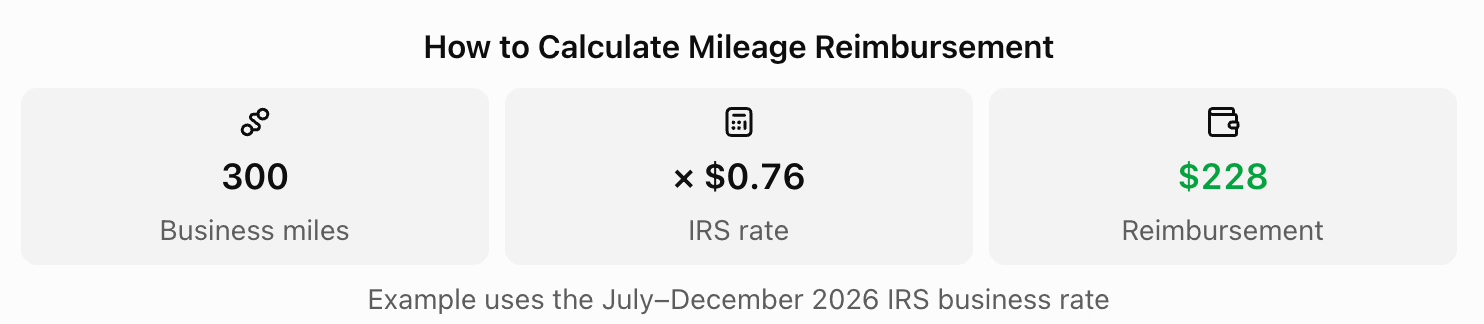
To calculate mileage reimbursement, multiply the total number of eligible business miles driven by the applicable reimbursement rate.
Mileage Reimbursement = Business Miles Driven × Reimbursement Rate
This is the simplest approach for most employers because it eliminates the need to calculate individual fuel, maintenance, and insurance expenses. Here’s how it works:

Track business miles: Record the total distance driven for eligible work-related trips, excluding personal travel and regular commuting.
Identify the applicable rate: Use your employer’s approved rate.
Calculate reimbursement: Multiply eligible miles by the rate.
Submit the claim: Provide mileage records and any additional documentation required by your employer.
Example: A sales representative drives 300 business miles in August 2026. Using the IRS rate of $0.76 per mile:
300 miles × $0.76 = $228 reimbursement
If the employee also drove 200 business miles in June, those miles would be calculated separately at $0.725 per mile, resulting in $145. The total reimbursement for both periods would be $373.
This method is mainly relevant when calculating tax deductions for self-employed individuals.
Actual Vehicle Expenses × Business-Use Percentage = Business Vehicle Expense
Example: Suppose an independent consultant incurs $8,000 in eligible annual vehicle expenses and uses the car 60% for business.
$8,000 × 60% = $4,800 in business vehicle expenses
Employers may also design reimbursement arrangements based on substantiated actual costs, but these should not be confused with the tax deduction method.
For tax deductions, the IRS also imposes restrictions on switching between methods. For example, taxpayers who own a vehicle generally must choose the standard mileage method in its first year of business use to preserve the option of using it later. Leased vehicles have additional restrictions. See IRS Publication 463 for details.
Employees can use odometer readings, GPS mileage-tracking apps, or mapping tools to document eligible trips.
Consider these common situations:
Round-trip travel: An employee drives 18 miles to a client meeting and 18 miles back. If both journeys qualify as business travel, the total is 36 miles.
Multiple stops: A sales representative visits three clients in one day. The employee should record the actual business route rather than treating every stop as a separate round trip.
Mixed business and personal travel: If an employee makes a personal detour during a business trip, the additional personal miles should be excluded.
When employers use the IRS standard mileage rate, a single per-mile payment accounts for most vehicle ownership and operating expenses, eliminating the need to reimburse each cost separately.
However, certain business-related expenses, such as parking fees and tolls, may be reimbursed in addition to mileage.
The IRS standard business mileage rate accounts for both fixed and variable vehicle costs. The IRS business rate covers fuel and oil, maintenance and repairs, tires, insurance, registration and licensing, and depreciation or lease costs.
Since these expenses are already accounted for, employees generally shouldn’t claim them again when receiving reimbursement at the IRS standard rate.
Mileage reimbursement doesn’t cover regular commuting, personal trips or detours, or traffic and parking fines.
For example, if an employee drives 100 business miles in August 2026 and pays $12 in tolls, the employer can reimburse $76 for mileage plus $12 for tolls, totaling $88, subject to the company’s policy and proper documentation.
Not every driving-related expense qualifies for business mileage reimbursement. Common exclusions include:
Regular commuting: Travel between an employee’s home and regular workplace.
Personal trips: Shopping, errands, vacations, or other non-business travel.
Personal detours: Additional miles driven for personal reasons during a business trip.
Traffic and parking fines: Penalties resulting from traffic violations or illegal parking.
Employers should clearly define eligible and excluded expenses in their travel reimbursement policy to reduce claim disputes and prevent duplicate payments.
Mileage reimbursements that don’t meet IRS accountable-plan rules are treated as taxable wages, subject to applicable payroll taxes.
Under an IRS accountable plan, employers can reimburse eligible business mileage without treating the payment as taxable compensation.
To qualify, the reimbursement arrangement must satisfy three requirements:
Business connection: The mileage must relate to legitimate work activities, such as visiting clients or traveling between job sites.
Adequate documentation: Employees must substantiate business miles, travel dates, destinations, and business purposes within a reasonable period.
Return of excess payments: Employees must return any reimbursement advances exceeding their substantiated expenses within a reasonable period.
The IRS generally considers documentation submitted within 60 days and excess advances returned within 120 days to be timely safe-harbor practices, although other arrangements may qualify.
When these requirements are satisfied, qualifying reimbursements aren’t subject to federal income tax withholding or Social Security and Medicare taxes. They generally don’t need to be reported as wages on Form W-2.
A non-accountable plan doesn’t meet all three IRS requirements.
For example, suppose an employer pays employees a fixed $250 monthly vehicle allowance without requiring mileage records or substantiation of business expenses.
Because the payment isn’t adequately tied to documented business travel, the entire $250 is generally treated as taxable wages, subject to applicable payroll taxes.
Employers can reimburse employees above the IRS standard mileage rate. However, under a mileage allowance arrangement, the amount exceeding the applicable federal rate is generally taxable unless covered by separately substantiated allowable expenses.
For example, an employee drives 200 business miles in August 2026:
| Calculation | Amount |
|---|---|
| Employer reimbursement: 200 × $0.85 | $170 |
| IRS mileage allowance: 200 × $0.76 | $152 |
| Excess taxable reimbursement | $18 |
A business mileage log should capture the following information:
Date of travel: When the business trip took place.
Starting point and destination: Where the employee traveled from and to.
Business purpose: Why the trip was necessary, such as a client meeting or site inspection.
Business miles driven: The actual distance traveled for work, excluding personal mileage.
Mileage verification: Starting and ending odometer readings or reliable mileage-tracking records.
Additional expenses: Eligible parking fees and tolls, supported by receipts where required.
Here’s an example of how an employee might document business travel in August 2026.
| Date | Business purpose | Miles | Rate | Reimbursement |
|---|---|---|---|---|
| Aug 3 | Client meeting | 35 | $0.76 | $26.60 |
| Aug 5 | Site inspection | 48 | $0.76 | $36.48 |
| Aug 7 | Supplier Visit | 22 | $0.76 | $16.72 |
| Total | 105 | $79.80 |
The Fair Labor Standards Act (FLSA) doesn’t require employers to pay the IRS standard mileage rate. However, it prohibits shifting business expenses to covered employees when doing so reduces their earnings below the federal minimum wage or required overtime compensation.
Example: Suppose a delivery driver earns $8 per hour and works 40 hours weekly, earning $320. If the employee incurs $40 in unreimbursed vehicle expenses for required deliveries, their effective earnings fall to $280, or $7 per hour.
This falls below the federal minimum wage of $7.25, potentially violating the FLSA.
Several states impose additional requirements for reimbursing necessary employee business expenses, including vehicle-related costs.
| State | Reimbursement requirements |
|---|---|
| California | Labor Code §2802 requires reimbursement of necessary expenses incurred while performing job duties, including qualifying personal vehicle use. |
| Illinois | Requires reimbursement of reasonable, necessary, authorized work expenses under 820 ILCS 115/9.5, subject to statutory conditions and written policies. |
| New Hampshire | RSA 275:57 generally requires reimbursement of qualifying employer-requested expenses within 30 days after proof of payment is presented. |
| North Dakota | Century Code §34-02-01 requires employers to indemnify employees for certain necessary expenses incurred in performing their duties, subject to exceptions. |
| South Dakota | Codified Law §60-2-1 provides an employee indemnification requirement for necessary expenses incurred in carrying out work duties, subject to exceptions. |
| Minnesota | Minnesota Statutes §177.24 restricts deductions for work-related travel expenses that would reduce wages below minimum wage and requires reimbursement of specified deducted amounts upon termination. |
Importantly, requiring reimbursement doesn’t necessarily mean requiring the IRS mileage rate. Some states require employers to cover reasonable or necessary expenses rather than pay a particular amount per mile.
Reimbursement obligations generally follow where the work is performed. A company headquartered in Texas, for example, may still need to meet California’s expense reimbursement rules for an employee working in California.
Business mileage generally includes travel between work locations, client visits, and other authorized business trips. Regular travel between an employee’s home and primary workplace is considered commuting and doesn’t qualify for tax-free mileage reimbursement under IRS rules.
The IRS treats ordinary commuting as a personal expense, even when employees use their vehicles to get to work.
For example, an employee who drives 15 miles from home to the office and 15 miles back cannot generally claim those 30 miles as tax-free business mileage.
| Travel scenario | Eligible business mileage? |
|---|---|
| Home to regular office | No |
| Office to client location | Yes |
| Travel between two job sites | Yes |
| Home to qualifying temporary work location | Generally yes |
| Home to qualifying principal home office’s client location | Yes |
| Personal errands during a business trip | No |
Employers can choose to cover commuting expenses, but ordinary commuting reimbursements are generally taxable unless a specific tax exclusion applies.
The IRS generally considers a work location temporary when the assignment is realistically expected to last, and actually lasts, one year or less.
For example, if an employee normally works at an office but is assigned to another location for three months, mileage between home and the temporary location may qualify.
Employees without a regular work location generally face stricter rules, particularly for temporary assignments within their home metropolitan area.
Employees whose homes qualify as their principal place of business may claim eligible business travel from home to client offices, meetings, or other work locations.
For example, a consultant operating from a qualifying home office who drives 25 miles to meet a client and 25 miles back may have 50 eligible business miles.
However, simply working remotely doesn’t automatically make home-to-office travel reimbursable on a tax-free basis. The home must meet applicable IRS requirements for a principal place of business.
Unlike employees, independent contractors and gig workers generally don’t receive mileage reimbursement under an employer’s expense policy. Instead, they can negotiate travel payments with clients or claim eligible business vehicle expenses as tax deductions.
Self-employed professionals who use personal vehicles for business can generally claim eligible mileage deductions on Schedule C (Form 1040).
For example, a freelance consultant who drives 500 eligible business miles in September 2026 could claim a $380 business mileage deduction (500 × $0.76).
This reduces taxable business profit; it isn’t a $380 tax refund or reimbursement payment.
Rideshare and delivery drivers can generally deduct miles driven to pick up, transport, or deliver, and between assignments. Any mileage payments from clients count as business income.
Employees who use electric vehicles (EVs) for business travel qualify for the same IRS standard mileage rate as gasoline and hybrid vehicles.
Yes. The standard mileage rate is intended to cover vehicle operating costs, including the electricity used to charge an EV, along with maintenance, insurance, and depreciation.
This means employees generally shouldn’t claim home or public charging expenses separately when already receiving the full IRS mileage rate.
Employers have several options for covering employees’ business driving expenses beyond standard mileage reimbursement.
The right approach depends on how frequently employees drive, vehicle costs, administrative effort, and the tax treatment of payments.
A Fixed and Variable Rate (FAVR) plan reimburses employees for business use of personal vehicles through two components:
Fixed payment: Covers ownership-related costs such as insurance, depreciation, registration, and taxes.
Variable payment: Covers mileage-dependent expenses such as fuel, tires, and maintenance, with adjustments for geographic cost differences.
FAVR plans can offer more individualized reimbursement than a uniform cents-per-mile rate, especially for employees who drive frequently across different locations.
However, IRS-compliant FAVR plans must satisfy specific conditions, including:
At least five employees covered by the plan.
Generally, at least 5,000 substantiated business miles annually per employee, or a higher mileage threshold specified under IRS rules.
Vehicle eligibility, cost, and other program restrictions.
For 2026, the maximum standard automobile cost used to calculate a FAVR allowance is $61,700.
When properly structured and substantiated, qualifying FAVR payments can receive tax-free treatment.
A car allowance provides employees with a fixed amount, such as $400 per month, to help cover vehicle-related expenses.
It’s simple to administer and offers predictable budgeting. However, a flat allowance paid without adequate business expense substantiation is generally treated as taxable wages.
Some employers provide company-owned or leased vehicles instead of reimbursing employees for using personal cars.
Business use of a company vehicle can generally qualify as a tax-free working-condition benefit.
| Method | Best suited for | Tax treatment | Administrative effort |
|---|---|---|---|
| Standard mileage rate | Occasional to moderate business driving | Generally tax-free under an accountable plan | Low |
| FAVR | Employees with substantial recurring business mileage | Tax-free when IRS requirements are satisfied | High |
| Car allowance | Employers seeking predictable monthly payments | Generally taxable without accountable-plan substantiation | Low |
| Company Car | Roles requiring regular or specialized vehicle use | Business use generally tax-free; personal use generally taxable | High |
A clear mileage reimbursement policy helps employers manage business travel expenses consistently, prevent inaccurate claims, and comply with applicable tax and labor laws.
Specify which employees qualify for reimbursement, such as field sales representatives, technicians, or employees who occasionally use personal vehicles for work.
Clearly distinguish eligible business travel from regular commuting, personal errands, and other non-reimbursable trips.
Decide whether to follow the IRS standard mileage rate or establish a company-specific rate.
If using IRS rates, account for changes during the year. Also, ensure the selected rate meets applicable state reimbursement requirements.
Require employees to submit mileage logs containing:
Travel date, starting location, and destination.
Business purpose and total eligible miles.
Applicable reimbursement rate.
Supporting receipts for separately reimbursable parking and tolls.
Define how frequently employees should submit claims, who approves them, and when reimbursements will be paid.
Ensure qualifying tax-free reimbursements are distinguished from taxable allowances or excess payments in payroll records.
Managing mileage claims manually becomes difficult when employees travel frequently or work across multiple locations.
An expense management platform like Keka can help employers:
Record business mileage and calculate reimbursements using predefined rates.
Configure expense policies and approval workflows.
Validate claims against company rules before approval.
Process approved reimbursements through payroll or off-cycle payouts.
Track claim statuses and maintain visibility into reimbursement spending.
Automation reduces administrative effort, but employers remain responsible for establishing compliant policies and reviewing exceptions.
Accurate calculations, detailed mileage logs, and a clear line between business and personal travel keep reimbursements fair and tax-free under IRS accountable-plan rules and applicable state laws.
With Keka’s expense management software, employers can streamline mileage claim submissions, approval workflows, and reimbursement processing while maintaining better visibility into business travel expenses.
Book a demo to see how Keka can simplify employee expense reimbursements.
What is the mileage reimbursement rate in Texas?
Texas doesn’t mandate a universal mileage reimbursement rate for private-sector employers. Many businesses use the IRS standard rate of 76 cents per mile for July–December 2026, although they may establish a different rate, subject to applicable wage laws. Texas state employees follow separate government reimbursement rules.
Is the IRS mileage rate a good reimbursement rate?
Yes. The IRS standard mileage rate provides a widely recognized benchmark that accounts for typical vehicle operating costs, including fuel, maintenance, insurance, and depreciation. However, employers should ensure their reimbursement arrangements adequately cover necessary expenses under applicable state laws.
How long does mileage reimbursement take?
Reimbursement timelines depend on company policy and applicable state laws. Employers may process approved claims through regular payroll or separate expense payments. For IRS accountable plans, employees generally have a 60-day safe-harbor period to substantiate expenses, but this isn’t a mandatory employer payment deadline.
Subscribe to keep up with the latest strategic finance content.
Request a demo