Login


What Is ERISA? The Employee Retirement Income Security Act of 1974 Explained



PRODUCTS
 Payroll Suite
 HR Suite
 Talent Suite
 Project Services Suite
Meet the platform tailored to your business
Core system of record
One platform for the entire employee journey
How Srijan Technologies streamlined timesheets management with Keka
Read customer story
BY INDUSTRY
BY COMPANY SIZE
LEARN
EXPLORE KEKA
Navigate every labor law, wage regulation, and statutory requirement across all 28 states and 8 union territories without the legal headaches.
Learn More
ERISA (Employee Retirement Income Security Act of 1974) is a US federal law that sets minimum standards for most private-sector retirement and health benefit plans. It protects employees by requiring transparent plan information, establishing fiduciary responsibilities, and providing legal remedies when plan benefits or rights are violated.
ERISA sets standards for managing workplace benefit plans, sharing plan information, and protecting employees’ interests. The US Department of Labor (DOL) oversees many of these requirements.
ERISA stands for the Employee Retirement Income Security Act of 1974, also called ERISA law or the ERISA Act.
ERISA is codified under Title 29 of the United States Code, beginning at 29 U.S.C. § 1001. The law works alongside federal tax and healthcare regulations, making it an important part of employee benefits administration in the United States.
The US Congress passed ERISA in 1974 to protect employees’ retirement benefits from poor plan management, underfunding, and inadequate oversight.
One major catalyst was the 1963 collapse of automobile manufacturer Studebaker’s pension plan. When the company closed its South Bend plant, around 4,000 active employees received only about 15% of their promised pension benefits, while thousands of younger workers lost their benefits entirely, exposing serious gaps in pension protections.
ERISA introduced minimum standards for managing employee benefit plans and established the Pension Benefit Guaranty Corporation (PBGC) to insure certain private-sector pensions.
ERISA generally applies to private-sector employers that establish or maintain covered retirement or employee welfare benefit plans. There is no minimum employee count for ERISA coverage, meaning even a small business may have obligations under the law.
Both for-profit businesses and nonprofit organizations can fall under ERISA if they offer covered employee benefit plans.
Employers with covered plans may need to:
Provide employees with required plan documents and disclosures.
Follow applicable reporting and recordkeeping requirements.
Ensure plan fiduciaries act in participants’ best interests.
Maintain appropriate claims and appeals procedures.
Specific obligations vary depending on the plan type, size, and applicable exemptions.
Under 29 U.S.C. § 1003, the following plans are generally excluded:
| Excluded Plan | Explanation |
|---|---|
| Government plans | Plans established or maintained by federal, state, or local government entities. |
| Qualifying church plans | Plans maintained by churches or qualifying church-associated organizations, unless an election has been made for ERISA coverage. |
| Legally required benefit plans | Plans maintained solely to comply with applicable workers’ compensation, unemployment compensation, or disability insurance laws. |
| Certain overseas plans | Plans maintained outside the US primarily for employees who are nonresident aliens. |
| Unfunded excess benefit plans | Plans designed solely to provide certain benefits exceeding Internal Revenue Code limits. |
Top-hat plans are deferred compensation arrangements for a select group of management or highly compensated employees. They are exempt from ERISA’s participation, vesting, funding, and fiduciary provisions, but remain subject to other rules, including claims procedures and enforcement. They may also qualify for simplified reporting through a one-time statement filed with the DOL.
ERISA generally covers two main categories of private-sector employee benefit plans:
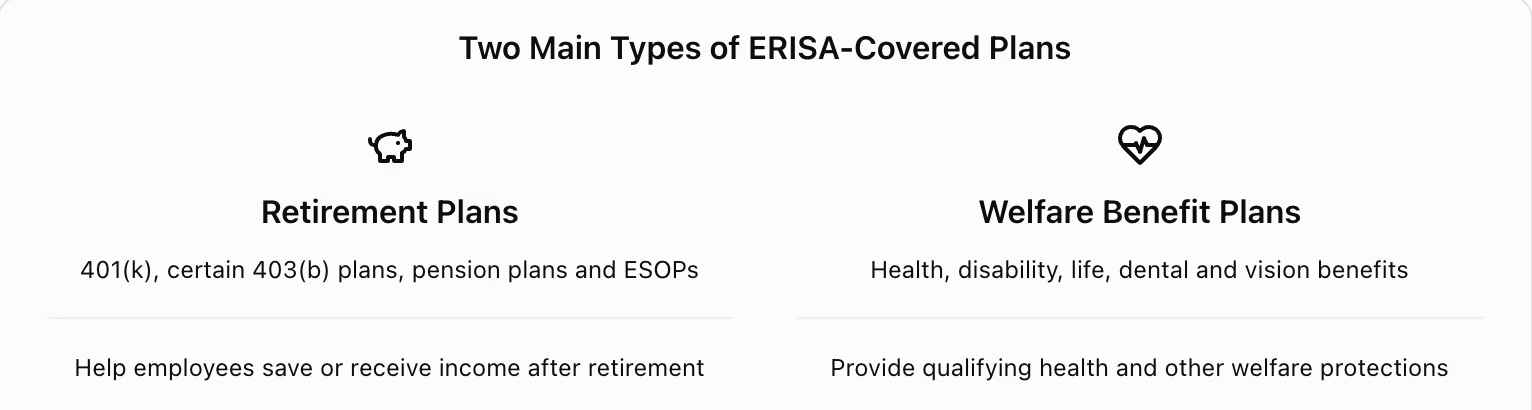
However, the requirements differ depending on how each plan is structured and administered.
| Feature | Defined Benefit Plan | Defined Contribution Plan |
|---|---|---|
| How it works | Promises a specific retirement benefit, often based on salary and years of service. | Builds an individual retirement account through employee and/or employer contributions. |
| Retirement benefit | Determined by a predefined formula. | Depends on contributions, investment performance, and fees. |
| Investment risk | Generally borne by the employer or plan sponsor. | Generally borne by the employee. |
| Examples | Traditional pension plans | 401(k), 403(b), and ESOP plans |
| PBGC protection | Generally available for covered private-sector pensions, subject to limits. | Not available |
A 401(k) plan lets employees contribute part of their salary toward retirement, often with additional employer contributions. A 403(b) plan serves a similar purpose but is typically offered by public schools and certain tax-exempt organizations.
Not all 403(b) plans fall under ERISA. Governmental and qualifying church plans are generally excluded, while certain private nonprofit arrangements may be exempt when employee participation is voluntary and employer involvement is limited.
An Employee Stock Ownership Plan (ESOP) is a defined contribution retirement plan that invests mainly in the employer’s stock. Because of this, fiduciaries must carefully review stock valuations and any transactions involving employer shares.
ERISA also covers many employer-sponsored welfare benefit plans, including:
Health insurance: Medical, dental, and vision coverage.
Disability insurance: Benefits that replace income or provide financial support during qualifying disabilities.
Life insurance: Financial benefits for designated beneficiaries following an employee’s death.
Other welfare benefits: Certain employer-established programs offering benefits such as apprenticeship training, prepaid legal services, or childcare assistance.
Unlike retirement plans, welfare benefit plans generally aren’t subject to ERISA’s pension funding and vesting requirements.
ERISA requires those managing covered employee benefit plans to act in participants’ best interests, manage plan assets prudently, and avoid conflicts of interest.
An ERISA fiduciary is anyone who exercises discretionary authority over a benefit plan’s management or administration, controls its assets, or provides investment advice for a fee under applicable fiduciary rules.
Common examples include:
Plan trustees: Individuals or institutions responsible for holding and managing plan assets.
Investment managers: Professionals with authority to make investment decisions on behalf of a plan.
Plan administrators: Individuals or entities responsible for plan administration who may also have fiduciary duties depending on their functions.
Benefits or investment committee members: Employees who make decisions about plan administration, investments, or service providers.
Fiduciary status depends on what someone does, not their title: an HR manager who exercises discretion over plan administration may be a fiduciary.
Under ERISA Section 404(a), fiduciaries must manage benefit plans with the care, skill, prudence, and diligence of a knowledgeable person acting under similar circumstances.
Their key responsibilities:
Act in participants’ best interests: Decide solely for participants and beneficiaries.
Exercise prudence: Evaluate investments, providers, costs, and risks before deciding.
Diversify investments: Spread investments to limit major losses, unless clearly prudent not to.
Follow plan documents: Administer the plan by its documents, if they comply with ERISA.
Monitor fees and providers: Review providers regularly and keep expenses reasonable.
ERISA generally prohibits certain transactions involving plan assets and parties in interest, such as employers, fiduciaries, service providers, and certain related individuals.
Examples include:
Using retirement plan assets to finance the employer’s business operations.
Receiving personal compensation or benefits in exchange for directing plan investments.
Lending plan money to a related business without an applicable exemption.
Entering transactions that improperly benefit a fiduciary or another party in interest.
Some transactions are permitted under statutory or Department of Labor exemptions, provided the required conditions are met.
Violating fiduciary duties can result in personal liability, including restoring plan losses or returning improper profits. Certain prohibited transactions may also trigger excise taxes and other penalties.
The Department of Labor offers a Voluntary Fiduciary Correction Program for correcting eligible violations.
ERISA Section 404(c) provides limited liability protection for fiduciaries of qualifying individual account plans, such as certain 401(k) plans, when participants control their investment decisions. Plans must offer a broad range of investment options and enough information for participants to make informed choices. Fiduciaries must still prudently select and monitor the options offered.
Covered plans must share key information with participants and, where applicable, file reports with federal agencies.
A Summary Plan Description (SPD) explains, in plain language, how a benefit plan works. It must cover:
Who is eligible
What benefits the plan provides, and any limits
How to claim benefits or appeal a denial
Participants’ rights and responsibilities under ERISA
Plan administrators generally must provide an SPD within 90 days after an employee becomes covered, or within 120 days after a new plan becomes subject to ERISA.
Form 5500 is an annual report on a benefit plan’s financial condition, operations, and compliance. Most ERISA-covered retirement plans and many welfare plans must file it electronically through the DOL’s EFAST2 system.
The deadline is generally the last day of the seventh month after the plan year ends, or July 31 for a calendar-year plan, with an extension of up to two and a half months. Reporting depends on the plan’s size and structure:
Certain small plans qualify for simplified Form 5500-SF reporting.
Many small, unfunded or insured welfare plans are exempt from filing.
Larger plans generally require an independent audit unless an exemption applies.
Here are some important reporting and disclosure deadlines:
| Document or disclosure | General deadline |
|---|---|
| Summary of Material Modifications (SMM) | Within 210 days after the end of the plan year in which the change was adopted. |
| Summary Annual Report (SAR) | Generally within nine months after the plan year ends, or two months after an extended Form 5500 deadline. Not required for PBGC-covered defined benefit plans, which provide the annual funding notice instead. |
| 401(k) benefit statements | At least quarterly for participant-directed individual account plans. |
| 401(k) investment and fee disclosures | Generally before participants first direct investments and annually thereafter; actual account charges disclosed at least quarterly. |
| Pension annual funding notice | Generally within 120 days after the plan year ends; qualifying small plans follow different deadlines. |
Note: Material reductions in group health plan benefits generally must be disclosed within 60 days after adoption.
An ERISA fidelity bond protects an employee benefit plan against losses caused by fraud or dishonesty, such as theft or embezzlement of plan funds. Under ERISA Section 412, individuals who handle plan assets, including trustees, administrators, employees, and service providers, generally must be bonded. Certain unfunded or insured welfare plans are exempt.
Note: An ERISA bond isn’t fiduciary liability insurance. The bond protects the plan from theft or fraud, while fiduciary insurance covers breach-of-duty claims and doesn’t replace the bond.
ERISA generally requires fidelity bond coverage equal to at least 10% of the plan funds handled by each covered person during the preceding year, subject to these limits:
Minimum coverage: $1,000.
General maximum required coverage: $500,000 per person, per plan.
Plans holding employer securities: Maximum required coverage increases to $1 million per person, per plan.
For example, if an employee handles $2 million in retirement plan assets, the required bond coverage would generally be at least $200,000.
ERISA gives participants and beneficiaries of covered plans the right to claim benefits, challenge denied claims, and seek legal remedies when their rights are violated.
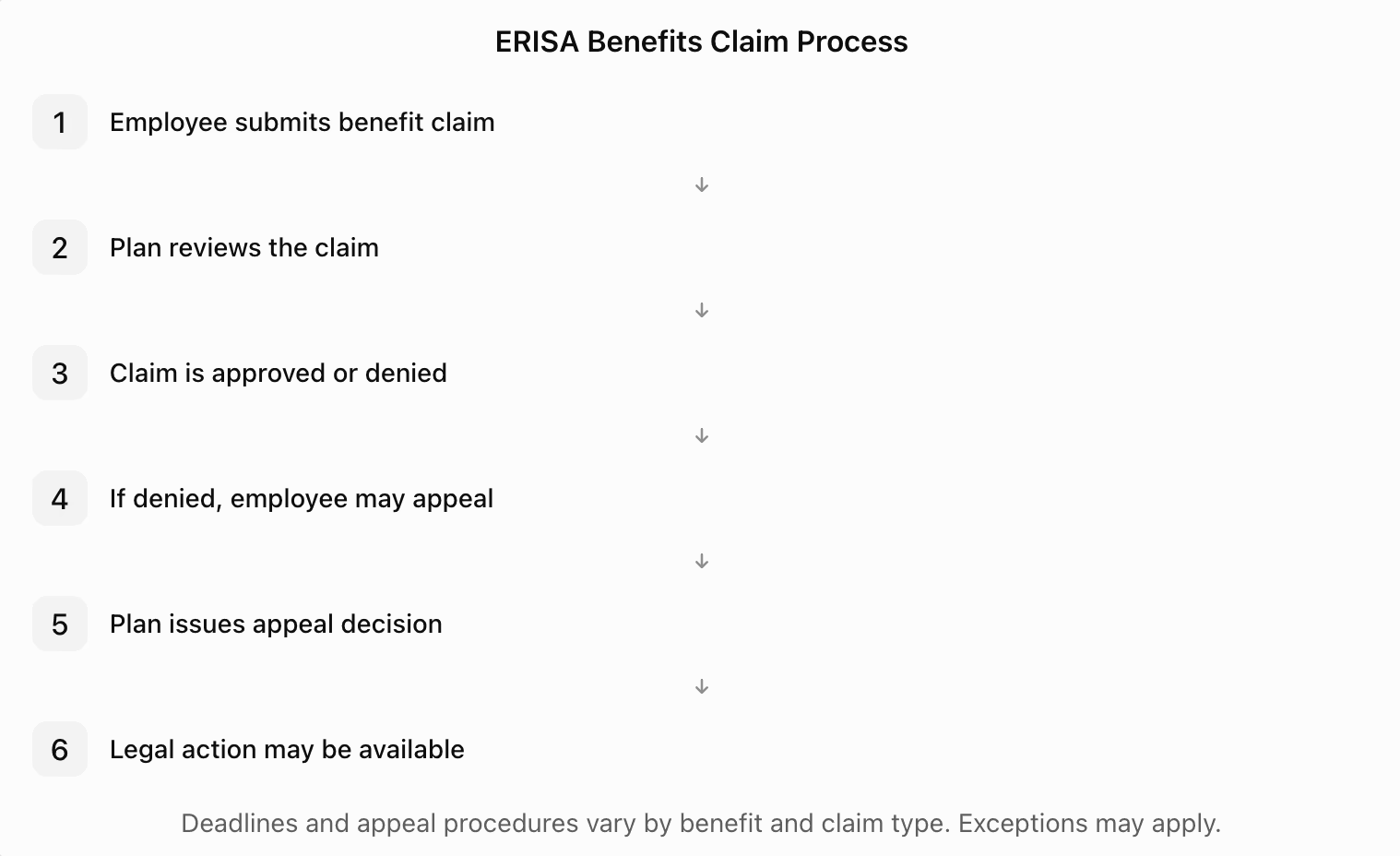
Employees should start with the Summary Plan Description (SPD), which explains eligibility and how to file. The plan must then decide the claim within these deadlines:
| Claim type | Initial decision deadline |
|---|---|
| Retirement or pension benefits | Generally within 90 days |
| Disability benefits | Generally within 45 days |
| Health insurance – urgent care | As soon as possible, but no later than 72 hours |
| Health insurance – pre-service claims | Generally within 15 days |
| Health insurance – post-service claims | Generally within 30 days |
Note: These are general maximum deadlines. Certain claims qualify for extensions when specific conditions and notification requirements are met.
Plans must offer a full and fair review of denied claims. Participants generally have at least 60 days to appeal a denied retirement claim and 180 days for health or disability claims, and can submit more information and request relevant documents.
If an appeal is unsuccessful, participants may be able to file a lawsuit under ERISA Section 502.
Depending on the circumstances, available legal remedies may include:
Recovering benefits wrongfully denied under the plan.
Enforcing rights or clarifying future benefits under plan terms.
Seeking appropriate equitable relief for certain ERISA violations.
Pursuing remedies for breaches of fiduciary duty.
Recovering reasonable attorney fees and costs when awarded by the court.
Participants generally must complete the plan’s internal claims and appeals process before suing for denied benefits, although exceptions may apply.
For breaches of fiduciary duty, ERISA Section 413 generally requires lawsuits to be filed within the earlier of:
Six years after the relevant breach or violation, subject to statutory rules for omissions.
Three years after the claimant gains actual knowledge of the breach or violation.
In cases of fraud or concealment, a suit may be filed within six years after discovery. For denied benefit claims, ERISA sets no universal deadline; plans may specify reasonable limits, which can sometimes begin before the internal appeal concludes.
ERISA sets minimum standards for when employees gain permanent ownership of their retirement benefits.
Employees are always 100% vested in their own retirement contributions and earnings. Employer contributions may vest gradually based on years of service.
For example, an employee who leaves after two years keeps all their own 401(k) contributions but may receive only part of the employer’s, depending on the vesting schedule.
ERISA allows two ways to vest employer-funded benefits:
Cliff vesting: Employees become fully vested at once after a set number of years.
Graded vesting: Ownership increases with each year of service.
| Vesting schedule | Defined contribution plans (e.g., traditional 401(k)) | Defined benefit pension plans |
|---|---|---|
| Cliff vesting | 100% after 3 years | 100% after 5 years |
| Graded vesting | 20% after 2 years, increasing to 100% after 6 years | 20% after 3 years, increasing to 100% after 7 years |
Employers can offer faster vesting schedules, including immediate vesting. Certain plans, such as safe harbor 401(k)s and cash balance pension plans, have special vesting requirements.
PBGC protects retirement benefits when certain private-sector pension plans end without enough money to pay promised benefits. It operates primarily through premiums paid by insured plans, investment income, and assets from plans it takes over, and it covers defined benefit plans, not 401(k)s.
The amount an employee receives depends on factors such as age, benefit type, and guarantee limits. For single-employer plans terminating in 2026, PBGC’s maximum guarantee at age 65 is $7,789.77 per month for a straight-life annuity. Actual benefits may be lower.
Multiemployer plans are typically maintained through collective bargaining agreements involving several employers, often in the same industry. PBGC runs a separate program for them with generally lower limits. For example, the maximum guarantee for a participant with 30 years of covered service is generally $12,870 annually.
Employers that completely or partially withdraw from an underfunded multiemployer plan may also owe withdrawal liability, their allocated share of unfunded vested benefits.
These plans must also comply with applicable requirements under COBRA, HIPAA, and the Affordable Care Act (ACA).
The Consolidated Omnibus Budget Reconciliation Act (COBRA) allows eligible employees and family members to temporarily continue group health coverage after qualifying events such as job loss, reduced working hours, divorce, or an employee’s death.
COBRA generally applies to private-sector group health plans sponsored by employers with at least 20 employees on more than 50 percent of their typical business days in the previous calendar year.
Coverage typically lasts 18 or 36 months, depending on the event.
The Health Insurance Portability and Accountability Act (HIPAA) protects health coverage enrollment rights and medical information.
Key requirements include:
Special enrollment: Eligible employees and dependents can enroll after events such as losing coverage, marriage, birth, or adoption.
Enrollment deadlines: Generally, at least 30 days to request special enrollment, or 60 days for certain Medicaid and CHIP-related events.
Privacy: Covered health plans must protect health information under applicable HIPAA Privacy Rule requirements.
The ACA introduced additional protections for employer-sponsored health plans, including:
Prohibiting pre-existing condition exclusions.
Extending dependent coverage until age 26.
Requiring standardized Summaries of Benefits and Coverage (SBCs).
Covering specified preventive services without cost-sharing, where applicable.
Under the ACA’s employer shared responsibility provisions, businesses averaging 50 or more full-time employees, including full-time equivalents, in the preceding year generally qualify as Applicable Large Employers (ALEs).
ALEs may face penalties if they fail to offer qualifying health coverage to the required full-time employees and their dependents, subject to applicable conditions.
Under ERISA Section 514, federal law generally takes precedence over state laws that relate to covered employee benefit plans. However, ERISA doesn’t override every state law affecting employee benefits; certain state insurance regulations continue to apply.
How ERISA preemption works depends partly on the health plan’s funding arrangement.
Fully insured plans: The employer buys coverage from an insurer, and the insurer must follow state insurance laws.
Self-funded plans: The employer pays claims from its own funds, so state insurance mandates generally don’t apply, but federal rules still do.
In Pilot Life Insurance Co. v. Dedeaux (1987), an employee sued his employer’s insurance provider under Mississippi state law after his disability benefits were repeatedly terminated and reinstated. The Supreme Court ruled that ERISA preempted these state-law claims because they concerned how benefits were handled under an ERISA-covered plan.
Three federal agencies enforce ERISA:
| Federal agency | Primary responsibilities |
|---|---|
| Department of Labor (DOL) | Through the Employee Benefits Security Administration (EBSA), enforces fiduciary standards, reporting and disclosure requirements, and participant protections. |
| Internal Revenue Service (IRS) | Oversees retirement plan tax qualification, applicable tax-related requirements, and excise taxes on certain prohibited transactions. |
| Pension Benefit Guaranty Corporation (PBGC) | Insures covered private-sector defined benefit pension plans, collects insurance premiums, and provides protection when insured pension plans fail. |
Form 5500 is the shared annual report the DOL, IRS, and PBGC use to collect plan information.
Keka’s HR and payroll platform simplifies benefits administration by connecting employee data, benefits, and payroll workflows. With Keka, employers can:
Centralize employee records: Maintain employee information and documents in one place.
Manage benefits enrollment: Enable employees to review plans and select benefits through self-service.
Synchronize payroll deductions: Align health insurance deductions and retirement contributions with benefit elections.
Coordinate retirement benefits: Integrate with providers like Guideline to sync 401(k) contributions with payroll.
While Keka supports benefits administration, employers and plan fiduciaries remain responsible for ERISA compliance.
Simplify benefits administration with Keka. Schedule a demo to explore its connected HR, payroll, and benefits workflows.
What are the requirements for ERISA health plans?
ERISA-covered health plans generally must provide required plan disclosures, follow fiduciary standards, maintain claims and appeals procedures, and meet applicable reporting obligations. They must also comply with relevant COBRA, HIPAA, and ACA requirements.
Which employers and plans are excluded from ERISA?
Government plans and qualifying church plans are generally excluded from ERISA, along with arrangements such as unfunded excess benefit plans. Top-hat plans remain subject to ERISA but are exempt from some of its requirements.
Subscribe to keep up with the latest strategic finance content.
Request a demo