


 Login


Form 5500
Read Time: 6 Mins


PRODUCTS
 Payroll Suite
 HR Suite
 Talent Suite
 Project Services Suite

Meet the platform tailored to your business
Core system of record
One platform for the entire employee journey

BY INDUSTRY
BY COMPANY SIZE
LEARN
EXPLORE KEKA
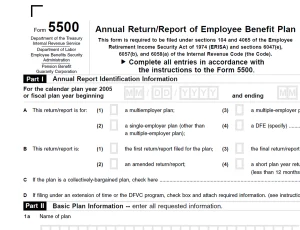
Form 5500 is an annual report that employers must file for employee benefit plans, such as retirement or health plans. It provides key information about a plan’s financial condition, operations, and compliance. Form 5500 serves as a transparency tool for government agencies, plan participants, and other stakeholders. It’s a regulatory requirement under the Employee Retirement Income Security Act (ERISA), which helps ensure that these plans are properly managed and transparent.
Developed by the U.S. Department of Labor, the Internal Revenue Service (IRS), and the Pension Benefit Guaranty Corporation, Form 5500 collects key information about a plan’s financials, operations, and compliance status.
Most employers who offer employee benefit plans subject to ERISA must file Form 5500 annually.. Welfare benefit plans that provide benefits such as medical, dental, life insurance, or disability, are generally required to file as well.
Specific plans are exempt from this filing requirement. Below is a breakdown of the main exemptions:
Health and welfare plans with fewer than 100 participants on the first day of the plan year may be exempt from filing if the plan is unfunded (benefits are paid directly from the employer’s general assets), fully insured (benefits are provided entirely through insurance policies), or both.
When determining whether a plan qualifies for the small plan exemption, only covered employees, Consolidated Omnibus Budget Reconciliation Act (COBRA)-qualified former employees and covered retirees are counted. Dependents (spouses and children) are not included in this count.
Unfunded plans pay benefits directly from the employer’s general assets and do not use a separate trust or fund. Certain Section 125 cafeteria plans may also qualify as unfunded if they meet the requirements outlined in the Department of Labor’s Technical Release 92-01.
Plans that provide all benefits through insurance policies may also be exempt, provided the premiums are paid entirely by the employer or shared between the employer and employees.
Form 5500 is due by the last day of the seventh month after the plan year ends. For calendar year plans, the deadline is July 31.
To request an extension, file Form 5558 before the due date. Please note that late filings may result in higher penalties.
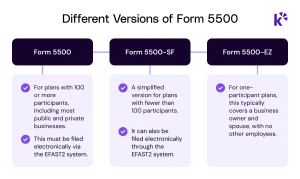
For plans with 100 or more participants, including most public and private businesses. This must be filed electronically via the EFAST2 system.
A simplified version for plans with fewer than 100 participants. It can also be filed electronically through EFAST2.
For one-participant plans, this typically covers a business owner and spouse, with no other employees.
After filing Form 5500, plan administrators are required to share a Summary Annual Report (SAR), a brief summary of the information provided in the form. It must be shared with the participants and beneficiaries within 2 months of the filing deadline, typically by September 15, or December 15 if an extension was filed.
For a seamless and error-free filing of Form 5500, mindfully follow the steps below:
Step 1. Determine if you need to file Form 5500 by countingall eligible employees, even if they’re not enrolled. Then choose the appropriate version of the form based on the number of plan participants.
Step 2. Create a DOL (Department of Labor) account. Register on the EFAST2 (ERISA Filing Acceptance System II) website. Please note that only authorized individuals can file on behalf of the plan.
Step 3. Complete the form online. Log in to EFAST2 and enter the following details:
Step 4. Review your submission. Make sure you check for typos and any missing information.
Step 5. File your submission on or before the deadline. The deadline to fill Form 5500 is the last day of the seventh month after the end of the plan year (for example, July 31 for calendar-year plans). However, you can file request an extension until October 15 by filing Form 5558 on or before the original due date.
Here are some of the most common filing mistakes and simple ways to avoid them:
Retirement plan sponsors who fail to file Form 5500-EZ may be entitled to penalty relief under Revenue Procedure 2015-32. This procedure only applies to non-ERISA, one-participant plans, meaning plans providing coverage to either a sole owner or a partnership, whether or not their spouses are included. It includes any foreign plans kept outside of the U.S. for non-resident aliens.
Please note that plans covered by ERISA do not qualify to use this procedure and must use the Department of Labor’s Delinquent Filer Voluntary Compliance Program.
The program applies to the late filing of Form 5500-EZ and, in some cases, Form 5500, for non-ERISA plans for which the plan sponsor filed before 2009. If you received notice of CP 283 that imposed a penalty, you cannot apply for relief for that year.
Here’s how you can apply for the penalty form:
Once you’ve provided all the details, mail the form to this address: IRS, 1973 Rulon White Blvd., Ogden, UT 84201
Subscribe to keep up with the latest strategic finance content.
Request a demo


