Every month, when that salary notification hits your phone, there’s a moment of relief—rent sorted, bills covered, plans back on track. But behind that simple transaction sits a payroll specialist juggling thousands of calculations, navigating compliance mazes, and racing against unforgiving deadlines.
Despite the critical nature of their work, payroll and compliance professionals often lack access to reliable compensation benchmarks. Online searches yield scattered data points and Reddit threads offer unrealistic figures.
The HR Pay Pulse Report 2026, created by Keka in collaboration with SHRM, changes this narrative. Based on 184,000 data points across nine key HR functions, this comprehensive study provides scientifically validated salary benchmarks for payroll and compliance roles in India.
This guide examines payroll and compliance specialist salaries across experience levels, industries, and cities, offering data-driven insights for professionals planning their careers and organizations structuring competitive compensation packages.
Payroll and Compliance Specialist Salaries: Key Highlights
Median Salary Ranges (2026):
- Payroll Executive: ₹7-13 LPA
- Payroll Coordinator: ₹12-22 LPA
- Senior Payroll Specialist: ₹18-35 LPA
- Compliance Manager/Head: ₹38-72 LPA
- GEO/BU Head Payroll: ₹45-95 LPA
- Head of Global GEO Payroll: ₹70-135 LPA
Highest Paying Cities: Mumbai (+27%), Chennai (+22%), Hyderabad/Delhi NCR (+13%)
Highest-Paying Industries: BFSI and Hi-Tech (+18-23% over median)
Key Growth Drivers: Multi-country expertise, regulatory complexity, and strategic leadership drive the biggest salary jumps.
Now that we understand the landscape, let’s examine how experience shapes compensation.
How Experience Levels Influence Salaries of Payroll Specialists?
The payroll function experienced sharp growth last year, with salaries up 15-18%. This reflects how complex regulatory environments have become and how much organizations now depend on specialized expertise.
Table 1: Comprehensive salary breakdown by role
| Role |
P25 (LPA) in ₹ |
Median CTC (LPA) in ₹ |
P75 (LPA) in ₹ |
P90 (LPA) in ₹ |
| Head of Global GEO Payroll |
70 |
90 |
115 |
135 |
| GEO/BU Head Payroll |
45 |
60 |
80 |
95 |
| Compliance Manager/Head |
38 |
48 |
60 |
72 |
| Senior Payroll Specialist |
18 |
24 |
30 |
35 |
| Payroll Coordinator |
12 |
15 |
18 |
22 |
| Payroll Executive |
7 |
9 |
11 |
13 |
Did you notice how salary growth compresses in mid-to-senior roles? That’s because of standardized processes and automated platforms. Career advancement today depends more on strategic thinking than just processing transactions.
Fresher Level Salary Breakdown (₹7 – 22 LPA)
As a Payroll Executive or Coordinator, you’re handling the backbone of payroll processing. Your day involves managing employee data, calculating tax deductions, ensuring compliance filings are accurate, and making sure data flows smoothly between HR and payroll systems.
Payroll Executives earn a median of ₹9 LPA (range: ₹7-13 LPA), with variable pay often tied to accuracy and compliance metrics.
Move up to Payroll Coordinator, and you’re looking at ₹15 LPA (range: ₹12-22 LPA).
That ₹6 LPA jump reflects your shift from pure execution to coordination and regulatory oversight.
Mid-Level Salary Breakdown (₹18 – 35 LPA)
Once you hit the Senior Payroll Specialist level, you’re the operational backbone. You’re maintaining global standards, running system audits, managing payroll for specific regions or business units, and leading implementations.
Senior Payroll Specialists earn a median of ₹24 LPA (₹18-35 LPA range)—a solid ₹9-15 LPA increase from coordinator level.
If you specialize in audit, expect ₹15-18 LPA. At this stage, sign-on bonuses are becoming common; retention bonuses hit 10-15% of base, and ESOPs appear in growth-stage companies.
This phase typically spans 3-5 years. Develop multi-country expertise here, and you can fast-track to senior leadership.
Senior Leadership Level (₹48 – 135 LPA)
As a Compliance Manager, GEO Payroll Head, or Head of Global GEO Payroll, you’re running strategic operations. You’re managing teams, driving technology transformation, ensuring enterprise-wide compliance, and sitting in rooms with the CFO and CHRO.
Compliance Managers earn ₹48 LPA (₹38-72 LPA range)—a ₹24 LPA jump from specialist roles. GEO/BU Heads make ₹60 LPA (₹45-95 LPA) with an extra ₹12 LPA premium for multi-team leadership.
At the top, Heads of Global GEO Payroll command ₹90 LPA (₹70-135 LPA), with that ₹30 LPA premium reflecting their global responsibility and C-suite interface.
Variable compensation here is serious: 15-28% in sign-on and retention bonuses, ESOPs and RSUs with 3–5-year vesting, and performance bonuses tied to compliance metrics and strategic initiatives.
Understanding how experience affects pay is crucial, but industry choice becomes the next major differentiator in your compensation potential.
How Industry Choice Influences Payroll and Compliance Salaries?
Two people with identical experiences can have vastly different salaries based on industry alone. A Hi-Tech specialist might earn 20% more than someone in Manufacturing doing similar work.
That’s because regulatory complexity, operational scale, and tech sophistication determines how much value organizations place on payroll expertise.
Table 2: Industry-Wise Salary Comparison
| Industry |
Head of Global GEO Payroll |
GEO Payroll Head |
Compliance Manager/ Head |
Global Payroll Specialist |
Payroll Audit Specialist |
Payroll Executive/ Coordinator |
| All Median |
90 |
60 |
48 |
24 |
15 |
9 |
| Hi-Tech |
106 |
71 |
57 |
28 |
18 |
11 |
| BFSI |
110 |
73 |
59 |
29 |
18 |
11 |
| Manufacturing & Auto |
95 |
63 |
50 |
25 |
16 |
9 |
| Healthcare & Pharma |
99 |
66 |
53 |
26 |
17 |
10 |
| Retail & Consumer Services |
90 |
60 |
48 |
24 |
15 |
9 |
| Transportation & Logistics |
86 |
57 |
46 |
23 |
14 |
9 |
| Energy & Utilities |
85 |
56 |
45 |
22 |
14 |
8 |
| Professional Services |
94 |
62 |
50 |
25 |
16 |
9 |
| BPO/ GBS |
99 |
66 |
53 |
26 |
17 |
10 |
BFSI and Hi-Tech Sectors (18-23% Above Median)
They’re dealing with multi-layered compliance (RBI, SEBI, international frameworks), union complexity, specialized tax knowledge, and advanced systems integration. If you want the highest pay and fastest growth, these sectors are where you’ll find it.
Healthcare, Pharms, and Professional Services (8-12% Premiums)
They have healthcare-specific regulations, complex contractor management, and pharmaceutical compliance requirements. Professional services give you broad exposure to diverse scenarios—great foundation for leadership roles.
Manufacturing, BPO/GBS, Retail, and Logistics (Below Median)
Manufacturing has standardized processes and limited cross-border complexity. BPO/GBS keeps base salaries lower through cost optimization but offers strong process exposure.
Retail and logistics deal with high turnover and seasonal workforce challenges but less regulatory complexity.
Here’s the thing about industry choice: it compounds. Starting in BFSI versus Manufacturing creates a small gap initially, but over time, that difference grows significantly due to compounding growth rates and opportunities.
While compensation varies by industry, location creates another crucial layer of differentiation.
Payroll and Compliance Salaries by Location
Geography creates salary swings up to 25% between top metros and Tier-II cities.
Table 3: Location-Wise Salary Comparison
| Location |
Head of Global GEO Payroll |
GEO Payroll Head |
Global Payroll Specialist |
Compliance Manager/ Head |
Payroll Audit Specialist |
Payroll Executive/ Coordinator |
| Bangalore |
90 |
60 |
48 |
24 |
15 |
9 |
| Mumbai |
113 |
75 |
60 |
30 |
19 |
11 |
| Delhi NCR |
101 |
67 |
54 |
27 |
17 |
10 |
| Hyderabad |
101 |
67 |
54 |
27 |
17 |
10 |
| Pune |
99 |
66 |
53 |
26 |
17 |
10 |
| Chennai |
106 |
71 |
57 |
28 |
18 |
11 |
| Kolkata |
95 |
63 |
50 |
25 |
16 |
9 |
| Tier II cities |
88 |
59 |
47 |
23 |
15 |
9 |
Mumbai (22-27% Premium)
It’s India’s financial capital, home to most banks and insurance companies, with the highest cost of living and intense talent competition. Entry-level starts at ₹11 LPA; executives reach ₹113 LPA.
Chennai (17-22% Premium)
It’s seeing massive MNC expansion, has a growing GCC presence, and offers the best compensation-to-cost ratio of any metro. Entry at ₹11 LPA, executives at ₹106 LPA.
Delhi NCR and Hyderabad (11-13% Premium)
Delhi NCR brings capital city advantages and strong professional services presence. Hyderabad is India’s fastest-growing GCC hub with cost-effective operations attracting global payroll centers. Both start entry-level at ₹10 LPA, executives at ₹101 LPA.
Pune and Bangalore (8-10% Premium)
Pune has manufacturing concentration and Mumbai spillover. Bangalore dominates in tech and has the highest concentration of payroll companies. Entry at ₹10 LPA for Pune (₹9 LPA Bangalore), executives at ₹99 LPA for Pune (₹90 LPA Bangalore).
Tier-II Cities (10-12% Discount)
Cities like Coimbatore, Jaipur, Chandigarh, Indore, and Kochi show 10-12% discounts at senior levels. They’re good for entry-level roles due to cost arbitrage, but senior opportunities are limited. If you start here, plan to relocate within 3-5 years.
Location Selection Framework
For Maximum Earning Potential:
- First Choice: Mumbai (if in BFSI) or Chennai (for best value)
- Second Choice: Hyderabad (GCC roles) or Delhi NCR (professional services)
- Consider: Bangalore for technology exposure
For Career Growth:
- Best exposure: Bangalore (technology) or Mumbai (BFSI)
- Fast-growing: Hyderabad (GCC expansion)
- Balanced: Pune (diverse industries)
For Quality of Life:
- Best value: Chennai or Pune (salary-to-cost ratio)
- Emerging: Hyderabad (infrastructure + opportunity)
- Established: Bangalore (lifestyle + career)
Cost-of-Living Adjusted Rankings:
- Chennai (highest real income)
- Hyderabad (strong value + growth)
- Pune (balanced proposition)
- Bangalore (premium lifestyle costs)
- Delhi NCR (high costs, moderate premium)
- Mumbai (highest costs despite highest salary)
When you adjust for the cost of living, Chennai offers the highest real income, followed by Hyderabad and Pune. Mumbai pays the most nominally, but costs eat into it. Bangalore’s premium lifestyle costs offset its advantages.
What Actually Drives Your Salary?
Understanding salary determinants enables professionals to strategically position themselves for compensation growth and career advancement.
Location Compounds Over Time
Start in Mumbai versus a Tier-II city, and you’re looking at a ₹2-3 LPA initial gap that expands to ₹15-20 LPA at senior levels because of compounding growth and opportunity access.
Why Location Matters:
- Industry concentration: BFSI dominance in Mumbai, Hi-Tech in Bangalore, GCCs in Hyderabad.
- Talent competition: Metros have higher demand-to-supply ratios for specialized expertise.
- Regulatory complexity: Proximity to headquarters requiring sophisticated compliance.
- Career mobility: Metro hubs offer more lateral and upward movement opportunities.
Strategic Career Moves Matter More Than Tenure
Switching to Hi-Tech or BFSI accelerates growth. Developing niche expertise in years 3-5 maximizes mid-career jumps. Moving from individual contributor to people management creates the steepest increases.
Career Acceleration Factors:
- Switching to higher-paying industries (Hi-Tech, BFSI) accelerates growth
- Developing niche expertise in years 3-5 maximizes mid-career jumps
- Moving from individual contributor to people management creates steepest salary increases
- Professional credentials (ICWAI, CPP, FPC) unlock faster progression
The biggest salary jumps happen at leadership transitions—seek them actively.
Technical Skills Are Mandatory
Proficiency with modern payroll systems isn’t optional anymore. AI-powered exception handling, blockchain for international payments, multi-country tax platforms, and predictive analytics are becoming standard expectations.
Regulatory Complexity Pays Premium
Compensation correlates with regulatory sophistication, not company size. BFSI violations carry severe penalties, creating demand for specialized knowledge. If you develop niche expertise (pharmaceutical clinical trial payroll, investment banking equity compensation), you can command 25-40% premiums within the same industry.
Multi-Region and Global Scope Specialization
Global scope is the highest-value specialization. Managing multi-country payroll, understanding cross-border taxation, transfer pricing, global mobility, and multi-jurisdiction compliance puts you in a rare position.
Professionals with US payroll expertise in India command 25-30% premiums because they manage high-value headcount from cost-effective locations.
Career Growth Landscape in Payroll and Compliance
The payroll and compliance sector offers a well-defined career progression pathway with clear milestones, escalating responsibilities, and accelerating compensation growth at senior levels.
Unlike many fields where advancement can be ambiguous, payroll careers follow predictable patterns that professionals can strategically navigate.
Table 4: Payroll and Compliance Career Ladder
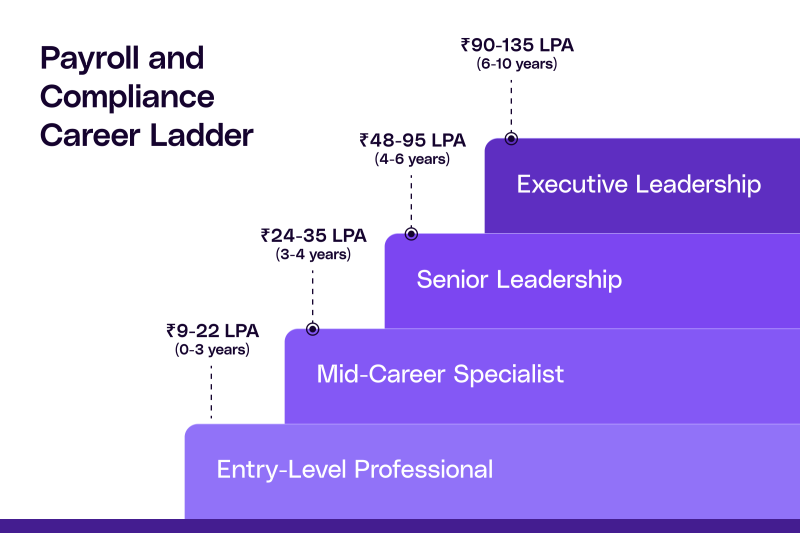
Here’s how it looks:
- Years 0-3: Master processing for 500+ employees, build platform proficiency (SAP, Workday, Keka), understand statutory compliance, achieve 99%+ accuracy. Volunteer for implementations, document processes, and start building one specialization.
- Years 3-8: Develop multi-state or multi-country expertise, advance analytics capabilities, master audit methodologies, understand payroll’s financial impact. This is where specialization choices determine your trajectory.
- Years 8-15: Transition to people leadership. Build teams, manage budgets, drive technology transformation, and partner with executives. This inflection point—from technical expert to strategic leader—creates the biggest salary jumps.
- Years 15+: Global strategic leadership. C-suite partnership, enterprise-wide impact, digital transformation ownership. These roles saw 15-18% year-over-year growth, significantly outpacing mid-level positions.
Wrapping it Up
The payroll and compliance landscape in India has matured into a sophisticated profession offering clear career pathways and competitive compensation for those who approach it strategically.
For professionals currently in or considering payroll careers, the data provides a clear roadmap: build strong technical foundations early, specialize strategically in years 3-8, pursue leadership transitions actively, and optimize location and industry choices at each career stage.
For organizations, the salary benchmarks highlight the premium required to attract and retain specialized payroll talent, particularly in global roles, complex industries, and metro markets.
The Indian payroll profession has evolved from back-office function to strategic capability. If you’re in this field or considering it, the path is clear: build strong foundations early, specialize strategically in your mid-career years, actively pursue leadership transitions, and optimize your location and industry choices at each stage.
The compensation potential is real for those who approach it strategically.
Frequently Asked Questions (FAQs)
Q1. What is the average payroll salary in India in 2026?
The overall median is ₹24 LPA, with significant variation by experience, location, and industry. BFSI and Hi-Tech professionals earn 18-23% above median, while Mumbai adds another 22-27% premium.
Q2. Which cities offer the highest payroll salaries in India?
Mumbai leads at 22-27% premium (₹11-113 LPA), followed by Chennai at 17-22% (₹11-106 LPA), Delhi NCR and Hyderabad at 11-13% (₹10-101 LPA), and Pune at 8-11% (₹10-99 LPA).
Q3. How much do payroll specialists with 5 years of experience earn?
With 5 years of experience, specialists typically earn: P25 (₹15-18 LPA), Median (₹20-24 LPA), P75 (₹28-30 LPA), and P90 (₹32-35 LPA).
Q4. How can I use this salary data when negotiating my compensation?
Benchmark your salary against the percentiles for your role, factor in location and industry premiums, highlight your specializations, present data-driven justification during negotiations, and time career moves at leadership transitions.


 Login