Login


Quick overview
The best performance management software in 2026 are Keka (unified HR, payroll, and performance), Lattice (manager-led reviews and OKRs), 15Five (manager coaching), BambooHR (reviews inside a simple HRIS), Leapsome (reviews linked to learning), Engagedly (AI-powered talent management), PerformYard (flexible review cycles), Betterworks (enterprise OKRs and calibration), and Quantum Workplace (engagement-led talent reviews). .
December is great for the holiday season but also dreadful because of the performance review season looming over it. It’s a thin, delicate line between what makes a good review and what makes people feel alienated.
I’ve sat on the HR side of that process, and the problem starts at the root: goals that were set before, feedback-capturing mechanisms, ratings, and pay growth being captured in different places, so the conversation happens from incomplete evidence.
Good performance management tools fix this. They keep goals current between reviews, help managers run 1;1s worth having, make calibration fair and visible, and carry the outcome into raises and development plans without re-keying.
In this guide, I compare the 9 best performance management software for US employers in 2026.
9 Best Performance Management Software at a Glance
| Tool | Best for | Pricing details | G2 rating | Free trial |
|---|---|---|---|---|
| Keka | Unified HR, payroll and performance | Custom quote | 4.4/5 | Yes |
| Lattice | Manager-led reviews and OKRs | Starts from $13/seat/month (Foundations); | 4.6/5 | Free interactive tour |
| 15Five | Manager coaching and effectiveness | Perform $11/user/month | 4.6/5 | Demo |
| BambooHR | Reviews inside a simple HRIS | Pro (includes performance) from $17.50/employee/month | 4.4/5 | Quote and demo |
| Leapsome | Reviews linked to learning | Performance Reviews module €7/employee/month plus HRIS foundation | 4.8/5 | 14-day free trial |
| Engagedly | AI-powered talent management | Performance Suite $5–8/user/month | 4.3/5 | Demo |
| PerformYard | Flexible review cycles | Performance $5–15/person/month | 4.7/5 | Demo |
| Betterworks | Enterprise OKRs and calibration | Performance $8/user/month | 4.4/5 | Demo |
| Quantum Workplace | Engagement-led talent reviews | Custom quote | 4.3/5 | Demo |
How I Chose the Best Performance Management Software in 2026
Having run review cycles and hiring from the HR seat, I judged each tool by what’s negotiable and absolutely non-negotiable in real life:
1. Review flexibility. Can one platform run an annual review for corporate staff, a 90-day probation review for new hires, and a project-based review for consultants at the same time?
2. Calibration and talent decisions. Is there a calibration view, a 9-box or bell curve, and a record of who changed which rating and why? Fair performance appraisal depends on this step.
3. Goal alignment. Do goals cascade, and does progress update from the tools where work happens, such as Jira or Salesforce?
4. Manager enablement. Do 1:1s, notes, and AI assistance make managers better between reviews, or only at review time?
5. Connection to pay and HR data. Do ratings reach compensation and payroll without exports? For US employers, payroll accuracy across states matters as much as the review itself.
6. Rollout and support. How long does implementation take, and is a named person helping?
7. Pricing transparency and reviewer sentiment. I checked each vendor’s pricing page and recent G2 reviews.
Disclaimer: Keka is our product, and I’ve evaluated it using the same criteria and standards as every other platform on this list.
Top 9 Performance Management Software in 2026: Ultimate Breakdown
1. Keka (G2: 4.4/5)
Keka runs performance management software inside the same platform that handles HR, payroll, and time, all built on one data model. Goals, 1:1s, continuous feedback, 360 degree reviews, and calibration read from the same employee record, so a rating reaches compensation and payroll without an export.
Keka AI recommends goals by role, schedules 1:1s with suggested agendas, captures notes and action items, and refines feedback for clarity and tone.
For US teams, this connection comes in handy during raises. A calibrated rating can set the salary increment, and the approved raise flows straight into Keka’s US payroll software, instead of a spreadsheet handoff. For hourly and field roles, attendance and shift data from Keka’s Workforce management module adds context to the review, so a manager rating a field supervisor sees reliability alongside goal progress.
Keka is built for businesses of all sizes, and it is SOC 2, ISO 27001 and GDPR compliant.
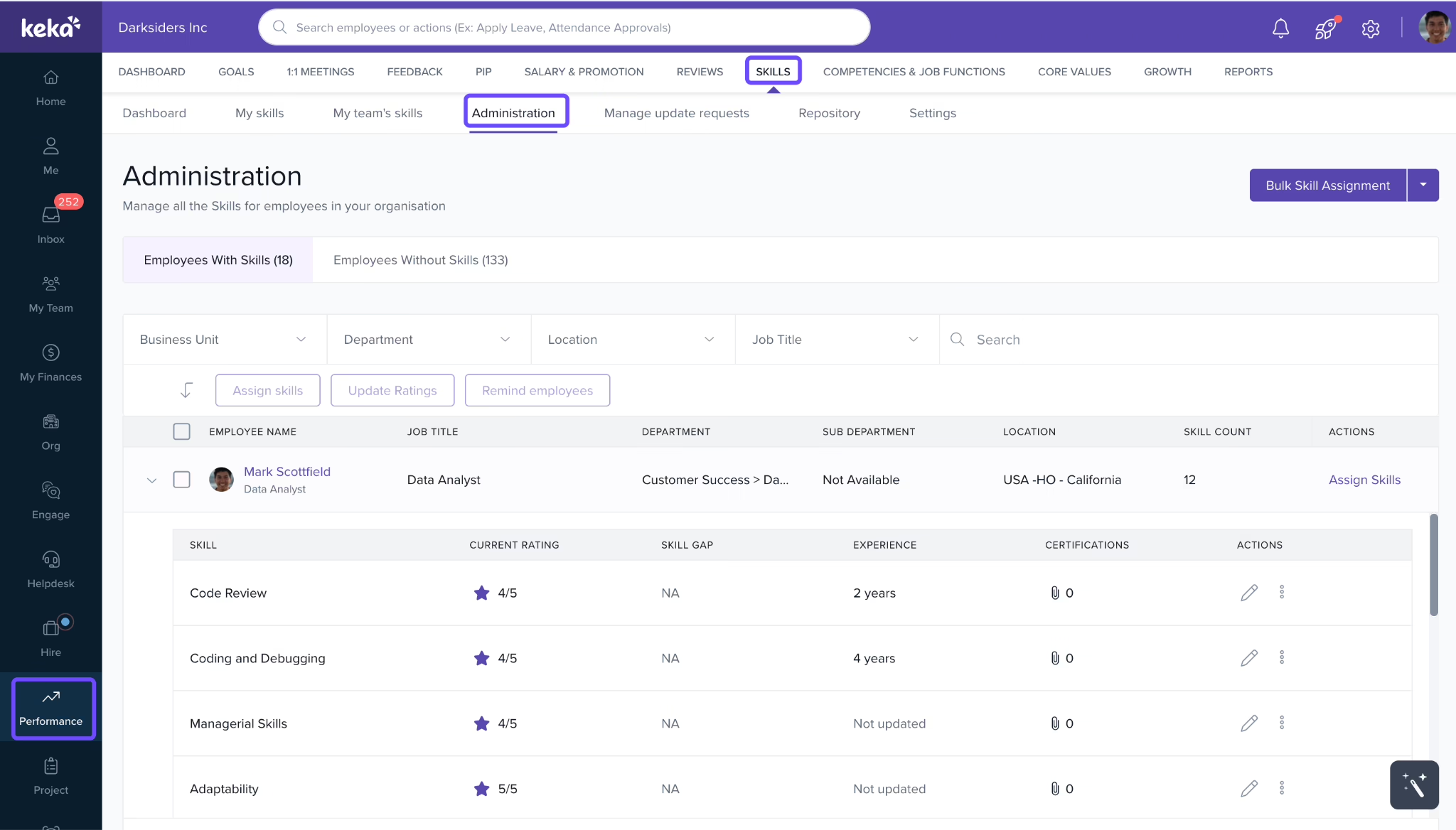
What are the key features of Keka HR?
-
Pay-for-performance on native US payroll: When a review cycle closes, rating-based raises and bonuses move straight into Keka’s 50-state payroll and take effect in the next pay run, with no re-entry.
-
Flexible review cycles: Run reviews quarterly, half-yearly, or yearly, based on each employee’s joining date or one common date, with different templates for different groups.
-
360-degree and continuous feedback: Run 360 reviews with peer nominations and anonymous options. Keka AI refines feedback for clarity and tone, and helps schedule 1:1s, suggest agendas, and capture action items for continuous feedback.
-
OKRs and goal alignment: Set company, team, and individual goals with OKR software, with AI-suggested goals by role. Progress can sync from Jira or Google Sheets through Keka’s integrations.
-
Calibration tools: Compare ratings with before-and-after bell curves and a 9-box grid, filtered by department or manager, and link raises to ratings.
-
Performance analytics: Compare ratings across cycles and review groups, with goal and skill distribution updated in real time.
| Pros | Cons |
|---|---|
| Performance ratings, attendance, payroll and project data sit on one employee record, so merit decisions don’t depend on spreadsheet exports | Keka’s performance module can run on its own, but teams that adopt the broader platform get more from connected workflows |
| Keka runs goals and OKRs, 1:1s, continuous feedback, 360-degree reviews, calibration and growth plans in a single module | Teams may need to document review templates, approval chains and calibration rules before configuring cycles. |
Pricing: Custom quote. A free trial is available on the Keka US website.
Best for: Mid-market and enterprise US employers consolidating their HR tech stack; CHROs and People Ops directors tired of integration headaches; organizations that need payroll-anchored performance data.
2. Lattice (G2: 4.6/5)
Lattice is a San Francisco-based people management platform used by more than 5,000 organizations. It is designed for HR teams that want performance, goals and engagement to run as everyday manager habits, often alongside an existing system of record such as Workday.
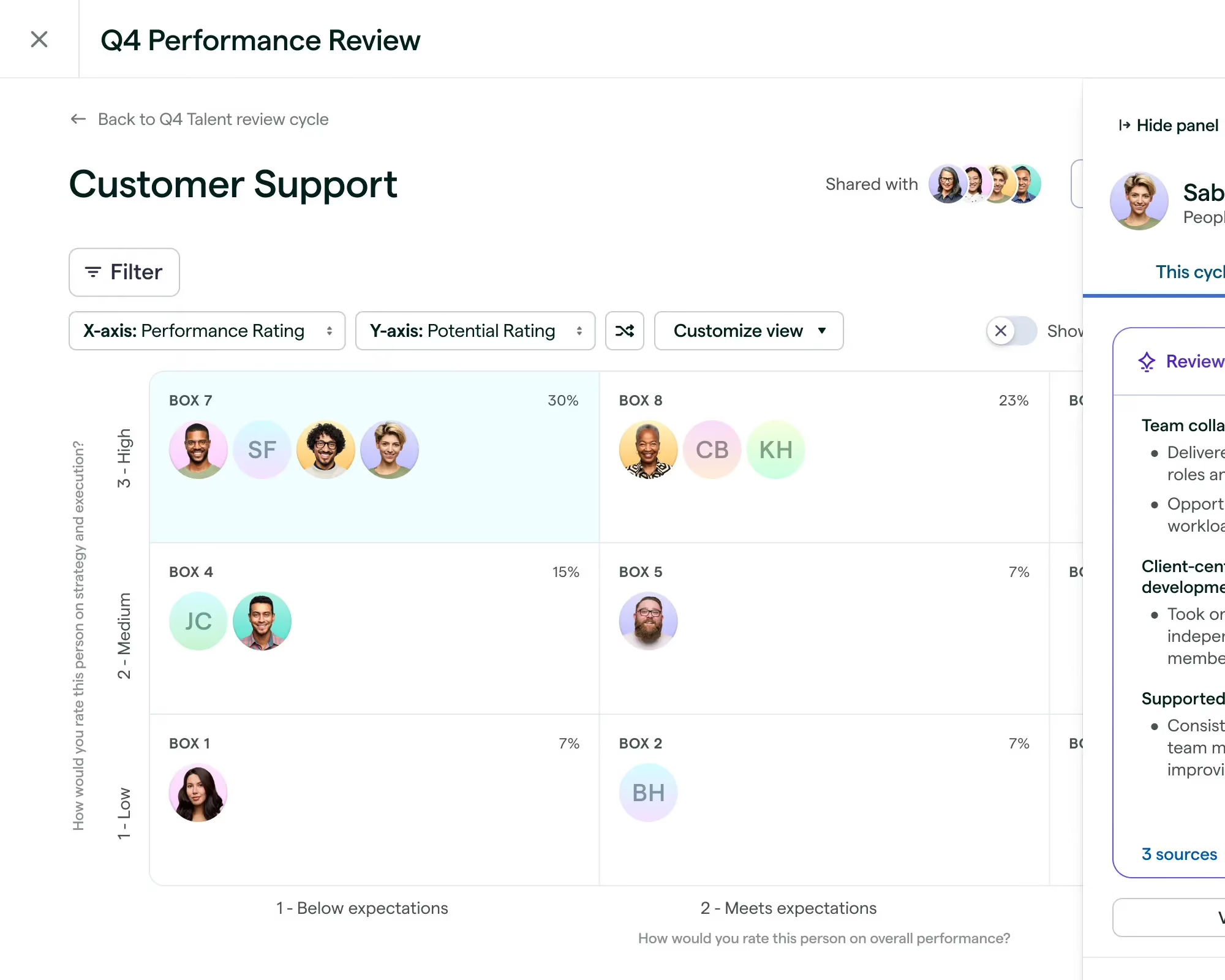
What are the key features of Lattice?
-
Reviews and calibration: Combines review cycles, calibration, promotions, PIPs, and succession planning, so promotion decisions use the same calibrated data.
-
OKRs tied to work tools: Supports cascading goals and progress updates, with Salesforce and Jira integrations that keep goals current.
-
1:1s and continuous feedback: Shared agendas, action items, and weekly updates come with every plan, and Slack reminders bring up talking points before meetings.
-
Analytics and AI agent: Every plan includes analytics and an AI agent that answers questions and coaches managers.
| Pros | Cons |
|---|---|
| Ties development plans to career competencies, career track and 1;1 meetings. Importing career track metrics is a game changer | Feedback can be requested only about direct reports |
| Review cycles run with little HR effort | Hard to set up goals that cascade through multiple levels |
Pricing:
-
Foundations package $13/seat/month (Performance, Goals & OKRs, Manager Tools, Analytics, AI Agent).
-
Base products: Performance $10, Goals & OKRs $8, Engagement $4 per seat/month.
-
Enterprise is custom; $4,000 minimum annual agreement.
Best for: Mid-market companies that want manager-led reviews, OKRs and engagement surveys running beside an existing HRIS such as Workday.
Not for: Teams below Lattice’s $4,000 minimum annual spend, or those that want payroll and performance in one platform
3. 15Five (G2: 4.6/5)
15Five is a performance management platform used by more than 3,000 organizations. Its philosophy centers on the manager: better managers produce better reviews, engagement and retention, so much of the product lives inside weekly manager routines.
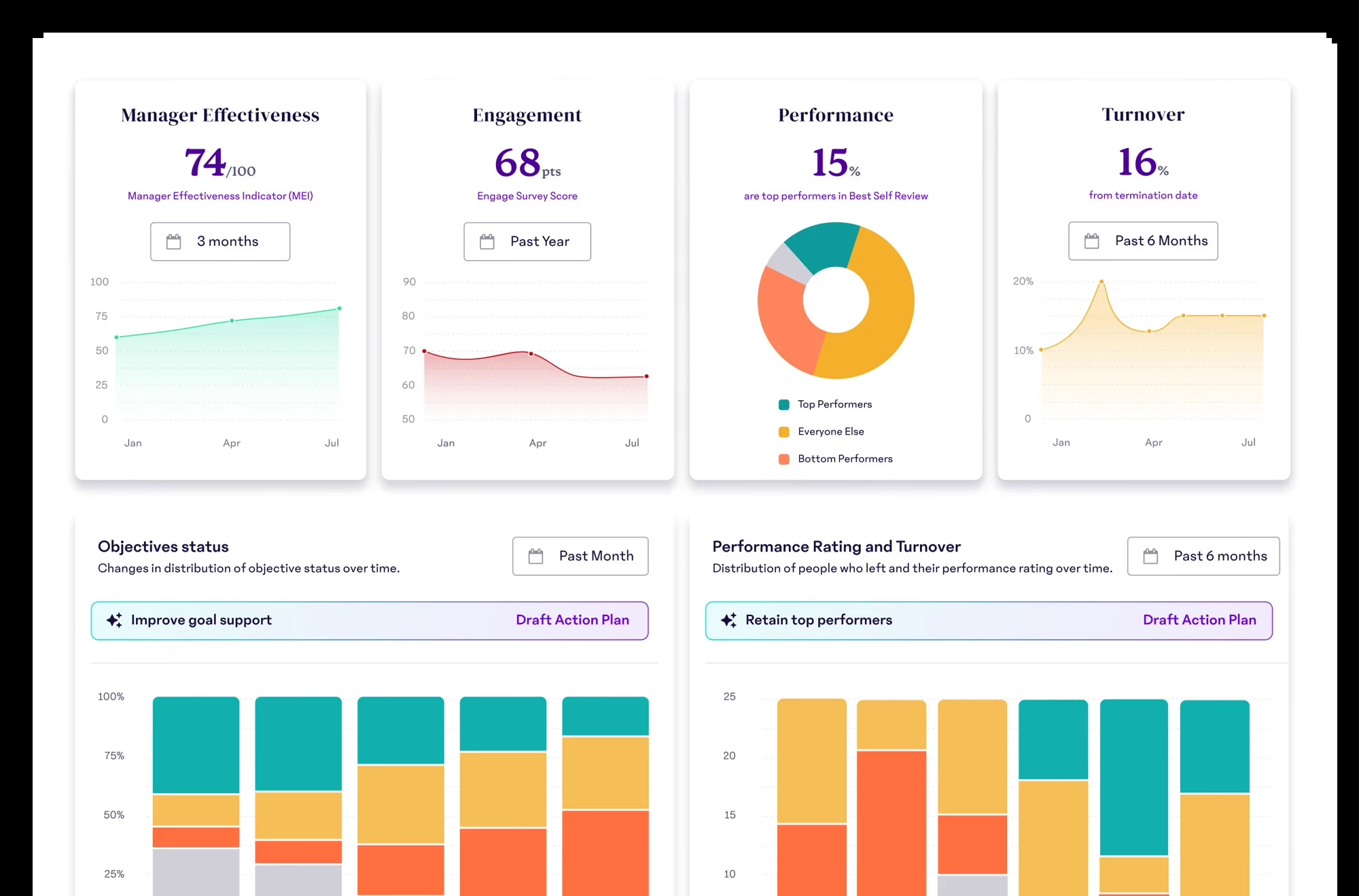
What are the key features of 15Five?
-
Weekly check-ins: Employees share a pulse score, wins, challenges, and priorities, giving managers a record to use in reviews.
-
1:1s with Kona AI: Meetings include shared agendas, notes, and action items. The Kona Notetaker add-on ($2/employee/month) records notes and feeds them into reviews.
-
Manager coaching: Kona Coach gives managers AI coaching, and the Manager Effectiveness index links their behavior to turnover and engagement.
-
Calibration and talent reviews: The Perform plan includes calibration, a 9-box grid, and growth planning tools.
| Pros | Cons |
|---|---|
| Makes it easy for admins to upload goals, whether creating individually or importing.l | The Best Self review allows you to make custom rubric but the system is not set up to support that from a scoring perspective |
| Performance records, 1;1 agendas, appraisal notes, performance documents, kept together for clear decisions | 15Five is easy for employees, hard for admins. |
Pricing:
-
Engage $4, Perform $11
-
Total Platform $16 per user/month, billed annually
Best for: Organizations investing in first-time and growing managers through weekly check-ins, 1-on-1s and AI coaching.
Not for: Teams looking for a task or project tracker, or for HR, payroll and performance on a single record.
4. BambooHR (G2: 4.4/5)
BambooHR is a Utah-based HR platform trusted by more than 30,000 companies. Many teams start with it as their first real HRIS, then add payroll, benefits and performance as they grow, which is why BambooHR performance management is a common next step for its existing customers.
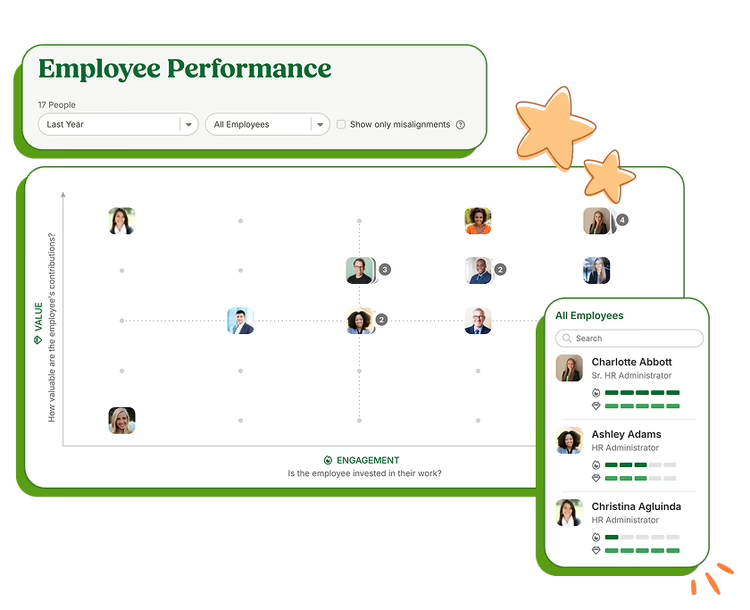
What are the key features of BambooHR?
-
Custom review cycles (Pro plan): HR sets the timing, questions, and participants, and results are ready as soon as the cycle closes.
-
360 feedback and self-assessments: Each review can combine self, manager, and peer feedback.
-
Goal tracking: Goals sit in the same profile as job and pay data, which makes merit discussions easier.
-
Built-in HRIS: Performance runs inside BambooHR’s HRIS, with 150+ integrations like Slack and Google Workspace, plus an optional payroll add-on.
-
Compensation tools (Elite plan): Adds compensation planning, salary benchmarks, and pay levels and bands.
| Pros | Cons |
|---|---|
| Past reviews help set new goals, and helps give feedback to peers and managers in the same platform | Review cycles are hard to customize compared to enterprise competitors. Customizing them can be difficult or impossible. |
| Gives one view of a large team and makes it easy to manage requests, review goals, and annual reviews | The base plan is reasonable but costs add up quickly once modules like payroll, time tracking or performance management are added |
Pricing:
-
Core $10.25, Pro $17.50,
-
Elite $25 per employee/month for teams over 25 employees
-
Flat $250, $425 or $650 per month for 25 or fewer.
Best for: Small and mid-sized US companies already running BambooHR that want straightforward reviews, self-assessments and goals inside their HRIS.
Not for: Large enterprises that need calibration grids, 9-box talent reviews or deep custom integrations.
5. Leapsome (G2: 4.8/5)
Leapsome is a people platform with offices in New York and Berlin, used by more than 2,000 organizations. It is aimed at HR teams that treat performance and development as one loop, and it now pairs its Talent Suite with its own HRIS foundation for US customers.
What are the key features of Leapsome?
-
360-degree feedback with external reviewers: Runs self, manager, peer, and upward reviews, with drag-and-drop calibration, and can include reviewers from outside the company.
-
OKR management: Individual, team, and company OKRs roll up in a goal tree, with automatic progress tracking and a Jira integration.
-
Learning and development: Assigns courses, videos, and quizzes, and connects with LinkedIn Learning and GoodHabitz.
-
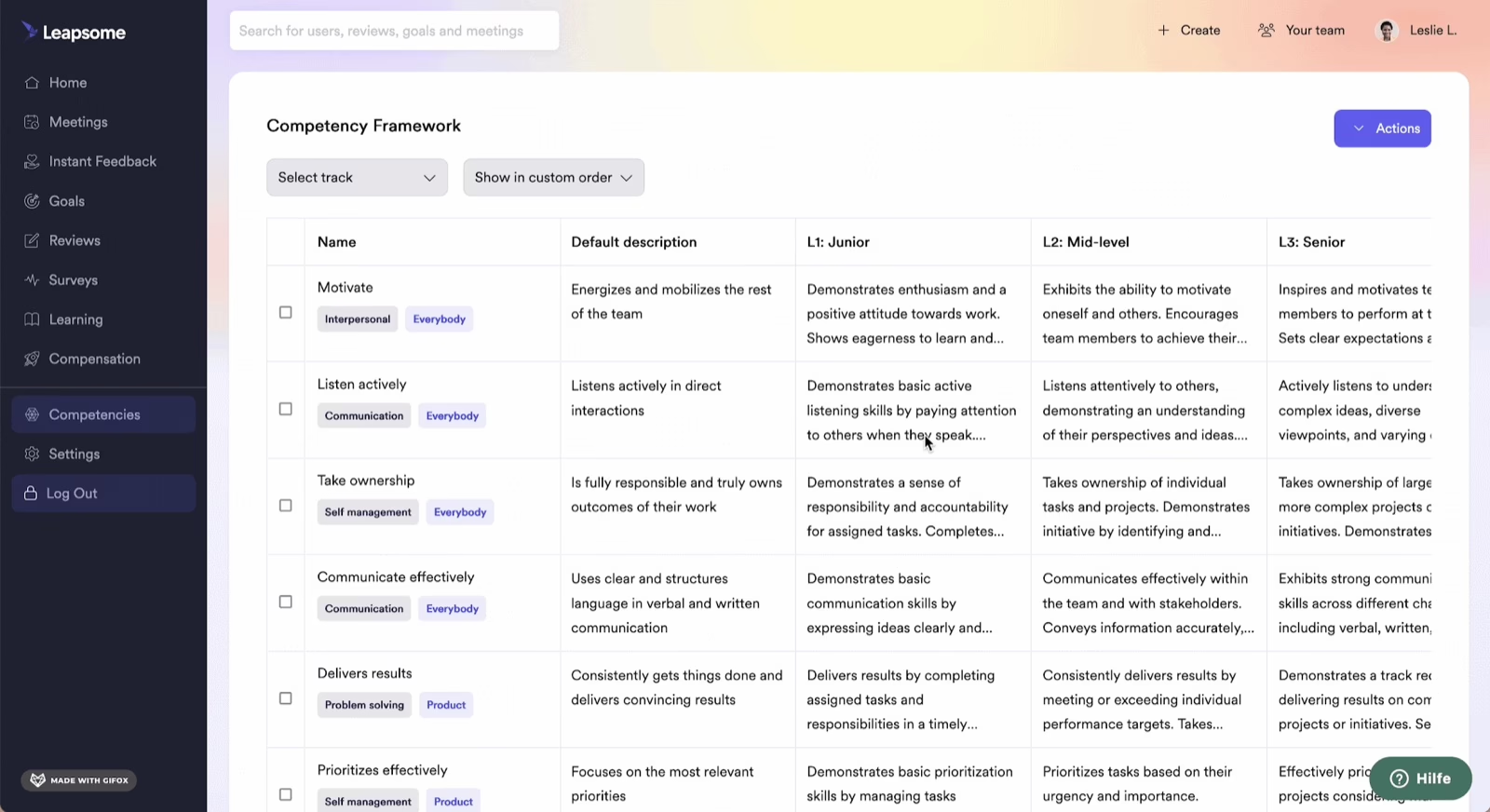
Skills gap analysis: Competency frameworks feed reviews, so gaps between required and actual skills show up during the review.
-
Development plans: Development goals link to learning paths, so a skill gap quickly turns into an assigned course.
| Pros | Cons |
|---|---|
| Probation reviews run automatically, and historical tracking is seamless and stays intact even during manager handovers | Hard for admins to set up review cycles or have custom workflows. |
| Clear calibration is helpful; the workflows cut down administrative overhead significantly | The platform can feel overly complex for a small company |
Pricing
-
Performance Reviews €7, Goals & OKRs €4
-
Engagement Surveys €4, Learning €4, Compensation €3 (a USD view is available on the page).
Best for: Growing companies that want reviews, competencies and learning connected in one development loop.
Not for: US teams that want payroll processed in the same platform as performance.
6. Engagedly (G2: 4.3/5)
Engagedly is a talent management platform that brings performance, engagement, learning, growth and recognition into one experience. It suits HR teams that want a single vendor for the whole talent cycle, with AI layered across it rather than bolted on.
What are the key features of Engagedly?
-
AI insights from Marissa: Engagedly’s AI agent connects data across modules, highlights priorities for HR and leaders, and suggests goals.
-
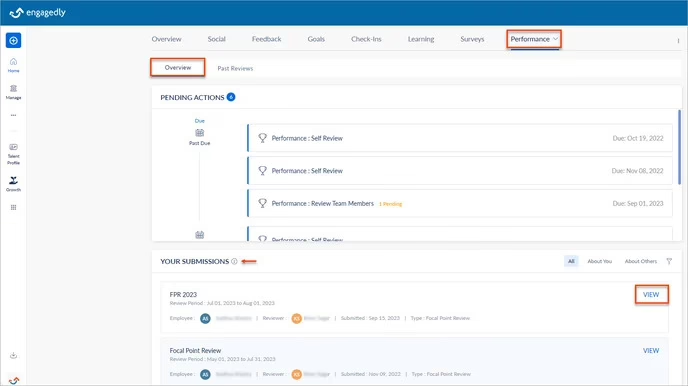
Flexible reviews and 360 feedback: Templates cover 30-60-90 day, anniversary, and focal reviews, plus 360 feedback that can include outside reviewers.
-
Weighted OKRs: Set weighted goals with AI suggestions, and feed them straight into reviews.
-
Continuous feedback and recognition: Real-time feedback, a praise wall, and rewards keep recognition going between reviews.
-
Broader talent suite: Includes learning, career mobility, mentoring, and compensation tools for pay-for-performance.
| Pros | Cons |
|---|---|
| Flexible and accommodating of different talent and performance management philosophies | AI summaries and reports are still immature and need further development |
| Strong performance and 360 modules, backed by good support | Some sections can’t be changed or customized to fit the business |
Pricing: Performance Suite $5–8 per user/month, billed annually; other modules (Learning, Recognize & Reward, Engage & Listen, Talent Mobility) are priced separately. Pricing varies by headcount and bundling, with a $7,500 annual minimum; enterprise pricing is custom.
Best for: Mid-sized organizations that want performance, learning, recognition and AI insights from one talent management vendor.
Not for: Teams that only need a lightweight review tool or want HR and payroll on the same platform
7. PerformYard (G2: 4.7/5)
PerformYard is a performance management platform, popular with HR directors at accounting firms, IT services companies, and other professional organizations. It’s designed for HR teams that want to run reviews their own way without building every form from scratch.
What are the key features of PerformYard?
-
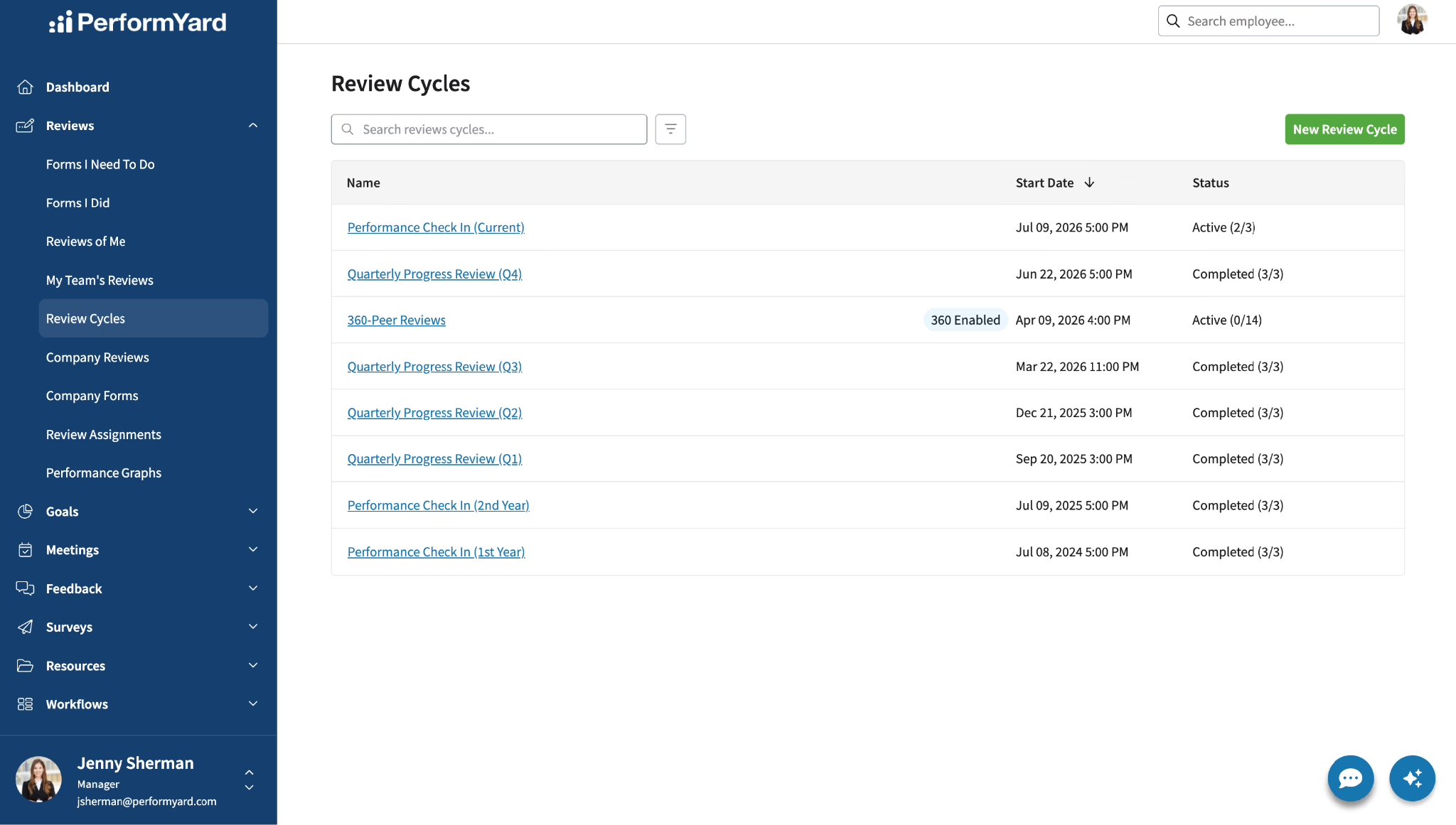
Performance review cycles of any shape: Annual, quarterly, project-based, 360-degree, probation, and PIP cycles can run side by side, with automated reminders and workflow tracking that show HR who still owes a review
-
Performance appraisal templates: Custom forms and rating scales can be saved, reused, and adjusted for each cycle, and forms calculate scores automatically for company-wide reports
-
360-degree feedback: Manager, peer, upward, and self input feed the same review, alongside continuous feedback and recognition between cycles
-
Goal tracking and alignment: Cascading goals and OKRs carry into reviews, and AI Coaching builds a brief before every 1:1 from goals, feedback, and meeting history, then flags bias or vagueness in written feedback
-
Calibration-ready analytics: Cascading goals and OKRs carry into reviews, and AI Coaching builds a brief before every 1:1 from goals, feedback, and meeting history, then flags bias or vagueness in written feedback
| Pros | Cons |
|---|---|
| Flexible quarterly reviews that also feed pay decisions. It also gives a centralized space to document performance and support compensation decisions | Can’t launch reviews automatically by hire date, and support recommends the user launch review cycles on a monthly basis for every employee |
| Goal progress is shown as a percentage with email nudges | Cannot reduce seats once bought |
Pricing:
-
Performance $5–15 per person/month
-
Talent Development (compensation, coaching, competencies) $5–15 per person/month.
Best for: Professional services and mid-sized firms that run several review types at once and want hands-on support.
Not for: Companies that want HR, payroll, and performance in a single system.
8. Betterworks (G2: 4.4/5)
Betterworks has focused on performance management since 2013 and serves large, global organizations such as Colgate-Palmolive and Intuit. It’s built for companies where strategy has to cascade through thousands of people across regions and languages.
What are the key features of Betterworks?
-
**OKR management at scale:**It supports OKRs, SMART goals, or a custom methodology, and AI Goal Assist suggests goals for each person from organization-specific data
-
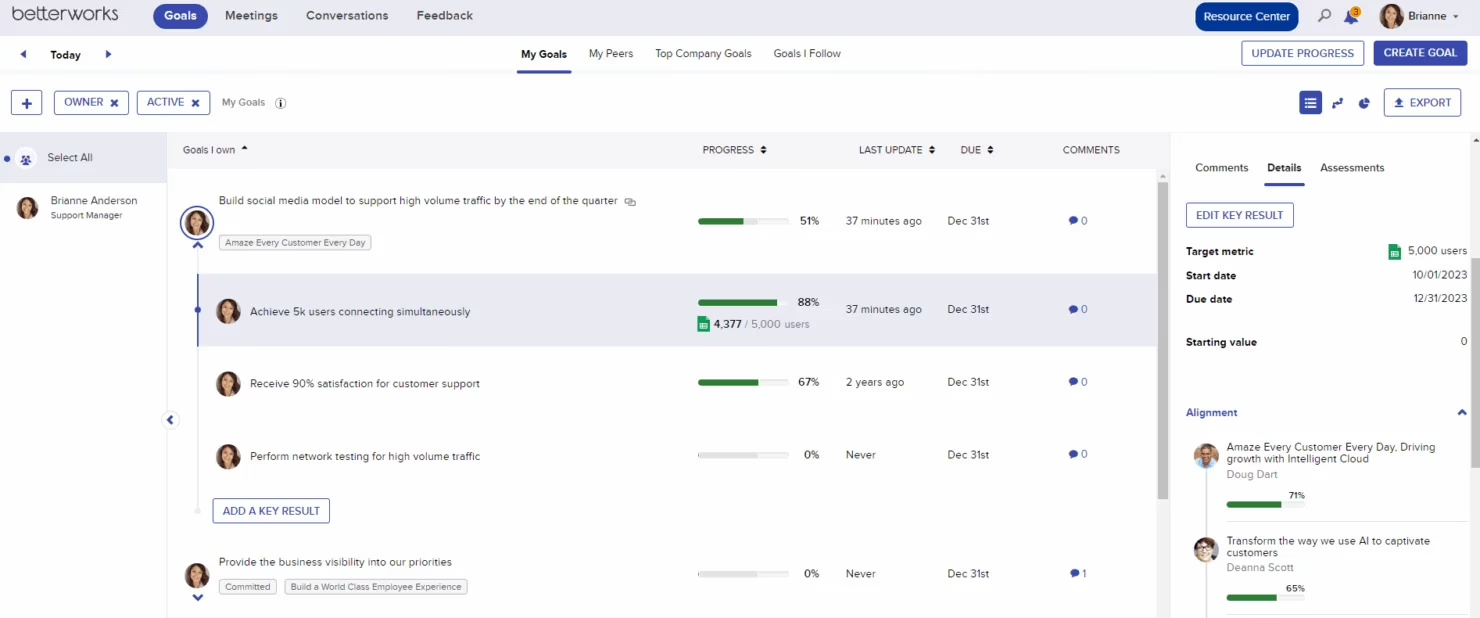
Goal tracking and alignment from work tools: Progress updates automatically from Jira, Asana, Salesforce, and Google Sheets, and goals roll up into a company-wide tree; leaders see how team work ladders to strategy
-
Continuous feedback: Conversations, feedback, and recognition sit in one view, with a running summary of peer and manager input. It also works inside Slack, Microsoft Teams, Gmail, and Outlook
-
Standalone calibration: Calibration runs on its own schedule, separate from reviews, so talent planning can happen quarterly instead of only at year-end
-
Performance analytics and reporting: Centralized, on-demand performance data gives HR and leaders visibility without analyst or IT support
| Pros | Cons |
|---|---|
| A running record of work for review time; you can enter milestones and goals to update and change alone the way | Heavy self-review work several times a year, with unclear payoff |
| Reminders inside the tools people already use | Integrations and AI insights need work |
Pricing:
-
Performance $8/user/month
-
Performance + Talent Intelligence $9/user/month
-
Enterprise custom
Best for: Large, multi-region enterprises running company-wide OKRs that need calibration outside the annual cycle
Not for: Small teams without an OKR practice, or buyers wanting HR and payroll in the same platform
9. Quantum Workplace (G2: 4.3/5)
Quantum Workplace is a US talent platform with more than 20 years of work in employee engagement, including its Best Places to Work program, and a network of more than 10,000 organizations. It suits mid-market and enterprise HR teams that want engagement signals and performance data read together.
What are the key features of Quantum Workplace?
-
Employee engagement software at the core: Pulse, annual and lifecycle surveys flag disengagement and flight risk in critical roles, then guide managers through action plans
-
Talent reviews and calibration: Managers answer three quick questions per report, and results plot on a performance grid. Calibration Mode hides the names of anyone who may be in the room during live sessions
-
360-degree feedback: Performance reviews collect manager, peer and self input and review analytics show response trends across teams
-
Continuous feedback and 1-and-1s: Regular check-ins, structured feedback and goal tracking keep coaching conversations going between cycles, with a Goal Generator to draft goals
-
Employee recognition software: Peer recognition and rewards run on the same platform, so a public shout-out sits beside goal progress and survey results
| Pros | Cons |
|---|---|
| Has different review templates for specific user attributes, and an easy place for performance conversations, and promotions | No bulk goal assignment and weak links to payroll and hiring tools |
| Action items carry over between check-ins | Reporting and analytics are hard to use |
Pricing: Custom quote based on organization size and modules
Best for: Mid-market and enterprise HR teams that want engagement, recognition and talent reviews in one platform.
Not for: Teams that need payroll and core HR in the same system, or a fast, lightweight rollout.
How to Choose Performance Management Software
The best performance management tool is the one your managers use without reminders. Answer these five questions before you book demos.
1. How Do You Want to Run Reviews?
Be honest about your rhythm. An annual cycle needs flexible forms and calibration; continuous feedback requires 1:1 tools managers will actually use.
2. Will It Work With Your Existing Stack?
If your HRIS, payroll and performance data live in separate tools, every review cycle creates more exports. Test HRIS integration, SSO, Slack or Teams, and tools where goals live, such as Jira.
3. Can You See the Numbers Leadership Needs?
Ask to see performance analytics on your own sample data. You should be able to compare ratings across managers, cycles, and departments and track KPIs such as review completion, goal attainment and regretted turnover.
4. What Will it Really Cost?
Look beyond the per-seat price. Add base seats, AI and compensation features, minimum contracts, implementation and training before comparing quotes.
5. Can You Defend a Rating When It’s Challenged?
In every demo, walk through calibration, a performance improvement plan, and a rating-based raise. The right performance management software should maintain a clear record of who changed a rating, when, and why.
Which Performance Management Software Should You Choose?
The right performance management software depends on your company’s size, how you run reviews, and the tools you already use. Keka suits US companies that want HR, payroll, and performance on one employee record, so approved raises reach payroll without exports.
Schedule a demo to see how it works.