Login


Strategies for Workplace Conflicts



PRODUCTS
 Payroll Suite
 HR Suite
 Talent Suite
 Project Services Suite

Meet the platform tailored to your business
Core system of record
One platform for the entire employee journey

BY INDUSTRY
BY COMPANY SIZE
LEARN
EXPLORE KEKA
Workplace conflict happens a lot more than most managers want to say. It creates problems that're not obvious at first. These problems can lead to productivity and more people leaving the company. Fixing these problems needs management skills. It also needs support from the human resources department. It needs steps for moving forward and good behavior, from leaders. This guide looks at why conflict happens. It explains a six-step way to deal with it. It lists five ways to fix the problems. It also talks about what leaders should do.
No one wants to see a heated argument between two employees..
Not to say this is a rare occurrence.
According to an Acas report, 35% of employees said they had experienced some form of conflict at work between 2018 and 2019.
That’s 9.7 million people dealing with tensions that disrupt productivity. Remember, this conflict isn’t always loud and open. It happens clandestinely, too.
But, such conflicts can be devastating. They cause productivity loss, team stress, and the wastage of time and resources.
Moreover, around 485,800 employees quit their jobs yearly because of workplace conflicts.
That’s why you need to inculcate strategies that don’t just help you resolve conflicts but prevent them in the first place.
Let’s see how you can do it.
Workplace conflicts are issues that emerge when people or teams in a company have clashing goals, values, or interests. They can stem from personality differences, miscommunication, competition, or power struggles.
Sometimes, conflict is apparent—heated arguments, passive-aggressive emails, or teams refusing to work together. Other times, it marinates beneath the surface, kind of like a cold war.
This can burst at any moment and can also create constant friction and frustration.
But conflict doesn’t have to be a headache without a cure. If you handle it properly, you can improve teamwork and inspire your people to find better solutions to their differences.
Sometimes, they may even brainstorm together to give you novel innovations.
Some common types of workplace conflict include:
Workplace conflict doesn’t happen in isolation. It often rears its ugly head due to deeper issues regarding how people work, communicate, and interact.
If you can recognize these sources, it will be easier for you to tackle conflicts overall.
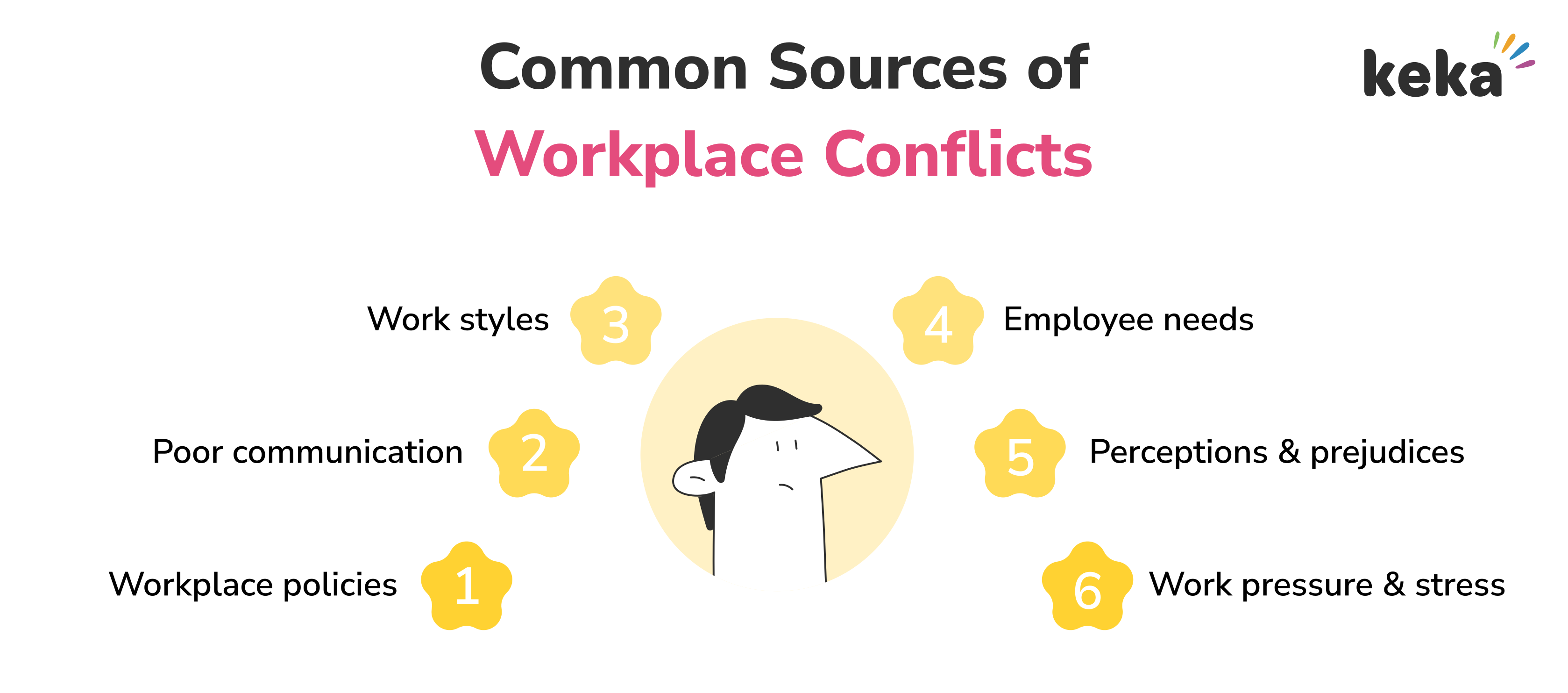
Here are some common ones to help you understand them:
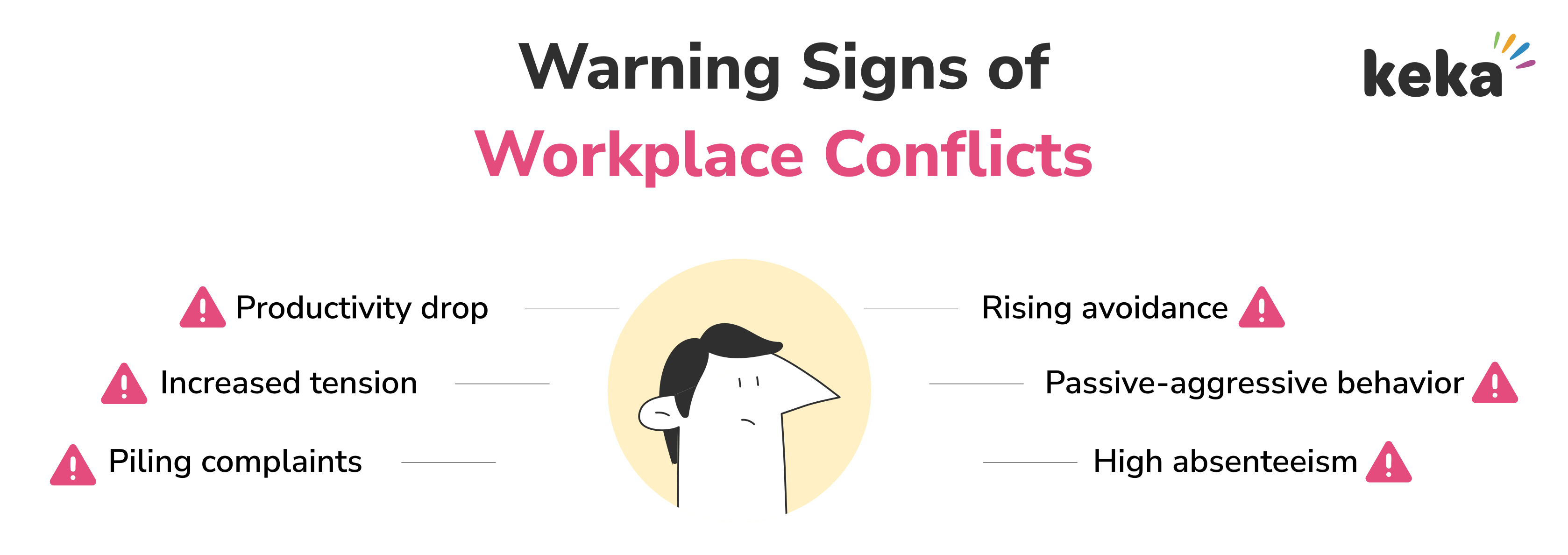
The first step to preventing workplace conflicts is to identify them.
And for that, you need to stay vigilant and be able to notice the early signs.
So, here are some of them:
Now that you understand how to notice a conflict brewing, it’s time for the steps you need to manage and prevent them.
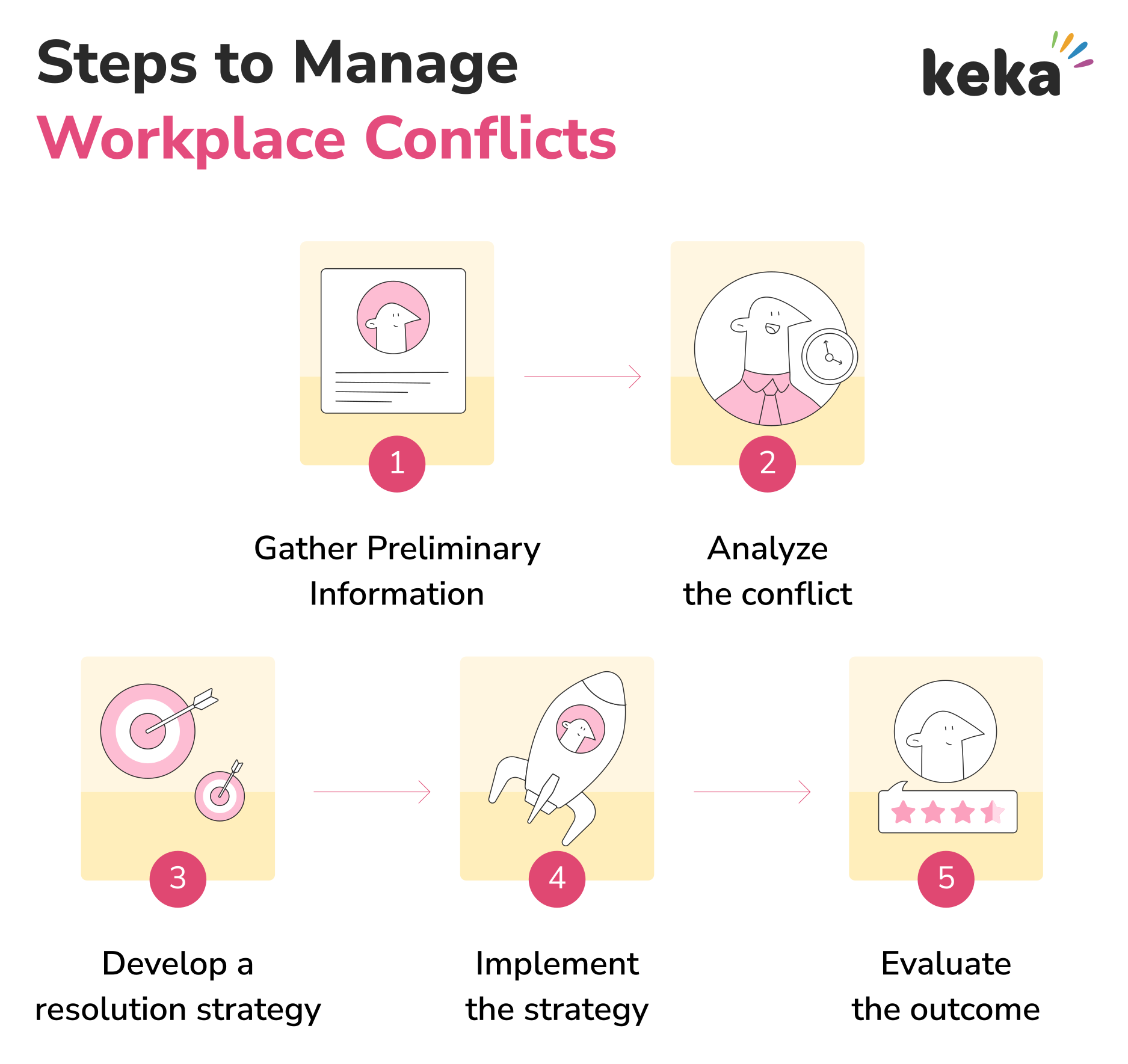
The most common causes of conflicts include miscommunication, clashing work styles, or mismanaged changes. Sometimes, conflicts are obvious, and other times, they manifest as passive-aggressive behavior or avoidance.
Let’s say a company introduces new software, but some employees don’t want to use it. This is causing delays for you. Here, you need to find the real issue, which possibly might be poor communication about the transition. Instead of pushing for change, you should provide training and create open discussions.
Before taking action, gather details from all parties involved.
You don’t want to cause further misunderstanding or act on incorrect or unverified information.
Imagine two departments that blame each other for project delays, but a review of their workflow reveals unclear task ownership. Holding a joint team meeting to clarify roles and update documentation removes confusion and prevents future disputes.
After you gather your info, you need to analyze the entire problem.
Ask yourself questions like:
Finding answers to these and similar questions can help break down the conflict into easily solvable chunks.
Once you reach this stage, you are no longer just looking to resolve conflicts; you want to come up with a proper solution.
This means doing three major things:
Remember to encourage direct, constructive conversations while you stay neutral. To improve at this stage, you can also seek professional conflict resolution training. Keep your communication channels open and monitor emotion levels constantly to keep things in check.
Before choosing a conflict resolution model, consider conducting a SWOT analysis to identify team dynamics.
Execution is crucial.
Clearly communicate the resolution plan, ensuring all parties understand expectations and timelines. Facilitate discussions, offer training where needed, and encourage cooperation. Ongoing support is always better for conflict resolution.
Actively check in with employees to address concerns and prevent resentment.
After implementing a resolution, assess its effectiveness by gathering feedback. Are employees more collaborative? Has productivity improved?
Make sure that all parties feel heard so that the conflicts don’t pop up again. Monitor workplace dynamics and intervene early if signs of tension show their faces again.
Managing conflicts is a very dynamic process.
You need to do what’s needed within the purview of the circumstances. Moreover, every individual handles conflict differently. Let’s find out which style of conflict management should be used under which situations:
This is where assertiveness meets cooperation. You work with the other party to find a solution that makes everyone happy. It’s not about compromise—it’s about creating something better together.
Use this when long-term relationships matter, like merging two departments. This is your go-to strategy if you want the best from both sides.
Here, you push for your own interests, even if it’s at someone else’s expense. It’s aggressive but sometimes necessary—like when you’re competing for a big client. Just don’t use this inside your team. Winning the argument but losing relationships isn’t worth it.
Not every fight is worth having. This style means stepping back, either because the issue isn’t important or the timing isn’t right. If a minor disagreement pops up—like a co-worker’s bad habit that doesn’t really affect you—let it go. But if a major issue lingers, avoidance won’t fix it.
This is the opposite of competing. You let the other person have their way. It’s useful when the relationship matters more than the issue, like letting your boss pick the lunch spot. But be careful—if you accommodate too often, resentment can build.
You give a little, they give a little. Neither side gets everything, but both walk away with something. This works best when time is tight, and a quick solution is better than a perfect one. But know that compromise means no one is fully satisfied—so use it wisely.
How you handle conflict determines whether your organization thrives or struggles. A workplace where conflicts are addressed constructively fosters collaboration, trust, and innovation. The key? Strong leadership, avoiding common pitfalls, and adopting the right strategies.
As a leader, you set the tone.
You can create an environment where employees feel safe to voice concerns or tensions simmer beneath the surface. Here’s what you should focus on:
Many leaders unintentionally make conflicts worse. Here are common mistakes to avoid:
Not all conflict is bad. Good conflict can lead to positive outcomes, often pushing us to be our best selves, to understand others better, and to find more innovative or creative solutions to problems.
Great leaders turn conflict into an opportunity for growth. Here’s what they get right:
It’s not just about handling disputes—it’s about fostering a workplace where conflicts lead to progress rather than division.
Workspace conflicts can prove detrimental for any organization. Your best bet to avoiding the damages such conflicts may cause is to tackle them before they spiral out of control.
That’s where dedicated HR Management software like Keka can help.
Keka helps organizations create a conflict-free workplace with tools that improve communication, engagement, and support. Its Employee Help Desk quickly resolves concerns, while Pulse Surveys can help detect issues early.
By integrating Keka, you create a more transparent, engaged, and collaborative work environment. So, what are you waiting for? Try Keka today.
Spotting conflict early prevents it from escalating, reduces workplace tension, and allows for quicker, more effective resolutions.
It fosters a positive work culture, improves collaboration, reduces turnover, and boosts overall productivity.
Active listening, clear and respectful dialogue, open-ended questions, and focusing on solutions rather than blame.
Address issues early, gather all perspectives, stay neutral, encourage collaboration, and implement practical solutions.
It’s the process of addressing disputes constructively to find solutions that satisfy all parties while maintaining a healthy work environment.
Subscribe to keep up with the latest strategic finance content.
Request a demo