Login


Who Pays for Unemployment? How Benefits are Funded in the US


PRODUCTS
 Payroll Suite
 HR Suite
 Talent Suite
 Project Services Suite

Meet the platform tailored to your business
Core system of record
One platform for the entire employee journey

BY INDUSTRY
BY COMPANY SIZE
LEARN
EXPLORE KEKA
Unemployment benefits in the US are primarily funded by employers through federal (FUTA) and state (SUTA) payroll taxes, not employee contributions. This guide explains how unemployment insurance works, when employees qualify, and how claims impact employer costs through experience rating. For HR leaders, understanding funding, compliance, and claim management is key to controlling long-term payroll tax exposure.
On an unsuspecting gray afternoon, Jordan sat at the conference table. The clock read 4:50 PM, and a familiar weight began to settle in as the HR head, Alex, said something no employee ever wants to hear: “We are restructuring.”
By 5:00 PM, Jordan walked out of the building where he had spent the past four years, severance check in hand, with one thought looping in his mind: “How will I pay rent next month?”
Alex, meanwhile, had a different concern. He knew Jordan would likely file for unemployment insurance and wanted to be supportive. But he also knew approved claims could affect the company’s finances in the coming quarter.
In the United States, unemployment benefits are primarily paid by employers through federal (FUTA) and state (SUTA) payroll taxes. Employees typically do not contribute, except in Alaska, New Jersey, and Pennsylvania. When an eligible worker receives benefits, the money comes from employer-funded state trust funds, not from the employee’s paycheck or general tax revenue.
If you have been on either side of that table, you already know how much confusion surrounds unemployment benefits. Who actually funds them? Does the money come from the employee’s paycheck? Is the employer on the hook every time someone files a claim?
This guide breaks it all down, clearly and practically.
Key Takeaways
- Employers, not employees, fund unemployment benefits in almost every US state through FUTA and SUTA payroll taxes.
- Only Alaska, New Jersey, and Pennsylvania require any employee contribution, and even then it is a small amount.
- Every approved unemployment claim can raise an employer’s future SUTA tax rate through experience rating.
- Employees who quit voluntarily, are fired for misconduct, or lack sufficient work history may not qualify for benefits.
- HR teams that respond to claims on time, document separations thoroughly, and audit benefit charges regularly can meaningfully control unemployment tax costs.
Let’s get started.
Unemployment benefits in the US are primarily paid by employers, not employees.
Here is how the system is structured. Employers pay federal and state unemployment taxes on employee wages. States use these taxes to build unemployment trust funds, which pay weekly benefits to eligible workers. The federal government oversees the system, using federal unemployment tax revenue to help states administer programs and extend loans when state funds run low.
When an eligible worker receives unemployment benefits, the money comes from employer-funded tax accounts. It does not come from the employee’s paycheck, and it is not drawn from general income tax revenue.
Quick tip:
If you are an employee who just lost your job, know this: your benefits are not coming out of anyone’s pocket right now. Employers have been paying into your state’s trust fund all along, specifically for situations like yours.
In almost every state, employees never pay into unemployment insurance through payroll deductions. Three states are the exception:
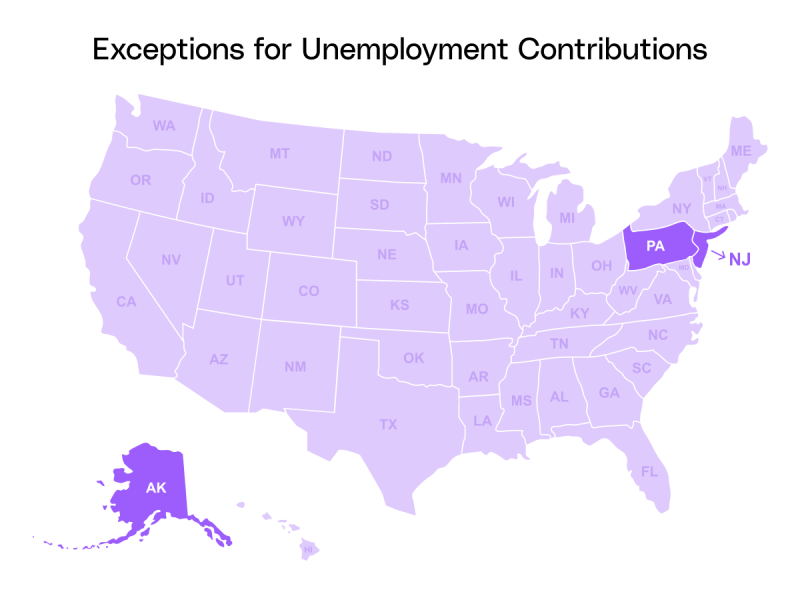
Even in these states, employers still pay the majority of the total unemployment cost.
Now that we know who pays for unemployment benefits, let us look at how the system actually works.
Unemployment insurance is a federal-state partnership that provides temporary wage replacement when workers lose their jobs through no fault of their own.
The US Department of Labor sets broad national standards and oversees state programs. Each state runs its own unemployment insurance system, with its own rules for eligibility, benefit amounts, and duration, all within federal guidelines. States hold unemployment tax revenue in state trust funds and use those funds to pay weekly benefits to eligible claimants.
While details vary by state, workers typically must meet three criteria:
Most states provide up to 26 weeks of regular benefits, with exact duration and weekly amounts set by each state.
Quick tip for HR teams:
Eligibility rules differ significantly from state to state. If your company operates across multiple states, make sure your HR policies account for those differences so employees get accurate information at the time of separation.
With eligibility covered, the next question is whether employees themselves ever contribute to this system. The answer, for most workers, is no.
Employees do not pay into unemployment insurance in almost every US state.
In nearly all states, employees do not see unemployment insurance contributions withheld from their paychecks. Employers pay both the federal unemployment tax (FUTA) and the state unemployment tax (SUTA or SUI).
This makes unemployment insurance distinct from Social Security and Medicare, where both employers and employees contribute through FICA payroll taxes.
Key distinction:
Social Security and Medicare taxes (FICA) are split between employers and employees. Unemployment taxes (FUTA and SUTA) are paid almost entirely by employers. These are two separate systems with very different funding structures.
Only three states require direct employee contributions to unemployment insurance: Alaska, New Jersey, and Pennsylvania. In these states, the employee portion is relatively small, and the employer’s tax obligations remain the primary funding source.
Now that we have established who pays for the unemployment benefits, it is worth understanding exactly how employers make those payments.
Employers fund unemployment insurance through two taxes: a federal tax under FUTA and a state tax under SUTA or SUI.
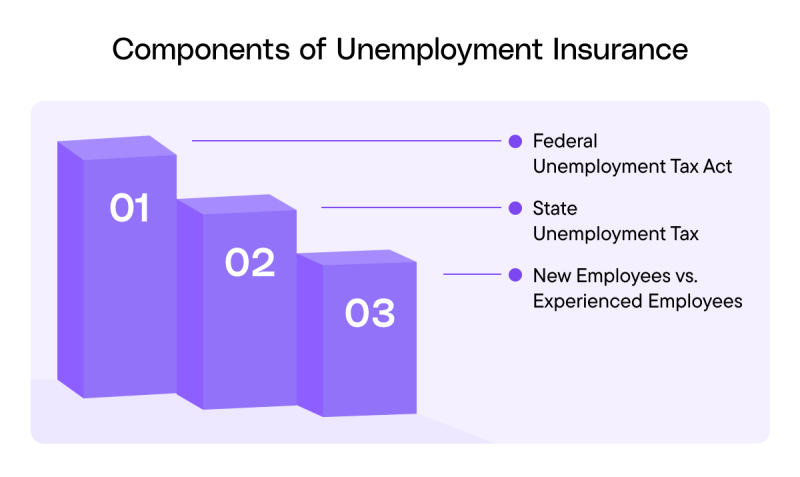
FUTA requires employers to pay unemployment tax on the first $7,000 of each employee’s wages per calendar year.
The statutory FUTA rate is 6%. Employers that pay their state unemployment taxes in full and on time in non-credit-reduction states receive a credit of up to 5.4 percentage points, bringing the effective FUTA rate down to just 0.6%.
FUTA revenue funds program administration and provides loans to states whose trust funds run short.
Quick tip:
Most employers end up paying the reduced FUTA rate of 0.6% because they pay their SUTA taxes on time. Staying current on state tax filings is one of the simplest ways to keep your federal unemployment tax costs low.
At the state level, employers pay a state unemployment tax, commonly called SUTA or SUI.
Each state sets its own taxable wage base. Rates vary by employer and typically range from 1% to 8% or more. States use an experience rating system that ties each employer’s tax rate to its own history of unemployment claims and payroll.
The more benefits charged to an employer’s account, the higher that employer’s SUTA rate may climb in future years.
New employers start with a standard “new employer” rate, since they have no prior claims history.
After a few years of payroll and claims activity, the state transitions them to an experience-rated SUTA rate based on a multi-year lookback.
Stable employers with few layoffs benefit from lower rates. Employers with frequent separations and approved claims face higher unemployment tax costs over time.
Key insight:
Experience rating is effectively a feedback loop. The more unemployment claims approved against your account, the more you pay in future tax years. This is why thoughtful hiring, strong retention, and careful documentation of separations are not just HR best practices. They are direct cost-control levers.
Understanding how employers pay is only part of the picture. There are also active responsibilities that kick in the moment a claim is filed.
Beyond paying FUTA and SUTA, employers have several hands-on responsibilities whenever unemployment claims are involved.
Employers must register with state workforce agencies and the IRS. They must track wages accurately each quarter and pay FUTA and SUTA on time to avoid penalties and loss of the FUTA credit.
Late or inaccurate filings can trigger penalties, interest charges, and higher effective tax costs.
When a former employee files a UI claim, the state sends the employer a notice requesting details such as:
HR must respond by the stated deadline, typically around 10 business days. Missing the deadline can lead to automatic claim approvals, increased charges, and potential penalties.
Quick tip for HR teams:
Set up an internal process for routing UI claim notices immediately when they arrive. Missing the response deadline is one of the most common, and most preventable, reasons employers end up with charges they could have contested.
Employers may verify claims when a separation was beyond the employee’s control, such as a layoff. They can contest claims when eligibility is in question, for example if the worker quit voluntarily without good cause or was terminated for serious misconduct.
If a contested claim is approved, employers can appeal and participate in a hearing, presenting documents, witnesses, and testimony.
States send regular statements showing benefits charged to each employer’s account. Proactive HR teams review these statements against internal records, dispute incorrect charges, and request corrections to protect their experience rating and future SUTA rate.
Not every separated employee will qualify for benefits. Here are the situations where eligibility is most commonly denied.
Not everyone who leaves a job qualifies for unemployment. Here are the most common disqualifying situations.
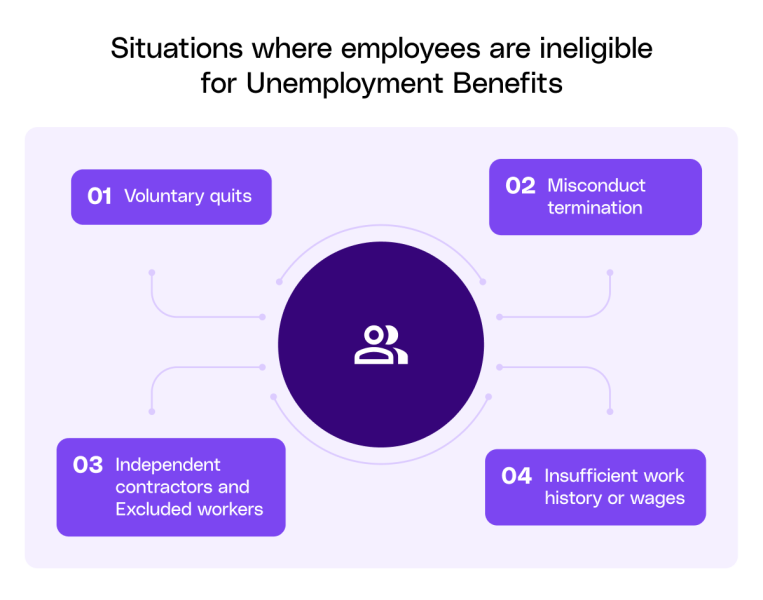
Employees generally do not qualify if they quit voluntarily without “good cause” as defined by state law. Good cause might include unsafe working conditions or major changes to the role. Wanting a career change typically does not qualify.
Workers fired for misconduct, such as serious policy violations, theft, or repeated unexcused absences after warnings, are typically disqualified. Employers can contest these claims and submit documentation during the claims or appeals process.
Independent contractors, gig workers, and many self-employed individuals are generally not covered by state unemployment programs because no UI tax was paid on their earnings. Unless special programs are enacted, as happened temporarily during the COVID-19 pandemic, they typically cannot collect standard UI benefits.
Even when the reason for separation is valid, employees must meet minimum earnings and work history thresholds during a defined base period. Workers with very short tenure, limited hours, or significant employment gaps may be ineligible or qualify for only a small weekly benefit.
With the full picture of who qualifies and who does not, it helps to understand why the system is built this way in the first place.
Employers fund unemployment insurance for reasons that go beyond regulatory compliance.
Unemployment benefits act as an automatic economic stabilizer. When workers lose jobs, ongoing income helps them cover housing, food, and utilities. That continued spending slows economic downturns and makes it easier for businesses to recover when hiring picks back up.
UI gives displaced workers time to find suitable roles rather than accepting any available job out of financial desperation. For employers, handling claims fairly signals responsible, values-driven leadership. That reputation strengthens employer brand and builds trust among current employees.
Experience rating ties future SUTA rates directly to an employer’s claims history, creating a clear incentive to reduce unnecessary layoffs, invest in retention, and document separations carefully.
Employers who generate more unemployment claims bear more of the cost. Those who maintain stable workforces pay lower rates over time.
In the US, employers pay for unemployment benefits in almost all cases, through federal (FUTA) and state (SUTA or SUI) payroll taxes that fund state unemployment trust funds. Employees generally do not pay, except for modest contributions in Alaska, New Jersey, and Pennsylvania.
For HR and people leaders, understanding who pays for unemployment benefits matters. It also helps to know how claims affect your experience rating and future tax rates. This knowledge helps you manage costs, stay compliant, and communicate clearly with employees about what to expect if they lose their jobs through no fault of their own.
Unemployment is funded by employer-paid state taxes, even if you are fired, as long as you meet eligibility criteria. Benefits come from your state’s unemployment trust fund. In Alaska, New Jersey, and Pennsylvania, employees also contribute a small amount through payroll deductions.
Not immediately, but yes over time. Benefits are paid from employer-funded SUTA and FUTA contributions already made. A pattern of approved claims raises the employer’s future SUTA rate through experience rating, increasing total payroll tax costs in the years that follow.
More approved claims raise an employer’s SUTA rate, increasing future payroll tax costs. Employers also contest claims they believe are ineligible, such as voluntary quits or misconduct terminations, to prevent incorrect charges from affecting their experience rating and driving up long-term tax obligations.
FUTA is a federal employer tax on the first $7,000 of wages, with an effective rate of 0.6% for most employers after the state credit. SUTA is a state-level tax with rates and wage bases that vary by state and by each employer’s individual claims history.
No. FUTA and SUTA are mandatory for most employers. However, employers can manage their effective tax rate by maintaining stable employment, documenting separations carefully, responding to claims on time, and auditing benefit charge statements to dispute any incorrect charges.
Subscribe to keep up with the latest strategic finance content.
Request a demo