Login


Form 2553
Read Time: 6 Mins


PRODUCTS
 Payroll Suite
 HR Suite
 Talent Suite
 Project Services Suite

Meet the platform tailored to your business
Core system of record
One platform for the entire employee journey

BY INDUSTRY
BY COMPANY SIZE
LEARN
EXPLORE KEKA
Form 2553 is an IRS form that allows eligible small business corporations and certain LLCs to elect S corporation status for federal tax purposes, enabling pass-through taxation benefits. Businesses must meet IRS criteria, including shareholder limits and consent requirements.
A corporation or other entity eligible to be treated as a corporation files this form to make an election under section 1362(a) to be an S corporation.
To qualify, a business must:
Filing Form 2553 accurately is essential to unlocking the tax benefits of S corporation status.
Let’s dig in.
To file Form 2553 and elect S corporation status, a business must meet these criteria:
Meeting these requirements is key to qualifying for S corporation tax benefits.
Form 2553 must be filed within 2 months and 15 days from the start of the tax year when the S corporation election will take effect. For most businesses that begin their tax year on January 1, the filing deadline is March 15, unless it’s a leap year.
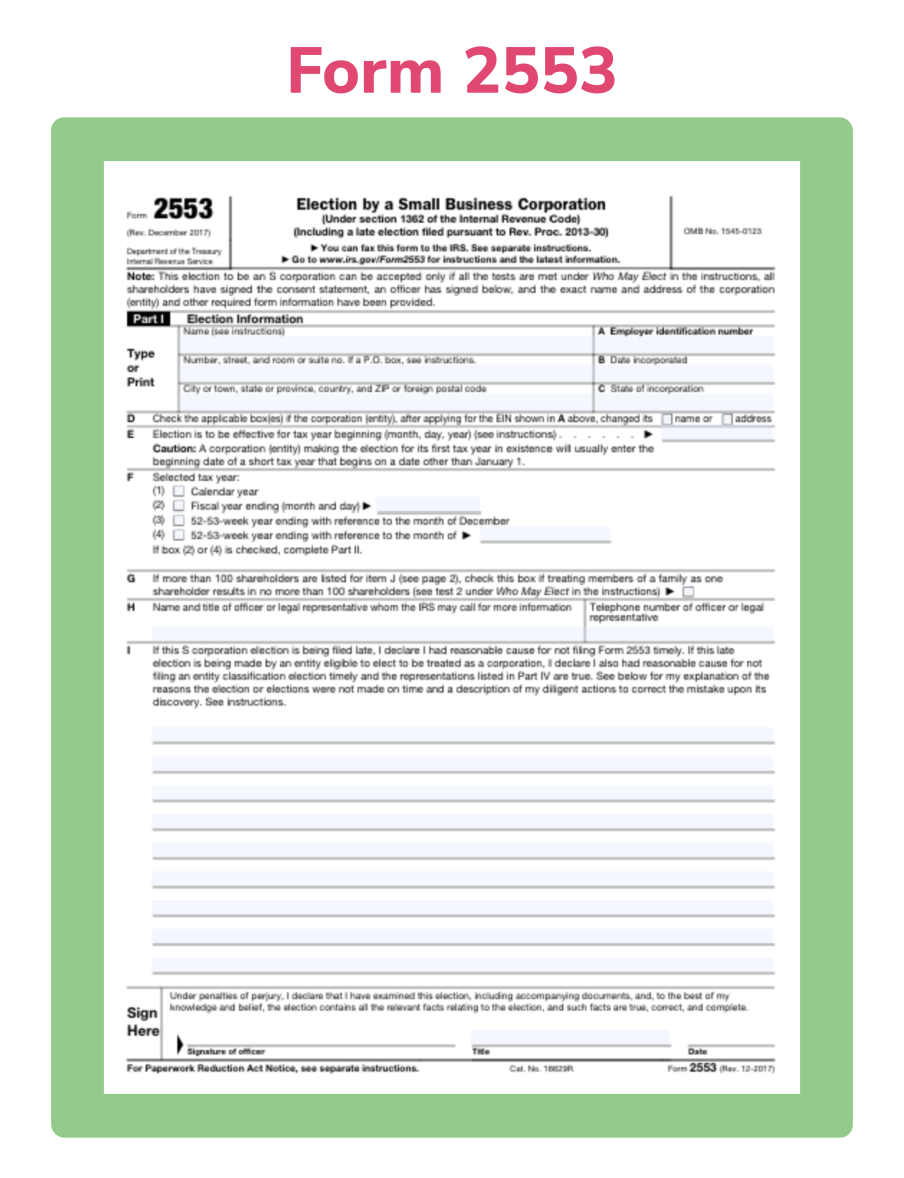
If the corporation isn’t electing S status for its first tax year, it must specify the start date of the first year the S election will apply. For corporations changing their tax year and opting for S status during a short tax year, the start date of the short year should be entered. If S status isn’t desired for the short year, the start date of the next full tax year should be listed, and Form 1128 may need to be attached.
In Item F, the corporation selects its desired tax year (calendar year, fiscal year, etc.). If opting for a fiscal year, additional details and documentation might be required in Part II to justify the choice.
The corporation must list all current and former shareholders in Column J, including names, addresses, and ownership information.
A corporate officer (e.g., president, vice president, or treasurer) must sign and date the form. Unsigned forms will be rejected.
If stock is owned by a Qualified Subchapter S Trust (QSST), the income beneficiary must complete Part III or provide a separate statement to make the QSST election.
The completed form should be mailed or faxed to the IRS office designated for the corporation’s region.
Ensure submission is made no later than 2 months and 15 days after the start of the tax year for which S corporation status is desired.
Once submitted, the IRS will review the application. If issues arise, such as missing shareholder consents, the corporation can address them by following the guidance in Regulations section 1.1362-6.
Additional Notes:
By following these steps thoroughly and consulting with a tax professional for complex matters, a corporation can navigate the S election process smoothly and enjoy its tax benefits.
Link used: https://www.irs.gov/instructions/i2553
Ref: https://www.bench.co/blog/tax-tips/s-corp-taxes
| Feature | IRS Form 8832 | IRS Form 2553 |
| Purpose | Elect C-Corp status or change entity type. | Elect S-Corp status for tax purposes. |
| When to File | Before the first tax return or with ownership changes. | By March 15 (calendar year businesses) or within 75 days (new businesses). |
| Taxation | Double taxation (corporation and shareholders taxed). | Pass-through taxation (income taxed at the shareholder level). |
| Foreign Shareholders | Allowed. | Not allowed. |
| Filing Method | Mailed or faxed to the IRS. | Mailed or faxed to the IRS. |
| Compensation Requirement | None for shareholders. | Reasonable compensation required for shareholder-employees. |
| Shareholder Limit | No limit. | Maximum 100 shareholders. |
| Who Uses It | LLCs or corporations electing C-Corp status. | Corporations electing S-Corp status. |
A. Processing Form 2553 usually takes about 60 days. Once submitted, the IRS will send a notice to confirm whether the election is approved or rejected. It’s a good idea to file early to allow enough time for processing, especially if there are any time-sensitive matters related to the tax year.
A. If someone misses the due date, they may still be able to file late and request relief if they have a valid reason for the delay. The IRS offers late election relief under certain conditions, but it requires submitting extra documentation to show the cause of the delay. It’s important to follow IRS guidelines carefully when requesting this relief.
A. Yes, if there’s a mistake on Form 2553, the form can be amended. The person would need to submit a corrected form along with an explanation of the error. If the original filing was late, the amendment might also require late election relief. All shareholder consents and signatures should be updated when submitting the corrected form.
A. If Form 2553 is rejected, the IRS will notify the filer of the issue. Common reasons for rejection include missing signatures or incomplete details. To move forward, the form can be corrected and resubmitted. If the rejection was due to a late filing, the person may be eligible for late election relief, which allows them to request retroactive approval for the S-corp status.
Subscribe to keep up with the latest strategic finance content.
Request a demo