Login


Resignation Letter Format (with Samples)


PRODUCTS
 Payroll Suite
 HR Suite
 Talent Suite
 Project Services Suite
Meet the platform tailored to your business
Core system of record
One platform for the entire employee journey
How Srijan Technologies streamlined timesheets management with Keka
Read customer story
Anarock replaces fragmented HR processes with one platform for 2,500+ employees
Read the story
BY INDUSTRY
BY COMPANY SIZE
LEARN
EXPLORE KEKA
Navigate every labor law, wage regulation, and statutory requirement across all 28 states and 8 union territories without the legal headaches.
Learn More
A well-written resignation letter helps employees exit gracefully and protects professional relationships. This guide explains what to include: clear intent to resign, last working day, brief reason (optional), gratitude, and transition support. It offers multiple templates for different tones and scenarios, including short notice and personal reasons, so employees can communicate respectfully, while HR gets clean documentation for notice, handover, and compliance.
A resignation letter should be brief, clear, and professional. It usually includes your reason for leaving (if you wish to share one), your intended last working day, and a note of appreciation for your time at the organization. Getting the wording and format right can help you leave on a positive note.
In this guide, we’ll cover the key components of a resignation letter, explain how to write one, and share six ready-to-use templates for different situations.
A resignation letter is a formal written communication through which an employee informs their employer about their decision to leave the organization voluntarily. It serves as an official record of the employee’s resignation and includes important details such as their designation, date of submission, and intended last working day.
In India, the notice period generally depends on the employment agreement, appointment letter, and applicable company policies. A notice period of 30 to 90 days is common across many organizations, although the duration can vary depending on the employee’s role and employment terms.
You might wonder whether a resignation letter and a resignation email are the same. Both communicate the employee’s decision to leave, but they differ in how they’re submitted.
A resignation letter is generally submitted as a printed document or signed attachment, while a resignation email carries the same information in the email body.
Most organizations in India prefer a resignation email, but it’s always better to check your company’s resignation policy before submitting one.
A standard resignation letter should be brief, clear, and professional, with a few essential details to include. While the wording may vary depending on your reason for leaving, most resignation letters follow the same simple structure.
Here’s what you should include:
Date and recipient details: Start with the date of submission, followed by your manager’s name, designation, and company name.
Statement of resignation: Clearly communicate your decision to resign and mention your current job title.
Last working day: Specify your intended last working day based on your notice period or an agreed release date.
Reason for leaving (optional): You can briefly mention why you’re resigning, but you don’t have to disclose personal details.
Gratitude and transition support: Thank your employer for the opportunities and offer to assist with the handover.
Professional sign-off: Close the letter with a formal sign-off such as “Sincerely” or “Regards”, followed by your name.
Here’s a standard resignation letter sample you can use:
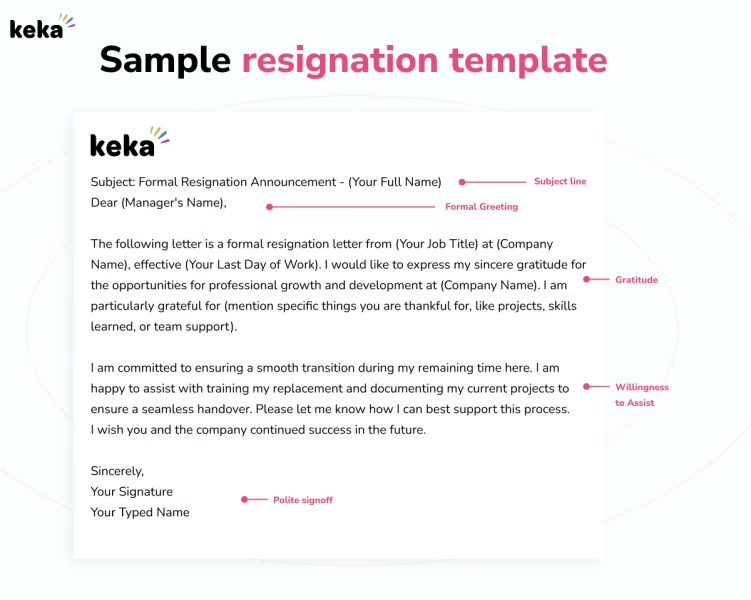
This is a basic resignation letter format that you can customize based on your role and circumstances.
You can write a resignation letter by following a simple format that addresses your reporting manager, states your intent to resign, specifies your last working day, and offers transition support.
You don’t need to go into every detail about why you’re leaving. Just follow these five steps to keep your letter clear and professional.
Start by addressing your resignation letter to your reporting manager or the person responsible for receiving resignations in your organization. You can also copy the HR team if required by company policy.
Tip: Ideally, speak to your manager before submitting the formal letter. This gives you an opportunity to communicate your decision directly and discuss any questions about your notice period or transition.
The first paragraph should make your decision clear. There’s no need to begin with a lengthy introduction or explain your reasons before mentioning that you’re resigning.
One of the most important details in a resignation letter is your last working day. Make sure you mention the exact date rather than using phrases such as “30 days from today”.
Before confirming the date, check your employment agreement for the applicable notice period. If you’ve discussed an early release or a change in the notice period with your manager, ensure that the agreed date is confirmed by the employer.
Your resignation letter should briefly communicate your willingness to help with the transition.
You can mention that you’ll:
Document ongoing projects and important process information.
Brief the colleague taking over your responsibilities.
Complete pending assignments before your last working day.
Transfer relevant files and client information through approved company channels.
You don’t have to include every handover activity in the letter. A simple statement offering to assist with the transition is enough.
A resignation letter should ideally fit within two or three short paragraphs. Keep your language professional and avoid unnecessary explanations, even if you’re leaving because of disagreements or dissatisfaction with your current role.
If you’re submitting your resignation through email, use a clear subject line and check the recipient details, last working day, and other information before sending it.
A professional resignation letter should be brief and clear, and since it serves as an official record of your resignation, it needs to cover all the essential details. Here’s a quick checklist to help you get it right before submitting it to your manager or HR team.
Employee details: Your full name, designation, department, and employee ID, if applicable.
Recipient details: Your reporting manager’s name and designation.
Date of submission: The date on which you’re formally submitting your resignation.
Statement of resignation: A clear sentence communicating your decision to leave.
Last working day: The intended date of departure based on your notice period or an agreed release date.
Reason for resignation: A brief explanation, if you’re comfortable sharing one.
Expression of gratitude: Acknowledgment of the opportunities and support you’ve received.
Transition support: Your willingness to complete pending work and assist with the handover.
Professional sign-off: Your name and signature, wherever applicable.
These are the basic components of a professional company resignation letter. You can always customize the wording depending on your situation, as long as the essential details are covered.
A resignation letter should stay brief, clear, and professional, so there are a few things you should avoid including. After all, its purpose is to communicate your decision, not to revisit every disagreement or concern you’ve had at work.
Here are some things to leave out:
Negative comments: Avoid personal criticism of your manager, colleagues, or organization.
Unnecessary personal details: You don’t have to explain private family circumstances or provide a lengthy account of why you’re leaving.
Salary complaints: Compensation-related concerns are better discussed separately with HR or through the appropriate feedback process.
Informal language: Avoid phrases such as “Hey, I’m heading out next month.” Use a professional greeting and sign-off instead.
Unrelated career details: You can mention that you’ve accepted another opportunity, but there’s no need to explain every detail of your next role.
If you have concerns about your workplace experience, you can always raise them through an exit interview or the appropriate HR channel. Keep your resignation letter focused on your departure.
To make things easier, here are five resignation letter templates you can customize based on your situation.
Not every resignation looks the same. Someone leaving for a new job may need a different approach from someone resigning due to personal circumstances or requesting an early release.
You can use this short, straightforward template if you want to keep things simple. It communicates your decision, mentions your last working day, and includes a brief note of appreciation.
Subject: Resignation: [Your Full Name], [Job Title]
Dear [Manager’s Name],
I am writing to formally resign from my position as [Job Title] at [Company Name]. As per my notice period, my last working day will be [Date].
Thank you for the opportunities and support during my time here. I will complete my pending responsibilities and assist with the handover before my departure.
Sincerely,
[Your Full Name]
You can use this format if you’ve spent several years with an organization or hold a senior position and want to provide a little more context in your resignation letter. It allows you to acknowledge your experience while keeping the communication professional.
Subject: Formal Resignation: [Your Full Name], [Job Title]
Dear [Manager’s Name],
I am writing to formally resign from my position as [Job Title] in the [Department Name] at [Company Name]. In accordance with my notice period, my last working day will be [Date].
During my time here, I’ve had the opportunity to work on [Project or Responsibility] and develop my professional skills. I appreciate the guidance and support I’ve received from you and the team.
I will ensure that my current responsibilities are handed over properly and that all important project information is documented before my departure.
Thank you for your support. I wish the organization continued success.
Sincerely,
[Your Full Name]
You can use this template if you need to leave your job due to personal circumstances that you don’t wish to discuss in detail. It keeps your explanation brief while formally communicating your decision.
Subject: Resignation: [Your Full Name], [Job Title]
Dear [Manager’s Name],
I am writing to formally resign from my position as [Job Title] at [Company Name] due to personal circumstances. My last working day will be [Date].
I appreciate the support and opportunities I’ve received during my time here. I will ensure that my pending responsibilities are handed over before my departure.
Thank you for your understanding.
Sincerely,
[Your Full Name]
A short notice resignation letter informs your employer that you cannot serve the complete notice period mentioned in your employment agreement. You can use it to request an early release and briefly explain your circumstances.
Subject: Resignation with Short Notice: [Your Full Name]
Dear [Manager’s Name],
I am writing to formally resign from my position as [Job Title] at [Company Name]. Due to [Brief Reason], I am unable to serve the complete notice period specified in my employment agreement.
I would like to request an early release, with [Proposed Last Working Day] as my intended last working day. I understand that this is shorter than the required notice period and would appreciate your consideration of my request.
I will complete the necessary handover and document my pending responsibilities before my departure. Please let me know how any notice period shortfall or related adjustments will be handled under company policy.
Thank you for your understanding.
Sincerely,
[Your Full Name]
You can use this template to resign when you’ve accepted another job offer and are planning to move to a different organization. It mentions your decision briefly without going into the details of your new role.
Subject: Resignation: [Your Full Name], [Job Title]
Dear [Manager’s Name],
I am writing to inform you that I have accepted a new professional opportunity and would like to resign from my position as [Job Title] at [Company Name]. My last working day will be [Date], in accordance with my notice period.
I appreciate the experience and support I’ve received during my time here. Working with the team on [Project or Responsibility] has been a valuable part of my professional experience.
I will complete my pending assignments and prepare the necessary handover documentation before my departure.
Thank you for your support. I wish you and the team the very best.
Sincerely,
[Your Full Name]
A resignation acceptance letter formally acknowledges an employee’s resignation, confirms their last working day, and outlines the handover and exit formalities that follow. So far, we’ve looked at resignation letters submitted by employees, but this one comes from the other side of the process: the employer or HR team sends it once an employee submits their resignation.
Here’s a simple resignation acceptance letter format:
Subject: Acknowledgement and Acceptance of Resignation: [Employee’s Name]
Dear [Employee’s Name],
This is to acknowledge receipt of your resignation letter dated [Date of Submission]. We accept your resignation from the position of [Job Title] at [Company Name].
Your last working day will be [Date], as agreed and confirmed by the organization.
Please coordinate with your reporting manager to complete the handover of your responsibilities before your departure. Our HR team will share the applicable exit formalities, including the return of company assets and details of the full and final settlement process.
We appreciate your contributions during your time with the organization and wish you success in your future endeavors.
Sincerely,
[Your Name]
[Your Designation]
[Company Name]
After you submit your resignation, you’ll usually need to serve your notice period, hand over your responsibilities, and complete the exit formalities. Submitting your resignation letter is only the first step in the exit process, and your manager or HR team will typically acknowledge the communication and initiate the necessary formalities.
These may include:
Resignation acknowledgment: Your employer acknowledges receipt of your resignation and communicates the next steps.
Notice period: You continue working as per the applicable notice period or any mutually agreed arrangement.
Handover: You document pending work, transfer responsibilities, and brief the colleague taking over your role.
Exit formalities: You complete the required documentation, return company assets, and participate in an exit interview, if applicable.
Full and final settlement: HR processes eligible salary, leave encashment, gratuity, and other applicable dues based on employment terms and relevant rules.
What if you change your mind after submitting your resignation? You can request to withdraw it in writing. However, whether the employer accepts the request depends on the circumstances, applicable employment terms, and the stage of the exit process.
For HR teams, managing these activities involves coordinating handover tasks, collecting company assets, conducting exit surveys, and preparing the necessary documents. Keka’s employee offboarding process helps HR teams manage these activities through automated exit workflows, survey collection, and document generation and tracking.
A resignation letter is an important part of your exit from an organization. While there’s no need to make it lengthy, ensure that it communicates your decision clearly and includes all the essential details. Check your notice period, confirm your last working day, and keep the tone professional, regardless of your reason for leaving.
If you’re unsure where to start, choose a resignation letter template that matches your situation and customize it with your details. A little attention to the format and wording can help you communicate your decision clearly and make the transition easier for both you and your employer.
Subscribe to keep up with the latest strategic finance content.
Request a demo