


 Login
Login

Employee Net Promoter Score
Read Time: 3 Mins


PRODUCTS
 Payroll Suite
 HR Suite
 Talent Suite
 Project Services Suite
Meet the platform tailored to your business
Core system of record
One platform for the entire employee journey

BY INDUSTRY
BY COMPANY SIZE
LEARN
EXPLORE KEKA
Employee Net Promoter Score or eNPS measures how likely employees are to recommend their employer as a great place to work. It asks one simple question on a 0-10 scale, then classifies responses into Promoters (9-10), Passives (7-8), and Detractors (0-6). The final score equals % of Promoters minus % of Detractors, producing a value between –100 and +100.
eNPS gives HR teams a quick pulse on employee engagement and loyalty. It helps them pinpoint areas needing focus.
Want to keep your best people and build a happy workplace? Use Keka’s pulse surveys to listen, understand, and act on what your team truly needs.
eNPS score can be calculated using the formula below:
eNPS = % Promoters − % Detractors (ignore Passives)
For example, in a survey of 100 employees, 60 score 9-10 (Promoters), 25 score 7-8 (Passives), and 15 score 0-6 (Detractors).
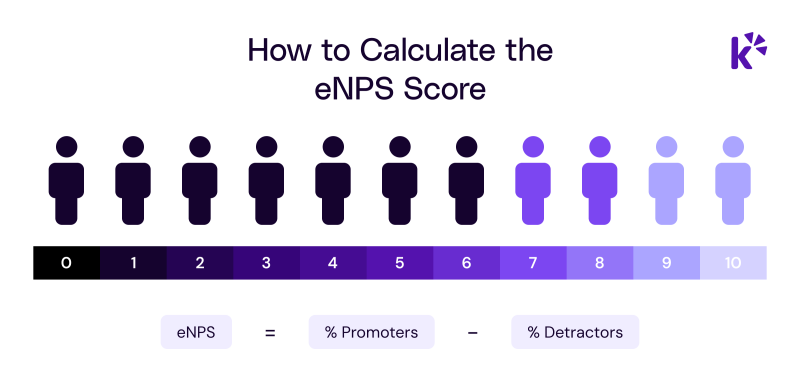
The eNPS score will be 45, i.e. the difference between promoters (60%) and detractors (15%).
Who are promoters, detractors, and passives?
- Promoters are employees who rate 9-10 on the eNPS scale. They feel highly satisfied, loyal, and are likely to recommend the company to others.
- Passives are employees who rate 7-8. They are generally content but not enthusiastic enough to actively promote the company.
- Detractors are employees who rate 0-6. They are dissatisfied or disengaged and may discourage others from joining or staying with the organization.
Running an eNPS survey gives HR teams a reliable pulse on how teams feel and helps them take smart action. Below are the benefits of conducting an eNPS survey.
NPS measures how likely customers are to recommend a product or service, while eNPS applies the same method to measure how likely employees are to recommend their employer.
| Parameter | NPS | eNPS |
| Focus | Customer satisfaction and loyalty | Employee engagement and workplace advocacy |
| Survey question | Will you recommend the product? | Do you recommend working here? |
| Use cases | Product feedback, retention, marketing | Culture audits, turnover risk, and employer branding |
| Response motivation | Based on consumption experience | Based on job, culture, management, and stability |
| Typical score level | Can run high (50 to 70 in top brands) | Even modest positives (+10 to +30) often signal strong culture |
Below are some best practices to improve eNPS score.
Subscribe to keep up with the latest strategic finance content.
Request a demo


