Login


Tax Write-Off: A Guide for Individuals and Small Businesses



PRODUCTS
 Payroll Suite
 HR Suite
 Talent Suite
 Project Services Suite

Meet the platform tailored to your business
Core system of record
One platform for the entire employee journey

BY INDUSTRY
BY COMPANY SIZE
LEARN
EXPLORE KEKA
A tax write‑off legally reduces income. Most individuals and small businesses. Misunderstand what qualifies for a write‑off or fail to document enough to claim a write‑off. Knowing the difference, between deductions, credits and non‑deductible spend shapes year‑end planning for owners, finance and employees. This guide breaks down what write‑offs are, the write‑offs, how to claim a write‑off and what does not count as a write‑off.
One of the most powerful tools available to individuals and businesses to legally reduce their taxable income is the tax write-off.
Often misunderstood or underutilized, tax write-offs, also called deductions, can significantly impact how much you pay the government each year.
At its core, a tax write-off is an expense or amount you can subtract from your total income before calculating the taxes you owe. The lower your taxable income, the lower your tax liability. For individuals, that might include mortgage interest, student loan payments, or charitable donations. For business owners, it could be office rent, equipment, travel, or even a portion of your phone bill, if it’s used for business purposes.
In this guide, we break down what tax write-offs really are, how they work, and why they matter.
A tax write-off is an expense that you can legally subtract from your total income to reduce how much of that income is subject to tax.
In simpler words, it lowers your taxable income, which in turn reduces the amount of taxes you owe.
These are often referred to as tax deductions, and they’re one of the most common ways individuals and businesses reduce their overall tax burden.
According to the IRS, tax deductions (write-offs) are amounts that taxpayers can subtract from gross income in order to arrive at the amount of income that is actually taxable. By reducing taxable income, deductions help lower the total tax liability.
While the terms are often used interchangeably, there’s a key difference between write-offs (deductions) and tax credits:
A tax deduction (or write-off) reduces your taxable income. For example, if you earn $60,000 and claim $10,000 in deductions, you’re only taxed on $50,000.
A tax credit, on the other hand, directly reduces the amount of tax you owe. So if your total tax due is $3,000 and you have a $500 credit, you only pay $2,500.
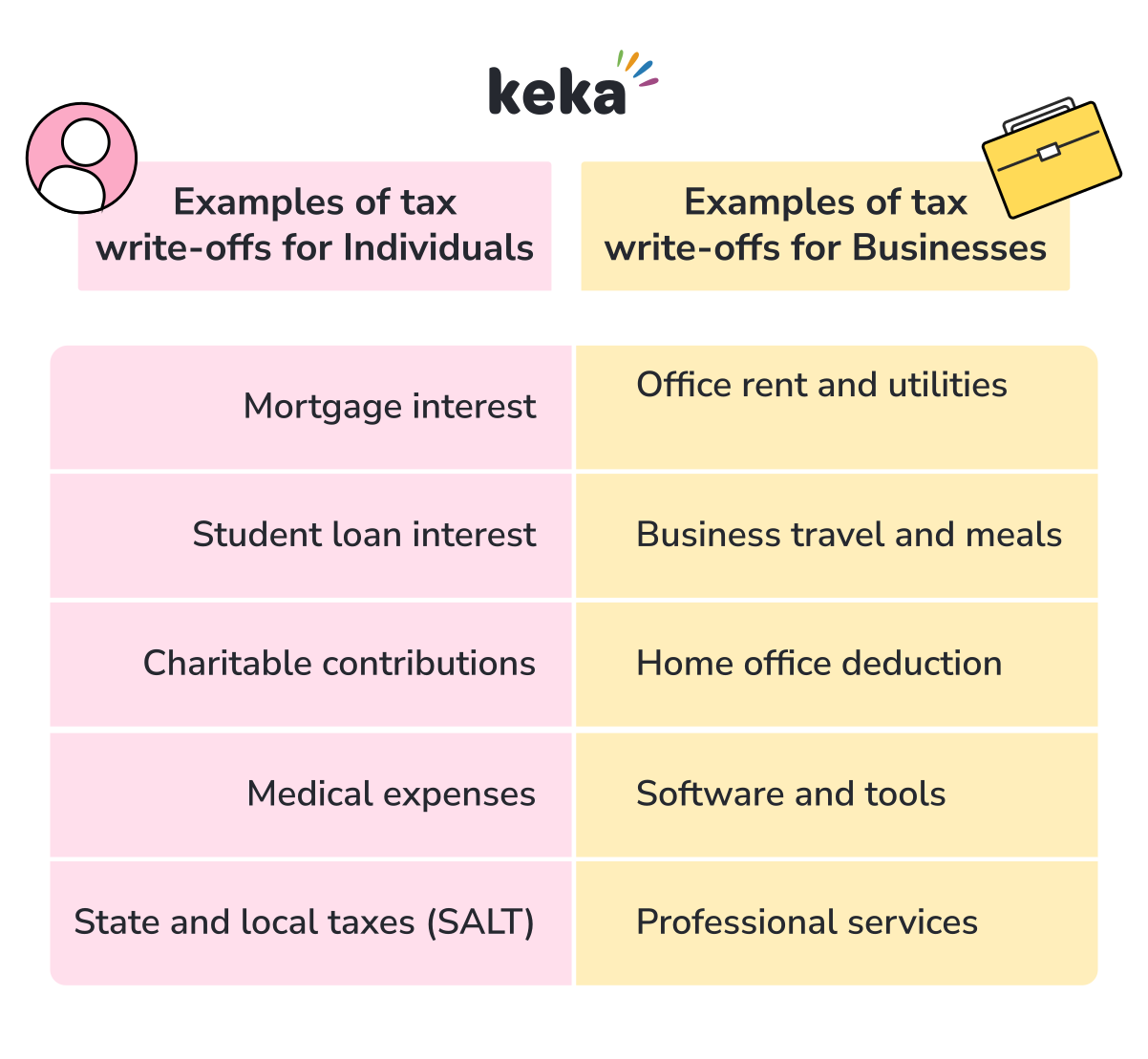
Tax write-offs come in many forms and can apply to both individuals and businesses.
For individuals, it can mean:
For businesses, it can mean:
Some are designed to reduce your taxable income as an individual, while others are available to business owners to reflect the costs of running a company.
As an individual taxpayer, you typically have two options when it comes to deductions:
A fixed amount that reduces your taxable income. For 2024, it’s $14,600 for single filers, $29,200 for married couples filing jointly, and $21,900 for heads of household. You don’t need to list individual expenses to claim this.
A list of eligible expenses you can claim instead of the standard deduction, but only if their total exceeds the standard deduction amount.
If you itemize, you can deduct interest paid on up to $750,000 of mortgage debt ($1 million if the mortgage originated before Dec 15, 2017). This is one of the most valuable deductions for homeowners.
You can deduct unreimbursed medical expenses that exceed 7.5% of your adjusted gross income (AGI). This includes surgeries, dental treatments, mental health care, and some travel for medical care.
You can deduct up to $10,000 in a combination of state income taxes or sales taxes, and property taxes. This cap applies whether you’re single or married.
Cash donations to qualified nonprofits are deductible, as are donations of goods, but proper documentation is required. The limit is generally 60% of your AGI for cash gifts.
You can deduct up to $2,500 in interest on qualified student loans, even if you don’t itemize, subject to income limitations.
When you earn money, the government doesn’t tax your entire income. Instead, you’re allowed to subtract certain qualifying expenses, called deductions or write-offs, from your total income. The result is your taxable income.
Once your taxable income is calculated, the tax authority applies the applicable tax rates to it. The lower your taxable income, the lower your tax liability.
Let’s say you’re a freelance graphic designer who made $80,000 this year. You kept good records and claimed these business deductions:
Laptop and software: $2,000
Home office expenses: $4,000
Business meals: $1,000
Professional courses: $1,000
Advertising and subscriptions: $3,000
That’s a total of $11,000 in write-offs.
Now let’s do the math:
Total income: $80,000
Minus write-offs: –$11,000
Taxable income: $69,000
If you’re in the 22% federal tax bracket, you just saved $2,420 in taxes (22% of $11,000).
And that’s just the federal impact. State tax savings could add more.
For businesses, write-offs can mean the difference between reinvesting profits or handing them over in taxes. For individuals, it might mean qualifying for a lower tax bracket or a bigger refund.
The IRS expects you to keep thorough records and backup every deduction you claim. If done correctly, write-offs can significantly reduce your tax liability without causing compliance issues.
According to IRS Publication 463 (Pages 36–42), proper recordkeeping is not optional; it’s required. The IRS recommends keeping records that show:
Keep track of the following diligently:
| Type of Expense | Examples of Proof |
| Business meals | Receipts, name of client, business purpose of the meeting |
| Travel expenses | Itinerary, transportation receipts, hotel bills, mileage logs |
| Office equipment | Purchase invoices, warranty papers, and bank statements |
| Home office use | Utility bills, rent/mortgage, home office layout/size calculation |
| Contractor payments | Invoices, 1099-NEC forms, proof of payment |
The IRS generally recommends keeping tax-related records for at least three years, but some situations (like claiming depreciation) may require up to seven years.
The right form depends on your filing status and whether you’re claiming personal or business deductions.
While many expenses can help reduce your tax bill, not everything you spend money on qualifies as a deduction.
The IRS has strict guidelines, and deducting an ineligible expense can trigger audits, interest, and penalties.
Just because a cost feels business-related doesn’t mean it’s tax-deductible.
| Expense | Why It’s Not Deductible |
| Personal expenses | You can’t deduct personal purchases, even if occasionally used for work (e.g., groceries, home furniture). |
| Clothing | Unless it’s a uniform or protective gear required solely for business, clothing isn’t deductible. |
| Commuting costs | Traveling from home to a regular workplace is considered personal commuting, not a business expense. |
| Entertainment | Business-related entertainment (e.g., concert tickets for clients) was once deductible, but is no longer under current IRS rules (post-2018). |
| Fines and penalties | Government-imposed fines (parking tickets, OSHA violations, late fees, etc.) are not tax-deductible. |
| Political contributions | Donations to political parties, campaigns, or PACs are strictly non-deductible. |
| Club dues and memberships | Fees for social, athletic, or business clubs (like a golf club membership) are not deductible, even if used for networking. |
| Capital improvements (immediate) | Large equipment or real estate improvements must be capitalized and depreciated over time, not deducted all at once. |
| Gifts over $25 per person/year | You can deduct only up to $25 per recipient per year for business gifts, no matter how generous you are. |
| Life insurance premiums | If you’re the beneficiary, premiums for life insurance on yourself or employees are generally not deductible. |
| Illegal activities | Obviously, any expenses tied to illegal actions, like bribes, kickbacks, or trafficking, are not deductible. |
As an employer, knowing which expenses qualify and how to document them properly can save your company thousands of dollars, while also keeping you on the right side of tax regulations.
But managing payroll, deductions, reimbursements, and compliance, all while running a business, is no easy feat.
That’s where Keka comes in.
Keka simplifies your financial back-office by:
Subscribe to keep up with the latest strategic finance content.
Request a demo