Login


Year-End Payroll Checklist for India FY 2026-27: Complete Guide to Compliance & Reporting


PRODUCTS
 Payroll Suite
 HR Suite
 Talent Suite
 Project Services Suite

Meet the platform tailored to your business
Core system of record
One platform for the entire employee journey

BY INDUSTRY
BY COMPANY SIZE
LEARN
EXPLORE KEKA
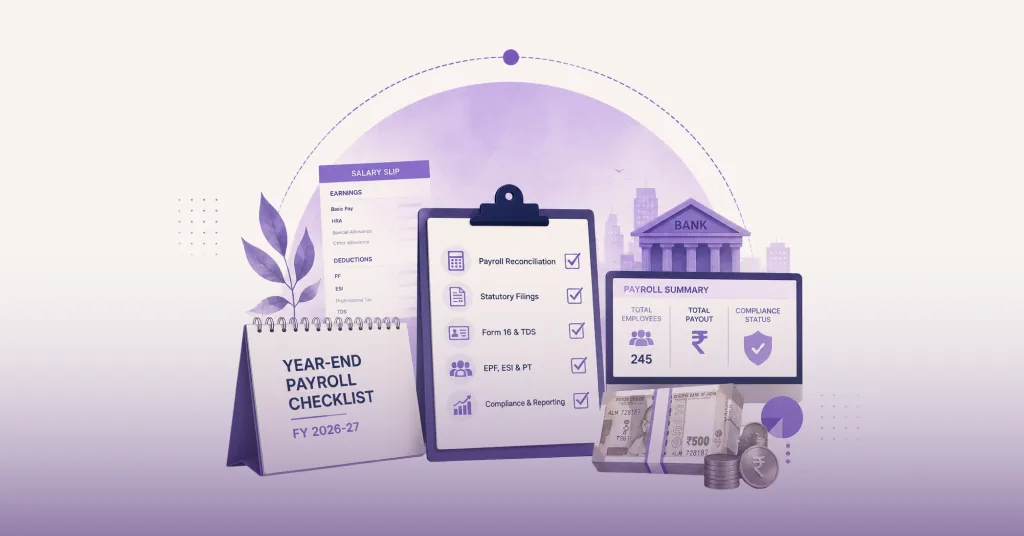
This Year-End Payroll Checklist for India FY 2026-27 walks HR and payroll teams through every stage of closing the financial year. From payroll reconciliation and statutory filings to Form 16, EPF, ESI, Professional Tax, and FY 2026-27 compliance updates, it provides a step-by-step framework to help businesses stay compliant and avoid costly payroll errors.
A year-end payroll checklist helps HR and payroll teams close the financial year accurately by reconciling payroll, verifying statutory deductions, filing TDS and other applicable returns, issuing employee tax certificates, and preparing the system for the next financial year.
For FY 2026-27, the process also includes two important transitions. Under the Income Tax Act, 2025, Form 16 and Form 24Q move to Form 130 and Form 138 for FY 2026-27’s own year-end reporting cycle. The Labour Codes have also changed the treatment of full and final settlements, with wage dues required to be settled within the prescribed two-working-day timeline where applicable.
This guide breaks the process into four practical phases: pre-year-end preparation, the final March payroll run, post-year-end reporting, and new financial year setup. The checklist continues well beyond 31 March because several reporting and filing obligations fall in April, May, and June.
Year-end payroll is the process of closing out a financial year’s payroll cycle and confirming that payroll records, tax deductions, statutory contributions, payments, and reporting requirements all reconcile correctly.
For an Indian employer, this includes final tax calculations and compliance across TDS, PF, ESI, and Professional Tax. It also involves issuing Form 16 or its applicable successor under the new framework and confirming that payroll records match actual salary payments and statutory deposits.
The process broadly runs across four phases:
Pre-year-end preparation (January – February): PAN verification, investment proof collection, and year-to-date reconciliation.
Final payroll run (March): Final TDS calculations, bonus and perquisite processing, statutory verification, and full and final settlement.
Post-year-end reporting (April – June): TDS returns, employee tax certificates, PF and ESI reporting, and Professional Tax compliance.
New FY setup (April): Tax configuration, statutory wage checks, and fresh investment declarations.
India’s payroll year runs from 1 April to 31 March. Unlike a simple salary close, employers also need to verify tax-saving investments and expenses employees declared earlier in the year, adjust TDS based on valid proof, and ensure compliance with both tax and labour-related obligations.
The Income Tax Department governs TDS, tax certificates, and investment declarations. Labour and social-security compliance covers wage-related obligations such as PF and ESI. That overlap is why a structured four-phase checklist works better than treating year-end payroll as one task completed in March.
Year-end is where several months of payroll activity finally have to reconcile.
A wrong or delayed employee tax certificate, an incorrect TDS adjustment, or a PF contribution that wasn’t deposited on time can create more than a filing problem. Employees see these issues as mistakes involving their salary or savings.
Payroll teams also need to manage frequent statutory changes while maintaining accurate workforce reporting. The practical challenge is making sure regulatory updates reach payroll before the deadline does.
HR Tip:
A payroll system that tracks statutory changes and upcoming deadlines can reduce the amount of manual monitoring required during year-end. Keka’s compliance capabilities help teams keep payroll and statutory requirements in the same workflow.
The financial year runs from 1 April 2026 to 31 March 2027, but many year-end obligations are completed in the following financial year.
| Compliance Activity | Typical Due Date |
|---|---|
| Q4 TDS return | 31 May 2027 |
| Form 16/ applicable successor certificate | 15 June 2027 |
| PF annual records and applicable returns | April 2027, subject to the applicable filing framework |
| ESI post-period compliance | Applicable deadline after the contribution period |
| Professional Tax annual returns | Varies by state |
| Fresh investment declarations | At the start of the new FY |
The exact applicability and filing dates should always be checked against the relevant current framework, especially during the FY 2026-27 transition period.
The best time to start year-end payroll is before March. By January and February, payroll teams should already be checking the information that will affect final TDS and statutory reporting.
A missing or invalid PAN can affect the applicable TDS rate and create unnecessary reconciliation work later. Verify employee PAN details before the final payroll run rather than discovering mismatches while preparing tax certificates.
Employees should also be asked to update changes affecting payroll, such as address details, tax regime selection where applicable, or other information required for statutory reporting.
Investment declarations collected at the start of the financial year are only estimates. Year-end TDS should be based on eligible and supported claims.
Set a clear deadline for submitting documents related to deductions, exemptions, and eligible expenses. Review the proof before applying the final tax benefit.
A missed deadline usually means payroll has to calculate TDS without considering an unsupported claim, which can increase deductions in the final months of the year.
Before March, compare payroll records with:
Salary paid through bank transfers
TDS deducted and deposited
PF and ESI contributions
Bonus and incentive payments
Leave encashment and other taxable components
Payroll-related provisions in the general ledger
The objective is simple: identify mismatches while there is still time to correct them in the final payroll cycle.
The March payroll run is where the year’s tax and salary calculations finally come together.
Calculate taxable income based on actual salary, verified declarations, exemptions, deductions, perquisites, and any final adjustments.
If an employee submitted a valid investment proof late, the resulting tax correction may significantly change their final-month TDS. Payroll teams should explain major adjustments where possible because employees often notice only the change in take-home salary.
Review any year-end bonus, incentive, arrear, perquisite, or other taxable payment that needs to be included in the final salary calculation.
This includes items such as employer-provided benefits and bonuses that may have been approved late in the year but still affect the relevant payroll period.
FY 2026-27 brings particular attention to the timing of employee exits. Where the applicable Labour Code provisions govern the payment, wage dues are subject to the prescribed two-working-day settlement timeline.
Any exit workflow still built around a 30 to 45-day settlement cycle needs to be reviewed against the applicable requirement. Manual calculation, manager approvals, leave adjustments, and asset recovery cannot be allowed to create unnecessary payroll delays.
Keka’s employee offboarding module can help bring exit calculations and workflow approvals into the same process.
Before closing the final run, confirm that contributions and deductions have actually been deposited.
A correctly calculated PF, ESI, or TDS amount can still trigger consequences if the payment itself is late. Year-end verification should therefore cover both the payroll calculation and the corresponding challan or deposit.
The payroll year may close on 31 March, but reporting continues into the next financial year.
The January to March TDS return is one of the most important post-year-end filings because employee tax certificates depend on accurate reporting.
For FY 2026-27, the payroll reporting framework transitions under the Income Tax Act, 2025. The salary TDS return moves to the applicable Form 138 framework for the relevant reporting cycle.
The return should be reconciled with payroll records before the employee tax certificates are generated.
Under the existing framework, the employee salary tax certificate includes:
Part A: TDS deducted and deposited
Part B: Salary, exemptions, deductions, and tax calculations
For FY 2025-26, employers continue with the applicable Form 16 cycle.
For FY 2026-27, the transition to Form 130 applies to the relevant employee tax certificate framework under the Income Tax Act, 2025.
The certificate should only be generated after the corresponding TDS reporting has been accurately completed.
PF and ESI records should be reconciled against:
Monthly payroll deductions
Employer contributions
Challan payments
Employee-wise contribution records
For FY 2026-27, payroll teams should ensure that their filing and reporting process reflects the applicable statutory framework, including relevant EPF Scheme 2026 requirements.
The important control is consistency. The contribution recorded in payroll should match the contribution reported and deposited.
Professional Tax is a state-level obligation, and its requirements can vary based on where employees work.
Employers operating across multiple states may need to manage different:
Registration requirements
Return frequencies
Forms
Payment schedules
A payroll process that works for employees in one state may not automatically satisfy the requirements of another.
The following forms and records commonly appear during the year-end process:
| Form | Purpose | Frequency | Typical deadline |
|---|---|---|---|
| Form 16/Form 130 | Salary TDS certificate | Annual | 15th June |
| Form 24Q/Form 138 | Quarterly salary TDS return | Quarterly | 31st May (Q4) |
| Form 12BA | Prerequisite disclosure | Annual, with Form 16 | 15th June |
| Form 3A | Individual PF contribution record | Annual | 30th April |
| Form 6A | Consolidated PF contribution record | Annual | 30th April |
| Form V | Consolidated EPF scheme 2026 return | Initial + Monthly | 15 days |
| PT Form 5 (State-specific) | Annual PT return | Annual | Varies by state |
The key is to use the form and process applicable to the relevant reporting period.
During a transition year, payroll teams should be particularly careful about relying on outdated checklists or form names.
Reconciliation is the control layer of year-end payroll.
It checks whether the numbers calculated in payroll match the amounts actually paid, deposited, reported, and recorded in the company’s accounts.
| Check | What it confirms |
|---|---|
| Salary vs general ledger | Payroll totals match accounting records |
| TDS vs returns filed | Tax deducted matches tax reporting |
| PF and ESI vs challans | Contributions match statutory deposits |
| Bank file vs net pay | Salary transfers match payroll calculations |
| Provisions | Bonus, gratuity, and leave liabilities are properly accounted for |
A mismatch should have a clear explanation before the financial year is closed.
For example, if payroll records ₹12 lakh in bonus expense while the general ledger shows ₹11.8 lakh, the ₹20,000 difference should be investigated.
It could be:
A timing difference
An accounting entry issue
An unrecorded liability
A payroll calculation error
The correction depends on the reason for the mismatch.
Note:
Keka’s payroll workflows can help surface payroll and statutory variances before they become a year-end reconciliation exercise.
Closing the old year and preparing the new one should be part of the same workflow.
Review the applicable:
Income tax slabs
Standard deduction
Cess
Surcharge
Tax regime settings
Budget 2026 did not require a general reconfiguration of the income tax slabs, surcharge, cess, or standard deduction for FY 2026-27. However, payroll teams should still verify their configuration against the applicable rules before processing the first payroll cycle.
Review the statutory treatment of:
New joiners
Employees whose compensation has changed
Employees approaching applicable wage thresholds
The applicable PF and ESI rules should be correctly reflected from the first payroll cycle of the new financial year.
The investment declaration process starts again with the new financial year.
Employees declare the investments and deductions they expect to claim during the year so payroll can estimate TDS from the beginning. Collecting these declarations early reduces the March rush that happens when every tax adjustment is left for the final payroll cycle.
The biggest year-end payroll problems are often created by issues that appear small during the year.
An invalid PAN can affect the applicable TDS rate. Missing investment proof deadlines can force payroll to exclude unsupported claims from the final calculation. ESI treatment needs to follow the applicable contribution-period rules rather than being adjusted incorrectly based on a single month’s salary.
State-level Professional Tax can also create gaps for companies expanding into new locations.
The common thread is timing. Most of these problems become difficult to fix only because they are discovered too late.
The basic compliance framework applies across businesses, but the operational risk changes as headcount grows.
Businesses approaching statutory thresholds need to monitor when new obligations begin.
ESI and EPF employee thresholds are important triggers and the obligations can continue even if headcount later drops below the original registration threshold.
Small teams should therefore track applicability continuously instead of reviewing thresholds only at year-end.
Larger businesses deal with additional complexity:
Multi-state Professional Tax obligations
Higher volumes of employee tax declarations
Greater reconciliation requirements
More formal audit and due-diligence expectations
| Business Size | Key Year-End Obligations |
|---|---|
| Under 20 employees | Statutory threshold monitoring, PAN and investment proof basics |
| 20-200 employees | Full TDS, PF, ESI, and PT calendar with stronger recordkeeping |
| 200+ employees | Multi-state compliance, formal reconciliation controls, higher audit exposure |
A missed payroll deadline can result in different consequences depending on whether the failure involves calculation, deposit, filing, or certificate issuance.
Late TDS statements can attract a fee of ₹200 per day under Section 234E, subject to the applicable cap.
In specified cases, a separate penalty ranging from ₹10,000 to ₹1,00,000 may apply under Section 271H.
Delayed TDS deposits can also attract interest under the applicable provisions.
Late statutory contribution payments can attract applicable interest and damages.
The important distinction is between calculating a contribution and depositing it. A payroll calculation is not the end of the compliance process.
Delayed issuance of the applicable employee tax certificate can also attract penalties under the relevant tax provisions.
| Violation | Section | Penalty |
|---|---|---|
| Late TDS return filing | 234E | 200/day, capped at TDS amount |
| Failure to file TDS statement | 271H | 10,000 to 100,000 |
| Late TDS deposit | 201(1A) | 1.5% per month interest |
| PF contribution default | EPF penalty structure | 1% per month, capped at 12% annually |
| Late Form 16 issuance | 272A | 500/day |
The practical approach is to track calculation, payment, filing, and certificate generation as separate tasks.
Completing one does not mean the others are complete.
Not every employee deduction looks like a traditional investment.
Section 80E covers eligible interest paid on qualifying education loans.
The deduction applies to the interest component, subject to the applicable conditions and prescribed period. Employees should provide the relevant lender certificate or supporting documents during the investment-proof verification process.
Loans from friends or relatives do not automatically qualify simply because the money was used for education.
This is why year-end proof collection should cover more than the most common deductions.
Employees need a clear process for submitting all eligible supporting documents before final TDS is calculated.
Year-end payroll becomes harder when:
Deadlines are tracked in one spreadsheet
Employee data is stored somewhere else
Tax calculations sit in another system
Statutory payments are manually reconciled at month-end
Payroll software can bring these activities into a more structured workflow by helping teams:
Automate payroll calculations
Maintain employee records
Track statutory deadlines
Generate payroll and compliance reports
Support reconciliation
Maintain audit trails
For a deeper evaluation framework, see our guide on how to choose payroll software in India.
Closing payroll for the financial year involves far more than processing the March salary.
The process starts with early preparation, moves through final TDS and statutory reconciliation, continues into post-year-end reporting, and finishes with setting up the next financial year correctly.
For FY 2026-27, payroll teams also need to keep the new Income Tax Act reporting framework and updated settlement requirements in view.
The four-phase checklist provides a practical sequence:
Prepare before March. Finalise and verify the March payroll. Complete post-year-end reporting. Configure the new financial year without carrying old errors into it.
If your team is still tracking payroll deadlines and reconciliations manually, a connected payroll system can reduce the amount of repeated work and improve visibility across compliance activities.
Keka helps businesses manage payroll calculations, statutory compliance, employee records, and reporting from the same platform.
Take the stress out of year-end payroll
Q1. What is year-end payroll?
Year-end payroll is the process of closing payroll for the financial year and reconciling salary payments, taxes, statutory deductions, and payroll records. It also includes post-year-end reporting, employee tax certificates, and preparing payroll for the next financial year.
Q2. When should year-end payroll activities happen?
Year-end payroll activities should ideally begin in January or February. PAN verification, investment proof collection, year-to-date reconciliation, and statutory checks should be completed before the final March payroll run.
Q3. What is the deadline for the Q4 TDS return?
The Q4 salary TDS return covering January to March is typically due by 31 May following the end of the financial year. Employers should ensure the return is accurately filed before generating the corresponding employee tax certificates.
Q4. When must employers issue the employee salary tax certificate?
The applicable employee salary tax certificate is generally issued by 15 June following the end of the financial year. For the FY 2026-27 reporting cycle, employers should follow the applicable Form 130 framework under the Income Tax Act, 2025.
Q5. How can payroll software simplify year-end payroll?
Payroll software can automate calculations, centralise employee data, track statutory deadlines, support compliance reporting, and reduce manual reconciliation. It is particularly useful at year-end because the same payroll data is required for tax reporting, statutory contributions, employee certificates, reconciliation, and new-year setup.
Subscribe to keep up with the latest strategic finance content.
Request a demo