Login


Minimizing Absenteeism in the Workplace


PRODUCTS
 Payroll Suite
 HR Suite
 Talent Suite
 Project Services Suite

Meet the platform tailored to your business
Core system of record
One platform for the entire employee journey

BY INDUSTRY
BY COMPANY SIZE
LEARN
EXPLORE KEKA
Absenteeism spikes when people are unmotivated, burnt out, sick without support, or facing conflict. Minimize it through flexibility, wellness programs, manager training to notice and care, clear expectations, and addressing root causes instead of punishing absence. Track patterns and intervene early.
Can you imagine that in 2022, Amazon almost ran out of workers?
As reported by Recode: “If we continue business as usual, Amazon will deplete the available labor supply in the US network by 2024.”
Even the founder, Jeff Bezos, was worried and said the company had to do a better job as an employer.
But isn’t Amazon one of the top three employers in the world?
While it is a place where smart, passionate, and innovating people gather, there is a major part of Amazon that remains unseen.
Behind every purchase you make, there is a team of workers packaging, shipping, and picking products at a poor wage. For some, it’s enough. For most, it is not.
This is the life of Amazon’s fulfillment associates, of those who work in the warehouses.
Coming back to why the company was about to run out of workers, the issue relates to how Amazon was dead set on surveilling each worker’s every move, pressurizing them to reach targets without any excuse for time off. Their employment would be reviewed if they didn’t notify the warehouse of an absence more than two hours before the shift. The injury rate was also 6.8 per 100 workers.
Workers’ well-being was neglected so much that Amazon had violated the federal law by penalizing emergency time-off as per their policy.
There was high absenteeism followed by attrition. In the end, the company was losing 5% of its workforce weekly, and 150% annually.
Sounds scary, doesn’t it?
Another example of workplace absenteeism is Covid-19. In 2022, there was an average of 1.6 million absences per month in the US. There was a spike in absenteeism levels as employees prioritized their well-being. Let us agree that our own well-being was a top priority during the pandemic – in fact, for most people, it has become even more important than it was during the lockdowns.
Also, absenteeism has been an issue even in 1998, as unplanned absences had gone up by 25% for the airlines – the highest in 7 years. About 26% of citations pointed toward ‘family issues.’
Now, you may ask:
What causes absenteeism in the workplace?
Absenteeism is caused by a number of factors like:
Employee absenteeism is usually intentional and results in higher costs for employers.
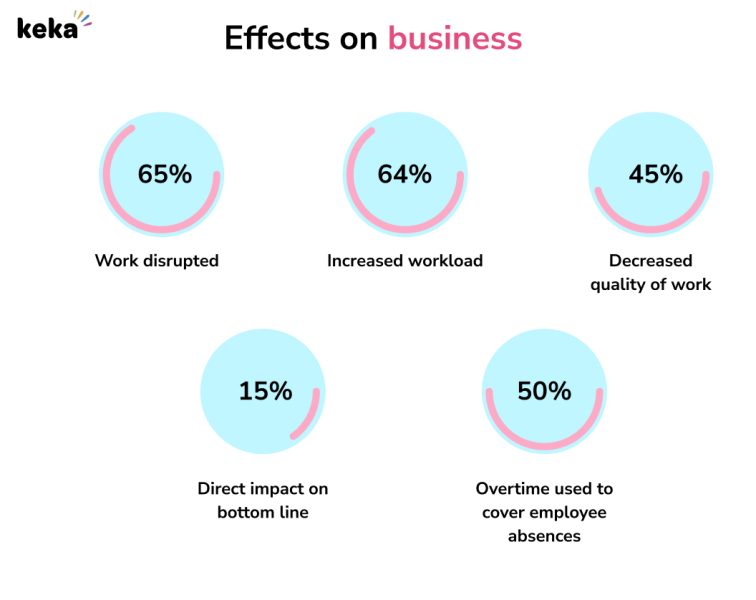
It affects quite a few aspects, but before we explore that, let’s see how it primarily affects productivity in the workplace:
Logically, an employee that works less is likely to be less productive. Other employees will have to take up extra workload, and managers have to spend a lot of time adjusting workflows and resources.
According to Centers for Disease Control and Prevention Foundation,
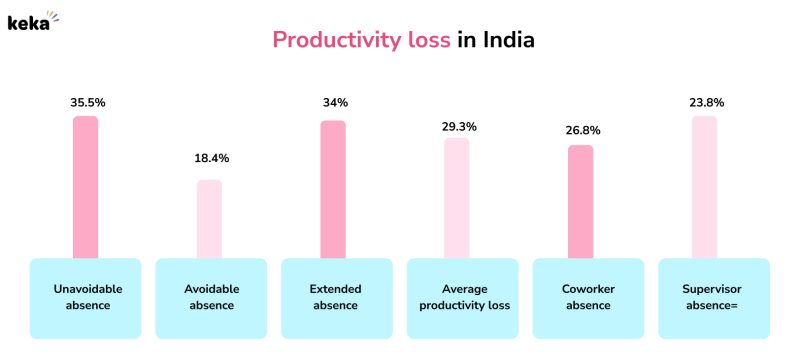
Go through this graph to see how employee productivity is affected in India:
 Source: Total Financial Impact of Employee Absences, 2014 – SHRM
Absenteeism in the workplace is divided into 4 types:
Planned and authorized absences typically do not have any adverse impact on productivity. However, absenteeism becomes an issue when it’s unauthorized as it creates frustration for those who are left to pick up the absent employee’s work. Most unplanned absences are unavoidable – such as accidents, family emergencies, illness, and so on. Such absences are high in India, placing it in the top 2 among 6 other countries.
One of the most common myths of absenteeism is that it is an employee’s personal problem and not the manager’s responsibility.
Leaders must recognize such employees as it heavily affects not only productivity but also business operations.
Imagine employees with specific roles – those who impact revenue directly, such as sales, consulting, software engineering, or those working in manufacturing. Absenteeism in such employee groups not only impacts teams but also potentially decreases revenue.
Absenteeism can be hard to tackle, especially when there’s a growing pressure on productivity and profitability. You can, however, keep tracking employee attendance to predict it and minimize.
Every company tracks attendance but differs in how they do it. Some use excel sheets while some rely on timesheets.
But is tracking attendance so important that you must change how you do it?
Well, it comes down to how Anne M. Mulcahy said it:
Managing your key to competitive advantage is crucial, and tracking their time is only the first step. It is important to:
While you can choose to track hours with spreadsheets, it is much more efficient and easier to adopt an online time and attendance system.
On average, employers spend 2.4 hours a week preparing shift schedules – and about 70% of employee work schedules are handwritten.
Employers not only lose thousands of dollars every year, but wage and time theft cost employers $22 billion and $11 billion a year respectively.
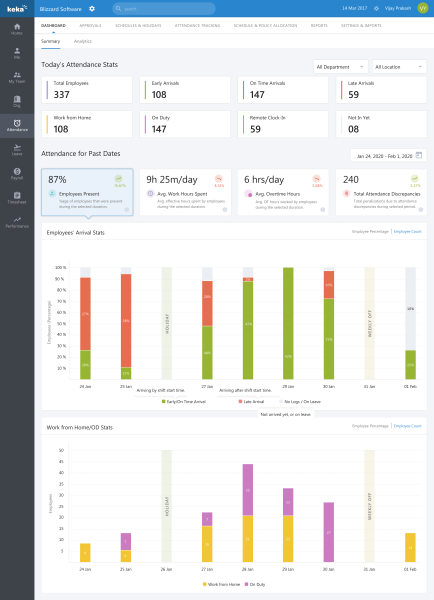
Keka is the only attendance software you will ever need as it integrates every aspect of time tracking. It has a beautiful interface for employers to track employee time, leave, and attendance:
In fact, absenteeism is the first sign of employee disengagement. Learn more about this here.
Let us consider Dan.
Dan is a new hire. He has missed 20 days of work since his hiring – due to an illness. He comes in sick at work or calls in sick at least two to three times per month.
His manager, Ross, is in a dilemma.
Ross knows it takes a lot of effort and resources to interview, hire, and train a new employee. Moreover, if he employs another person to replace Dan, he must continuously mold them into the person who is fit for their role.
What should Ross do?
Should he keep up with Dan or reach out to HR regarding this?
One thing Ross can do here is take the help of Gartner’s Analytic Value Escalator Framework.
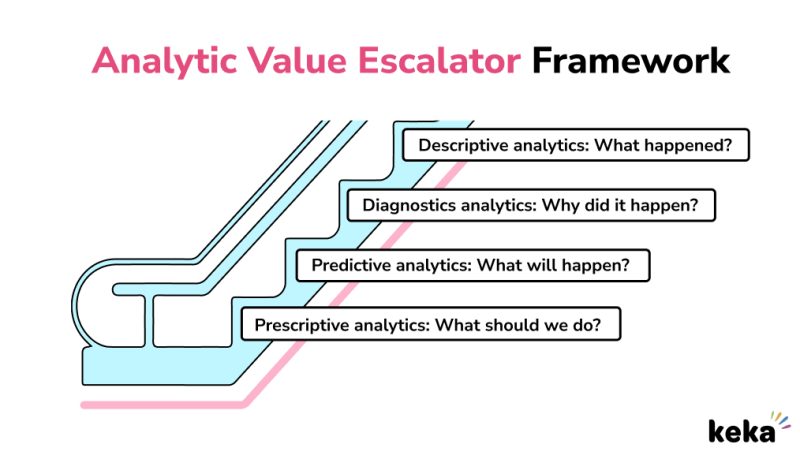
It subdivides business analytics into 4 levels:
As you can see, there is an evolution of data – from being descriptive to predicting what will happen and how we can influence it. By quantifying this data, you can improve the effectiveness of decision-making and strategy. Companies like Bain & Company, McKinsey, Deloitte, etc., have already realized this potential.
While it doesn’t necessarily mean only a top consulting firm can reap the benefits of AI, you can also leverage expertise from business strategists.
As to what Ross should do, this is the first step he should take:
In this type of analytics, Ross can use historical data from a single source to pinpoint when an event occurred.
For example:
Such information is often displayed in reports, making it convenient to take informed decisions.
Let’s look at what Ross found out in the first stage:
Now, Ross can dig deeper and analyze why this happened.
Diagnostic analytics digs deeper into the historical data collected above. The aim here is to identify patterns, trends, and correlations. It covers the ‘why’ aspect.
This is what Ross came across with:
Now, Ross has a good understanding of historical events: ‘when’ and ‘why’.
What next?
That’s what the next two analytics help decide.
Now the focus shifts from understanding historical events to generating insights about the current or future state. While it’s not possible to accurately predict what will happen in the future, Ross can identify the likelihood of potential outcomes.
Here are some possible outcomes Ross predicted, based on patterns and workload demands:
Since Ross has answered, “What will happen?”, he can develop actions based on these predictions – taking the best course of action.
In this stage, Ross will have to decide what will provide the best value to the organization.
Ross understood the likelihood of increased burden on other team members, as Dan is about 65% likely to come in sick. There would also be a decrease in sales. Ross decided to offer remote work options for Dan, when he is sick, while also adjusting work schedules to ensure minimal disruption to the team. Additionally, minor tasks were temporarily reassigned to his team members as per their expertise to avoid overburdening in the future.
Finally, Ross decided.
All that’s left is to communicate it to Dan.
Before exploring how Ross should communicate it with Dan, let’s agree that every organization faces employee absences – because after all, life happens. People get sick. People take vacations. People have social commitments. And so on.
It becomes serious when it’s excessive – causing an imbalance in the workload and affecting the bottom line.
If some amount of absenteeism is legal, normal, and expected…
What is considered excessive absenteeism, then?
Excessive absenteeism is two or more occurrences of unexcused absence in a 30-day period.
– SHRM
Now, communicating with an employee about their absenteeism is tricky – because they are entitled to sick days and time off, after all. Here are the steps you can take to discuss your employee’s absenteeism:
To start off, use an employee handbook to back you up. Remind the employee what was expected of them in terms of attendance when they accepted the role.
Don’t rush to let go of an employee because of their excessive absenteeism. If their performance is otherwise good, and perhaps even exceptional, letting go of them would be risky to the organization’s value.
Instead, discuss with the employee how they are late with tasks, or missed other tasks. Focus on addressing how their absence is affecting deadlines and other team members rather than the fact that they are not showing up to work. Overall, try resolving it together.
Not every employee who is absent is lazy or bored with their job. There might be something else going on – just like with Dan. Employees still have the right to remain silent, but addressing the underlying cause still matters.
Don’t just focus on the symptoms of absenteeism, but also on addressing the root causes. Listen and be empathetic but also use this opportunity to reinforce the expectations of the job. Explain how their attendance matters – both to the team and business operations. Ask how you can support them to help them show up – and on time.
As observed in Dan’s case, only a few months after continued absenteeism did Ross act. Delaying it will only make it worse for the team and the business.
A simple attendance management system is perfect to prove that an employee did not report for work. Well-documented evidence prevents you from accepting an employee’s continued excessive absences while also quickly addressing them.
If Dan’s company had used an attendance management system, Ross would have identified anomalies in attendance sooner.
Neuroscience research shows that employees respond better to rewards and recognition rather than threats and punishment. Many employees will be influenced by positive reinforcement, so recognize and give public praise for those with zero unexcused attendance or good attendance.
Let’s quickly explore ways to handle employee absenteeism:
Ross has successfully communicated the decision to Dan. Now, what is the way forward for Ross?
It was evident that Ross failed to address Dan’s attendance issues on time.
While some companies document and maintain attendance records, most use an employee attendance tracking system to identify patterns of absenteeism or poor conduct. The data captured by such software serves as a lens through which the management can address issues on time and manage work schedules.
Had Ross’ company used an attendance tracking system, would he have managed Dan’s work schedule on time? Yes. He would have also minimized the impact of Dan’s absenteeism on sales and the extra workload of other team members.
Subscribe to keep up with the latest strategic finance content.
Request a demo