Login
Login

How To Design A Leave Policy: For All Company Sizes


PRODUCTS
 Payroll Suite
 HR Suite
 Talent Suite
 Project Services Suite
Meet the platform tailored to your business
Core system of record
One platform for the entire employee journey

BY INDUSTRY
BY COMPANY SIZE
LEARN
EXPLORE KEKA
A step-by-step guide to creating a leave policy in India. This blog covers mandatory rules, policy structure, leave types, and templates to help companies build clear and compliant leave policies.
Leave policies set the rules for taking time off, making things fair and consistent for everyone in the company. A well-defined company leave policy allows clear communication between the employer and the employee and abides by the labor laws of the country.
Often HR managers stick to unwritten rules and parts of the constitution they assume are the industry norm while drafting these policies. This is usually considered a safe bet, protecting them from criticism or blame. However, it should be kept in mind that policies differ from company to company based on specific requirements.
Leave policies are an important contributing factor to company culture and employee experience. This article will guide the reader on how to design a leave policy as per the labor laws of India and how to select a leave management tool to adhere to the policy.
Switch to Hassle-Free Leave Management
Explore Keka
A leave policy is a written document that contains the rules and regulations of how employees can avail leave in the respective organization. It also states the number of different types of leaves that can be taken in a year and its eligibility.
The policy also consists of the process for requesting time off, approval procedures, and any specific conditions or requirements. Some leave policies may incorporate information on applicable legal regulations, such as family and medical leave laws. This is to ensure compliance with labor standards.
A leave policy is crucial for creating a healthy work environment, ensuring legal compliance, and fostering positive employee relations. Employees are granted leave to accommodate sickness, emergencies, personal matters, rest, and recreation.
A well-defined leave policy promotes work-life balance, allowing employees to manage their personal and professional responsibilities effectively. It supports the well-being of employees by providing them with the opportunity to take time off when needed for personal or health-related reasons.

There are 15 different types of leave policies for employees. The industry, company policies, and relevant labor laws may influence the specific provisions and durations of various types of leave. Here’s the list:
Sick leave is provided for employees facing health issues or illness. Companies typically allocate 7 to 15 days of sick leave per year.
It allows employees the necessary time to recover without compromising their pay. Depending on the policy, documentation, such as medical certificates or doctor’s notes, may be necessary for this type of leave.
Casual leave caters to unplanned or short-term absences. Companies generally grant 7 to 10 days of casual leave per year, providing flexibility for employees to address unexpected personal matters or take a brief break.
The terms and conditions for this type of leave should be detailed in the employee’s employment contract or company policy.
Paid or privileged leave is designed for planned time off, such as vacations or personal reasons. Companies often allocate 15 to 30 days of paid leave per year, allowing employees to recharge and attend to personal commitments.
Maternity leave is offered to expecting mothers, providing them with the necessary time for childbirth and postnatal care.
As per the Maternity Benefit Act, 1961, amended in 2017, female employees in India can avail a maximum of 26 weeks (182 days) of maternity leave, which can be taken both before and after childbirth based on their preference. However, if a woman has had two or more children, the entitlement is reduced to 12 weeks (84 days) of maternity leave.
Paternity leave is intended for new fathers to support them during the early stages of parenthood. Companies generally provide 5 to 15 days of paternity leave, allowing fathers to be actively involved in the care of their newborns.
Bereavement leave is granted to employees coping with the loss of a family member. Companies typically allow 3 to 7 days of bereavement leave, recognizing the need for employees to grieve and attend to funeral arrangements.
Menstrual leave addresses health issues related to menstruation. While the duration varies, companies often allow a day or two per month to accommodate the unique needs of female employees.
Compassionate leave is provided for situations requiring special consideration and support, such as family emergencies. The duration is case-specific, with companies typically granting 3 to 7 days for employees facing challenging circumstances.
Compensatory leave is granted in place of extra hours worked by employees. The duration is equivalent to the overtime worked, providing a fair mechanism for acknowledging and compensating additional effort.
Sandwich leave addresses situations where employees work on public holidays. The duration varies and may be granted as compensatory time off for holidays worked, ensuring a balanced approach to time management.
Floater leave is a flexible leave policy that allows employees to take time off for unforeseen personal or family needs. It provides a certain number of days, typically 1 to 3, which can be availed as needed, offering adaptability to address unexpected situations or events.
Marriage leave is granted to employees to celebrate their wedding. Companies usually provide 3 to 7 days of marriage leave, allowing employees to participate in wedding ceremonies and settle into married life.
Sabbatical leave is designed to allow employees to take an extended break from work for personal or professional development.
The duration of a sabbatical varies but is typically between 3 months to a year, providing employees with the opportunity for self-improvement or pursuing personal interests.
Unpaid leave, also known as Leave Without Pay (LWP) or Loss of Pay (LOP), allows employees to take an extended leave period without receiving regular salary payments.
The duration is determined based on mutual agreement between the employee and the employer, and it is often used for personal reasons or extended time off.
Adoption leave is provided to employees who are adopting a child. The duration is usually similar to maternity leave, ranging from 12 to 26 weeks. This policy recognizes the importance of providing support and bonding time for employees who are growing their families through adoption.
Several factors come into play while designing a leave policy. A large corporate organization with 20,000 employees cannot have the same policies as a startup with less than 50 employees.
Apart from size, the policy also depends on what kind of culture the company is trying to uphold and what are its business goals. Let us have a look at each of these factors in detail:
In smaller startups with fewer than 20 employees, an unlimited paid leave policy often works well due to the close-knit environment. This simplicity eliminates the need for other leave types and saves costs for the startup.
For larger companies with better cash flows, introducing various leave types becomes more feasible. A comprehensive leave policy, considering sick leave, casual leave, and others, can better cater to diverse employee needs while also preventing potential abuse.
As the business expands, a more structured leave policy aligns with the company’s growth and enhances employee satisfaction and well-being.
Employee leave is both a right and a statutory obligation for employers. In India, regulations on leaves are governed by the Factories Act and state-level Shops and Commercial Establishment Acts.
Additionally, other relevant acts include the Employees’ State Insurance Act, the Maternity Benefit Act, and the Industrial Employment (Standing Orders) Act, each contributing to the framework of leave policies in the country.
We will learn more about the legal requirements in the following sections.
The nature of a business shapes its leave policy. In industries with continuous operations, like manufacturing, a structured and strict leave policy is common to maintain a consistent workforce presence. This ensures uninterrupted production.
In contrast, creative or tech-based industries often adopt a more flexible approach. Policies may include options like remote work or flexible hours to accommodate project-driven workflows, allowing employees to balance their work and personal commitments effectively.
When crafting a leave policy, it’s crucial to tailor it to the specific goals of the business. Different job functions have distinct needs, so a one-size-fits-all approach doesn’t work. Collaborating with each department ensures policies align with overall business objectives.
If the goal is heightened productivity during a certain season, the policy may encourage non-essential roles to take leave then. Integrating business goals into leave policies ensures they not only meet employee needs but also contribute to the company’s success.
Example:
In the Indian B2B market, companies can incentivize the sales team to take leaves during slower festival periods like Dussehra and Diwali. Conversely, in B2C or retail markets, it is essential to ensure the availability of the entire sales force during peak business seasons.
Consider company culture and values when drafting leave policies. Align policies with the organization’s principles, fostering a positive work environment. Ensure leave provisions support values like work-life balance and employee well-being.
Implementing overly restrictive leave policies can lead to employee frustration, creating a negative impression of the HR function.
Some HR departments enforce irrelevant and complex leave rules, resembling a policing role, which neither serves business objectives nor supports employees. In the current era, it’s essential to steer clear of such practices to maintain a positive employee experience.

To prepare a good company leave policy, consider these key decisions:
When deciding on the types of leave for your employees, think about their needs and work demands.
For example, offering paid vacation leave allows employees to take well-deserved breaks. Sick leave supports them during health challenges. Family or parental leave caters to those needing time for family matters.
Clear rules make the leave process smooth. For instance, define how much notice employees should give before taking leave. Specify any required documentation, like a doctor’s note for sick leave. These rules bring consistency and fairness, ensuring everyone knows what to expect.
Some companies have a traditional Monday to Friday-workweek, while others adopt flexible schedules. Consider allowing compressed workweeks or alternative days off. This flexibility accommodates different preferences and work styles.
Create a calendar for public holidays to keep everyone on the same page. If possible, align these holidays with your employees’ cultural or regional festivities. For example, in India, acknowledging Diwali as a public holiday can enhance cultural inclusivity.
As per regulations, employees are entitled to paid leave and public holidays. If they exhaust their paid leave, they can opt for leave without pay or unpaid leave.

Legal considerations in a leave policy are essential to follow labor laws, protect employee rights, and create a fair workplace. The policy should align with legal requirements on types of leave, accrual, utilization, notice periods, and documentation to ensure compliance and maintain a positive work environment.
Here are the following rules to consider while designing a leave policy in India according to the Government:
The Factories Act, of 1948 regulates work conditions in factories, including provisions related to leave, working hours, and health and safety. It sets guidelines for leave entitlements, working hours, and rest intervals for factory workers.
The Indian Establishment Act (National & Festival Holidays) governs the declaration of national and festival holidays in establishments. It outlines the rules for holidays, ensuring that employees are appropriately compensated for work on such days.
The Maternity Benefit Amendment Act, 2017 amends the Maternity Benefit Act, extending maternity leave for eligible women employees. It mandates a significant increase in the duration of maternity leave and introduces provisions for work-from-home options.
The Shops and Establishments Act is enacted by individual states. This act regulates the conditions of work and employment in shops and commercial establishments. It includes provisions on working hours, rest intervals, and leave entitlements for employees.
The Employees’ Provident Funds And Miscellaneous Provisions Act, 1952 governs the establishment of provident funds for employees. While not directly related to leave, it impacts benefits provided to employees, including the accumulation of funds during periods of leave.
The Employees’ State Insurance (ESI) Act, of 1948 Provides social security to employees by ensuring access to medical care and monetary benefits during sickness, maternity, disablement, or death. It may impact leave-related benefits for employees covered under the ESI scheme.
The Payment of Bonus Act, of 1965 regulates the payment of bonuses to employees. While not specifically about leave, it may influence policies related to bonus payments during festive seasons or for employees on leave.
A Leave Management System allows you to effortlessly check leave status, view daily attendance records, and submit leave applications. With this system, an employee can:


The Admin will create user accounts based on the organizational hierarchy, granting access to the Leave Management System. All users will have standard USER roles, while a select few will be designated as SUPER USERS, and an even smaller subset will be assigned GATE USER rights based on their position in the hierarchy.

Companies with different employee strengths have different requirements. The same is true when looking at the functionalities of a leave management tool. A small company does not need an enterprise mobile app to manage or access leave-related information.
Here are the must-have features that a leave management tool should have tailored according to company size.
Tailor the leave policy to align with the specific needs and culture of a small company, ensuring flexibility and simplicity.
Receive instant email notifications for any leave policy updates or actions, facilitating quick communication in a small team setting.
Instantly analyze leave details through the HR dashboard, providing small businesses with efficient oversight.
Apart from the above features, a medium-sized company should have these additional features:
Establish an advanced communication hub for comprehensive email notifications, ensuring that all team members stay informed about leave updates.
Integrate advanced automation with workflow systems, streamlining leave approval processes and ensuring smooth transitions for a dynamic medium-sized workforce.
Create a centralized repository for supplementary documentation, ensuring a seamless review and approval process in a larger team setting.
As the company size grows, the need for more advanced features increases. Here are some features large companies must look for in a leave management tool.
Deploy sophisticated automation in the approval process and utilize smart links for efficient access, catering to the complexities of a larger workforce.
Establish an advanced system for supplementary documentation, allowing for quick and thorough review and approval processes in a large organizational structure.
Manage a diverse range of leave types seamlessly, considering factors such as gender, location, business unit, and other intricacies specific to a large organization.
A large organization needs a highly tailored tool that is customizable and easy to manage at the same time. Here are some basic features it must have:
Handle various types of leaves adhering to regulations, and meeting the diverse needs of a large and varied workforce in a global enterprise. It should consider differences and diversity across the globe.
Provide an all-inclusive mobile app for employees to easily check leave information, ensuring flexibility and accessibility across different regions and time zones.
Offer advanced tools for HR analytics, allowing instant and thorough analysis of leave details. This empowers strategic decision-making at the enterprise level.
Provide visual reports that are easy to understand, helping HR professionals and executives in large enterprises make quick and informed decisions.
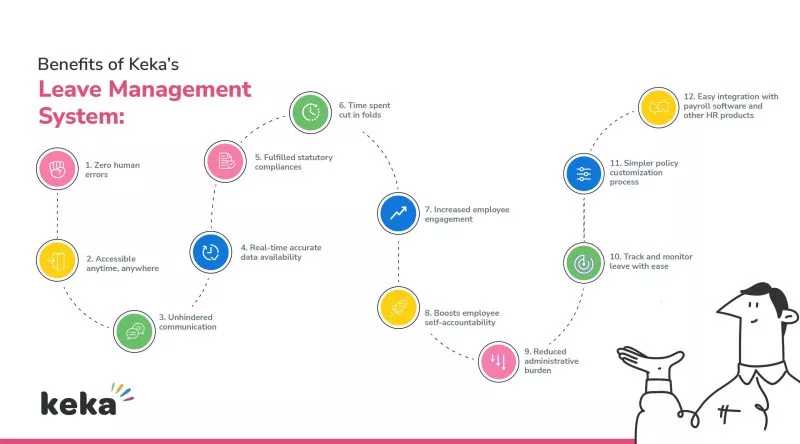
Keka HR is recognized for its robust Leave Management capabilities, offering businesses an efficient and streamlined solution for managing employee leaves. Here’s a more focused overview on its features:
Zimyo focuses on modern HR solutions, offering features such as:
HROne is an HR and payroll management platform with an emphasis on:
greytHR is known for its user-friendly HR and payroll solutions, featuring:
Darwin Box provides a unified HR platform with a focus on:
Designing a leave policy in India is like crafting a rulebook for time off, ensuring fairness and legal adherence. It hinges on company size, legal requirements, business nature, goals, and culture.
Ensure you understand staff needs, stay legally compliant, embrace flexibility, and involve employees in the process. Furthermore, technology aids in efficient leave management.
The kind of technology you want in a leave management tool should align with the company’s size. Tailored leave policies, smart notifications, and analytics are essential features.
In essence, a well-crafted leave policy, paired with technology, fosters a positive work environment and supports both employee well-being and organizational success.
Subscribe to keep up with the latest strategic finance content.
Request a demo