


 Login


Section 125 Plan
Read Time: 7 Mins


PRODUCTS
 Payroll Suite
 HR Suite
 Talent Suite
 Project Services Suite

Meet the platform tailored to your business
Core system of record
One platform for the entire employee journey

BY INDUSTRY
BY COMPANY SIZE
LEARN
EXPLORE KEKA
A Section 125 plan, also known as a Cafeteria Plan, is a benefit program outlined under Section 125 of the Internal Revenue Code (IRC). It allows employees to choose between receiving taxable compensation (like regular salary) or tax-free benefits, often referred to as qualified benefits.
The official IRS documentation (such as Notice 2005-42) outlines the rules, requirements, and acceptable structures for Section 125 plans.
Employers must maintain formal written plan documents that:
| Terms You Should Know Before We Dive Deep | |
| Qualified Benefits | Qualified benefits are non-taxable benefits that employees can choose under a Section 125 plan without triggering income tax liability. |
| Cafeteria Plan | A Cafeteria Plan is the formal name for a plan where employees select from a “menu” of benefits |
| Premium Only Plan (POP) | It allows employees to pay their portion of employer-sponsored health insurance premiums with pre-tax dollars. |
A Section 125 plan, or cafeteria plan, allows employees to pay for specific, IRS-approved benefits using pre-tax income. This structure offers significant tax savings to both employees and employers.
The qualified benefits under a Section 125 plan must be explicitly permitted by the Internal Revenue Code. These benefits are essential for employee health, family care, and financial planning.
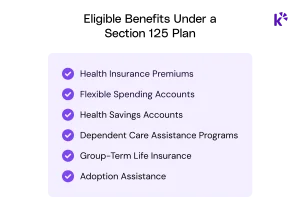
Employees can use pre-tax dollars to pay for employer-sponsored medical, dental, and vision insurance premiums.
FSAs allow employees to set aside pre-tax money to cover eligible out-of-pocket medical expenses, such as copays, prescriptions, and medical supplies.
Employees enrolled in a high-deductible health plan (HDHP) can contribute pre-tax income to an HSA to cover qualifying medical expenses, with funds that roll over year to year.
Employees can allocate pre-tax funds (up to IRS limits) to pay for childcare or dependent care expenses, including daycare, preschool, and elder care.
Premiums for group-term life insurance are eligible for pre-tax treatment only up to $50,000 of coverage per employee. Anything beyond that is considered taxable.
Pre-tax contributions can be used to reimburse qualified adoption expenses, such as adoption fees, court costs, and attorney fees, subject to IRS limits.
These benefits must be offered through a written cafeteria plan and must meet IRS eligibility and nondiscrimination requirements to retain tax-advantaged status.
Any employer who wants to provide pre-tax benefits to employees and their families should consider setting up a Section 125 plan, also known as a cafeteria plan. These plans allow employees to choose from a menu of tax-advantaged benefits, such as health insurance or dependent care, while helping employers reduce payroll taxes.
These employers can include a wide range of pre-tax benefits for employees.
Can offer Section 125 plans to common-law employees, but not to partners or members who own the business.
Can’t cover themselves, but may offer benefits to their employees and their families.
Eligible to offer cafeteria plans to reduce taxable income and enhance benefit options.
A Premium Only Plan (POP) under Section 125 is a simple and low-cost way to offer tax savings without complex administration.
A Premium Only Plan (POP) is actually a simplified version of a Section 125 plan, focused exclusively on allowing employees to pay for insurance premiums with pre-tax dollars. In contrast, a full Section 125 cafeteria plan offers a broader range of tax-advantaged benefits, providing greater flexibility for both employers and employees.
| Feature | Section 125 Plan (Full Cafeteria Plan) | Premium Only Plan (POP) |
| Scope of Benefits | Covers a broad range of pre-tax benefits, including health, dental, vision insurance, FSAs, HSAs, dependent care, adoption assistance, and more. | Limited to pre-tax deduction of insurance premiums (e.g., health, dental, vision, and certain life insurance). |
| Flexibility | Offers multiple benefit types and allows employees to customize their benefits package based on individual needs. | Focused only on premium payments, no FSAs, dependent care, or additional spending accounts. |
| Complexity & Setup | Requires more documentation, administration, and potentially third-party support for compliance and nondiscrimination rules. | Simple and easy to set up, making it ideal for small to mid-sized businesses seeking minimal administration. |
| TaxSavings Potential | Provides higher overall tax savings due to the inclusion of multiple pre-tax benefit options. | Offers basic tax savings by reducing taxable income through premium deductions. |
| IRS Compliance | Must comply with all Section 125 rules, including nondiscrimination and written plan requirements. | Must also comply with Section 125 rules, but requirements are simpler and more focused on premium handling. |
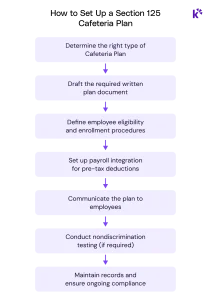
While it may sound complex, even small businesses can implement these plans effectively with the right structure and documentation.
Before anything else, decide what kind of Section 125 plan fits your business goals and team needs. There are three main options:
The simplest and most common version. It allows employees to pay their share of insurance premiums (medical, dental, vision, and some life insurance) with pre-tax dollars.
Offers a broader suite of pre-tax benefits, including FSAs (Flexible Spending Accounts), Dependent Care Assistance, HSAs, and Adoption Assistance.
Specifically designed for small businesses with 100 or fewer employees.
The IRS requires that all Section 125 plans be backed by a formal written plan document. Without this document, the plan is not legally valid, even if you are administering benefits correctly.
This document must include:
Most employers define eligibility as full-time employees after 30 days of employment, but the specific terms are up to you.
You’ll also need to establish:
Once elections are made, they are generally irrevocable for the entire plan year, unless a qualifying event occurs.
To activate the tax benefits, the employee contributions must be deducted pre-tax from their payroll. Work with your payroll provider to:
Proper payroll integration is essential here.
You must provide each eligible employee with a Summary Plan Description (SPD), which outlines:
Host information sessions, provide written materials, and offer assistance during enrollment.
To maintain its tax-advantaged status, a Section 125 plan must pass IRS nondiscrimination testing, ensuring that it doesn’t favor highly compensated employees (HCEs), officers, or owners.
Three types of tests may apply:
Even after setup, ongoing compliance is key.
Employers must:
Also, stay informed of IRS updates and changes to contribution limits for FSAs, HSAs, and dependent care.
| Sign up for Keka’s free demo today! |
Subscribe to keep up with the latest strategic finance content.
Request a demo


