Login


Section 194J: TDS Rates, Threshold Limits, Services Covered & Compliance Rules for FY 2026-27


PRODUCTS
 Payroll Suite
 HR Suite
 Talent Suite
 Project Services Suite

Meet the platform tailored to your business
Core system of record
One platform for the entire employee journey

BY INDUSTRY
BY COMPANY SIZE
LEARN
EXPLORE KEKA
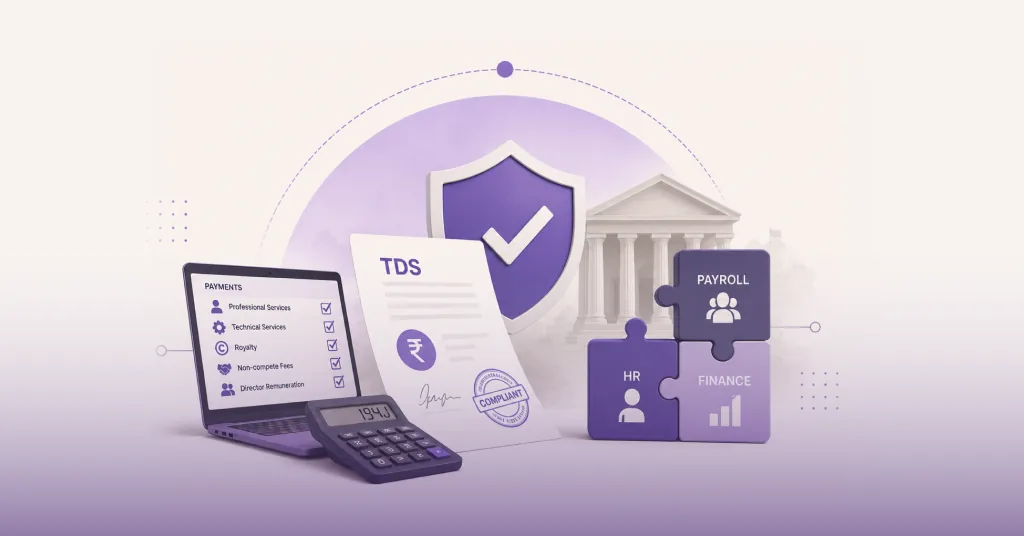
Section 194J governs TDS on professional services, technical services, royalty, non-compete fees, and director remuneration. This guide explains the applicable TDS rates, ₹50,000 threshold, covered payments, GST treatment, deduction timelines, penalties, and compliance requirements for FY 2026-27. It also covers the transition to Section 393(1) under the Income-tax Act, 2025, helping payroll, HR, and finance teams classify payments correctly and stay compliant.
Section 194J governs TDS on payments for professional services, technical services, royalty, non-compete fees, and director remuneration. For FY 2026-27, the TDS threshold is ₹50,000 per payment category. TDS is generally deducted at 2% for technical services and 10% for professional services, royalty, and director remuneration, while payments made without a valid PAN can attract 20% TDS.
FY 2026-27 also brings an important compliance change. From 1 April 2026, the Income-tax Act, 2025 replaces the Income Tax Act, 1961, and Section 194J is renumbered as Section 393(1). The underlying rules remain broadly unchanged, but the section reference, reporting codes, and return form change.
| Requirement | FY 2026-27 |
|---|---|
| Threshold | ₹50,000 (per payment category) |
| Technical Services | 2% |
| Professional Services, Royalty, Director Fees | 10% |
| PAN not Furnished | 20% |
| Director Fees | 10%, no threshold |
| New Section from April 1st 2026 | Section 393(1) |
| New Return Form from April 1st 2026 | Form 140 (replaces Form 26Q) |
This guide explains the rates, threshold limits, covered services, deduction rules, GST treatment, deadlines, penalties, and the transition to Section 393(1) for FY 2026-27.
Whether you’re processing payroll, paying vendors, or filing TDS returns, you’ll know exactly which provisions apply and how to stay compliant.
Section 194J requires specified taxpayers to deduct TDS when paying a resident for professional services, technical services, non-compete fees, or director remuneration. Individuals and Hindu Undivided Families (HUFs) below the applicable tax audit threshold are generally excluded.
The provision came into force on 1 July 1995 and was significantly restructured by the Finance Act, 2020, which introduced different TDS rates based on the nature of the payment. In practitioner shorthand, this created the familiar distinction between Section 194J(a) for technical services and Section 194J(b) for professional services and other specified payments.
From 1st April 2026, these provisions move under Section 393(1) of the Income Tax Act, 2025.
Tip:
For transactions where the credit or payment happened before 1 April 2026, the old framework continues to apply. Those transactions remain governed by Section 194J and the earlier reporting structure.
The applicable TDS rate depends primarily on the nature of the payment.
| Nature of Payment | Rate of TDS | Threshold Limit |
|---|---|---|
| Fees for technical services | 2% | ₹50,000 |
| Payments to call center operators | 2% | ₹50,000 |
| Royalty for sale, distribution, or exhibition of cinematographic films | 2% | ₹50,000 |
| Other royalty | 10% | ₹50,000 |
| Professional services and all other payments under this section | 10% | ₹50,000 |
| Any payment where PAN is not furnished | 20% | ₹50,000 |
| Director fees, commissions, or remuneration | 10% | Nil |
The distinction between professional and technical services matters because it determines whether TDS is deducted at 10% or 2%.
For example, fees paid to an architect for professional design services generally fall within the professional services category. Payments for technical support or certain consultancy services may fall within the technical services category, subject to the nature of the work.
The threshold under Section 194J is ₹50,000 in a financial year, increased from ₹30,000 by Budget 2025 with effect from FY 2025-26.
The important part is that the threshold applies separately to different categories of payments. A business may therefore need to track professional fees, technical fees, and royalty payments independently rather than simply aggregating every payment made to the same person.
Director remuneration is treated differently. Fees, commission, or remuneration paid to a director, other than salary, attract TDS at 10% without any minimum threshold.
Suppose a professional receives ₹10,000 initially and another ₹50,000 later in the same financial year. The total reaches ₹60,000. Once the threshold is crossed, TDS applies to the amount required under the applicable rules, including the earlier payment within that category.
This is why accounts payable teams should track cumulative payments throughout the year instead of evaluating each invoice in isolation.
Every person responsible for making a covered payment may be liable to deduct TDS, subject to the specific exemptions available to individuals and HUFs.
Companies, partnership firms, LLPs, and other entities generally have to deduct TDS when the conditions of Section 194J are met. Individuals and HUFs are generally required to deduct TDS when they were subject to tax audit in the preceding financial year.
The commonly referenced thresholds are:
Business turnover exceeding ₹1 crore
Professional receipts exceeding ₹50 lakh
An individual or HUF below the relevant audit threshold is generally outside the regular TDS obligation under Section 194J. Personal-purpose payments also receive different treatment.
An individual or HUF whose turnover stays below these limits is not required to deduct TDS under 194J. If the payment is made exclusively for personal purposes, such as hiring a lawyer for a personal matter rather than a business one, no TDS applies.
Tip:
A sole proprietor consultant earning ₹40 lakh a year in professional receipts does not need to deduct TDS on payments to their own vendors, since they fall below the ₹50 lakh audit threshold for professions. The obligation begins the year after receipts cross that line.
Section 194J broadly covers professional services, technical services, royalty, non-compete fees, and specified payments to directors.
Is this payment covered:
Paid to a lawyer, doctor, CA, architect, or CBDT-notified professional → professional services, 10%
Paid for managerial, technical, or consultancy work involving a person, not a machine → technical services, 2%
Paid for use of a patent, trademark, design, or copyrighted work → royalty, 2% (film) or 10% (other)
Paid to a director as fees, commission, or sitting fees, not salary → director remuneration, 10%, no threshold
Paid in exchange for a non-compete agreement → non-compete fees, 10%
The traditional professional categories include medicine, law, architecture, engineering, and accountancy. CBDT-notified professions also extend the scope to several other specialised occupations.
The notified list also covers certain sports-related professions, including sportspersons, commentators, event managers, anchors, umpires, referees, physiotherapists, coaches, trainers, team physicians, and sports columnists.
Fees for technical services cover managerial, technical, and consultancy services, excluding anything already treated as salary in the recipient’s hands.
A useful distinction is the human element. Courts have examined whether a person is actually rendering technical expertise or whether the service is being delivered entirely through an automated system. A machine-generated service does not automatically become a “technical service” simply because the underlying technology is complex.
Royalty can cover payments for the use or transfer of rights relating to inventions, patents, trademarks, designs, or other specified intellectual property.
Non-compete fees cover payments made in connection with agreements that restrict a person from carrying on certain business activities or sharing specified commercial knowledge or rights.
Director payments require a separate check. Sitting fees, commission, and remuneration other than salary generally attract TDS under Section 194J at 10% without a threshold. Salary paid to a whole-time or executive director falls under the provisions governing TDS on salary.
The distinction is primarily a rate classification:
Section 194J(a) refers to payments such as technical services that attract TDS at 2%.
Section 194J(b) covers professional services, specified royalty payments, and director remuneration, generally attracting TDS at 10%.
From 1 April 2026, the same distinction continues under Section 393(1), although the reporting framework changes.
| Old framework (until 31st March 2026) | New framework (from 1st April 2026) |
|---|---|
| Technical services, call center, film royalty | Section 393(1), SI. No. 6(iii).D(a) |
| Professional services, other royalty, director payments | Section 393(1), SI. No. 6(iii).D(b) |
| Form 26Q | Form 140 |
| Earlier reporting framework | Codes 1026, 1027, and 1028 for relevant categories |
The practical takeaway is simple: the tax rate does not change merely because the provision has been renumbered. The challenge for businesses is updating systems and reporting references to reflect the new Act.
TDS under Section 194J may not apply when:
Payments remain within the ₹50,000 threshold for the relevant category.
The payer is an individual or HUF below the applicable audit threshold.
A valid lower or nil deduction certificate applies under Section 197.
The transaction falls outside the categories covered by Section 194J.
A payee whose actual tax liability is expected to be lower than the standard TDS rate can apply for a lower or nil deduction certificate under Section 197.
The application is made through Form 13. Once issued, the certificate is generally specific to the deductor and relevant payment category and remains subject to the terms mentioned by the tax authority.
A certificate issued for one client should not automatically be assumed to apply to payments from another deductor.
Tip:
A Section 197 certificate is specific to both the deductor and the section it is issued under. A certificate obtained for one client’s payments cannot be used against a different deductor.
For deductors, exemptions answer whether to deduct. The calendar answers when the deducted amount has to reach the government.
For most non-government deductors, TDS must be deposited by the 7th of the following month. TDS deducted in March has a later deadline of 30 April.
| Time of Payment | Non-Government Deductors | Government Deductors |
|---|---|---|
| Any month except March | 7th day from the end of the month | 7th day if paid through challan; same day if without challan |
| March | 30th April | 7th day if paid through challan; same day if without challan |
Quarterly TDS statements are also required within the applicable filing deadlines.
| Quarter | Period | Due Date |
|---|---|---|
| Q1 | April – June | 31st July |
| Q2 | July – September | 31st October |
| Q3 | October – December | 31st January |
| Q4 | January – March | 31st May |
From FY 2026-27, businesses should also account for the transition from Form 26Q to Form 140 under the new framework.
TDS is generally calculated on the service component and excludes GST when GST is separately shown on the invoice.
CBDT Circular No. 23/2017 clarified that the GST component should not form part of the TDS base where it is separately indicated.
For example:
Service fee: ₹80,000
GST: ₹14,400
Applicable TDS rate: 2%
TDS would be calculated on ₹80,000. The TDS amount would therefore be ₹1,600.
If the invoice presents a single composite amount without separately identifying the GST component, the TDS treatment can differ because the exclusion is linked to the tax component being separately shown.
The calculation follows four basic steps:
Identify the nature of the payment.
Check the applicable TDS rate.
Track cumulative payments against the relevant ₹50,000 threshold.
Apply TDS to the correct base amount, excluding separately stated GST where applicable.
A business pays a professional ₹55,000 in April and ₹22,000 in December. Since the payment exceeds the applicable threshold, TDS at 10% applies as required to the covered payments.
A technical service provider raises an invoice for ₹80,000 plus ₹14,400 GST. Since GST is separately shown, TDS at 2% is calculated on ₹80,000.
TDS: ₹80,000 × 2% = ₹1,600
A company pays a director ₹1,00,000 as sitting fees or commission. Since director remuneration other than salary has no threshold exemption, TDS at 10% applies.
TDS: ₹1,00,000 × 10% = ₹10,000
Failing to deduct or deposit TDS under Section 194J triggers expense disallowance under Section 40(a)(ia), monthly interest, and potential penalties under Sections 271C and 276B.
| Default | Consequence |
|---|---|
| No TDS deducted | 30% of the expense disallowed in that year’s profit and loss account; re-allowed once TDS is eventually paid |
| Tax not deducted at all | Interest at 1% per month or part month, from the date deduction was due to the date of actual deduction |
| Tax deducted but not deposited | Interest at 1.5% per month or part month, from the date of deduction to the date of deposit |
The 30% disallowance is not permanent. Once the applicable TDS is paid to the government, the expenditure may be allowed in the relevant year under the applicable rules.
Late TDS statement filing can also attract a fee under Section 234E, while Section 271H provides for additional penalties in certain cases. Serious and wilful defaults can trigger prosecution provisions.
Payees should check their TDS credit before filing their income tax return. Traditionally, this involves reviewing Form 26AS, the Annual Information Statement, and the relevant TDS certificate, such as Form 16A.
If the credit is missing or incorrect because of a wrong PAN, missing filing, or incorrect deduction amount, the deductor generally has to correct the underlying TDS statement.
From 1 April 2026, the Income Tax Act, 2025 also changes the numbering of several tax forms. Businesses should therefore ensure that their payroll and finance teams update references and documentation during the transition.
Section 194J often overlaps with other TDS provisions in practical situations. The correct classification depends on the substance of the payment.
| Payment Scenario | Applicable Section |
|---|---|
| Lawyer, CA, or doctor’s professional fee | 194J |
| Printer, caterer, or transport contractor | 194C |
| Agent’s commission on facilitated sales | 194H |
| Director’s board sitting fee or commission | 194J |
| Director’s fixed monthly salary | 192 |
The key distinction is the nature of the relationship.
Section 194C generally applies to contract work. Section 194H applies where the payee acts as an agent and earns commission. Section 192 applies to salary.
A professional paid a percentage of a transaction does not automatically become an agent. If the person is providing independent professional advice, the payment may still fall within Section 194J.
FY 2026-27 is the year in which businesses need to update their compliance systems from the old Section 194J framework to Section 393(1).
The practical checklist is straightforward:
Classify each payment correctly as professional, technical, royalty, or director remuneration.
Apply the ₹50,000 threshold separately to the relevant category.
Verify the payee’s PAN before applying the standard rate.
Exclude GST from the TDS base when it is separately shown.
Update payment and reporting references for transaction from 1st April 2026
Use the appropriate new reporting codes and Form 140 where applicable.
Review standing vendor contracts, payroll templates, and accounting workflows that still hardcode Section 194J or Form 26Q.
Tip:
Run a one-time audit of any standing vendor contracts or payroll templates that hardcode “Section 194J” or “Form 26Q” in invoice or compliance language, so nothing generates a defective filing after 1 April 2026.
Section 194J continues to be an important TDS provision for professional and technical payments, with a ₹50,000 threshold, a 2% rate for specified technical payments, and a 10% rate for professional services, royalty, and director remuneration. Director payments other than salary continue to have no threshold exemption.
The biggest change in FY 2026-27 is the transition to Section 393(1) under the Income Tax Act, 2025, effective from 1 April 2026. The underlying classification and rate principles remain largely familiar, but businesses need to update their section references, reporting codes, forms, and internal compliance processes.
For payroll, finance, and HR teams, the real challenge is usually classification. Getting the nature of the payment wrong can lead to the wrong TDS rate, incorrect filing, interest, or reconciliation issues later.
As compliance requirements continue to evolve, managing TDS, payroll, statutory deductions, and tax filings through a single system can reduce manual effort and errors. Keka Payroll helps businesses automate payroll calculations, statutory compliance, and TDS processes so teams can spend less time managing compliance manually.
Make Payroll Compliance Simpler
Q1. What is Section 194J under the Income Tax Act?
Section 194J governs TDS on payments for professional services, technical services, royalty, non-compete fees, and director remuneration. The applicable threshold is generally ₹50,000 per payment category, while director remuneration other than salary has no threshold.
Q2. What is the difference between Section 194J(a) and 194J(b)?
Section 194J(a) is commonly used to refer to the 2% TDS category for specified technical services. Section 194J(b) covers professional services, specified royalty payments, and director remuneration, generally attracting 10% TDS.
Q3. What is the threshold limit under Section 194J for FY 2026-27?
The threshold is ₹50,000 in a financial year for the relevant categories of professional and technical payments. The limit was increased from ₹30,000 with effect from FY 2025-26. Director remuneration other than salary has no minimum threshold.
Q4. How is TDS calculated on professional fees that include GST?
When GST is shown separately on the invoice, TDS is calculated on the fee component and excludes the separately stated GST amount. This treatment follows CBDT Circular No. 23/2017.
Q5. Does Section 194J still apply in FY 2026-27?
From 1 April 2026, the provisions earlier covered under Section 194J moved to Section 393(1) of the Income-tax Act, 2025. The classification and TDS rates broadly continue, but businesses must update their reporting references, applicable codes, and return form.
Subscribe to keep up with the latest strategic finance content.
Request a demo