


 Login


When it comes to HR software, it’s easy to get caught up in the buzzwords: “seamless integration,” “AI-powered,” “cloud-based efficiency”, the list goes on.
But after exploring Rippling and Workday, I realized that the reality of using these platforms isn’t all rainbows and butterflies. Sure, they both promise a lot, but when it comes to managing payroll, onboarding, and compliance under pressure, there’s a big difference in how they deliver.
Rather than get sucked into the marketing speak, I decided to dive into what people really think. I didn’t want theoretical benefits, I wanted to hear from the folks actually stuck dealing with payroll crises and last-minute hires.
So, I scoured forums, reviews, and social media posts, looking for the unfiltered truth.
What works?
What makes people want to pull their hair out?
And, crucially, which platform delivers when the stakes are high?
In this blog, I’ll break down those real-world insights, helping you figure out which platform will actually make your job easier (or at least less stressful).
Rippling vs. Workday at a Glance
The following table breaks down the key features of Rippling and Workday side by side. It highlights what each platform does well, where they stumble, and who takes the crown, so you can get a quick overview.
| Feature | Rippling | Workday | The Winner |
|---|---|---|---|
| HR Information Management |
|
| Workday for deeper data capabilities and enterprise-grade accuracy. Rippling is easier, but Workday wins at scale. |
| Payroll Processing |
|
| Rippling for everyday payroll is faster and lighter to manage. |
| Reporting & Analytics |
|
| Workday for more powerful and strategic when analytics drive decisions. |
| Implementation Complexity |
|
| Rippling for lower barrier to adoption and far less operational pain. |
| Scalability |
|
| Tie — Rippling scales more comfortably; Workday scales more strategically for large orgs. |
| User Experience |
|
| Rippling for better everyday usability and lower learning curve. |
| Customer Support |
| Solid support for complex configurations and system optimization. | Rippling for consistent, practical, and supportive across core workflows. |
Why You Should Believe This Review
Most Rippling vs. Workday comparisons sound more like sales pitches than real evaluations. You get long feature lists, copy-pasted product pages, and cherry-picked claims that don’t reflect what actually happens after your team signs the contract. That kind of content might help you memorize buzzwords, but it doesn’t help you choose what will work in the real world.
So, for my article, I went straight to the people living with these tools. I focused on what it’s like to onboard new employees, run payroll across multiple states, manage benefits, and scale your HR operations without losing your mind.
Here’s how I got the real scoop:
- Real User Voices: I scoured forums, social media, and verified G2 reviews to hear directly from people who use Rippling and Workday every day.
- Hundreds of Verified Opinions: I read through the good, the bad, and the “could be better” to identify patterns and recurring wins or frustrations.
- Deep Dive Into Official Info: I explored official pricing, features, and support resources to understand what each platform truly offers beyond the hype.
This review cuts through the noise so you can make a confident, informed decision.
Rippling vs. Workday: Feature-by-Feature Breakdown
Rippling and Workday both aim to simplify HR and payroll, but what suits one business may not suit another. Instead of overwhelming you with specs, I’ve broken down each key feature to reveal what truly matters in real use.
HR Information Management
HR information management is essentially how well a platform handles your employee data. That includes personal details, benefits, payroll, and performance records. When it works smoothly, you spend less time fixing mistakes, stay compliant without scrambling, and get insights that help you make better decisions.
Rippling: Rippling centralizes all HR functions in one intuitive platform, covering time off, payroll, benefits, and employee data. Users appreciate how it “eliminates the back-and-forth between multiple systems,” making HR management seamless and organized. The platform is highly user-friendly, and support is responsive, though some features, like review cycles, are still expanding.

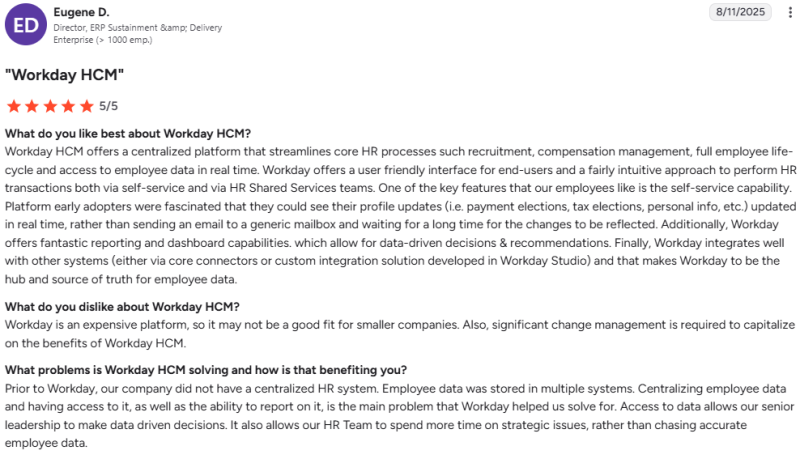
Workday: Workday HCM provides a comprehensive HR hub, offering real-time employee data, self-service capabilities, and powerful reporting dashboards. It streamlines recruitment, compensation, and full employee life-cycle management. Users value the centralized access for accurate data and strategic insights, though Workday requires significant investment and change management for smaller organizations.
Payroll Processing
Payroll processing is a core HR function that ensures employees are paid accurately and on time, while maintaining compliance with tax regulations and labor laws. Efficient payroll systems reduce errors, save administrative time, and improve overall employee satisfaction.
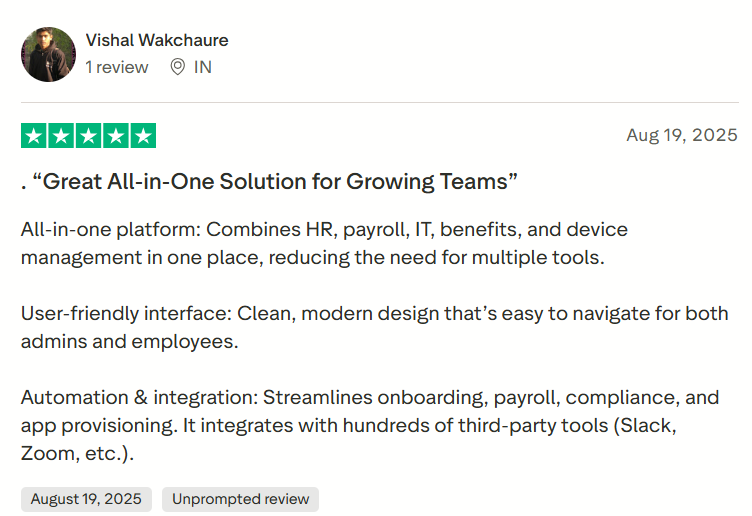
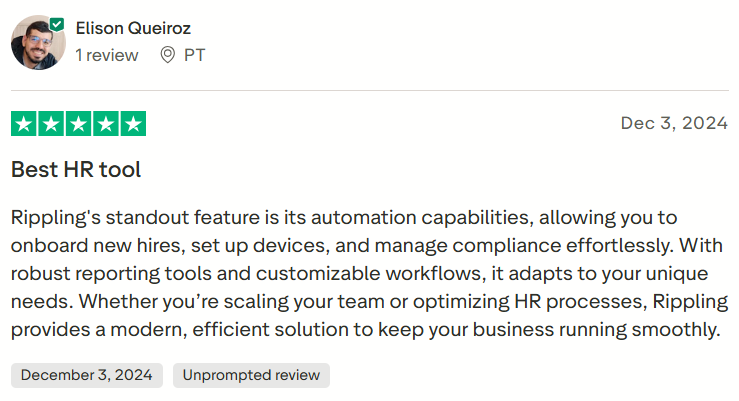
Rippling: Rippling provides an all-in-one payroll solution integrated with HR, IT, benefits, and device management. Users appreciate its clean, modern interface and automation capabilities, which streamline payroll, onboarding, and compliance. The platform’s integration with hundreds of third-party apps like Slack and Zoom makes managing payroll across multiple systems seamless. By consolidating these processes, Rippling reduces administrative burden and errors, enabling teams to focus on growth rather than manual tasks.
Workday: Workday centralizes payroll, HR, and time tracking in one platform, giving real-time access to payroll data. Users find the interface clean and efficient, though some tasks require multiple clicks, and occasional lag can slow workflows. Overall, Workday improves accuracy, minimizes manual work, and supports efficient employee management.

Reporting & Analytics
Reporting and analytics are crucial for HR systems, enabling organizations to track workforce data, monitor compliance, and make informed, data-driven decisions. Effective reporting reduces errors, uncovers trends, and helps leaders optimize operations.
Rippling: Rippling offers robust reporting and analytics capabilities within its all-in-one HR platform. Users value the customizable dashboards and automated workflows, which allow real-time insights into payroll, benefits, compliance, and employee activity. The system’s reporting tools are intuitive, making it easy for HR teams to generate actionable insights without relying on external software. Whether scaling a team or managing complex HR processes, Rippling helps streamline reporting, improve accuracy, and support strategic decision-making.
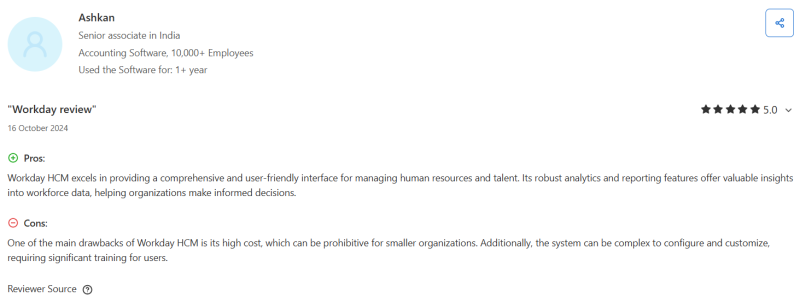
Workday: Workday HCM provides comprehensive analytics and reporting features that deliver deep insights into workforce metrics. Its user-friendly interface makes navigating reports straightforward, and organizations can access real-time data to support operational and strategic decisions. While powerful, the platform can be complex to configure, and smaller organizations may find training and setup demanding.
Implementation Complexity
Implementation complexity is a key consideration when choosing an HR platform, as it affects how quickly and smoothly your organization can adopt and start benefiting from the software. A system that is difficult to configure can slow down onboarding, require extensive training, and increase costs.
Rippling: Rippling is praised for its user-friendly interface and strong customer support, which help simplify implementation across various use cases. Onboarding, multi-country payroll setup, IT device provisioning, and integrations with tools like Google Workspace and DocuSign are streamlined, reducing manual effort. Users report that while certain processes, such as payroll configuration, can feel complex, Rippling’s support team provides quick guidance, making adoption manageable. Its automation features, global contractor management, and IT suite for device and identity management further ease the implementation process.

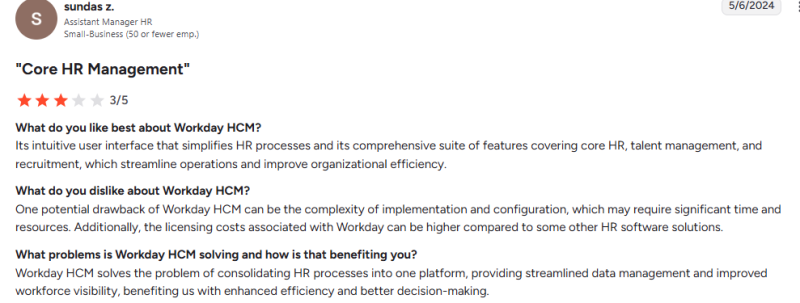
Workday: Workday HCM offers a comprehensive suite covering core HR, talent management, and recruitment. However, users often cite its implementation as complex, requiring significant time, resources, and careful configuration. While powerful, smaller organizations may find the setup challenging and resource-intensive.
Scalability
Scalability is a critical factor for HR platforms, as businesses grow and evolve, they need systems that can handle increasing employee counts, complex processes, and expanded operational requirements without adding excessive workload.
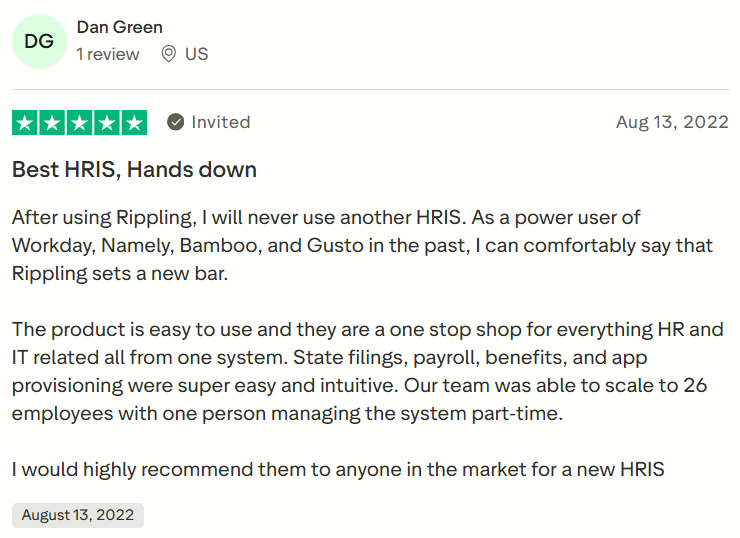
Rippling: Rippling excels in scalability, offering a unified platform for HR, payroll, IT, and benefits management. Users report that even small teams can manage the system efficiently, while larger teams benefit from streamlined automation and centralized data. One user highlighted managing 26 employees part-time with ease, showcasing Rippling’s ability to support expanding teams.
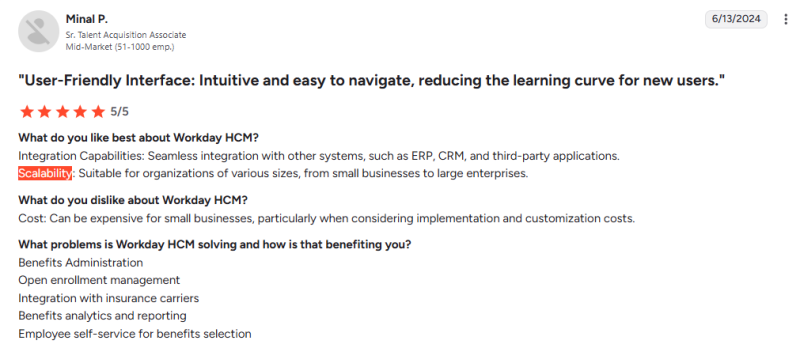
Workday: Workday HCM is also designed for scalability, supporting organizations from small businesses to large enterprises. Its seamless integrations with ERP, CRM, and third-party systems allow HR, payroll, and benefits processes to grow with the organization. However, high costs and complex implementation can make scaling more resource-intensive for smaller companies.
User Experience
User experience determines how easily employees and admins can navigate, manage, and interact with an HR platform. A clean interface, intuitive workflows, and mobile accessibility all contribute to smoother HR operations and higher adoption rates.
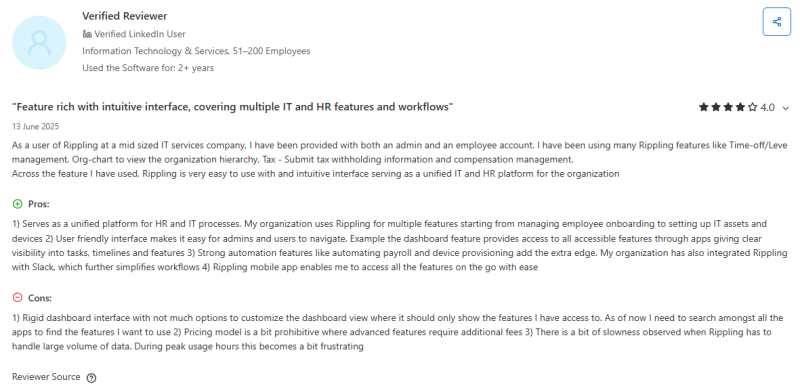
Rippling: Users appreciate its automation for payroll, device provisioning, and time-off management, as well as integrations with tools like Slack. The mobile app adds convenience for employees on the go.
While the dashboard can feel rigid and navigating large data volumes may be slower during peak usage, overall, Rippling makes complex HR and IT workflows more manageable, providing clear visibility and centralized control.
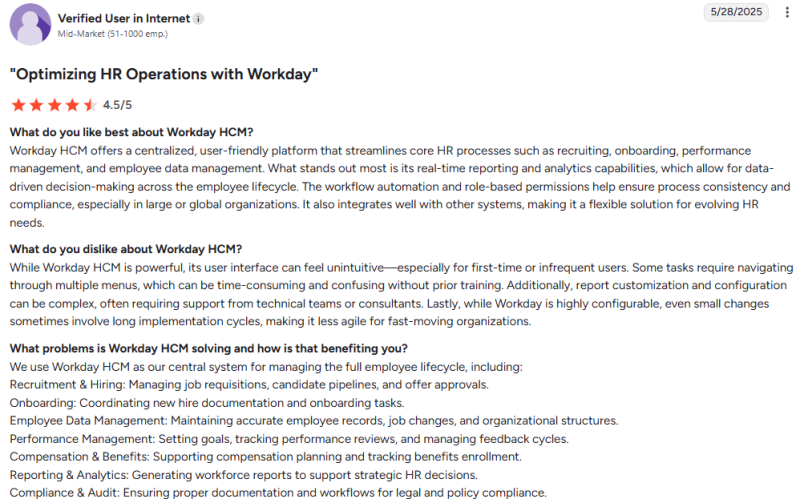
Workday: Workday HCM provides a centralized platform for recruiting, onboarding, performance management, and employee data management. Real-time reporting and workflow automation enhance efficiency, especially for large or global organizations. However, first-time or infrequent users may find the interface less intuitive, with complex menu navigation and report customization requiring technical support.
Customer Support
Reliable customer support is a crucial factor when choosing an HR platform, as timely assistance ensures smooth operations, quick issue resolution, and minimal disruption to payroll, benefits, and employee management processes.
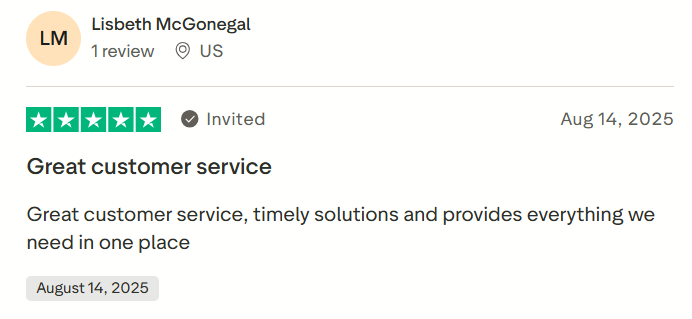
Rippling: Rippling is praised for its responsive and helpful customer support. Users report that issues-from payroll errors to onboarding questions-are addressed promptly, and the support team is knowledgeable about both HR and IT-related processes.
The availability of guidance for complex workflows, combined with proactive problem-solving, gives administrators confidence that they can rely on Rippling when challenges arise.
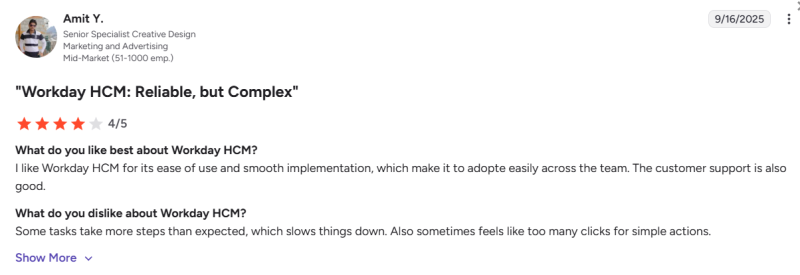
Workday: Workday HCM also offers strong customer support, assisting organizations with implementation questions, troubleshooting, and system optimizations. Users appreciate that support is generally timely and professional, particularly when addressing complex configurations or reporting requirements. While Workday’s system can be complex, the support team helps organizations navigate the platform, ensuring that HR processes continue uninterrupted.
Keka: A Better Alternative to Rippling and Workday
If you’re looking for an easy-to-use, all-in-one HR and payroll system, Keka offers a solid alternative to Rippling and Workday.
While both of these platforms are packed with features, they can sometimes be too complex or overwhelming, especially for small and mid-sized businesses. Keka, however, brings all your HR needs into one platform with simplicity and efficiency.
All-in-One HR Management
Keka makes managing employees easy by offering a unified platform. From hiring and onboarding to performance management, everything is integrated in one place. Payroll is fully automated, with payroll processing, paystub generation, and time-off tracking all happening seamlessly.
This saves time and reduces the risk of errors, making it much easier than juggling separate tools like Rippling and Workday.
Smarter Hiring with AI
Keka also stands out for its AI-powered Applicant Tracking System (ATS), which helps streamline the hiring process. The AI generates job descriptions, rates candidates, and speeds up approvals, all with minimal effort.
This automation helps businesses hire faster and more efficiently compared to the more manual processes of Workday or Rippling.
Employee Engagement and Growth
Keka doesn’t stop at payroll and hiring, it also focuses on keeping employees engaged. With features like pulse surveys, recognition badges, and a learning management system (LMS), employees feel more connected and appreciated.
These features help employees develop new skills and stay motivated, which can be a challenge in more traditional platforms like Workday.
Conclusion
When it comes to choosing between Rippling and Workday, it’s not about picking a “winner” — it’s about finding the right fit for your business.
Rippling excels in flexibility, especially for small to mid-sized companies. It’s an all-in-one platform that blends HR, payroll, IT, and benefits management, all in one place.
The interface is clean and simple, and the integration capabilities make managing different aspects of HR a breeze. For businesses that are growing fast, managing a mix of full-time staff, contractors, and international teams, Rippling’s ability to handle global payroll and streamline IT processes is a huge bonus.
In contrast, Workday is geared towards enterprises with complex operations. If you’re running a large organization and need deep features for talent management, reporting, and analytics, Workday has the depth you need. It’s built for scale, offering sophisticated tools to manage global teams and drive data-backed decisions.
But, with that power comes complexity — it’s costly, tough to implement, and requires more time to master.
If you’re looking for something that strikes a balance between simplicity and powerful features, Keka might be worth considering. It combines HR, payroll, and employee engagement tools in one seamless platform.
With features like AI-driven hiring and performance tracking, Keka offers an efficient, user-friendly solution without the price tag or complexity of the bigger players.


