Login


Evolving gig worker rights : How Businesses can adapt



PRODUCTS
 Payroll Suite
 HR Suite
 Talent Suite
 Project Services Suite
Meet the platform tailored to your business
Core system of record
One platform for the entire employee journey
How Srijan Technologies streamlined timesheets management with Keka
Read customer story
BY INDUSTRY
BY COMPANY SIZE
LEARN
EXPLORE KEKA
Navigate every labor law, wage regulation, and statutory requirement across all 28 states and 8 union territories without the legal headaches.
Learn More
Gig worker protections are becoming stricter quickly and companies that still see contractors as an informal group with low rules to follow are at risk of being caught out. They could face issues with how workers classified and even problems with not paying them properly. To stay ahead businesses need to include gig workers, in the onboarding process how they are evaluated the benefits they get and how risks are handled. They should not keep them off the books. This guide explains how to deal with gig worker compliance and offers a way to bring gig workers into the HR plan. The guide explains how to deal with gig worker compliance and offers a way to bring gig workers into the HR plan.
Around 51% of gig workers have experienced wage theft at least once.
However, the Evolving gig worker economy continues to provide benefits to employees. The number of independent workers who would instead work in a traditional employment setting has dropped from 34% in 2012 to 22% in 2018.
This is owed to factors such as:
For years, gig economy workers enjoyed being independent at the cost of missing out on employer-provided benefits.
However, the recent legal laws can potentially change the entire gig economy upside down. In January 2024, a new worker classification regulation was released, set to go live in March. It ruled out standards on when a worker counts as an employee as opposed to independent contractors. This means, these qualified ‘employees’ will be entitled to overtime pay, unemployment insurance, and other employer-provided benefits under the law.
The main reason for this regulation is that some businesses classified full-time employees as gig workers to avoid providing benefits and reduce costs.
The other reason is that the gig workforce was entitled to have consistent wages, sick time, health care, and other benefits.
But the potential downsides are that not all gig workers would want to be considered employees and adhere to a new set of rules on how they perform their work. They would lose the main benefit they have enjoyed for years – the ability to choose when and when not to work.
This transition may lead to fewer gig opportunities as businesses adjust their models. Companies facing increased costs might reduce their reliance on gig workers or limit the number of open positions, impacting the flexibility and income potential that gig workers traditionally enjoyed.
However, not all contractors will be stamped out as employees and lose their benefits of flexibility, as per the Department of Labor.
Now, businesses must understand gig worker compliance and how they can manage independent contractors who can be classified as ‘employees.’
Now, the classification of gig workers as employees varies across U.S. states based mainly on specific state laws and federal guidelines.
For instance, California enacted Assembly Bill 5 (AB 5), using the ABC Test to classify workers. A worker is presumed to be an employee unless the company proves the following:
However, Proposition 22 allows app-based rideshare and delivery companies to classify their drivers as gig workers while offering some benefits.
Many other states follow California’s ABC or DOL’s (Department of Labor) six-factor test.
Businesses must adapt to these evolving laws to ensure compliance and avoid legal pitfalls. The rise of new regulations highlights the need for companies to stay informed and proactive in managing their workforce amidst these shifting legal requirements.
In the gig economy, the lines between employee and independent contractor can blur. To reduce misclassification risks, businesses should invest in AI-driven classification systems that analyze the role, responsibilities, and working conditions of each gig worker.
To truly align with changing laws, businesses should embrace employee benefit segmentation:
Some states have specific requirements regarding the transition of workers from independent contractors to employees. For example, if a gig worker’s role shifts to meet employee classification, the company must immediately update the worker’s benefits to reflect their new status. This avoids penalties for misclassification.
While the gig economy laws change across states, businesses need real-time compliance tracking systems to stay informed about new regulations. Take the opposition against California’s Prop. 22, for example. Most companies and workers are pushing back and are not enforcing this law.
There will be new regulations with time, and this is why companies should implement:
One best way is that businesses treat compliance as an ongoing conversation with their gig workers. This way, they are more likely to spot issues early.
Implement feedback loops through dedicated platforms where workers can raise concerns about classification or benefits. Organizations can use this feedback to update workers on any changes or adjustments. Transparency is key to maintaining trust and legal compliance, after all.
It’s not enough that businesses just react to changing laws. They must drive the conversation on gig worker rights, pushing for industry-wide standards and better practices.
One way to make the above easier for a business is by using HR technology. With the right HR management system, businesses can streamline everything from worker classification to managing benefits and generating compliance reports. Not only does this help in staying on top of changing regulations, but it also simplifies gig workforce management overall. For instance, once you classify workers based on state-specific laws, Keka HRMS handles and automates all federal and state filings including W-2s, W-4s, and more. It also integrates with third-party carriers to manage payroll and benefits in one place.
As gig work continues to rise in the U.S, it’s becoming increasingly clear that organizations cannot treat gig workers as just an afterthought. Instead, integrating gig workers into their
broader HR strategy improves efficiency and compliance. Let’s understand why this is important and how the IWMM model can help.
Gig workers are now a part of many industries. With this integration comes a responsibility to make sure they are managed ethically and legally. By incorporating gig workers into HR strategy, organizations can not only safeguard themselves against legal pitfalls but also improve their work environment. When gig workers feel valued and included, their productivity levels also soar, positively impacting the bottom line.
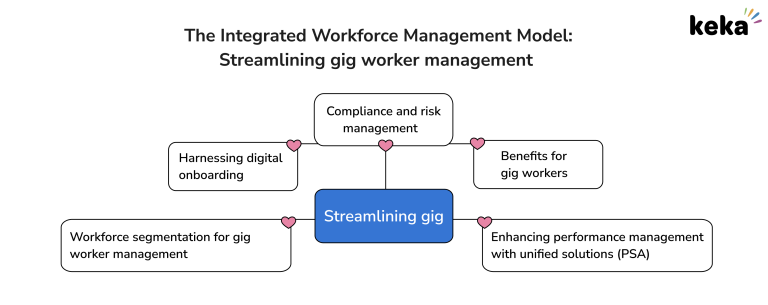
So, how can organizations manage this workforce? The integrated workforce management model streamlines and optimizes the management of all types of workers, with a special focus on gig workers. Here’s how it works:
Organizations need to understand who their gig workers are. This means taking the time to segment the workforce based on their roles, like freelancers, independent contractors, or those handling specific projects.
Why does this matter?
Well, by categorizing gig workers, organizations can customize their management practices. This helps them stay compliant and keep their gig workers motivated.
Digital onboarding programs make it much easier to conduct a smooth and efficient onboarding process. Organizations can use digital onboarding platforms to provide orientation materials and training videos. This saves a lot of time and ensures gig workers have access to the information they need.
Businesses can also consider creating a hub where gig workers can access policies, guidelines, or project briefs. Having everything in one place makes it simpler for them to get up to speed. Consider using tools like Keka to automate the onboarding process, from hiring to onboarding. This includes document collection, training schedules, and so on. It streamlines the entire onboarding experience.
Keka ensures the onboarding process isn’t just about paperwork. Gig workers will have the opportunity to connect with their teams and learn about company culture. A welcoming introduction can set the tone for their entire experience.
Managing gig workers’ performance starts with the right tools. While many organizations rely on timesheets, some use project management tools or a unified solution like Professional Services Automation (PSA). It helps
The tool should:
Reclassifying gig workers as traditional employees is problematic and reduces the flexibility they seek. This model below addresses their unique needs and work patterns:
Each state must establish a gig worker benefits platform to host benefits for gig workers. Then, employers must make minimum contributions for workers based on income threshold. These contributions must cover the expected costs of mandated injury benefits.
Additionally, employers can make additional contributions beyond the minimum and allow gig workers to contribute to their benefits accounts as well. All gig workers earning above state workers’ compensation (WC) minimums qualify for medical and indemnity benefits. Employers must provide benefits based on average weekly earnings over the previous quarter.
The contributions can be made for:
Workers can be offered the option to automatically allocate a percentage of earnings above a defined threshold to a savings account.
Other than these, organizations can negotiate group discounts with wellness providers for services like gym memberships, mental health apps, or online fitness classes to support gig workers’ health at an affordable cost.
To implement the above model:
Employers can also monitor overall benefits spend and identify extra spending to maximize ROI.
HRs must partner with legal professionals to ensure that business practices stay aligned with changing laws. Introducing a compliance checklist helps monitor and address issues on an ongoing basis. Here’s a simple compliance checklist:
Worker misclassification has shone a light on a key issue in workforce management: ensuring equal rights and treatment for all workers.
Moving forward, companies need to take a more responsible approach. Here are a few ways to prevent the mistakes of the past:
Ultimately, creating a fair and supportive workforce for all will create a stronger, more loyal workforce.
Subscribe to keep up with the latest strategic finance content.
Request a demo