Login


Annual Leave in GCC: Policy, Calculation & Best Practices for 2025



PRODUCTS
 Payroll Suite
 HR Suite
 Talent Suite
 Project Services Suite
Meet the platform tailored to your business
Core system of record
One platform for the entire employee journey
How Srijan Technologies streamlined timesheets management with Keka
Read customer story
BY INDUSTRY
BY COMPANY SIZE
LEARN
EXPLORE KEKA
Navigate every labor law, wage regulation, and statutory requirement across all 28 states and 8 union territories without the legal headaches.
Learn More
Annual leave entitlement in the UAE and wider GCC is set by labour law, and miscalculating accrual, carry-forward, or encashment is one of the most common sources of payroll dispute. Getting it right connects leave policy to attendance data, payroll runs, and workforce planning across HR and finance. This guide breaks down entitlement rules, how leave is calculated, employer best practices, and building a policy.
Knowing annual leave is essential to keeping a healthy work-life balance, whether you’re counting down the days until your next vacation or simply attempting to determine how many days off you have coming up.
You should be well-informed about your leave entitlements in the United Arab Emirates, including how they are calculated and what happens if you don’t use them all.
Let’s simplify it so you can confidently organize the ideal vacation or take some well-earned time off!
Automate Leave Management in 4 clicks
Annual leave is a key employment benefit that gives employees paid time off each year. It promotes work-life balance, supporting employee well-being and boosting productivity by providing time to rest and recharge.
Annual leave at work is usually granted based on length of service and is subject to certain eligibility requirements. For instance, after one year of service, workers in the United Arab Emirates are entitled to thirty days of annual leave.
In the Middle East, comparable labor laws guarantee workers can take time off to avoid burnout and preserve a positive work-life balance. Employers who provide yearly leave meet legal obligations and boost worker satisfaction and productivity.
In the next section we will discuss in detail about annual leave policies and their part.
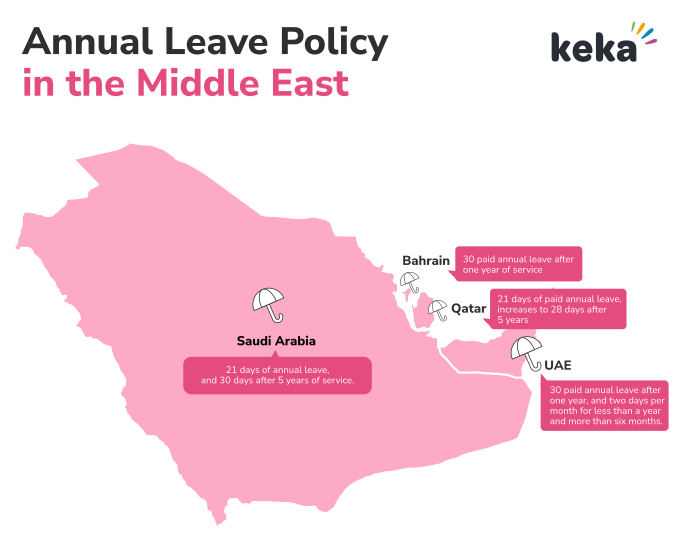
Across the region, annual leave policies are governed by national labor laws, often requiring employer notification and approval for scheduling and carry-forward. Let’s look at them in-depth:
Annual leave is earned overtime, typically each month. For instance, in the UAE, employees accumulate about 2.5 days of leave every month, which adds up to 30 days after a full year of service.
Here is what happens in different scenarios:
1. During Probation:
Employees on probation often don’t earn full leave until their probation period is over. Some employers may offer a smaller, prorated amount during this time, but it’s usually based on how long the employee has been with the company.
2. Early Resignation or Termination:
If someone leaves the company before reaching a full year, they are usually entitled to leave based on how many months they worked. Any unused leave might be paid out instead of taken as time off.
3. Carry-Forward and Encashment:
In many companies, unused leave can be carried forward into the next year, though there might be a limit to how much. Alternatively, if someone doesn’t take their leave, they may be able to encash it, meaning they get paid for the days instead.
Note: These annual leave calculations are based on calendar days which also public holidays count, or working days, excluding weekends, depending on the company’s policy.
Proper management of annual leave is central to staff satisfaction and organizational productivity. Employers can achieve effective working practices where policies are clearly established while maintaining staff rights.
Well, we have a few best practices that will help you manage your annual leave with ease:
By implementing these best practices, employers can assist in achieving a healthy balance of annual leave that works for the team as well as organizational achievement. However, the best choice is to automate leave management.
Creating or updating your company’s annual leave policy is crucial for ensuring clarity and consistency in how leave is managed across your organization.
Here’s a framework to guide you in drafting or revising your leave policy:
Always ensure your policy is aligned with local labor laws, such as those in the UAE, to avoid any legal issues.
Technology has transformed how companies manage annual leave, and HR & leave management software like Keka plays a pivotal role in automating and streamlining the entire process.
1. Automate Accruals
Keka automates leave accrual based on company policies, ensuring that employees receive accurate leave entitlements without manual intervention. This reduces errors and ensures compliance with labor laws.
2. Simplify Approval
With Keka, the leave approval process is simplified. Employees can request leave via an easy-to-use interface, while managers can quickly approve or decline requests, all while maintaining transparency.
3. Real-Time Tracking
Keka offers real-time leave tracking, allowing both employees and managers to stay updated on remaining leave balances and scheduled time off, reducing confusion and administrative burden.
Using Keka’s Leave Management Software ensures a seamless experience for HR teams, employees, and managers. It improves compliance and enhances employee satisfaction.
For more on how Keka can simplify leave management, explore our Keka Leave Management Software page and check out our guide on UAE Public Holidays 2025.
A productive, equitable, and legally compliant workplace depends on efficient leave management. Employers can ensure accuracy and transparency by automating accruals, approvals, and tracking using HR and payroll software such as Keka. An unambiguous and open leave policy promotes worker welfare and keeps business operations running smoothly.
1. How many annual leave days are employees entitled to in the UAE?
A. In the UAE, employees are entitled to 30 days of annual leave after completing one full year of service.
2. Does annual leave include public holidays?
A. No, annual leave does not include public holidays. Public holidays are separate from the annual leave entitlement.
3. What happens to unused annual leave at the end of the year?
A. Unused annual leave can be carried forward to the next year, but there might be limits depending on company policies. Some employers may also offer leave encashment for unused days.
4. Is annual leave accrued during the probation period?
A. Employees typically don’t accrue full leave during the probation period, but some companies may offer prorated leave depending on their policy.
Subscribe to keep up with the latest strategic finance content.
Request a demo