Login
Login

Leave of Absence Explained: Rights, Types, and Policies



PRODUCTS
 Payroll Suite
 HR Suite
 Talent Suite
 Project Services Suite
Meet the platform tailored to your business
Core system of record
One platform for the entire employee journey

BY INDUSTRY
BY COMPANY SIZE
LEARN
EXPLORE KEKA
A Leave of Absence is time away from the job for health issues taking care of someone, personal matters or urgent situations. More people are asking for this kind of time off every year for three years in a row. Managing these requests properly involves knowing the rules that decide who can take time off the process to get approval keeping the job safe making sure pay continues and dealing with laws about time off for human resources and team leaders. This guide explains the kinds of time, off the best ways to create policies and the usual problems that come up when managing these requests.
Even dedicated employees may occasionally need extended breaks from work.
And increasingly, they’re asking for it. In 2024, 57% of HR managers reported an uptick in extended leave requests, marking the third straight year of growth.
Whether it’s for medical treatment, caregiving, personal development, or unexpected emergencies, organizations must be prepared to cater to leaves of absence.
This article covers everything you need to know about leave of absence: its types, the legal boundaries to stay within, and how you can build a leave of absence policy that’s both clear and caters to employees’ leave of absence requests effectively.
A leave of absence is an extended break from work while maintaining employment status and job security. Unlike paid time off (PTO) or vacation days, it’s typically longer-term for specific circumstances such as medical reasons, family emergencies, or personal matters. Leave of absence may be paid or unpaid depending on company policy, but the employee’s position remains protected.
Employers authorize leaves of absence to allow employees time away from work for various important circumstances. Common reasons include personal illness, recovery from surgery, family emergencies, and military service.
Employees may also take educational leave to pursue academic programs or training, and family medical leave to care for sick relatives or newborn children.
It is easy to confuse time taken off work with a leave of absence. Time off covers short-term absences such as taking a day for a doctor’s appointment, using vacation days for a week-long trip, or calling in sick with the flu. Once employees register time off in the system, it usually requires manager approval, and no additional updates are needed unless the absence changes.
Leave of absence, on the other hand, addresses longer periods away from work when the return date remains uncertain or the time off extends indefinitely. For example, an employee might take a 12-week maternity leave after childbirth, medical leave following major surgery with an unknown recovery timeline, or consider this real employee experience shared on Reddit. This Reddit post illustrates the complexity employees face when determining their options and navigating the system.
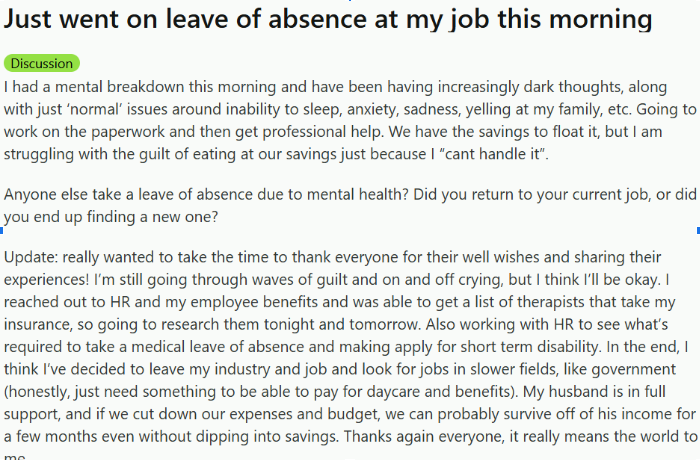
As this example shows, employees often struggle to understand which type of leave applies to their situation. Here’s how you can decide between opting for time off vs when to apply for leave of absence:


A leave of absence falls into two categories: mandatory and voluntary.
Here, certain leaves, like family leaves, jury duty, military training, etc., have legal protections, whereas leaves like time off for educational purposes or a professional sabbatical are voluntary leaves accepted/approved by an employer.
Mandatory leaves are governed by law and must be granted under specific circumstances. For example, family and medical leaves under the Family and Medical Leave (FMLA), military leave, jury duty, etc. Employers are required to approve these types of leaves, and in many cases, employees are entitled to job protection during their absence.
Common examples include:
Voluntary leaves, on the other hand, are at the discretion of the employer. These are not required by law, but may be granted as part of the organization’s policies or culture. While voluntary leaves may not come with legal protections, they can significantly impact retention, employee morale, and long-term engagement when handled thoughtfully.
Common examples include:
Besides meeting legal obligations, a well-drafted leave of absence policy helps avoid confusion, ensures consistent treatment, and supports timely return-to-work outcomes.
Here are five best practices to help you create a simple framework for building the leave of absence policy:
Start by specifying which employees qualify for leave, under what circumstances, and whether the leave is paid or unpaid.
Ensure that eligibility criteria align with federal and state laws like the Family and Medical Leave Act (FMLA), the Uniformed Services Employment and Reemployment Rights Act (USERRA), the Americans with Disabilities Act (ADA), and relevant local ordinances. If your organization offers non-statutory leaves like sabbaticals or personal leave, detail those separately.
Set up a clear and seamless leave request submission process. You can outline the acceptance methods (whether an HR portal or email), standard advance notice (typically 30 days for foreseeable events), and documents (medical certifications or service orders) to validate the leave request.
Also, list how leave approvals are communicated and what happens in case of incomplete documentation.
Include the maximum duration of a leave of absence for each leave category and whether there is the ability to use multiple leave categories together. Als,o understand what the interaction is between disability benefits or workers’ compensation, along with job protection and paid time off. Include information on whether employment benefits like health coverage, bonus eligibility are accessed while on leave.
Clearly communicate whether the employee will have the same position held open and what the rights are upon return next period. Remember that if FMLA or USERRA is based on the knowing if it provides job protection, which is provided under either of these laws.
Ensure you indicate whether a return to work/initially back to work will be guaranteed or factored available under discretionary leave.
Here are the main challenges HR teams face when managing leave, with practical, personalized solutions under each issue.
Manual tracking of absences makes it hard to identify who is on leave. As a result, key teams can be left short-handed and projects may fall behind. According to Absencesoft’s 2025 State of Leave and Accommodations Report, 57% of HR managers reported an increase in leave requests, with over half noting a rise of 21% or more. Automated tracking systems connected to team calendars and scheduling tools can help prevent these gaps.
Keeping up with laws like FMLA and handling overlapping leave types (such as parental, caregiver, and sick leave) often leads to compliance issues. The 2025 NFP US Leave Management and HR Trend Report reveals that around 53% of HR professionals say this is one of their top administrative challenges. Moreover, only 1% of companies currently use AI-based tools for managing leave, indicating how manual the process still is.
Introducing leave platforms with built-in legal updates and automated decision flows reduces the risk of errors. It also ensures policies are applied fairly and consistently across all departments.
Leave requests often get lost or ignored when they’re sent via email or chat. In the end, this leads to confusion about what was agreed to and when. Many organizations still opt for direct discussions with managers instead of a structured approach, which makes tracking approvals and records impossible and open to discrepancy.
Centralizing leave requests can help capture every application submission, review, and approval in one central platform.
Disconnected systems are a big issue when your leave data does not connect to your payroll system. In the previously mentioned 2025 NFP report, 71% of employers said their leave benefits are easy to administer, suggesting the benefits of technological advancements.
By creating automated end-to-end workflows, you can ensure that your leave balances and accruals, and deductions are accurately applied in your records in a timely and coherent manner.
Employees have become accustomed to employers meeting varying personal and cultural needs. This can take on many forms, including caregiving duties, observing religious holidays, and asking to take leave to care for their mental health.
Flexible leave policies that allow for customization can help fulfill these demands. Employers should have systems in place that allow HR to add new leave types and set leave rules based on geographic location, culture, or role. This can help ensure equity without unnecessary complication.
A clear, compliant leave of absence policy helps protect both the employer and employee. By defining eligibility, streamlining processes, and addressing real-world challenges, HR teams can create a system that’s fair, efficient, and adaptable, that supports people when they need it most while keeping business operations on track.
A leave of absence is applicable whenever an employee is unable to work but plans to return later. Acceptable reasons for leave include illness, injury, family responsibilities, military service, or education. The reason for the leave must be serious enough to require it, must be documented, and approved in advance due to company policy or applicable laws.
An employee must formally request leave through the employer’s process. This usually involves submitting a written notice, explaining the reason, and providing any required documents. Approval depends on the type of leave, its urgency, and whether it is covered by law or company policy.
No, a leave of absence is not the same as paid time off. PTO is usually used for short-term breaks like vacations or personal days. A leave of absence covers longer periods and may be unpaid, depending on the reason and eligibility.
Some leaves are paid, others are not. Paid leaves include certain medical or family-related absences covered by company policy or law. Unpaid leave is common for personal, educational, or extended medical reasons.
Yes, employers can deny a request if the leave is not legally required or if the employee does not meet eligibility criteria.
The length depends on the reason and applicable laws or policies. Legally protected leaves, like FMLA, allow up to 12 weeks. Company-approved leaves may be longer or shorter.
Under U.S. law, the FMLA requires covered employers to provide up to 12 weeks of unpaid leave for qualifying reasons. Other legal leaves include military service, jury duty, and disability. Eligibility depends on tenure, hours worked, and employer size.
Subscribe to keep up with the latest strategic finance content.
Request a demo