Login
Login

TDS on Salary 2026: Complete Rate Chart and Section 192 Guide for FY 2026-27


PRODUCTS
 Payroll Suite
 HR Suite
 Talent Suite
 Project Services Suite
Meet the platform tailored to your business
Core system of record
One platform for the entire employee journey

BY INDUSTRY
BY COMPANY SIZE
LEARN
EXPLORE KEKA
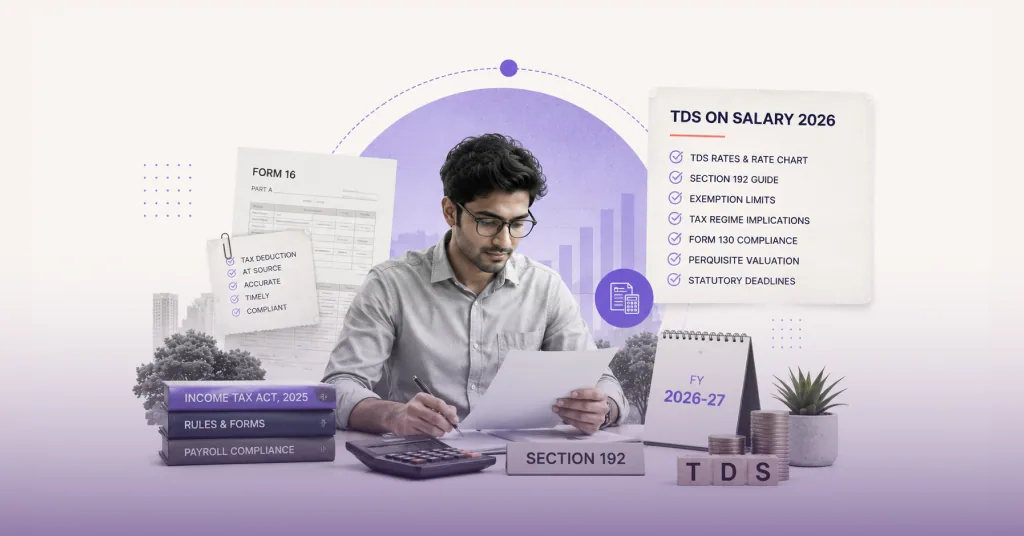
TDS on salary remains governed by Section 192 for FY 2026-27, but payroll teams must adapt to key changes introduced under the Income Tax Act, 2025. This guide explains salary TDS rates, exemption limits, tax regime implications, Form 130 compliance, perquisite valuation updates, and statutory deadlines. It also provides step-by-step calculation methods, compliance requirements, and practical payroll scenarios to help employers ensure accurate deductions, timely filings, and year-round tax compliance.
It usually starts with a simple employee query.
A team member notices their take-home pay is lower than expected and wants to know why. The payroll team checks the salary register, reviews the employee’s tax regime declaration, recalculates the annual tax liability, and traces the change back to a bonus payout, a salary revision, or an updated investment declaration.
Now multiply that across hundreds of employees, multiple payroll cycles, and a calendar full of statutory deadlines. TDS on salary quickly becomes one of the most scrutinized payroll responsibilities, where even a small error can lead to employee concerns, compliance risks, or year-end reconciliation issues.
For FY 2026-27, payroll teams have another layer of change to navigate. The Income Tax Act, 2025 has come into effect, Form 16 has been replaced by Form 130, and several perquisite valuation rules have been updated. While the core principles of salary TDS remain unchanged, the compliance landscape around it has evolved.
Quick Check: TDS on Salary 2026Governing section: Section 192, now consolidated under Section 393 of the Income Tax Act, 2025New regime exemption limit: ₹4,00,000Standard deduction (new regime): ₹75,000Effective zero-tax income limit (new regime): ₹12,75,000Monthly TDS deposit deadline: 7th of the following month (30 April for March deductions)Form 16 is now Form 130 from Tax Year 2026-27Section 206AB does not apply to salary TDS and was omitted from 1 April 2025
This guide covers everything employers need to know about TDS on salary for FY 2026-27, from tax slabs and threshold limits to monthly calculations, Form 130 compliance, statutory deadlines, and the key changes introduced under the Income Tax Act, 2025.
Before any calculation makes sense, it helps to know exactly what Section 192 is asking the employer to do, because most payroll confusion traces back to skipping this step.
TDS on salary is the tax an employer deducts under Section 192 before paying an employee, calculated using the employee’s average tax rate for the year and deposited with the government against the employer’s TAN.
The employer isn’t choosing a number out of habit. It estimates the employee’s full-year income, applies the regime and deductions the employee is entitled to, works out tax payable for the year, and divides that by 12.
That calculation only holds together if three things are in place:
Under the Income Tax Act, 2025, none of the logic has changed, and only the legal address has changed. Salary paid on or after April 2026 falls under the new Act. Anything paid on or before 31 March, 2026 still falls under the Income Tax Act 1961.
With the basics in place, the next question every payroll team asks is simple: how much, exactly, should be deducted this year.
The honest answer is that TDS on salary follows the income tax slab rates for the regime the employee has chosen, with 4% Health and Education cess added on top, and surcharge only kicking in once income crosses ₹50 lakh. The official Income Tax Department chart lists Section 192 simply as salary payment at the normal slab rate.
Translating that into payroll terms means calculating tax on slabs first, adding surcharge if the threshold is crossed, then adding cess on the combined figure.
| New Tax Regime | Income Tax Slab | Rate |
|---|---|---|
| Up to ₹4,00,000 | Nil | Nil |
| ₹4,00,001 to ₹8,00,000 | 5% above ₹4,00,000 | 5% |
| ₹8,00,001 to ₹12,00,000 | ₹20,000 + 10% above ₹8,00,000 | 10% |
| ₹12,00,001 to ₹ 16,00,000 | ₹60,000 + 15% above ₹12,00,000 | 15% |
| ₹16,00,001 to ₹20,00,000 | ₹1,20,000 + 20% above ₹16,00,000 | 20% |
| ₹20,00,001 to ₹24,00,000 | ₹2,00,000 + 25% above ₹20,00,000 | 25% |
| Above ₹24,00,000 | ₹3,00,000 + 30% above ₹24,00,000 | 30% |
Note for payroll teams: The ₹75,000 standard deduction applies before this table comes into play. Combined with the Section 87A rebate of up to ₹60,000, taxable income up to ₹12 lakh is effectively tax-free, pushing the real zero-tax salary figure to roughly ₹12.75 lakh.
| Old Tax Regime | Income Tax Slab | Rate |
|---|---|---|
| Up to ₹2,50,000 | Nil | Nil |
| ₹2,50,001 to ₹5,00,000 | 5% above ₹2,50,000 | 5% |
| ₹5,00,001 to ₹10,00,000 | ₹12,500 + 20% above ₹5,00,000 | 20% |
| Above ₹10,00,000 | ₹1,12,500 + 30% above ₹10,00,000 | 30% |
Senior citizens aged 60 to 79 get a slightly wider exemption band, starting at ₹3,00,000 instead of ₹2,50,000:
| Old Tax Regime | Income Tax Slab | Rate |
|---|---|---|
| Up to 3,00,000 | Nil | Nil |
| ₹3,00,001 to ₹5,00,000 | 5% above ₹3,00,000 | 5% |
| ₹5,00,001 to ₹10,00,000 | ₹10,000 + 20% above ₹5,00,000 | 20% |
| Above ₹10,00,000 | ₹1,10,000 + 30% above ₹10,00,000 | 30% |
Once income crosses the surcharge threshold, you’ll need to apply surcharge on the income tax amount first, and then add Health & Education cess. The official chart states that cess is 4% on income tax plus surcharge, in both regimes.
| Income Limit | New Regime Surcharge | Old Regime Surcharge |
|---|---|---|
| Up to ₹50 lakhs | Nil | Nil |
| ₹50 lakhs to ₹1 crore | 10% | 10% |
| ₹1 crore to ₹2 crores | 15% | 15% |
| ₹2 crores to ₹5 crores | 25% | 25% |
| Above ₹5 crores | 25% | 37% |
Cess of 4% applies on tax plus surcharge, in both regimes. There’s one exception worth flagging for completeness: the enhanced 25% and 37% surcharge slabs don’t apply to certain capital gains and dividend income, where surcharge caps out at 15%, though this rarely touches pure salary income.
If your team is still rebuilding these tables in a spreadsheet every appraisal cycle, that’s exactly the kind of repetitive work Keka’s payroll engine handles automatically, recalculating TDS the moment a salary revision or regime change is logged.

Not every employee on your payroll owes TDS, and getting this wrong in either direction creates problems. Deduct too early and an employee under the exemption limit ends up overpaying until the next reconciliation. Skip it for someone who’s crossed the limit, and the employer is the one who answers for it later.
No TDS applies under the new regime when net taxable income stays below ₹4,00,000, and none applies under the old regime when it stays below ₹2,50,000, with higher limits for senior citizens. The check is always run on net taxable income, after standard deduction and other eligible deductions, never on gross salary alone.
If the employee opts for the new regime, you should deduct no TDS on salary when net taxable income is below ₹4 lakh. The standard deduction available under the new regime is ₹75,000, and deductions under Section 80CCD(2) and rebate under Section 87A can also reduce liability.
Under the old regime, the basic exemption limit remains ₹2,50,000 for individual taxpayers below 60 years of age and the standard deduction available to salaried taxpayers and pensioners is ₹50,000. Resident senior citizens (aged 60 to below 80 years) have a basic exemption limit of ₹3,00,000, while resident super senior citizens (80 years and above) enjoy a basic exemption limit of ₹5,00,000 under the old tax regime.
| Income Slabs | Age <60 Years & NRIs | Senior Citizens (60 to 80 years) | Super Senior Citizens (80+) |
|---|---|---|---|
| Till ₹2.5 lakh | NIL | NIL | NIL |
| ₹2.5 lakh – ₹3 lakh | 5% | NIL | NIL |
| ₹3 lakh – ₹5 lakh | 5% | 5% | NIL |
| ₹5 lakh – ₹10 lakh | 20% | 20% | 20% |
| ₹10 lakh and above | 30% | 30% | 30% |
TDS is deducted at the time salary is actually paid, not when it accrues. Since salary is usually paid monthly, the deduction happens every cycle, and missing it doesn’t make the obligation disappear, it just adds interest exposure under Section 201A.
Payroll checklist for the threshold check: Confirm regime declaration before the first payroll run of the financial year.Recalculate the annual income estimate after any salary revision, bonus payout, or mid-year joiner with income from a previous employer.Re-verify investment proofs before the January-March quarter, since this is when old regime declarations most often turn out to be overstated.
Once the threshold question is settled, the actual arithmetic of the deduction is next, and this is the part that trips up even experienced payroll teams.

The math itself isn’t complicated, but it has enough moving parts, salary components, regime, deductions, that small errors compound quickly across a few hundred employees.
The short version: annualize the salary, subtract eligible deductions for the chosen regime, apply slab rates to get annual tax, then divide by 12 for the monthly figure.
Annualize income across all heads: basic salary, dearness allowance, HRA, bonus or incentive payouts, and salary from a previous employer in the same financial year.
Apply the deductions available under the chosen regime.
Calculate net taxable income:
Net Taxable Income = Total Income for the Fiscal − Total Deductions and Exemptions
Apply slab rates to that figure and divide the resulting annual tax by 12.
The employer deducts TDS at the employee’s average rate of income tax:
Average Rate = Income Tax Payable/Estimated Annual Income
Take an employee earning ₹1,00,000 a month, ₹12,00,000 for the year. After tax on the applicable slabs plus 4% cess, annual tax payable comes to ₹1,48,200. That’s an average rate of 12.35%, so the monthly TDS on the ₹1,00,000 salary works out to ₹12,350.
| Particulars | Under New Tax Regime | Under Old Tax Regime |
|---|---|---|
| Gross income from salary | ₹15 lakh | ₹15 lakh |
| (less) Standard deduction | ₹75,000 | ₹50,000 |
| (less) Chapter VI deductions | Nil | ₹1.5 lakh |
| Net taxable income | ₹14.25 lakh | ₹13 lakh |
| Income tax payable for the fiscal | ₹97,500 | ₹2.11 lakh |
| Monthly TDS on salary to be deducted | ₹8,125 | ₹17,550 |
This is one of the most common questions HR fields, and the answer surprises most employees: nil, under the new regime, in most cases.
Annual salary of ₹9,00,000 minus the ₹75,000 standard deduction leaves taxable income at ₹8,25,000. Tax on that comes to ₹22,500, fully offset by the Section 87A rebate since taxable income stays under ₹12 lakh. Monthly TDS is zero.
Under the old regime, the outcome depends on declared deductions. With ₹1.5 lakh of Chapter VI-A deductions, taxable income drops to ₹7 lakh, annual tax including cess comes to roughly ₹54,600, and monthly TDS lands around ₹4,550.
Edge cases worth flagging: Mid-year joiner: Annualize only income from the joining date, plus any reported income from a previous employer in the same financial year, not a full 12-month projection.Mid-year exit: Recompute the annual estimate at the time of exit and true up the TDS already deducted before the final settlement goes out.
These calculations look very different depending on which regime an employee picks, and that choice deserves its own conversation.
Every payroll cycle eventually runs into the same employee question: which regime should I actually pick? The honest answer depends on the person, but the broad pattern is consistent across FY 2026-27.
The new regime is the default for TDS this year, and it usually results in lower monthly deduction unless the employee has significant Chapter VI-A deductions or home loan interest to claim against the old regime.
The new regime operates under Section 115BAC of the Income-tax Act, 1961 (Section 202 under the Income Tax Act, 2025), with a ₹4 lakh basic exemption limit. Taxpayers with taxable income up to ₹12 lakh pay zero tax through the Section 87A rebate.
| Annual Salary | Tax under New Regime | Tax under Old Regime | Savings Under New |
|---|---|---|---|
| ₹8 lakh | Nil (87A Rebate) | ₹75,400 | ₹75,400 |
| ₹10 lakh | Nil | ₹1,17,000 | ₹1,17,000 |
| ₹12 lakh | Nil | ₹1,79,400 | ₹1,79,400 |
| ₹13 lakh | ₹78,000 | ₹2,10,600 | ₹1,32,600 |
| ₹15 lakh | ₹1,09,200 | ₹2,73,000 | ₹1,63,800 |
| ₹20 lakh | ₹2,08,000 | ₹4,29,000 | ₹2,21,000 |
| ₹25 lakh | ₹3,43,200 | ₹5,85,000 | ₹2,41,800 |
| ₹30 lakh | ₹4,99,200 | ₹7,41,000 | ₹2,41,800 |
When an employee opts for the old regime, that choice is recorded through Form 141, along with the supporting investment declaration. No declaration on file means payroll defaults to the new regime automatically.
The old regime brings a ₹50,000 standard deduction and access to HRA, Section 80C, and Section 80D benefits the new regime doesn’t allow.
Most salaried employees end up better off under the new regime unless they’re claiming sizeable deductions or home loan interest. Regime selection shouldn’t be a once-a-year box to tick and forget.
It’s worth revisiting the declaration if salary structure, bonus payout, or benefit eligibility changes materially during the year, since a stale declaration usually means an incorrect monthly deduction down the line.
Inside Keka’s payroll module, regime comparisons run automatically for every employee, so this stops being a manual recheck each appraisal season.
Regime choice changes the math, but who’s actually responsible for deducting and depositing TDS changes with the type of employer altogether.
Section 192 applies the same way no matter where someone works, but the person actually responsible for deducting and depositing TDS depends on the organization’s legal structure.
| Type of employer | Person responsible for TDS |
|---|---|
| Central or State Government and Public Sector Undertakings | The appointed drawing and disbursing officers |
| Private and Public Limited Companies | The company and its principal officer |
| Partnership Firms | The managing partner or any partner authorized by the firm |
| Hindu Undivided Family | The Karta of the HUF |
| Sole Proprietorship | The proprietor of the business |
| Trust | The managing trustees in charge |
Whoever is liable to pay the salary deducts TDS based on the employee’s estimated total income for the year. In government departments, that’s the DDO. In an HUF, it’s the Karta.
Section 192 covers regular salary, including government salaries processed through a DDO.
Section 194P is narrower and separate: it lets a specified bank act as a deemed employer for senior citizens aged 75 and above who have only pension and interest income through that bank, deducting tax on their behalf and exempting them from filing a return at all.
It’s a relief measure for a specific group, not a substitute for regular Section 192 payroll.
The employer category settles who deducts. The next layer worth understanding is what’s actually changed at the legislative level this year.
A new tax law usually sounds scarier than it is in practice, and this is a good example. The mechanics of salary TDS haven’t moved. What’s changed is mostly structural, and worth knowing so nothing catches your team off guard mid-year.
From 1 April 2026, salary paid under the new law framework is governed by the Income-tax Act, 2025. For salary TDS documentation, the Income Tax Department’s guidance for Form 16 (now Form 130) specifically refers to employers covered under section 392(2), while section 393 appears in the same guidance in relation to specified senior citizen cases rather than general salary withholding.
The new Act gathers what used to be scattered sections under the 1961 law into one Section 393. Apart from a few procedural changes for specific transaction types, the rate structure itself hasn’t moved.
Form 15G/15H is now Form 121, and Form 26AS is now Form 149, which changes how non-deduction declarations and annual tax statements get filed and read, even though the underlying logic stays familiar.
The new Act takes effect from 1 April 2026, but income earned up to 31 March 2026 still falls under the 1961 Act and gets reported as AY 2026-27.
From 1 April 2026 onward, the relevant period is called Tax Year 2026-27, with no separate Assessment Year layered on top.
Budget 2026 left slab rates untouched for FY 2026-27, so both regimes carry forward the same rates as the prior year.
The rule for deciding which Act applies comes down to timing. If the deduction event happened on or before 31 March 2026, the Income-tax Act, 1961 governs it. If it happens on or after 1 April 2026, the Income Tax Act, 2025 takes over.
For payroll, the date salary is actually paid out decides which law applies, not the month it was earned for.
What used to sit under Section 115BAC of the 1961 Act now lives under Section 202 of the 2025 Act.
The substance of the regime hasn’t changed: limited deductions, lower rates, and a structure that tends to suit employees without elaborate tax-saving investments.
The legislative shift also brought a rename that’s generated more confusion than anything else this year, so it deserves its own section.
If there’s one change that will actually land on your desk this year, it’s this one. Form 16 hasn’t disappeared, but it has a new name, a new portal-only issuance rule, and a slightly different internal structure.
Form 130 replaces Form 16 as the annual salary TDS certificate, starting with Tax Year 2026-27, and it must be downloaded from the TRACES portal rather than generated through any other software or manual process.
Form No. 130 is the certificate an employer issues to a salaried employee or pensioner each year, summarizing salary paid, tax deducted, and tax deposited. It’s the proof an employee needs that tax was actually withheld and paid to the government on their behalf.
| Old (ITA 1961) | New (ITA 2025) | Purpose |
|---|---|---|
| Form 16 | Form 130 | Salary TDS Certificate |
| Section 203 | Section 395(4)(b) | Corresponding section |
| Rule 31 of IT Rules, 1962 | Rule 215(1) of IT Rules, 2026 | Corresponding rule |
Form 130 has three parts:
Form 130 is system-generated and tied directly to the TDS return the employer files. It has to be pulled from TRACES, it can’t be created through payroll exports or manual templates, and the employer signs it digitally or physically before issuing it.
| Old Form | Proposed New Form | Purpose |
|---|---|---|
| Form 16 | Form 130 | Salary TDS Certificate |
| Form 16A | Form 131 | TDS Certificate on non-salary payments |
| Form 26AS (AIS) | Form 168 | Annual tax/AIS reflecting tax credits |
| Form 24Q | Form 138 | Employer’s quarterly TDS returns |
| Form 26Q | Form 140 | Quarterly TDS return (other resident payments) |
| Form 27Q | Form 144 | Quarterly TDS return (non-resident payments) |
| Form 15G/15H | Form 121 | No-deduction declaration |
| Salary TDS Certificate | Period | Form | Issuance Date |
|---|---|---|---|
| Salary TDS Certificate | FY 2026-27 | Form 16 | June 15, 2026 |
| Salary TDS Certificate | TY 2026-27 | Form 130 | June 15, 2027 |
Form 130 cannot be issued in any informal or offline format. It has to come from TRACES, and a certificate prepared through any other route doesn’t count as legally valid, even if the numbers on it happen to match.
Knowing when TDS applies is one side of this. Knowing when it doesn’t, and what to do if it’s being deducted more than it should, is the other.
Not every salaried employee owes TDS, and not every employee who does owe it has to accept the standard deduction rate without question.
No TDS applies when net taxable income stays below ₹4 lakh under the new regime or ₹2.5 lakh under the old regime, and an employee expecting lower actual liability can also apply for a Section 197 certificate to bring the deduction down further.
An employee is exempt from TDS only when estimated salary stays under the basic exemption limit for their regime. This holds even where the employee hasn’t furnished a PAN, though a missing PAN triggers a separate higher-deduction rule under Section 206AA regardless of income level.
In practice, the effective no-TDS zone runs up to roughly ₹5 lakh under the old regime and roughly ₹12.75 lakh under the new regime, once standard deduction and rebate are factored in.
An employee earning ₹6 lakh a year under the new regime, after the ₹75,000 standard deduction, lands at ₹5.25 lakh taxable income, comfortably inside the zero-tax zone, so monthly TDS is nil.
Section 197 exists for cases where regular payroll withholding would deduct more than an employee’s actual annual liability, often because of deductions or losses that don’t show up in a standard salary calculation.
The employee applies through Form 13 on the income tax e-filing portal, and the Assessing Officer reviews the request before issuing a certificate specifying the reduced rate, validity period, and the employer’s TAN it applies to.
What to expect from a Section 197 application: Full approval at the requested ratePartial reduction to a different rateRejection, with reasons recordedProcessing time of 7 to 15 days for clean compliance histories, though the department’s stated timeline is 30 days
Exemptions and lower-deduction certificates handle the edge cases. The rest of the year still runs on a fixed compliance calendar that doesn’t bend for anyone.
This is the section most payroll teams bookmark, because missing even one of these dates triggers interest or penalty regardless of how accurate the calculation was.
TDS deducted in any month other than March must be deposited by the 7th of the following month, March deductions by 30 April, and quarterly TDS returns follow a fixed calendar through the financial year.
| Quarter | Period | TDS Return Due Date |
|---|---|---|
| Q1 | April – June 2026 | 31st July 2026 |
| Q2 | July – September 2026 | 31st October 2026 |
| Q3 | October – December 2027 | 31st January 2027 |
| Q4 | January – March 2027 | 31st May 2027 |
| Form 130 issuance | Full Tax Year 2026-27 | 15th June 2027 |
| Section | Nature of default | Interest rate | Period |
|---|---|---|---|
| 201 A | Non-deduction of TDS | 1% per month | From date TDS was due to date of actual deduction |
| 201 A | Non-payment of TDS | 1.5% per month | From date of deduction to date of actual payment |
Beyond interest, Section 234E imposes a late fee of ₹200 per day for filing the TDS return late, capped at the total tax deductible for that period.
Failing to deduct or deposit altogether can trigger a penalty equal to the tax not deducted under Section 271C, plus a daily penalty under Section 272A for failing to issue Form 16 or Form 16A.
Integrate a working calendar: Track the monthly deposit date, the quarterly return date, and the annual certificate deadline as three separate streams, not one combined checklist. Missing any one of them carries its own penalty, even if the other two are on time. This is precisely the kind of multi-deadline tracking Keka’s compliance dashboard automates, with reminders before each due date rather than after.
Deadlines aside, one provision deserves a section of its own, mostly because so much of the internet still gets it wrong.
If you’ve read other guides on TDS compliance, you’ve probably seen Section 206AB mentioned as a live, active rule. It isn’t, and it never really touched salary anyway.
Section 206AB does not apply to salary TDS. It was omitted from the law entirely with effect from 1 April 2025, and even before that, salary income under Section 192 was specifically excluded from it.
The income tax department’s own rate chart confirms the provision was omitted effective 1 April 2025.
Even during the years it was active, the higher-deduction rule it imposed for non-filers carved out Section 192 (salary) and Section 192A (EPF withdrawal) as exceptions.
Salaried employees were never covered, because salary deductions always fell under Section 192.
A different and entirely new provision is actually relevant for payroll, named Section 206AA. It applies when an employee hasn’t furnished a PAN, in which case TDS is deducted at the higher of the applicable rate or 20%.
The practical takeaway for HR: PAN accuracy at onboarding matters far more than tracking non-filer status under 206AB, since that provision simply isn’t part of the salary conversation anymore.
Rates, deadlines, and exemptions cover cash salary. The next piece that often gets overlooked is everything that isn’t cash.
Salary TDS doesn’t stop at the basic pay and HRA line items on a payslip. Company cars, free meals, gift vouchers, and stock options all carry their own valuation rules, and a few of those rules changed meaningfully this year.
TDS under Section 192 covers perquisites and allowances as well as cash salary, and the Income-tax Rules 2026 revised several valuation limits that affect how much of a benefit actually gets taxed.
| Perquisite | Old Valuation | New Valuation |
|---|---|---|
| Motor car (Engine up to 1.6L or EV) | ₹1,800/month (+900 with chauffeur) | ₹5,000/month (+₹3,000 with chauffeur) |
| Motor car (Engine above 1.6L), employer paid | ₹2,400/month (+₹900 with chauffeur) | ₹7,000/month (+₹3,000 with chauffeur) |
| Free food per meal | ₹50, old regime only | ₹200, available under both regimes |
| Gift vouchers | ₹5,000 exemption | ₹15,000 exemption |
| Interest-free loan | ₹20,000 limit | ₹2,00,000 limit |
| Children’s education allowance | ₹100/month per child | ₹3,000/month per child, max two children |
For compensation reviews, the impact cuts both ways. Food, gift, loan, and education benefits became noticeably more tax-efficient for employees, while the company car perquisite now carries a higher taxable value, which directly raises monthly TDS for employees with a car benefit.
This is worth a line in employee communication if your organization offers company-leased vehicles.
Stock options follow a different timing rule from regular salary. The taxable event isn’t the date of grant, it’s the date the employee exercises the option. The taxable value is the gap between the Fair Market Value of the shares on the exercise date and whatever the employee actually paid for them.
Example: An employer allots shares with an exercise price of ₹500, and the FMV on the exercise date is ₹6,500. The taxable perquisite per share is ₹6,000. Across 100 shares, that’s a ₹6,00,000 perquisite added to that month’s salary income for TDS purposes, which can create a large one-time spike in deduction during the exercise month.
Eligible start-ups get more room here. They can defer TDS on ESOP perquisites until the earliest of three triggers:
That deferment is specific to recognized start-ups and doesn’t extend to other employers.
Once the deduction is correct, including the non-cash components, the final piece is making sure that deduction actually reaches the employee as usable tax credit.
A perfectly calculated deduction is only half the job. If it never reaches the employee’s tax records, it’s effectively invisible at return-filing time.
TDS deducted from salary shows up against the employee’s PAN in Form 26AS and the Annual Information Statement, and any excess deducted gets refunded only through filing the income tax return, not through a separate refund process.
When the amount deducted during the year exceeds actual tax liability, often because year-end investment proofs didn’t match the original declaration, the difference becomes refundable. There’s no standalone refund form for this.
The employee claims it by filing the income tax return, and the refund is processed against the credit already reflected in their tax records.
If an employer deducts TDS but fails to deposit it with the government, that amount never shows up against the employee’s PAN in Form 26AS. Without it appearing there, the employee can’t claim credit for it while filing their return, even though the deduction was taken from their salary.
This is one of the few situations where the employee bears the consequence of an employer’s compliance failure, and it’s worth flagging in any internal payroll audit since the fix sits entirely with the employer.
The final reconciliation at return-filing time follows the same logic across the board: TDS, TCS, and any advance tax already paid get reduced from total tax liability to arrive at the net amount payable or refundable.
Salary TDS is the part of the TDS system most HR teams deal with daily, but it sits alongside a few related provisions worth knowing by name.
Section 194P handles TDS for senior citizens aged 75 and above through a specified bank, Section 194O covers e-commerce operators deducting TDS from platform workers, and Section 195 governs TDS on payments to non-residents.
Specified banks deduct tax for senior citizens 75 or older who have only pension and interest income through that bank, computing the deduction on total income at the applicable rate and removing the need for that person to file a return at all. It sits apart from Section 192 and applies to a narrow group.
Section 194O requires e-commerce operators, think food delivery or ride-hailing platforms, to deduct TDS from payments made to participants on their platform, which is why it comes up often in gig-economy contexts rather than traditional payroll.
Section 195 covers TDS on payments made to non-residents, relevant when an organization pays salary or consulting fees to someone outside India’s resident tax framework.
Even with every calculation and deadline handled correctly, errors slip through occasionally, and the system has a defined way to fix them.
A wrong PAN, a mistyped challan number, an incorrect salary figure, these happen even in well-run payroll teams. The good part is that none of them are permanent once caught.
Errors in a filed TDS return get fixed through a revised return on TRACES using correction type codes C1 through C9, and the return can be revised more than once if needed.
| Type | Particular that can be corrected |
|---|---|
| C1 | Deductor details, name, and address |
| C2 | Challan details, amount, serial number, BSR code, tender date |
| C3 | Deductee (employee) details |
| C4 | Salary details previously reported |
| C5 | Deductee’s PAN |
| C9 | New challan and underlying deductee added |
Without correction, a wrong PAN or challan error keeps the employee’s Form 26AS and Form 130 inaccurate, which blocks their tax credit at return-filing time.
The employer files the revised return, pays the associated filing charge again, and TRACES processes it before the corrected figures flow through to the employee’s records.
If Form 130 itself contains an error, the fix runs through Form 138, the revised TDS statement, rather than a manual edit to the certificate. Once the revised statement is processed, the employer downloads the corrected Form 130 from TRACES and reissues it to the employee.
Salary TDS is one of those payroll responsibilities that only gets noticed when something goes wrong. A missed declaration, an incorrect deduction, a delayed deposit, or an inaccurate certificate can quickly turn into employee escalations and compliance headaches.
While the fundamentals of Section 192 remain the same, FY 2026-27 brings enough procedural changes to make a well-defined payroll process more important than ever. From regime declarations and perquisite valuations to Form 130 issuance and filing deadlines, accuracy depends less on knowing the rules and more on having a system that applies them consistently.
That’s where automation makes a difference. Instead of tracking tax calculations, compliance dates, and employee declarations across multiple spreadsheets, payroll teams can manage everything from a single platform.
Keka automatically calculates regime-based TDS, adjusts deductions when salaries or declarations change, tracks statutory deadlines, and helps teams stay prepared for year-end compliance.
The result is simpler payroll operations, fewer employee queries, and greater confidence that every deduction is calculated correctly and filed on time.
Simplify salary TDS compliance with Keka. Schedule a Demo
Q1. What is the TDS section for 2026?
Q2. What is the tax deduction for salary in 2026?
Q3. How much TDS is applicable on salary?
Q4. What is the TDS for ₹75000 salary?
Q5. What is the TDS rate on salary for FY 2026-27 under Section 192?
Q6. How do you calculate monthly TDS on salary under the new regime versus the old regime?
Q7. Which act governs TDS on salary paid on or after 01 April 2026?
Subscribe to keep up with the latest strategic finance content.
Request a demo