Login


Section 80D Deduction for AY 2026-27: Complete Guide to Health Insurance Tax Benefits & Limits


PRODUCTS
 Payroll Suite
 HR Suite
 Talent Suite
 Project Services Suite

Meet the platform tailored to your business
Core system of record
One platform for the entire employee journey

BY INDUSTRY
BY COMPANY SIZE
LEARN
EXPLORE KEKA
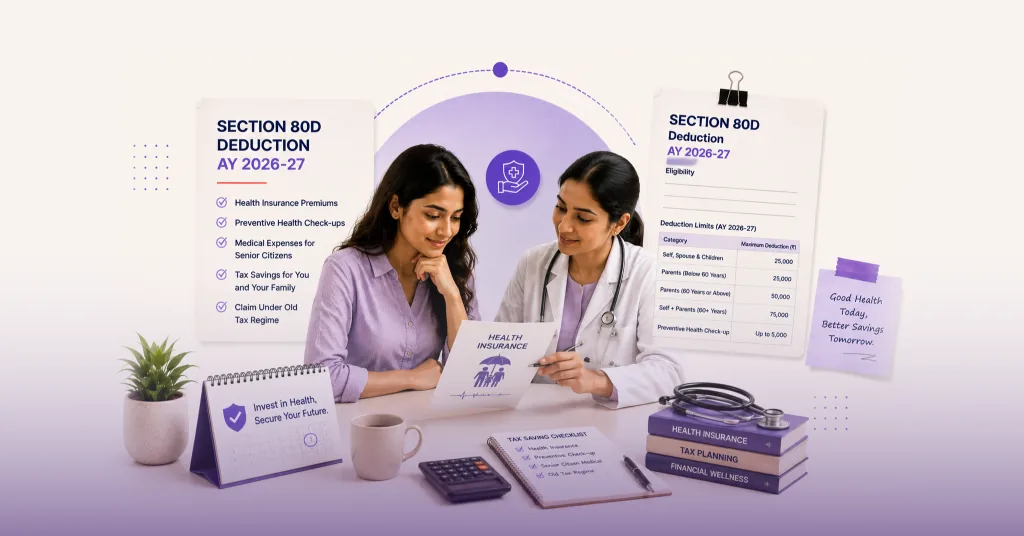
Section 80D allows individuals and HUFs to claim tax deductions on health insurance premiums, preventive health check-ups, and eligible medical expenses for uninsured senior citizens under the old tax regime. This guide explains AY 2026-27 deduction limits, eligibility, payment rules, tax regime differences, common mistakes, and how to maximize your Section 80D tax benefits while filing your income tax return.
Every March, Meera sends her HR team a copy of her health insurance premium receipt just days before the investment declaration deadline. Along with it comes the same question she asks every year: Will I get the full Section 80D deduction, or only part of it?
The answer usually depends on details most taxpayers overlook, such as who the policy covers, the age of the insured family members, how the premium was paid, and even the tax regime they choose.
For AY 2026-27, Section 80D allows individuals and Hindu Undivided Families (HUFs) to claim deductions on eligible health insurance premiums, preventive health check-ups, and, in certain cases, medical expenses for uninsured senior citizens. Depending on your family’s age profile, the deduction can go up to ₹1,00,000 under the old tax regime.
Although the Income Tax Act, 2025 comes into effect from 1 April 2026, AY 2026-27 relates to income earned up to 31 March 2026. That means claims for this assessment year continue to be governed by the Income Tax Act, 1961 and the existing Section 80D provisions.
This guide explains who can claim the deduction, the applicable limits for AY 2026-27, eligible expenses, payment rules, tax regime implications, and the common mistakes that reduce or invalidate Section 80D claims.
Section 80D sits inside Chapter VI-A of the Income Tax Act, the same group of provisions that houses Section 80C. Where 80C rewards saving and investing, 80D rewards something more basic: buying health cover before you need it.
It lets a taxpayer reduce their taxable income by whatever they’ve spent on eligible health insurance premiums, preventive check-ups, and, in specific situations, medical expenses for senior citizens who aren’t insured at all.
The deduction is built for individuals and Hindu Undivided Families, not companies or partnership firms, and it applies to premiums paid for self, spouse, dependent children, and parents. Top-up policies and critical illness plans fall inside its scope too, provided they meet the section’s conditions.
Resident individuals and NRIs can both claim this deduction for premiums paid on eligible family members, and so can HUFs, for any member of the family unit. Companies and firms are excluded entirely. This is a personal deduction, not a business one.
The eligibility narrows fast once you look at who counts as family. A few exclusions come up again and again in employee declarations:
More rejected claims trace back to this one rule than to anything else in Section 80D.
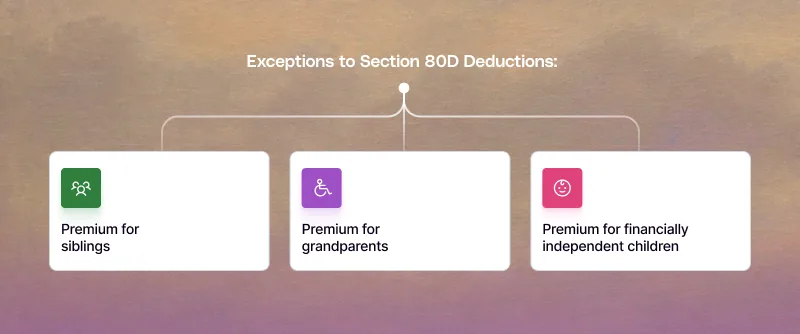
Self, spouse, dependent children, and parents. That’s the complete list. A premium paid for a working child sits outside Section 80D entirely, even though it’s genuine money spent for a genuine reason.
Quick tip:
Before you add a family member to a policy expecting a tax benefit, run them against this list first. It’s a five-minute check that saves an awkward surprise when you sit down to file.
Knowing who qualifies is the easy part. The harder part is knowing exactly how much each of those people counts toward your deduction, since the limit isn’t the same for everyone on that list.
Section 80D runs on two separate units. One is your immediate family, meaning you, your spouse, and your dependent children. The other is your parents. Each unit carries its own ceiling, and that ceiling shifts with age. Handled correctly, the deduction can reach ₹1,00,000 for a single household.
This is the table most people bookmark and return to every filing season. One detail to notice before you scan it: the preventive check-up amount, capped at ₹5,000, already sits inside these totals. It isn’t an extra allowance stacked on top.
| Policy Coverage | Self, spouse, children | Parents | Total maximum deduction |
|---|---|---|---|
| Self and family, all under 60 | ₹25,000 | Not applicable | ₹25,000 |
| Self and family + parents, all under 60 | ₹25,000 | ₹25,000 | ₹50,000 |
| Self and family under 60+ parents 60 or above | ₹25,000 | ₹50,000 | ₹75,000 |
| Self and family 60 or above + parents 60 or above | ₹50,000 | ₹50,000 | ₹1,00,000 |
| HUF members, all under 60 | ₹25,000 | Not applicable | ₹25,000 |
| HUF members 60 or above | ₹50,000 | Not applicable | ₹50,000 |
Parents get their own bucket, separate from the one covering you, your spouse, and your kids. Medical costs for older adults tend to run higher, so the law adjusts for age instead of applying one number across the board.
| Scenario | Coverage Combination | Maximum Claim | Rationale |
|---|---|---|---|
| Standard family | Self, spouse, kids (all under 60) + parents under 60 | ₹50,000 | Two units, both non-seniors |
| The sweet spot | Self, spouse, kids (all under 60) + senior citizen parents | ₹75,000 | Most common maximized deduction |
| The full shield | Self, spouse, kids, with any member 60+ + senior citizen parents | ₹1,00,000 | Both units qualify for senior citizen limits |
Covering senior citizen parents through a separate policy, rather than folding them into a family floater, is usually what pushes a household toward the higher end of this deduction.
Here’s a clause that deserves more attention than it usually gets. If a senior citizen, aged 60 or above, doesn’t have a health insurance policy at all, the medical expenses incurred for them during the year can still be claimed, up to ₹50,000.
Some elderly parents can’t get insured because of pre-existing conditions insurers won’t cover. For those families, this clause is the only tax relief available on medical spending that would otherwise go unrecognised.
These slabs are built around premiums, but Section 80D also recognises certain expenses that never touch a policy at all.
A premium payment is only one part of what Section 80D covers. The section recognises a handful of distinct expense categories, each with its own conditions.
Premiums qualify only when paid through a non-cash mode, and only when actually cleared within the financial year. A premium due but unpaid as of 31 March doesn’t count, even if the policy is active on paper.
The eligible list is broader than most taxpayers assume:
The 18% GST charged on your premium is treated as part of the premium itself, so it’s included in what you can claim toward your medical insurance premium deduction, not stripped out of it.
This allowance goes back to 2013-14, introduced to nudge people toward routine health screening instead of waiting for something to go wrong. Up to ₹5,000 can be claimed for check-ups covering self, spouse, dependent children, or parents, and this is the one part of Section 80D where cash payments are allowed.
Here’s where the arithmetic trips people up. Ravi paid ₹23,000 in premiums for his wife and children, plus ₹5,000 for his own health check-up that same year. His total eligible spend adds up to ₹28,000, but his ceiling is ₹25,000. So the deduction gets capped there: ₹23,000 goes toward the premium, and only ₹2,000 of the check-up counts, with the remaining ₹3,000 falling outside the claim.
Resident senior citizens without a policy can have their medical expenses claimed up to ₹50,000. The Act doesn’t define “medical expenditure” in a narrow way either, so consultations, medicines, and aids for impairments generally fall within scope.
Important tip:
Families often forget this deduction exists simply because there’s no policy document lying around to remind them of it. If a parent’s medical bills are piling up without insurance behind them, this is worth checking before you assume there’s nothing to claim.
All of this assumes you’re even eligible to claim the deduction in the first place, and that comes down to one decision made at the very start of the year: which tax regime you’re filing under.
This is the point where a lot of otherwise-eligible taxpayers lose the deduction without realising it, simply because of which regime they’ve filed under. It’s worth settling this question before you calculate anything else.
No, Section 80D is not available under the new tax regime. Anyone filing under the new regime, introduced through Section 115BAC, cannot claim deductions for health insurance premiums or preventive check-ups under this section, no matter how much they’ve genuinely spent.
The new regime trades away most popular deductions, including 80C, 80D, and HRA exemption, for lower slab rates. Since FY 2023-24, the new regime has been the default, which means anyone who doesn’t actively opt out is filing under rules that quietly drop this deduction.
| Feature | Old Tax Regime | New Tax Regime |
|---|---|---|
| Tax rates | Higher marginal rates | Lower marginal rates |
| Section 80D | Fully allowed, up to ₹1,00,000 total | Not allowed |
| Section 80C | Fully allowed, up to ₹1.5 lakh | Not allowed |
| Standard Deduction | ₹50,000 for salaried employees | ₹75,000 for salaried employees |
If you’re paying meaningful health insurance premiums, especially for senior citizen parents, and also using deductions like 80C, staying in the new regime by default usually costs you money over the year. The old regime tends to work out better for anyone carrying a fuller deduction stack.
Salaried employees can switch between the two regimes every financial year. Business owners and professionals only get one switch, so this decision needs more thought before it’s locked in.
Regime settled, the next step is arithmetic that involves turning eligible spending into an actual figure you can put on a return.
The method stays consistent no matter your income level. Split your spending into two units, self-and-family and parents, check the age band for each, and stop counting once you hit the ceiling. A Section 80D deduction calculator does this automatically, but it helps to know the logic behind it.
A 35-year-old with a spouse and one dependent child pays ₹18,000 for a family floater and ₹3,500 for an annual check-up. That’s ₹21,500 total, comfortably within the ₹25,000 ceiling. The entire amount is claimable.
A 48-year-old with a 45-year-old spouse pays ₹22,000 for their own top-up cover, plus ₹45,000 for a policy covering both parents, aged 70 and 68, and ₹4,000 for the parents’ preventive check-up. The self-and-spouse unit claims its full ₹22,000, under the ₹25,000 cap. The parents’ unit claims ₹49,000, under the ₹50,000 senior citizen limit. Total deduction: ₹71,000.
A 60-year-old taxpayer pays ₹32,000 for self and dependents, and ₹35,000 for parents aged 80. Both amounts fall fully within their ceilings, so the whole ₹67,000 is deductible.
Strip these examples down and the process repeats every time:
HR platforms build this exact logic into investment declaration workflows, which is why a health insurance tax deduction that seems complicated on paper usually takes seconds to calculate once the data is structured correctly.
One household unit deserves a closer look on its own: parents, because that’s usually where the bigger numbers show up.
Yes, parents have a separate deduction limit under Section 80D, and this is where most of the real deduction value hides for households that get it right.
Parents don’t need to be financially dependent on you for their premium to qualify. What matters is that you’re the one actually paying it.
Sneha pays ₹22,000 for her own family floater and ₹55,000 for a separate policy covering her 64-year-old mother. Because her mother is a senior citizen, that claim caps at ₹50,000 rather than the full ₹55,000 she paid. Her total deduction still comes to ₹72,000 once both units are added together.
When a parent can’t get insured at all, the law still leaves a door open. One taxpayer whose 80-year-old mother had no policy claimed ₹30,000 in consultations and medicines, plus ₹15,000 in diagnostic tests. The combined ₹45,000 sat within the ₹50,000 senior citizen ceiling, so the entire amount went through.
Yes, but only to the extent each sibling actually paid. If you and a sibling split a parent’s premium, each of you claims your own contribution, not a blanket share of the total. This rewards keeping clean, traceable payment records instead of settling things informally in cash between family members.
None of this money moves without leaving a trail, and that trail is exactly what decides whether a claim survives scrutiny.
Getting the eligible amount right is only half the job. The other half is making sure you actually paid for it the way the law requires, because Section 80D cares about payment mode almost as much as it cares about the amount itself.
This is arguably the single easiest way to lose a claim you’d otherwise be entitled to, so it’s worth stating clearly upfront.
| Payment Purpose | Allowed Payment Mode | Deduction Impact |
|---|---|---|
| Health insurance premiums | Any mode except cash | Fully eligible |
| Preventive health check-up | Any mode, including cash | Eligible up to ₹5,000 within the overall limit |
| Medical expenses for uninsured senior citizens | Non-cash only | Eligible within ₹50,000 senior citizen limit |
Pay your premium through net banking, UPI, a card, or a cheque, and the deduction stays protected. Pay in cash instead, and the claim disappears entirely, no matter how genuine the expense was.
There’s exactly one carve-out in the whole section, and it’s the ₹5,000 preventive check-up allowance, which can be paid in cash. It’s a small mercy for anyone who’s paid for a routine test at a local clinic that simply doesn’t take digital payments.
Important tip:
When you’re not sure whether a payment mode will hold up during scrutiny, default to digital every time. It’s the one habit that protects every part of a Section 80D claim at once, not just the premium.
Payment mode covers what happens with a premium paid once a year. Multi-year policies raise a different question entirely: what happens when one payment is meant to cover several years at once?
A multi-year premium doesn’t get claimed in one shot. Section 80D spreads it proportionately across the policy term instead.
Multi-year policies are popular because insurers discount them. For tax purposes, the lump sum gets spread evenly across the policy term, still subject to the same ₹25,000 or ₹50,000 ceilings that apply every other year.
A three-year policy paid as a ₹60,000 lump sum works out to ₹20,000 deductible each year. A two-year policy costing ₹40,000 splits into ₹20,000 annually.
| Policy Tenure | Total Premium Paid | Deduction Allowed/ Year | Income Tax Slab | Estimated Tax Saved Per Year | Total Estimated Tax Savings |
|---|---|---|---|---|---|
| 2 years | ₹40,000 | ₹20,000 | 5% | ₹1,000 | ₹2,000 |
| 2 years | ₹40,000 | ₹20,000 | 20% | ₹4,000 | ₹8,000 |
| 3 years | ₹75,000 | ₹25,000 | 30% | ₹7,500 | ₹22,500 |
| 3 years | ₹60,000 | ₹20,000 | 30% | ₹6,000 | ₹18,000 |
The premium is paid once, but the tax benefit gets recognised year by year. Anyone comparing an annual plan against a multi-year one should factor that timing difference in before assuming the multi-year option automatically saves more tax.
Tenure is one factor in that calculation. The kind of policy you’re holding is another, and it changes what actually counts as deductible.
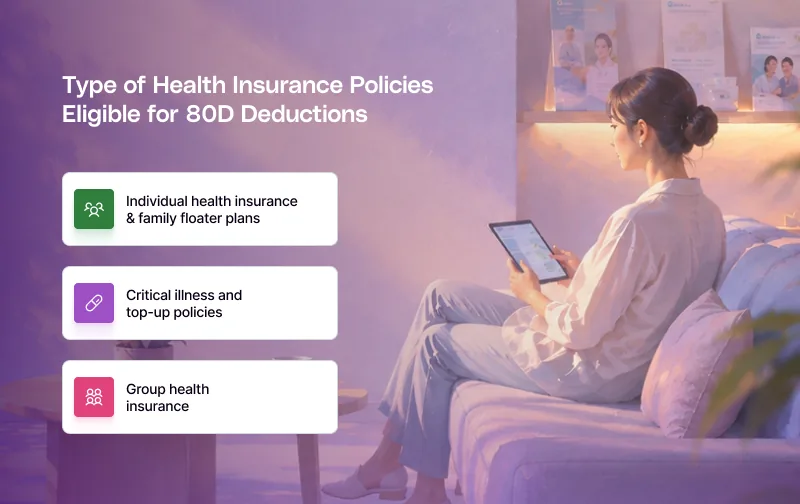
Most employees think of Section 80D as a mediclaim deduction and stop there. The scope is actually wider, and knowing where the boundaries sit changes how much of a premium actually ends up deductible.
Both formats qualify, but they behave differently in practice. A family floater covers everyone under one sum insured, which keeps the premium lower and the paperwork simpler during declarations, since HR only sees a single policy document for the whole family.
An individual policy covers one person against their own dedicated sum insured, which employees often prefer for a parent specifically, because a health event for one senior citizen doesn’t eat into the cover available for the rest of the family.
This is also why the earlier point about insuring parents separately matters so much in practice. A parent added to a young family’s floater draws from the same pool everyone else depends on. A standalone policy protects the parent’s cover, and the family’s, independently.
Employees usually buy top-up plans once their employer-provided cover starts feeling thin, particularly after a hospitalisation that came close to exhausting the base sum insured. The premium on a top-up qualifies in full under Section 80D.
Critical illness riders qualify too, but only for the portion of the premium going toward the health component, not toward any life insurance wrapper the rider is bundled with. Insurers don’t always break this out clearly on the premium receipt, which is why it’s worth asking for a split before assuming the whole amount counts.
Group health insurance paid directly by your employer generally isn’t something you can claim personally, and this is one of the most common points of confusion HR fields during investment declaration season.
Employees see a “health insurance” line in their CTC and assume it automatically counts toward Section 80D. It doesn’t, because the employer bore the cost, not the employee.
There’s one narrow exception. If the premium is added to your salary and then deducted, rather than paid separately by the company, you may be able to claim it, provided you can support that with documentation. Payroll teams that flag this distinction clearly at declaration time save employees from a claim that would otherwise get rejected at scrutiny.
Private policies are one side of the picture. Plenty of employees also contribute to schemes run by the government, and those follow a different set of rules altogether.
Not every government-linked health scheme behaves the same way under Section 80D. The deciding factor is simple: did the taxpayer actually pay a premium, or not.
A taxpayer can claim up to ₹25,000 for contributions to the Central Government Health Scheme or other notified schemes. This applies only to your own contribution, not to any amount paid on behalf of parents.
No, Ayushman Bharat contributions cannot be claimed under Section 80D, and the reason is straightforward once you see it. The scheme is fully funded by the government, so there’s no premium paid by the beneficiary, and Section 80D only covers expenses the taxpayer actually incurs. With nothing paid out of pocket, there’s nothing to deduct.
That doesn’t shut the door entirely. Any private health insurance bought alongside Ayushman Bharat remains eligible on its own terms, since that premium is a genuine, separate payment.
Understanding what qualifies solves half the problem. Getting it onto an actual tax return solves the other half.
Meera’s receipt, the one sitting in her HR team’s inbox every March, is exactly the kind of document this section is about.
The most important document is the premium payment receipt, showing the premium amount, policy number, names of the insured members, and the GST or cess paid. Keep the following alongside it:
None of this gets uploaded when you e-file. It needs to survive somewhere safe for up to eight years, in case the return is selected for scrutiny.
Salaried employees typically submit these documents to their employer through Form 12BB during the investment declaration window, or claim the deduction directly while filing their own return. Download the Section 80D certificate from your insurer’s portal first. It lays out exactly what was paid and when, in one place.
Where the deduction lands on the form depends on which one you’re filing. In ITR-1, it sits in the standard deductions section. In ITR-2 and ITR-3, it moves into a dedicated Schedule 80D.
Takeaway:
Keep your declaration to your employer and your final ITR claim identical. It avoids most of the reconciliation headaches that show up later.
Section 80D isn’t the only medical deduction sitting in the Income Tax Act, and it helps to know exactly where it ends and the others begin.
Section 80D often gets mentioned in the same breath as two other medical deductions, 80DD and 80DDB, and it’s easy to mix them up if you’ve never laid them side by side. Here’s how they actually differ.
| Section | What it covers | Who qualifies | Maximum deduction |
|---|---|---|---|
| 80D | Health insurance premiums, preventive check-up, medical expenses | Self, spouse, children, and parents | ₹25,000 – ₹1,00,000 age-based |
| 80DD | Medical treatment or maintenance of a disabled dependent | Dependent spouse, children, parents, siblings | ₹75,000, or ₹1,25,000 for severe disability |
| 80DDB | Treatment of specified critical illness | Self or dependent | ₹40,000 or ₹1,00,000 for senior citizens |
Section 80DD covers ongoing care and maintenance for a disabled dependent, including annuity or lump-sum payments into a scheme built for that purpose. Section 80DDB covers treatment costs for a defined list of critical illnesses. Neither substitutes for 80D. A family dealing with more than one of these circumstances at once can, in principle, claim across all three sections in the same year.
Knowing where these sections end doesn’t stop people from tripping over the same errors inside Section 80D itself.
Four mistakes account for most of the rejections HR and payroll teams see every March.
Most rejected claims trace back to these four issues, and they show up in almost every filing season without fail:
These mistakes matter more this year than most, because the underlying limits themselves haven’t moved in quite a while.
With the traps out of the way, it’s worth stepping back to see how AY 2026-27 actually compares to earlier years, since that context explains why getting these rules right matters more than waiting for the numbers to change.
Looking back a few assessment years puts the current limits in perspective, and it’s a fairly short list to review.
| Assessment Year | Limit (Self/ Family<60) | Limit (Senior Citizen) | Parent (SC) | Max Deduction |
|---|---|---|---|---|
| AY 2018-19 | ₹25,000 | ₹50,000 | ₹50,000 | ₹1,00,000 |
| AY 2024-25 | ₹25,000 | ₹50,000 | ₹50,000 | ₹1,00,000 |
| AY 2025-26 | ₹25,000 | ₹50,000 | ₹50,000 | ₹1,00,000 |
| AY 2026-27 | ₹25,000 | ₹50,000 | ₹50,000 | ₹1,00,000 |
The real lever for taxpayers was never going to be a higher limit showing up one year. It’s regime choice, payment mode, and documentation, three things fully within your control regardless of what the Budget does or doesn’t change.
Section 80D is one of the simplest ways to reduce your tax liability under the old tax regime, but only if you understand who qualifies, what expenses are covered, and how the deduction limits work. Choosing the correct tax regime, paying premiums through eligible payment modes, and maintaining the right documents are the three factors that determine whether you can successfully claim the deduction.
For salaried employees, submitting investment declarations and Form 12BB with accurate health insurance details before your employer’s deadline can prevent last-minute corrections during tax filing. HR and payroll teams can make this process easier by collecting declarations early and ensuring employees understand the eligibility rules before the financial year ends.
If you’re reviewing your Section 80D deduction for AY 2026-27, it’s also a good opportunity to revisit your other Chapter VI-A deductions, including Section 80C, Section 80DD, and Section 80DDB, so you don’t miss out on any available tax benefits.
Managing investment declarations, payroll, and tax compliance becomes significantly easier with an integrated HR and payroll platform like Keka. By bringing employee declarations, payroll processing, statutory compliance, and tax calculations into one system, Keka helps HR teams reduce manual work while ensuring employees claim the deductions they’re eligible for.
Make investment declarations, Form 12BB submissions, and payroll compliance effortless with Keka
Q1. What is the 80D deduction limit for FY 2025-26?
Q2. Can I claim Section 80D under the new tax regime?
Q3. What expenses are covered under Section 80D?
Q4. Which tax regime is better for claiming Section 80D?
Q5. Can I claim a separate Section 80D deduction for my parents?
Q6. Can I pay my health insurance premium in cash and claim Section 80D?
Q7. Can I claim medical expenses for uninsured senior citizen parents?
Q8. What is the maximum deduction available under Section 80D?
Q9. Is critical illness eligible for a Section 80D deduction?
Subscribe to keep up with the latest strategic finance content.
Request a demo