Login
Login

Keka HR Katalyst Chennai: Start with Talent Awareness, Attraction for Employer Branding


PRODUCTS
 Payroll Suite
 HR Suite
 Talent Suite
 Project Services Suite
Meet the platform tailored to your business
Core system of record
One platform for the entire employee journey

BY INDUSTRY
BY COMPANY SIZE
LEARN
EXPLORE KEKA
HR Katalyst is Keka’s on-ground event series where HR leaders meet to swap stories, trends, and hard-earned lessons. The Chennai edition focuses on local challenges, modern HR tech, and building people-first cultures, giving practitioners a chance to network, learn, and carry back practical ideas to their teams.
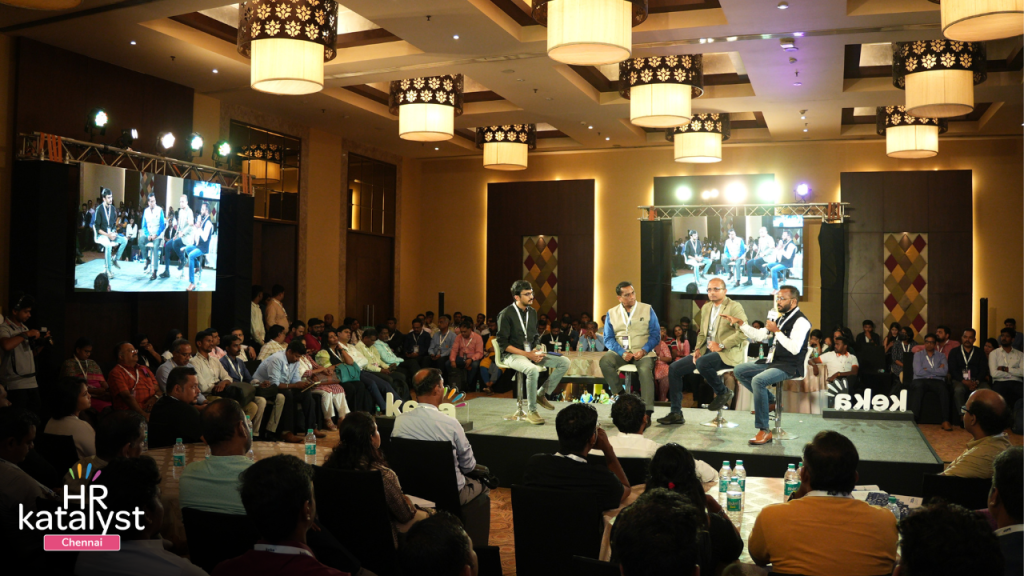
Food for thought: HR leaders taking part in a panel discussion at HR Katalyst in Chennai.
Many organizations faltered on employer branding as they started with recruitment marketing without focusing on talent awareness and attraction first, said a speaker at HR Katalyst summit in Chennai.
“Organizations must first spread awareness in the market about their purpose, industries and segments they operate in, and their offerings,” said Thirukumaran R., Talent Attraction Partner – India at Nokia.
Next, they must focus on talent attraction and recruitment marketing, which includes social media campaigns.
Last, organizations must align these three pillars of employer branding to their culture. “What you claim before external stakeholders must correlate with the internal functioning of your organization. If there’s a mismatch, it shows a failure of your employer branding,” added Mr. Thirukumaran.
He was explaining the four pillars of employer branding for recruitment at a discussion on ‘Tapping into Nontraditional Talent Pools’.
Keka, an HR technology provider to enterprises, organized this year’s third chapter of HR Katalyst in Chennai. The day-long gathering saw the participation of more than 200 HR professionals and founders. The gathering featured a keynote address, a panel discussion and a fireside chat.

Eager minds: HR professionals taking part in HR Katalyst in Chennai.
To strengthen employer branding, HR professionals must first experience what they’re selling, said Partha Samai, Regional Head of Human Resources – South, Jio. A former defense professional, Mr. Samai likened this hands-on approach to officers’ training. “A cadet lives the life of a soldier before becoming an officer. This way they understand the workplace culture better.”
With this experience, “you can pitch your organization strongly in the market and rattle out solutions adequately,” he added.
Explaining the evolving nature of hirings, Head HR at SRM Technologies Bala Vummidi said the traditional format of volume hirings was on the wane.
“Today, the average revenue per deal is declining in the IT industry. This is due to deep technology. As the field evolves, finding talent that keeps abreast of frequent updates is a challenge,” he said.
To overcome this, Mr. Vummidi said organizations could leverage the partnership ecosystem or employ consultants.
For instance, SRM technologies has joined hands with SRM University. The IT firm first offers classroom training to students in domains relevant to its clients and later provides them with hands-on training. “This has reduced the employees’ time to billability by three months,” said Mr. Vummidi.
To promote hirings, said Mr. Thirukumaran, organizations must maintain an inclusive tone on their career sites. “Most use a masculine tone which discourages applications,” he added.
Further, he anticipates the emergence of a talent intelligence system. This will combine talent acquisition, management and development. “This system could be linked to businesses and help them forecast skilling needs,” he stressed.
On the use of artificial intelligence, Mr. Vummidi advised HRs to apply the technology to simplify processes throughout the employee journey.
In fact, 75% HRs believe AI and HR professionals will coexist and complement each other, according to HRs as Change Agents.
“Professionals must not spend more than 20% of their time every day on tasks that don’t create value. Technologies must be deployed for such tasks,” he suggested.
Pointing to an AI application, Mr. Vummidi said SRM Technologies used a bot to screen resumes of job applicants. This has enhanced recruiters’ productivity by 40%.
At a fireside chat on ‘The Great Renegotiation – Will Hikes be Enough’, Ramanathan V., Chief Human Resources Officer, Dr. Agarwal’s Eye Hospital, agreed that salary was a driver. But for knowledge workers it wasn’t the primary one, he claimed.
He instead highlighted ‘total rewards’, an aspect of which was employee salary.
Today, the gig economy offered a unique opportunity to white-collar workers, believed Shashikanth Jayaraman, CHRO, MulticoreWare Inc. “It creates the opportunity to collaborate and put your talents to higher purpose and test across the globe, sitting at home.”
As a result, individuals were not confined to organizations. Professionals could now calibrate their needs and growth on their own terms, he added.
As regards technology use, Mr. Jayaraman struck up a word of caution. “Sometimes, in the name of technology we may ignore our role of connecting with employees. HRs must retain the human touch,” he said.
Subscribe to keep up with the latest strategic finance content.
Request a demo