Login
Login

How to Build a Scalable Performance Management Process for Your Team


PRODUCTS
 Payroll Suite
 HR Suite
 Talent Suite
 Project Services Suite
Meet the platform tailored to your business
Core system of record
One platform for the entire employee journey

BY INDUSTRY
BY COMPANY SIZE
LEARN
EXPLORE KEKA
Performance management that ran on casual check-ins stops working the moment an organization scales, leaving weak performers unaddressed and strong ones unrecognized. A structured process connects goal setting, feedback, reviews, and compensation decisions across managers, HR, and leadership. This guide breaks down what the performance management process involves, why it matters in the UAE, and how to make it scale.
Have you ever wondered about a common scenario?
As organizations grow, performance management often slips through the cracks.
What once worked—like casual check-ins or impromptu coffee chats to steer a slow performer—barely makes a dent.
Why? That’s because scaling your organization without evolving your performance management strategy destroys the very foundation of your workforce management.
This leads to lost goals, weakened feedback loops, and high turnover among your star performers.
Shocking, right?
“64% of organizations in the region note their current performance management systems don’t support long-term business goals or talent retention plans.”
— PwC Middle East Survey
Take Leena’s example. She is an HR leader at a mid-sized firm in Riyadh. Her quarterly review process once created deep emotional engagement between employees and managers. Leadership loved how it spotlighted top performers.
But things started unraveling fast.
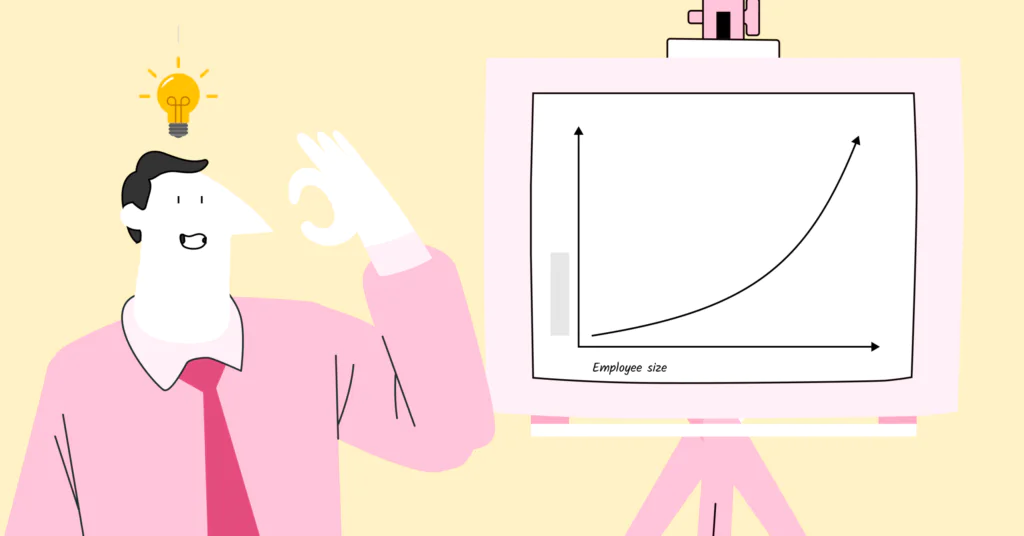
The company soon doubled its headcount within a quarter. Leena was getting stretched across every direction. What once was the soul of a connected culture soon became the reason behind mounting confusion and burnout.
Realizing the chaos wasn’t going away anytime soon, Leena took a step back and redesigned the system – this time with a clear scale and strategy in place.
In this blog, we will help you do the same. You’ll learn why traditional review models fail, what a future-ready performance management process is, and how to design one for your organization.
So, let’s get started by understanding what performance management means in this context.
Scale Performance Management Without the Growing Pains
Explore Keka
Performance management is an ongoing, strategic process where managers and employees align on goals, track outcomes, exchange feedback, and enhance performance.
It’s not an annual process but a system that continues throughout the employee’s life cycle.
A well-structured performance management system serves two critical outcomes:
It acts as a compass in scaling companies, helping them align every role with the company’s direction.
For HR leaders like Leena, moving to a continuous performance model also signifies:
Now that we have covered the basics, let’s understand why this performance management process is crucial for a growing organization.
When Leena’s organization began expanding their workforce, she was tasked with leading the hiring operations.
While she was confident about the talent pool, something kept nagging her. It wasn’t the hiring process (which you might have guessed) that caused problems.
There was a constant lack of engagement, clarity, and motivation. The goals were fuzzy. Feedback was sporadic. Development plans were missing.
And that’s a challenge faced by many growing firms in UAE and around the globe. Without a clear performance strategy, talent drains fast and along with it your culture.
That’s where performance management becomes an absolute necessity. It can transform how your firm scales and go the wrong way, causing everything to fall apart.
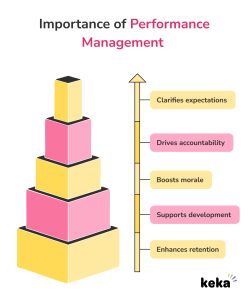
Here’s what an agile performance management model brings to the table:
Employees understand their role, purpose, and the true meaning of success. This helps them align their focus and priorities towards bigger business goals.
When goals are clearly visible and regularly discussed, teams stay aligned and motivated. This builds a culture of ownership, belongingness, and transparency.
Regular recognition and meaningful feedback increase engagement and inspire employees to go the extra mile.
Frequent conversations about surface skill gaps and career aspirations help HR managers craft personalized development plans or IDPs.
People who feel valued and heard are more likely to stay. This builds a strong employer brand and positive workplace culture.
Yet, many companies still treat performance management as an annual checkbox activity. The result? Low morale, high attrition, and underwhelming results.
Leena understood this system wouldn’t work in the long run. So, she redesigned her performance management system, making it continuous, conversational, and human-driven.
This led to higher retention, engagement, and better outcomes. Now, let’s see how Leena did it.
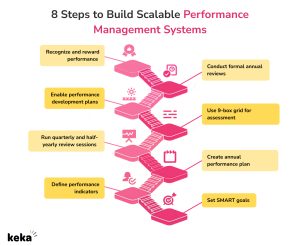
8 Essential Steps to Build a Scalable Performance Management Process
A strong performance management process depends on reviews and a continuous cycle of planning, tracking, reviewing, and developing employees in line with business goals.
Here’s how Leena built hers, and other HR leaders like you can also do it:
The foundation of performance management lies in meaningful goals, so use the SMART framework to define them:
Why it matters: Vague goals lead to confusion and weak accountability, whereas SMART goals create clarity and purpose.
Performance goes beyond tasks; it’s about how people achieve their milestones. So, to ensure it, include the following competencies:
Why it matters: These dimensions shape your culture and help you perform holistic performance evaluations.
Co-create an annual performance plan with the top management to shape the year ahead. This should:
Why it matters: A solid plan connects daily actions to business goals and keeps them on track.
Don’t wait until the end of the year to hold your review sessions. Quarterly reviews help:
Why it matters: Timely check-ins help address issues before they grow and recognize great work on time.
Map talent on the 9-box grid:
This mode of assessment helps identify:
Why it matters: It fuels better decisions in succession planning, promotions, and L&D initiatives.
Performance development plans (PDPs) align employee aspirations with business priorities. Use them to:
Why it matters: Employees stay longer when they see a future with your company.
At least once a year, conduct formal review sessions involving all stakeholders to:
Why it matters: Formal reviews support promotions, raises, and overall planning.
Your performance management plan should not just reward outcomes but recognize your employees’ efforts too. Use the following methods:
Why it matters: Recognition drives motivation and reinforces the behaviors that matter.
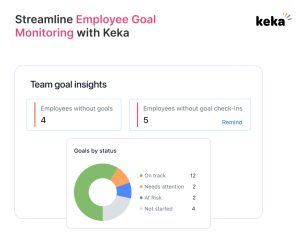
Now that you know how to build a scalable performance management system, let’s explore how Keka’s performance management system (PMS) can help you automate every step.
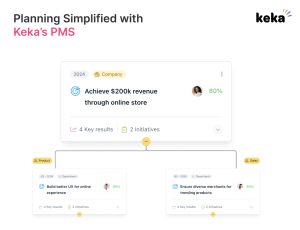
A truly scalable performance management system is rooted in alignment, accountability, and agility, not annual checkboxes.
Keka’s performance management suite helps you embed these core principles into every phase of your performance cycle, making performance a business advantage rather than just an HR task.
Here’s how Keka supports each phase of the process:
Key features:
Key features:
Key features:
Key features:
Key features:
Key features:
Thus, with Keka, performance management isn’t just automated but also a strategic asset.
Whether you are a team of five or five hundred, Keka gives you the structure, visibility, and tools to create a high-performance culture.
In the next section, let’s discuss some best practices to maximize your performance journey.
Even with the right tools, performance success depends on how you implement the system. Here are some proven tips to ensure your process stays agile and effective in the fast-changing business environment:
Stop relying on annual appraisals and break them into quarterly or monthly cycles. This helps with real-time adjustments, recognizing small wins, and keeping the momentum high.
Avoid saving feedback for the year-end. Instantly recognize wins, either small or big. This will keep motivation and reinforce business-aligned behavior.
Performance initiatives can lose direction without clear ownership. Train HR leaders to lead the process while aligning with business goals and top management’s vision.
Start KPI planning from your corporate goals and cascade them down to teams and individuals. This ensures that every role plays a part in achieving broader business goals.
Conduct workshops and webinars to train managers on agile performance practices. Highlight benefits to drive adoption across every level of the organization.
Don’t limit performance to only HR reviews; instead, make it a daily conversation. Use informal channels, town halls, and manager connections to reinforce this mindset.
Disconnected systems can derail even the best performance plans. A unified system like Keka ensures accurate reporting, central visibility, and elimination of duplicate efforts.
By following the above tips, you don’t just improve performance management but build a system that evolves with your business.
Building a Future-Ready Performance Culture
Remember Leena’s story? Like many HR leaders, she faced rapid scaling, leading her to outgrow her informal processes.
The difference between teams that struggle and those that excel lies in building a scalable, agile, data-driven performance system.
The 8-step framework discussed in this blog isn’t just a process but a mindset shift. When combined with the right performance management tool like Keka, it helps:
Performance management is no longer an annual task but a living, breathing part of your company’s culture.
Make Performance Your Growth Engine
Get Started with Keka
Subscribe to keep up with the latest strategic finance content.
Request a demo