Login


How can UAE employers take a proactive approach to Emiratization



PRODUCTS
 Payroll Suite
 HR Suite
 Talent Suite
 Project Services Suite

Meet the platform tailored to your business
Core system of record
One platform for the entire employee journey

BY INDUSTRY
BY COMPANY SIZE
LEARN
EXPLORE KEKA
Emiratization is the UAE's push to raise national participation in the private-sector workforce, and treating it as a quota to fill rather than a talent strategy is why most programmes stall after the hire. Meeting targets touches recruitment, onboarding, L&D, performance, and compliance reporting. This guide breaks down a five-step proactive approach, employer branding, and the technology that supports it.
“We the UAE 2031.”
It’s an amazing vision by the government to invest in social, economic, and development aspects. The main aim is to position UAE as an attractive global partner that is also influential.
As part of this initiative is the Emiratization program, which was introduced to encourage greater participation of locals in the labour market. This initiative has been a long-standing priority of the government, making it mandatory for the private sector. So far, the country has not been lenient in penalising companies that have violated this law.
Moreover, as of 2024, the law has now extended to smaller businesses as well.
Some requirements to keep in mind:
How companies are responding to Emiratization mandates
Many organizations in the UAE recognize Emiratization as an important step. While larger firms have structured programs in place, smaller businesses often struggle with compliance and adapting to the regulations.
For instance, the Ministry of Human Resources and Emiratization (MoHRE) has publicly prosecuted 1,379 companies who unlawfully hired 2,170 UAE citizens from 2022 to May 2024. Companies faced severe penalties, downgraded ratings, and even public prosecution.
Additionally, with a rising youth population and increasing competition companies are rethinking their hiring and retention strategies. Some are investing in training and development to attract Emirati talent, while others are adjusting compensation and career growth opportunities to retain them.
Despite challenges, businesses understand that embracing Emiratization is about long-term success and contributing to the nation’s economic vision.
A proactive approach to Emiratization involves organizations planning and implementing strategies to recruit, train, develop, and retain Emirati talent well before regulatory deadlines. This approach not only focuses on meeting quotas but also on creating a workplace that genuinely values and nurtures local talent.
There are many organizations to name that have already somewhat adopted this approach, such as ADNOC and Emirates Group. They show clear opportunities and benefits of joining their company, be it via specialized training academies or leadership programs.
The carefully designed 5-step tech-oriented pathway below will help organizations develop a talent strategy to attract and retain talent.
A proactive approach to Emiratization involves organizations to plan and implement strategies to recruit, train, develop, and retain Emirati talent well before regulatory deadlines. This approach not just focuses on meeting quotas, but also on creating a workplace that genuinely values and nurtures local talent.
There are many organizations to name that have already somewhat adopted this approach, such as ADNOC and Emirates Group. They show clear opportunities and benefits of joining their company, be it via specialized training academies or leadership programs.
The carefully designed 5-step tech-oriented pathway below will help organizations develop a talent strategy to attract and retain talent.
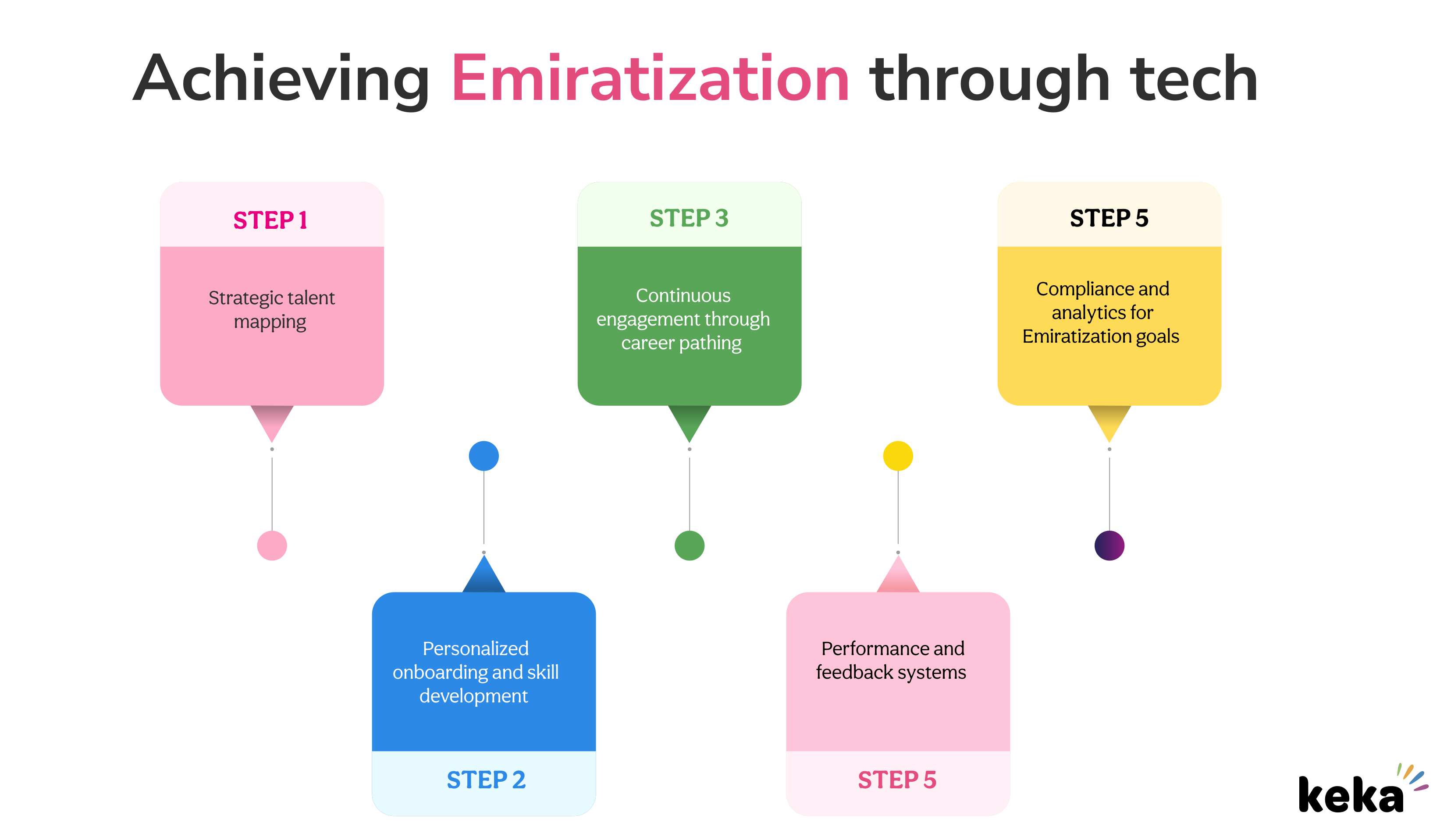
Simply hiring local talent without accounting for the specific strengths, aspirations, and cultural values of the candidates will lead to disengagement— and even high turnover. Emirati talent must be placed in roles that provide them with opportunities for career advancement or those that resonate with their ambitions. This way, they’re more likely to feel valued and connected to the organization.
A disconnect in this approach does not contribute to the UAE 2031 ambition, failing to support the UAE economy.
Additionally, Emirati talent may choose to leave the organization for better opportunities elsewhere. In fact, as per a PwC survey, nearly 60% of locals prefer jobs that have clear career advancement opportunities with better compensation.
Here’s an effective approach to tackle this:
Leveraging technology for skill mapping and alignment
A robust technology helps businesses break down their workforce needs by analysing the required skills and experience for each role.
For example, if a company is hiring for a project management role, the tool can identify Emiratis with the required experience or those whose skills align closely, helping target candidates ready for strategic responsibilities.
However, the talent management system must be efficient to fill roles with candidates who are well aligned with the job’s demands. Moreover, such systems also include job-matching algorithms that determine both hard and soft skills, ensuring candidates are not just technically capable but also culturally aligned. This is particularly important in the UAE where cultural fit plays an important role in long-term job satisfaction.
Segmenting roles by Emirati values and preferences
Many candidates value roles that offer flexibility or opportunities for growth without compromising family obligations. A good system would prioritise these values and instantly create job descriptions and career pathways that align with these expectations.
If the talent’s preferences and needs are not supported within the role, they may quickly feel dissatisfied. Without clear growth paths, employees may view the role as a dead-end position, prompting them to seek out organisations that offer structured progression.
Hence, organisations that prioritise Emiratization with a mindset solely to fulfil regulatory requirements can overlook these important nuances. This is why companies must approach this concept as a genuine opportunity to engage talent and support the economic goals.
Otherwise, it not only leads to penalties and legal defamation, but it also creates a cycle of constantly needing to rehire, costing the organisation both financially and reputationally.
Imagine an employee starting a new job where the onboarding feels impersonal and provides no real sense of how their unique skills and ambitions fit into the organisation.
Would they feel engaged, valued, or eager to contribute? Or would the person start to feel disconnected and question if the role even aligns with their career aspirations?
This lack of personalisation affects not just employees, but just any other employee joining a company. Again, this can lead to rapid turnover, which works against Emiratization’s objectives. To meet these mandates and promote true engagement, businesses may need to design an onboarding and development process that respects the aspirations of Emirati talent.
Create a personalised first impression via digital onboarding platforms
With digital tools, businesses can personalise onboarding journeys based on role, department, and even cultural backgrounds. This helps local talent feel seen and valued from day one.
For example, a digital platform can incorporate resources that align with the country’s culture and values, such as work-life balance or career progression. New hires can also access tailored content, such as guides on the organisation’s approach to Emiratization and its commitment to national goals. This can create a strong foundation of trust and engagement.
Custom e-learning paths to support career goals from the start
Technology also allows companies to design e-learning modules for each employee’s skills and career goals. The government also supports these learning and development initiatives through various programs. These include the NAFIS platform, and the ADGM academy.
They highly focus on reskilling and upskilling national talent in areas aligned with country’s goals, particularly in technology, healthcare, and finance. Integrating such programs within their own platforms helps employers ensure that new hires receive training that’s both aligned with national priorities and their personal growth aspirations.
All too often, new hires are onboarded without a clear roadmap for long-term growth strategy. Instead of feeling they’re on a purposeful journey, these employees may see themselves as placeholders hired to fulfil a quota rather than to contribute and grow within a company.
However, without defined career ladders or opportunities for mentorship, employees may feel stuck in static roles with limited scope for professional growth.
Thus, employers must offer a transparent, supportive, and progressive career path that aligns with employee goals and organisational objectives. Here’s how technology plays a key role in achieving this:
Building transparent roadmaps
Companies can create career pathing via tools that provide a clear view of advancement opportunities, required skillsets, and qualifications for each role. For instance, an entry-level HR role can see the pathway to a senior HR or management position, including the steps and skills required to get there.
Addressing development needs
Providing clear, defined opportunities for progression shows employees that they are on a meaningful growth journey. Tech-enabled career progression tools help HR teams track the readiness of new hires for new responsibilities and notify them of training or promotion opportunities as they become available.
For example, an AI-powered tool can assess an employee’s progress, evaluating their skill development and identifying gaps that need to be addressed. This allows HR to offer tailored training and development opportunities at the right time, such as leadership programs or specialized skills training.
Offering paths to leadership
Defined career ladders help employees visualize their future within the organization, showing them the steps required to move into leadership or specialized roles. The system can also suggest the specific skills, certifications, or experiences needed to reach these higher positions, giving employees a clear roadmap for advancement. This clarity reinforces that employees are valued for their potential and that the organization sees them as future leaders.
In the quest to meet Emiratization targets and create a more sustainable workforce, many employers miss a key factor in retaining local talent: the lack of consistent, meaningful performance feedback and recognition. Too often, organizations rely on outdated or ad-hoc methods for performance evaluation – annual reviews that feel more like a formality than a valuable conversation.
This leads to disengagement, as employees, who are often motivated by feedback and a clear sense of purpose, are left without the guidance or recognition they need to feel valued in their roles.
Moreover, without regular recognition, the company fails to acknowledge the specific strengths and achievements that employees bring to the table.
For companies aiming to create a more engaged, committed workforce, a shift toward automated and continuous performance tracking, along with meaningful recognition programs, is essential. Let’s break down how tech can make this happen:
Automated feedback systems for continuous improvement
A common mistake many companies make is relying solely on annual performance reviews. While important, annual reviews often fail to provide timely feedback and may come too late to address areas for improvement.
With automated feedback systems, HR teams can provide real-time insights into performance, allowing employees to understand where they’re excelling and where they need to improve. These systems use data-driven metrics to assess an employee’s work, offering specific feedback instantly after key tasks or milestones. For example, an employee working on a project can receive instant feedback on their communication skills, problem-solving abilities, or teamwork, providing immediate clarity on how they can improve.
Gamified recognition programs to improve motivation
Recognition is often cited as one of the top motivators for employees. Traditional recognition methods, such as an “Employee of the Month” plaque or a one-off bonus—are often too infrequent and impersonal. These approaches fail to keep employees consistently motivated or provide the positive reinforcement needed for long-term retention.
Gamified recognition programs allow companies to include rewards systems that track achievements, milestones, and overall performance in a more engaging, interactive way. Emirati employees can earn points or badges for reaching specific goals, such as meeting project deadlines, achieving personal development targets, or demonstrating leadership skills.
These rewards can then be redeemed for tangible incentives, such as career development opportunities, training courses, or even time off.
As the government increasingly emphasizes the integration of national talent into the workforce, employers who are slow to adopt systematic approaches for tracking, evaluating, and forecasting their Emiratization goals face significant risks.
Failing to adopt effective compliance systems damages an organization’s credibility and commitment to local talent.
Also, compliance tracking has been manual and fragmented, often reliant on spreadsheets or outdated systems that fail to provide real-time insights into a company’s Emiratization progress. Without streamlined processes and intelligent forecasting tools, businesses may fail to foresee gaps in their Emirati workforce.
Compliance tracking software to streamline Emiratization efforts
Compliance tracking software offers a systematic, automated solution for managing Emiratization obligations. These tools are designed to track the number of local employees within the organization, monitor progress against government-set quotas, and ensure that the business is adhering to national labour laws.
They can automatically update data on the percentage of Emirati employees within each department or role, alerting HR teams if the company is falling short of the required benchmarks. This proactive tracking helps businesses identify compliance gaps early and take immediate corrective actions.
Moreover, compliance tracking software often integrates seamlessly with other HR tools, allowing companies to update their hiring and retention strategies as they gather more data.
Data analytics for progress evaluation
Simply tracking compliance is not enough. Companies need to evaluate the effectiveness of their Emiratization strategies and continuously adapt to ensure success.
Advanced HR analytics platforms allow businesses to assess the effectiveness of their Emiratization programs by analysing key metrics such as retention rates of local employees, the speed at which they’re advancing within the organization, and how well they align with organizational goals. Through data-driven insights, HR can pinpoint areas that require attention in in recruitment practices, employee engagement, or career progression.
Predicting future needs and staying ahead of compliance
One of the most powerful aspects of HR technology in relation to Emiratization is its ability to predict future trends and needs. Forecasting tools leverage historical data, employee performance patterns, and industry trends to predict future staffing needs and compliance challenges.
For instance, these tools can forecast when talent will be ready for promotion or when additional hires will be needed to meet future Emiratization quotas. This predictive capability helps HR teams proactively plan recruitment and retention strategies, ensuring they don’t fall short of Emiratization goals as the company grows or changes over time.
As talent is often more inclined to seek positions within the public sector, private sector employers must rethink their approach to talent acquisition. Many young Emiratis view the public sector as a place of respect and prestige, which can make it challenging for private companies to attract and retain top talent.
To bridge this gap, organizations must strategically leverage employer branding, a method that highlights the unique value, culture, and opportunities within the company, showing how they not only respect but also align with values and aspirations.
Employees who have achieved significant career milestones, whether in leadership positions, technical expertise, or other fields, serve as relatable role models for potential candidates. These stories should go beyond just job titles and include details of career progression, achievements, and the respect they’ve earned both within the company and society.
Highlighting career growth and recognition reflects how the company values its employees and their contributions. Equally important is emphasising the honour and respect they have received. For local talent, respect within their workplace and the wider community is crucial; when they see fellow workers thriving and being valued, it creates a compelling reason to consider your organization.
Companies that support local communities, sponsor cultural events, and engage in meaningful social impact initiatives resonate more with this mindset. Partnering with country-specific initiatives and causes shows potential hires that your company is committed to the nation’s future.
Publicizing these efforts through targeted outreach channels and using Arabic content and localized storytelling helps make the brand feel relevant and approachable, particularly to younger local talent.
Community-focused campaigns that highlight your company’s involvement in national projects or charitable causes can further build a sense of purpose around your employer brand.
National talent values roles that allow them to contribute directly to national goals and projects of significance. To attract such candidates, it’s essential to highlight how your organization’s work aligns with the national priorities. This connection is important because it shows that their work is not just a job, but a way to contribute to something greater than themselves.
Another significant consideration for Emirati talent is work-life balance. Flexibility in terms of working hours and locations, as well as family-related benefits, are essential factors that can make your organization more attractive.
Support for cultural celebrations, travel allowances, or family health benefits, can go a long way in making your company stand out from competitors.
First impressions matter, especially when it comes to attracting and retaining local talent. A well-thought-out onboarding process can make all the difference in how quickly new hires feel integrated into your organization. A smooth onboarding experience that familiarizes talent with the company’s values, priorities, and growth pathways from day one helps employees feel supported in their transition to the corporate environment.
As Emiratization continues to shape the workforce and economic goals, the integration of HR technology is necessary to keep up with upcoming transformations.
Tech-enabled solutions, like those offered by Keka, empower employers to accurately predict and meet Emirati talent needs, ensuring the right candidates are identified and nurtured for long-term success. With automated compliance tracking, businesses can seamlessly adhere to Emiratization regulations, eliminating the risk of errors and ensuring that all work authorizations, IDs, visas, and permits are responsibly managed.
GPSSA compliance is also made effortless through integrations with payroll software, ensuring all laws and regulations are met while generating reports that provide full visibility of organizational data.
Moreover, Keka’s features streamline HR processes from onboarding to offboarding, automating routine tasks to free up valuable time for more strategic initiatives. The system provides tailored experiences for each employee, helping them feel more engaged and valued through personalized workflows.
With tech-driven solutions, businesses can now cultivate a more inclusive, supportive, and growth-oriented workplace for local employees, making Emiratization a sustainable success.
Subscribe to keep up with the latest strategic finance content.
Request a demo