


 Login
Login


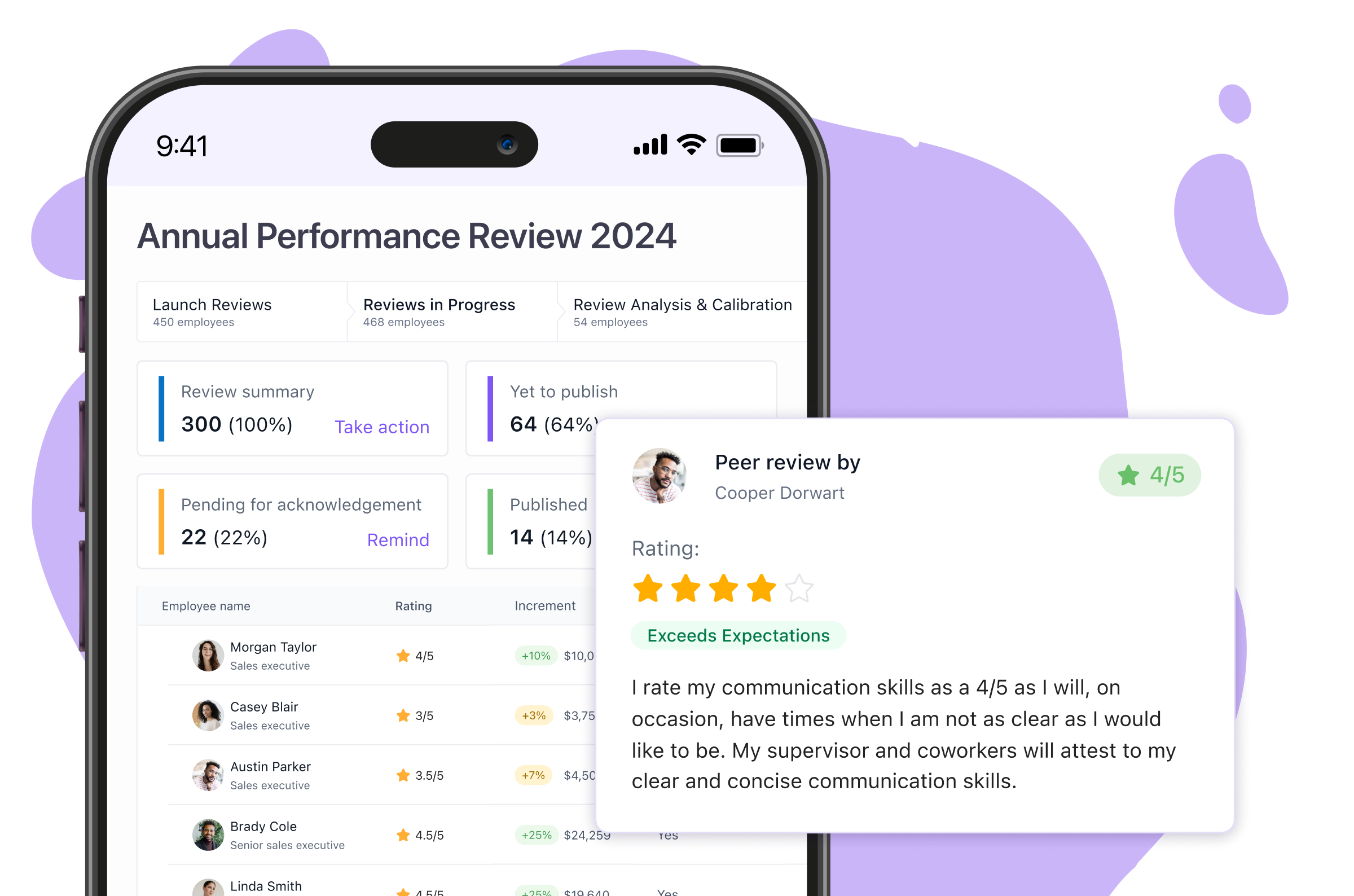
Performance reviews seem straightforward, but they often create more frustration than clarity. Managers scramble to recall contributions, feedback feels inconsistent, and employees walk away uncertain about where they stand.
This isn’t surprising when only about a quarter (26%) of organizations report that their managers are very or extremely effective at enabling their team’s performance. The same report shows that only 47% of employees know what’s expected of them.
When the process lacks structure, bias creeps in, goals get sidelined, and development conversations lose impact. HR teams are left chasing reminders, while employees feel disengaged and undervalued. The result is missed opportunities to build stronger teams and retain top talent.
Performance review software changes this. It replaces scattered systems with a single platform where HR can run fair cycles, managers can give focused feedback, and employees can track progress with confidence. Reviews shift from being a burden to becoming a foundation for growth and engagement.
In this guide, we’ll cover the best performance review software in 2026, along with features, pricing, pros and cons, and our take on which platforms best fit different types of organizations.
Research Methodology: How I Evaluated Performance Review Software
To identify the best performance review software in 2026, I focused on criteria that matter most to HR leaders and managers running review cycles. Each platform was assessed on the following:
- Review Cycle Management: Ability to set up annual, quarterly, or continuous reviews with customizable workflows.
- Feedback Quality: Features for peer feedback, 360-degree reviews, and manager assessments that reduce bias.
- Goal Alignment: How well the software connects individual goals to team and company objectives.
- Calibration Tools: Support for standardizing ratings across managers to ensure fairness and consistency.
- Employee Experience: Accessibility for employees to self-assess, request feedback, and view progress.
- Analytics & Insights: Depth of reporting on performance trends, skill gaps, and promotion readiness.
- Compliance & Documentation: Secure storage of review data for legal compliance and future reference.
Top 10 Performance Review Software in 2026
Performance reviews have shifted from once-a-year evaluations to ongoing, data-driven processes. The right software now enables continuous feedback, goal alignment, and fair assessments.
Below are the top tools in 2026 that help organizations streamline reviews and boost employee growth.
1. Keka
Keka’s performance review software helps organizations replace outdated annual appraisals with a continuous and structured process. It enables goal alignment, feedback collection, and performance tracking within a unified HR platform. Keka also supports competency frameworks, one-on-one meetings, and 360-degree feedback to make performance reviews more consistent and meaningful for both managers and employees.


Key Features of Keka Performance Review Software:
- Goal setting and OKRs: Align goals across teams and track progress with measurable outcomes.
- 360-degree feedback: Capture input from peers, managers, and reports for balanced evaluations.
- Continuous check-ins: Schedule regular review conversations instead of one annual appraisal.
- Competency frameworks: Define role-based competencies to standardize evaluations across teams.
- One-on-one meetings: Give managers structured agendas to hold meaningful discussions.
- Performance analytics: Track rating distributions, identify high performers, and spot gaps early.
- Self-reviews: Encourage employees to reflect on their own performance and development.
- HR and payroll integration: Link performance data directly with promotions and salary revisions.
Pros and Cons of Keka Performance Review Software:
| Pros | Cons |
|---|---|
| Goal setting and OKRs keep employees aligned with business priorities. | Mobile app supports only basic review functions. |
| 360-degree feedback builds fairness and transparency in evaluations. | Advanced analytics may need setup support. |
| Competency frameworks standardize reviews across different roles. | |
| One-on-one meeting tools help managers hold |
Ideal For: Small to mid-sized organizations that want to move beyond basic annual appraisals and adopt a structured, transparent system connected with HR and payroll.
Pricing:
- Foundation: $9/employee/month
- Strength: $16/employee/month
- Growth: $22/employee/month
Expert’s Opinion:
Keka is the best employee performance review software for organizations that want reviews to deliver measurable results. It connects performance data with payroll and HR so promotions and salary changes happen seamlessly. Its goal alignment, competency frameworks, and feedback tools make the review process structured and transparent.
2. Lattice
Lattice is a performance management platform built around continuous feedback and employee development. It helps organizations run structured reviews, set goals, and create a culture of ongoing performance conversations.

Key Features of Lattice Performance Review Software:
- Performance reviews: Run structured review cycles with customizable templates.
- Goals and OKRs: Align employee objectives with company priorities.
- Feedback tools: Enable peer, manager, and real-time feedback throughout the year.
- Analytics: Track performance trends and identify high-potential employees.
Pros and Cons of Lattice Performance Review Software:
| Pros | Cons |
|---|---|
| Combines performance reviews with goal-setting and OKRs in a single workflow. | Less suited for companies that prefer one-time annual review cycles. |
| Strong support for continuous feedback helps build an open culture. | It can feel process-heavy for organizations without structured HR practices. |
| Customizable review templates adapt well to different teams and roles. | Development modules work best when fully adopted, which takes commitment. |
| Analytics highlight top performers and areas for coaching. | Smaller teams may not fully use the platform’s breadth of features. |
Ideal For: Mid-sized and large organizations that want continuous feedback and development-focused reviews.
Pricing:
- Talent Management: $11/seat/month
Expert’s Opinion:
Lattice works well for companies that want reviews to focus on development as much as evaluation. Its combination of reviews, feedback, and goal alignment creates a holistic performance framework. The platform is modern and easy to use, but smaller teams may find it more complex than necessary.
3. Culture Amp
Culture Amp combines performance reviews with employee engagement tools. It helps organizations measure employee experience, collect feedback, and run performance cycles that prioritize fairness and development.

Key Features of Culture Amp Performance Review Software:
- Performance reviews: Conduct structured review cycles with flexible templates.
- Feedback collection: Capture peer and manager feedback during and between review cycles.
- Engagement surveys: Link performance with employee sentiment data.
- Analytics: Gain insights into performance distribution and engagement drivers.
Pros and Cons of Culture Amp Performance Review Software:
| Pros | Cons |
|---|---|
| Links performance reviews with employee engagement surveys for a fuller view. | Review setup can be complex if organizations run multiple engagement programs. |
| Emphasis on fairness and a feedback-driven culture. | Some organizations may find the platform broader than their immediate review needs. |
| Templates and frameworks support flexible review cycles. | Customization depth is limited compared to enterprise HCM systems. |
| Analytics connect performance ratings with engagement and turnover risks. | Works best for organizations with dedicated HR teams to manage insights. |
Ideal For: Organizations that want to combine performance management with employee engagement and culture insights.
Pricing: CultureAmp offers subscription-based pricing tailored to company size and selected modules. Typically positioned at the mid-to-enterprise level.
Expert’s Opinion:
Culture Amp is valuable for organizations that see performance and engagement as connected. Its mix of reviews, surveys, and analytics helps HR teams build a more complete picture of employee growth. However, companies looking for a straightforward review tool may find the platform broader than they need.
4. 15Five
15Five is built around continuous performance management with a focus on employee well-being and engagement. The platform helps managers and teams maintain regular check-ins, track goals, and run review cycles that emphasize growth and communication.

Key Features of 15Five Performance Review Software:
- Check-ins: Weekly updates to track goals, challenges, and wins.
- Performance reviews: Structured review cycles with customizable templates.
- Engagement tools: Surveys to measure employee morale and well-being.
- Goal tracking: Align team and company objectives through OKRs.
Pros and Cons of 15Five Performance Review Software:
| Pros | Cons |
|---|---|
| Weekly check-ins help managers stay connected to employee progress. | Review cycles are less flexible for organizations that prefer traditional appraisal structures. |
| Engagement surveys combine with reviews to give a full picture of performance and morale. | Frequent surveys and prompts may create fatigue for some employees. |
| Simple goal-tracking makes it easier for teams to align on priorities. | Limited ability to handle highly detailed competency frameworks. |
| Culture-first design encourages conversations rather than just evaluations. | It may not scale well for enterprises with very large or global teams. |
Ideal For: Small to mid-sized organizations that want a people-first approach to performance and engagement.
Pricing:
- Engage: $4/user/month
- Perform: $11/user/month
- Total Platform: $16/user/month
Expert’s Opinion:
15Five works well for organizations that value ongoing communication and employee morale as part of performance. Its weekly check-ins and surveys make it easier to catch issues early and keep employees engaged. The platform is well-suited for growth-focused teams, though enterprises with complex review structures may find it less comprehensive than full-suite HCM tools.
5. Leapsome
Leapsome combines performance reviews, learning, and engagement in a single platform. It helps organizations run structured reviews, link goals with feedback, and provide learning opportunities to support employee development.

Key Features of Leapsome Performance Review Software:
- Performance reviews: Flexible review cycles with customizable frameworks.
- Goals and OKRs: Align objectives across individuals, teams, and departments.
- Learning tools: Connect feedback to personalized learning paths.
- Engagement surveys: Measure sentiment and connect results to performance data.
Pros and Cons of Leapsome Performance Review Software:
| Pros | Cons |
|---|---|
| Combines reviews, goals, and learning into one connected system. | The wide feature set can feel overwhelming if a company only needs reviews. |
| Customizable review cycles allow HR to adapt frameworks to any role or department. | Linking learning modules to feedback requires careful setup to work well. |
| Engagement surveys link directly with performance data for deeper insights. | Advanced reporting needs HR teams to dedicate time to configuration. |
| Robust OKR alignment keeps performance closely tied to strategy. | Companies with simple structures may find it heavier than necessary. |
Ideal For: Mid-sized and large companies that want a combined system for reviews, engagement, and employee development.
Pricing: Leapsome uses a subscription-based pricing model, with costs based on modules and workforce size.
Expert’s Opinion:
Leapsome is a comprehensive tool that brings together reviews, goals, and learning in one ecosystem. It is a good fit for organizations that want performance management to go beyond evaluation and connect directly to development. While powerful, it may feel like more than necessary for companies that only want a streamlined review cycle tool.
6. SAP SuccessFactors
SAP SuccessFactors includes performance management as part of its broader HCM suite. It helps organizations design structured review cycles, align employee performance with business goals, and integrate performance outcomes with compensation planning.

Key Features of SAP SuccessFactors Performance Review Software:
- Performance reviews: Structured cycles linked to role and competency frameworks.
- Goal management: Align goals across individuals, teams, and business units.
- Continuous feedback: Enable regular feedback throughout the year.
- Integration with compensation: Link performance results directly to pay decisions.
Pros and Cons of SAP SuccessFactors Performance Review Software:
| Pros | Cons |
|---|---|
| Directly connects performance outcomes to compensation planning. | Heavy reliance on SAP’s ecosystem makes it harder to use as a standalone tool. |
| Supports large, global organizations with scalable review structures. | Complex implementation demands significant time and IT support. |
| Allows HR to design reviews around detailed role and competency frameworks. | Smaller businesses often find the system too complex for their needs. |
| Deep integration with SAP payroll and talent management modules. | Limited agility when adapting to modern continuous feedback practices. |
Ideal For: Large enterprises that already use SAP’s HCM ecosystem and want performance tightly connected with compensation.
Pricing: SAP SuccessFactors follows a subscription-based model. Pricing depends on modules and company size, and is typically aligned with enterprise budgets.
Expert’s Opinion:
SAP SuccessFactors is a good fit for global enterprises that need performance data tied directly to pay and promotion decisions. Its flexibility and scalability make it a reliable choice for large, complex organizations. However, the setup and usability may feel demanding for smaller teams, and companies not already invested in SAP’s ecosystem may find adoption challenging.
7. Bamboo HR
BambooHR includes performance management as part of its broader HR suite. It focuses on simple review cycles, goal tracking, and employee self-assessments, making it especially popular among small and mid-sized companies that want to streamline reviews without heavy complexity.

Key Features of BambooHR Performance Review Software
- Customizable reviews: Run review cycles tailored to team needs.
- Goal tracking: Monitor progress and alignment with company priorities.
- Self-assessments: Encourage employees to reflect on their own contributions.
- Feedback tools: Enable peer and manager input within the review process.
Pros and Cons of BambooHR Performance Review Software:
| Pros | Cons |
|---|---|
| Easy to set up and manage for small HR teams. | Limited support for complex frameworks like OKRs or competencies. |
| Self-assessment and feedback tools encourage participation. | Analytics are basic compared to larger enterprise systems. |
| Integrates directly with BambooHR’s broader HR platform. | Lacks deep linkage between performance data and compensation. |
| Streamlined workflows reduce admin time for managers. | Less scalable for very large or global organizations. |
Ideal For: Small and mid-sized companies that want simple, easy-to-run review cycles within an HR system.
Pricing: BambooHR follows a subscription model with pricing based on company size and selected features.
Expert’s Opinion:
BambooHR works best for organizations that want to introduce structured reviews without overcomplicating the process. Its simplicity and integration with HR data make it highly practical for smaller teams. However, companies looking for advanced performance frameworks or global scalability may outgrow the platform.
8. PerformYard
PerformYard is a dedicated performance management software that supports flexible review cycles and detailed evaluation frameworks. It is designed to adapt to the review style of each organization, whether annual appraisals, project-based reviews, or continuous feedback.

Key Features of PerformYard Performance Review Software:
- Flexible reviews: Run annual, quarterly, or project-based cycles.
- Custom frameworks: Build competency-based evaluations tailored to roles.
- Feedback and recognition: Support ongoing feedback alongside structured reviews.
- Analytics: Track rating distributions and performance trends over time.
Pros and Cons of PerformYard Performance Review Software:
| Pros | Cons |
|---|---|
| Highly flexible in supporting different review cycles and formats. | Requires setup time to tailor frameworks to each organization. |
| Robust support for competency-based evaluations. | Limited engagement features compared to all-in-one HR suites. |
| Feedback and recognition tools encourage ongoing performance conversations. | May feel specialized if a company wants broader HR functions included. |
| Analytics help HR teams identify patterns across review cycles. | Smaller teams may not need its depth of configuration. |
Ideal For: Organizations that want flexibility in review structures and rely heavily on competency-based or project-driven evaluations.
Pricing: PerformYard uses a subscription-based pricing model. Costs depend on workforce size and selected modules.
Expert’s Opinion:
PerformYard works well for organizations that want flexibility in how review cycles are designed. Its ability to support annual reviews, project-based evaluations, and competency frameworks makes it adaptable to different performance styles. However, companies looking for a full HR suite or very small teams with basic review needs may find it more than they require.
9. Workday Peakon Employee Voice
Workday Peakon Employee Voice focuses on continuous feedback and employee listening rather than traditional reviews alone. It helps organizations collect real-time insights from employees, analyze engagement data, and connect feedback with performance outcomes.

Key Features of Workday Peakon Employee Voice:
- Continuous listening: Collect ongoing employee feedback through surveys and pulse checks.
- Engagement analytics: Analyze feedback trends and link results to performance outcomes.
- Manager dashboards: Provide leaders with insights into team sentiment and performance drivers.
- Integration: Connect with Workday HCM for a unified view of employee experience and performance.
Pros and Cons of Workday Peakon Employee Voice:
| Pros | Cons |
|---|---|
| Real-time feedback helps managers respond quickly to employee concerns. | Less suitable for organizations that want structured, cycle-based reviews. |
| Analytics link engagement data with performance outcomes. | Works best when combined with Workday HCM, limiting standalone use. |
| Dashboards give managers actionable insights into team sentiment. | Smaller organizations may not fully use the platform’s advanced analytics. |
| Continuous listening builds trust and transparency. | Implementation requires commitment to ongoing feedback processes. |
Ideal For: Organizations that want to connect engagement and feedback directly with performance, especially those already using Workday HCM.
Pricing: Workday Peakon Employee Voice is priced as part of the Workday suite. Costs depend on modules and company size, and are generally aligned with enterprise budgets.
Expert’s Opinion:
Workday Peakon Employee Voice works best for companies that want real-time employee feedback to guide performance management. Its analytics and dashboards give leaders visibility into engagement and performance drivers. However, it is not a good fit for businesses that rely mainly on structured, periodic reviews or for smaller teams that do not need continuous listening at scale.
10. Zoho People
Zoho People includes a full performance management module inside its HR suite. It helps organizations set goals and KRAs, run appraisal cycles, collect multi-rater feedback, and track competencies with tools like the 9-box matrix.

Key Features of Zoho People Performance Review Software:
- Goals & KRAs: Define, assign, and track measurable goals across roles.
- Multi-rater & self-reviews: Support self-appraisal, peer feedback, and manager evaluations.
- Continuous review option: Run monthly, quarterly, or semi-annual check-ins alongside formal reviews.
- Performance reports: Access rating distributions, nine-box matrices, and review summaries.
Pros and Cons of Zoho People Performance Review Software:
| Pros | Cons |
|---|---|
| Combines annual reviews with continuous feedback for flexibility. | The setup of custom templates and automations can be time-consuming. |
| Multi-rater feedback provides a complete view of performance. | The mobile app has fewer performance review features compared to the web. |
| Its 9-box matrix helps identify high-potential employees and development needs. | Smaller companies may find many advanced options unnecessary. |
| Affordable pricing makes it accessible for small and mid-sized firms. | Reporting depth may not match enterprise-focused platforms. |
Ideal For: Small to mid-sized companies that want both structured appraisals and continuous reviews within a broader HR platform.
Pricing:
- Essential: $1.25/employee/month
- Professional: $2/employee/month
- Premium: $3/employee/month
- Enterprise: $4.5/employee/month
Expert’s Opinion:
Zoho People is a practical option for organizations that want flexibility in how reviews are managed. Its mix of KRAs, continuous reviews, and appraisal tools gives HR teams the ability to adapt the process to their culture. However, very large enterprises or teams that need highly advanced reporting may find the system less comprehensive than enterprise-grade platforms.
Top Performance Review Software 2026: A Comparison Table
Performance reviews shape how employees grow, stay engaged, and contribute to business goals. The tools below were reviewed on usability, flexibility, integration strength, and overall value.
| Tool | Key Features | Best For | G2 Rating | Free Trial |
|---|---|---|---|---|
| Keka |
| Small to mid-sized organizations moving beyond annual appraisals and wanting reviews tied to HR and payroll | 4.5/5 | Yes |
| Lattice |
| Mid-sized and large organizations that want development-focused reviews | 4.4/5 | Yes |
| CultureAmp |
| Companies combining performance management with employee engagement | 4.5/5 | Yes |
| 15Five |
| Small to mid-sized companies that want continuous communication and morale tracking | 4.6/5 | Yes |
| Leapsome |
| Mid-sized and large companies tying reviews with learning and development | 4.8/5 | Yes |
| SAP SuccessFactors |
| Large enterprises already using SAP’s HCM suite | 3.9/5 | No |
| BambooHR |
| Small and mid-sized companies that need simple review cycles in an HR suite | 4.4/5 | Yes |
| PerformYard |
| Organizations relying on project-driven or competency-based evaluations | 4.7/5 | Yes |
| Workday Peakon Employee Voice |
| Enterprises linking engagement and real-time feedback with performance | 4.6/5 | No |
| Zoho People |
| Small to mid-sized firms that want affordable reviews with flexible cycles | 4.4/5 | Yes |
Which Performance Review Tool is Best for You?
The best performance review software depends on your team size, review style, and how closely you want performance tied to engagement or payroll. Here’s a breakdown to help you choose:
1. Small to Mid-Sized Companies
For teams that want structured reviews without heavy complexity:
- Keka: Brings continuous reviews, 360-degree feedback, and competency frameworks into one system. Integrated with payroll to make promotions and salary changes seamless.
- BambooHR: Simple review cycles, self-assessments, and goal tracking. Works best for smaller teams looking for ease of use.
- Zoho People: Flexible appraisals with KRAs, continuous review options, and affordable pricing.
2. Growing Mid-Market Firms
For organizations moving beyond annual appraisals and aiming for continuous improvement:
- Keka: Supports OKRs, one-on-ones, and performance analytics, helping firms replace outdated appraisals with structured, ongoing reviews.
- 15Five: Weekly check-ins, feedback, and engagement tools that emphasize growth and communication.
- Leapsome: Combines reviews, goals, and learning in one platform to connect performance with development.
3. Large Enterprises
For global or complex organizations with detailed review frameworks:
- SAP SuccessFactors: Enterprise-scale reviews tied directly to compensation and SAP’s HCM ecosystem.
- Workday Peakon Employee Voice: Focuses on continuous feedback and engagement analytics at scale.
- PerformYard: Flexible review cycles and competency-based evaluations suited for project-driven enterprises.
4. Engagement-Driven Companies
For firms that want performance management closely linked to culture and employee experience:
- CultureAmp: Pairs reviews with engagement surveys and analytics to connect performance with sentiment data.
- 15Five: Combines check-ins and engagement surveys to make performance more people-focused.
- Workday Peakon Employee Voice: Prioritizes continuous employee feedback with strong analytics.
5. Holistic Development Platforms
For organizations tying performance to learning and career growth:
- Keka: Links performance data with promotions, pay, and growth paths inside a unified HR system.
- Leapsome: Connects performance reviews with learning tools and OKRs.
- Lattice: Mixes reviews, development frameworks, and goals to support ongoing growth.
Top Picks for Performance Review Software
| Best for | Software | Why It Stands Out |
|---|---|---|
| Small to Mid-Sized Companies | Keka | Combines continuous reviews, 360-degree feedback, and competency frameworks. |
| BambooHR | Simple review cycles, goal tracking, and self-assessments, practical for smaller teams. | |
| Zoho People | Flexible appraisals with KRAs, continuous review options, and accessible pricing. | |
| Growing Mid-Market Firms | Keka | OKRs, one-on-ones, and performance analytics to replace outdated annual reviews with a structured, continuous process. |
| 15Five | Weekly check-ins, feedback, and engagement tools to keep performance people-focused. | |
| Leapsome | Connects reviews, goals, and learning tools to tie performance with development. | |
| Large Enterprises | SAP SuccessFactors | Enterprise-scale reviews linked with compensation and SAP’s global HCM suite. |
| Workday Peakon Employee Voice | Continuous employee listening and analytics that connect engagement with performance outcomes. | |
| PerformYard | Flexible review cycles and competency-based evaluations tailored for project-driven enterprises. | |
| Engagement-Driven Companies | CultureAmp | Combines reviews with engagement surveys and analytics to connect performance with sentiment data. |
| 15Five | Check-ins and engagement surveys are designed to create open, people-first performance conversations. | |
| Workday Peakon Employee Voice | Continuous listening with dashboards that highlight engagement and performance drivers. | |
| Holistic Development Platforms | Keka | Links performance data with promotions, pay, and growth inside a unified HR system. |
| Leapsome | Brings reviews, learning, and OKRs together in one connected platform. | |
| Lattice | Mixes performance reviews with goal alignment and development tools for ongoing growth. |
How to Choose the Right Performance Review Software in 2026?
Picking the right platform depends on how your organization manages goals, feedback, and career growth. Keep these points in mind before making a decision:
- Clarify Review Style: Decide if you want traditional cycles, continuous feedback, or a mix of both. Different platforms are designed for different approaches.
- Consider Company Size: Lightweight tools work well for smaller teams, while enterprises need platforms that support complex frameworks and scale globally.
- Check Integration Needs: Look at how well the software connects with HR, payroll, or learning systems. Strong integrations reduce duplicate work.
- Evaluate User Experience: Adoption depends on how intuitive the tool feels for managers and employees. Choose software that makes reviews easy to run, not a burden.
- Budget and Pricing: Compare subscription tiers and factor in implementation costs. Look for transparent pricing that fits long-term needs.
- Pilot Before Committing: Use free trials or pilot runs to test features with real teams. This helps confirm if the tool matches your workflows.
Conclusion
Performance reviews shape how employees grow, stay motivated, and connect their work to business goals. Without the right system, reviews can feel inconsistent, one-sided, or disconnected from development. Performance review software brings structure, fairness, and visibility, helping managers run meaningful conversations and employees see a clear path forward.
Among the performance review tools available in 2026, Keka is the best employee performance review software. It combines goal alignment, 360-degree feedback, and competency frameworks with payroll and HR integration, so reviews lead to real outcomes in compensation and development.


