Login



Maybe it started with small frustrations. Perhaps it was the third time this month you had to apologize to a hiring manager because the ATS functionality couldn’t handle your recruitment volume, or the moment you found yourself dreading another interaction with customer support.
If you’re reading this, chances are Personio has become more of an obstacle than a solution in your daily work life. Let’s explore the alternatives that could transform your daily reality from frustrating workarounds to effortless efficiency.
Why Look For Personio Alternatives?
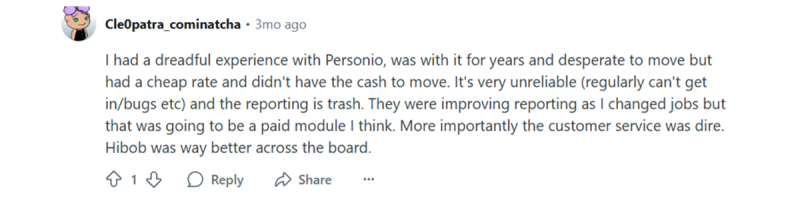
Real users across Reddit have shared surprisingly consistent frustrations that reveal deeper systemic issues. If your company is expanding beyond Europe or already has team members in North America, Asia, or other non-EU regions, Personio’s limitations become impossible to ignore.
Geographic Limitations That Fracture Global Teams
One of the most damaging limitations users encounter is Personio’s narrow geographic focus. A small SaaS company shared their evaluation experience on r/humanresources, noting that while Personio appeared very promising on paper, it proved entirely EU-focused (European Union–focused), creating significant challenges for their international teams. This creates a fundamental barrier, forcing companies to choose between their workforce distribution and their HR platform.
ATS Functionality That Falls Short
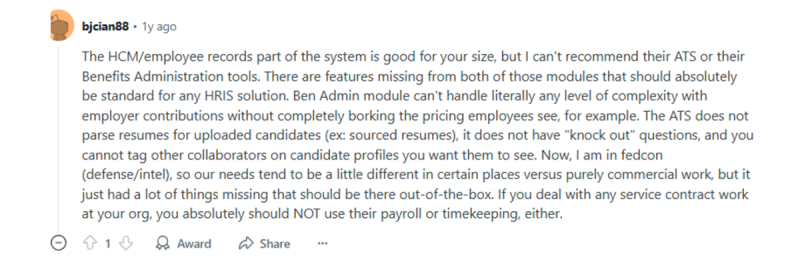
The recruitment experience with Personio consistently disappoints users who need robust hiring capabilities. A frustrated recruiter on r/recruiting explained their decision to move away from Personio, citing “limited ATS functionalities” that lacked essential automation features. The manual interview scheduling requirements and inability to handle high-volume recruitment needs force HR teams into time-consuming workarounds that defeat the purpose of having an integrated system.
Platform Reliability and Support Concerns
Most concerning are reports of platform reliability issues.. Users on Reddit described their terrible experience with Personio, highlighting frequent access issues and bugs, as well as “extremely poor customer service.” When your HR platform becomes unreliable, it doesn’t just frustrate your team; it impacts every employee interaction, from onboarding new hires to processing time-off requests.
Limited Reporting Capabilities
Modern HR teams need sophisticated analytics to drive strategic decisions, but Personio’s reporting features consistently fall short of expectations. Users describe the reporting functionality as “subpar”, forcing HR professionals to either accept limited insights or invest additional time in manual data manipulation and external reporting tools.
Top 6 Personio Alternatives
1. Keka
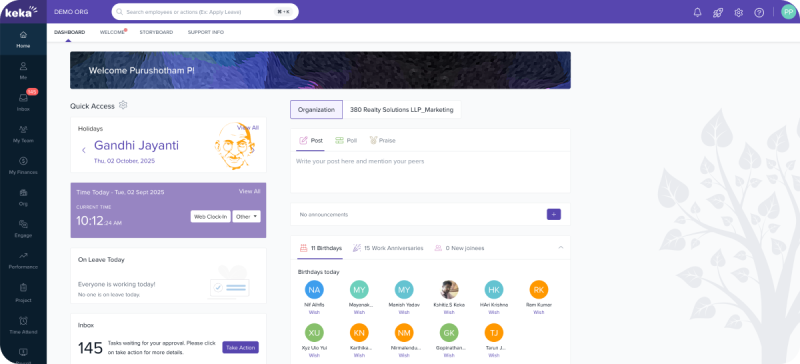
Keka emerges as a platform built for the modern, distributed workforce that defines American business today. Unlike Personio, Keka was designed from the ground up to support companies operating across multiple regions and time zones.
For US businesses tired of being treated as an afterthought by European-focused platforms, Keka offers a refreshing alternative that understands American work culture. Serving thousands of companies ranging from 20-member startups to organizations with over 1,000 employees, Keka has proven its ability to grow with ambitious US businesses without the geographic restrictions that plague Personio users.
Immaculate Summary Tab
The Summary Tab delivers what US executives need most: immediate visibility into headcount across locations, pending actions that could impact operations, and direct access to frequently used functions that keep distributed teams connected. The Quicklinks section eliminates the manual processes that frustrated Personio users, enabling bulk operations essential for US companies experiencing rapid growth.
For American businesses managing hybrid and remote workforces, the Employee Login Summary provides crucial visibility into team engagement patterns across different time zones and work arrangements. The New Hires and Exits section tracks not just compliance requirements but also cultural touchpoints like work anniversaries and team celebrations.
Measurable ROI Speaks to American Business Priorities
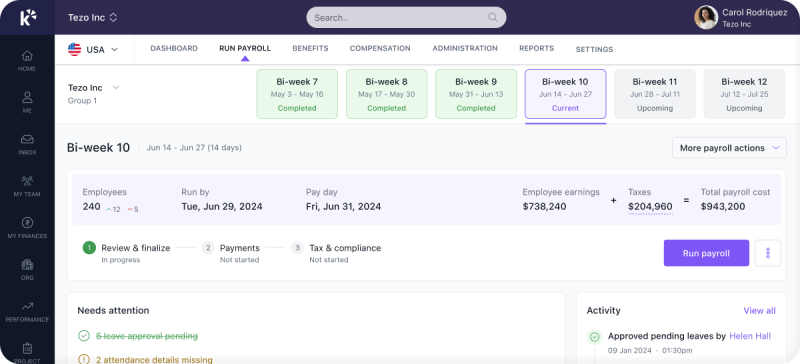
Keka excels in this area because it addresses the specific pain points that cost American businesses money. Take payroll processing for example. When Keka automates these calculations, handles tax computations, and streamlines compliance reporting, companies can immediately measure the time savings. A 20-hour monthly reduction in administrative work at least.
Cost-Conscious US Businesses Seeking Enterprise Capabilities
American companies, particularly in the SMB market, need enterprise-level functionality without enterprise pricing structures. Keka provides comprehensive capabilities at price points that make sense for US market dynamics.
Key Features That Solve Real Problems
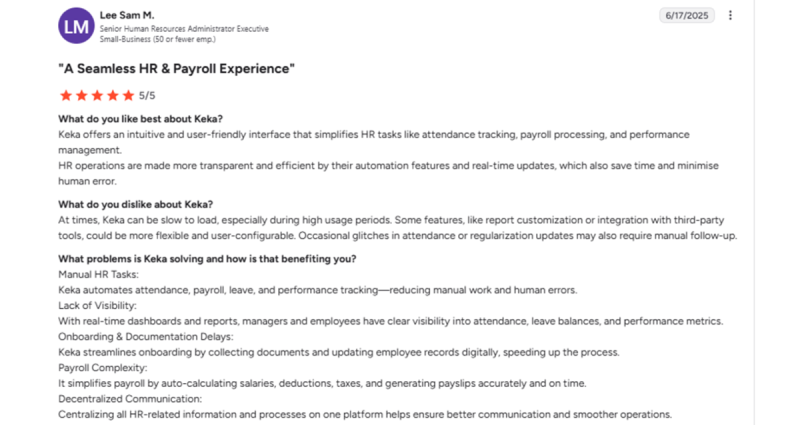
- Eliminates monthly payroll anxiety by automatically handling complex calculations, multi-location tax jurisdictions, loan deductions, and accounting system integration without manual intervention
- Shows employee conflicts upfront, automating policy calculations, and integrating leave balances directly with payroll processing
- Empowers employees to access payslips, update personal information, and manage leave requests independently through mobile-friendly interfaces
- Solves remote onboarding challenges by automating document collection, task assignments, and approval processes
- Turns HR data into strategic decisions with 50+ customizable reports
| Pros | Cons |
|---|---|
| Federal and state tax filing is included at all tiers with flexible pay schedules, direct deposit, and automated overtime calculations without separate contracts | Integration options are more restricted compared to enterprise platforms |
| 2-4 week deployment timeline with straightforward setup | Some employees find payroll information display confusing, requiring additional training |
| Grows seamlessly from small startups to 1000+ employee organizations without requiring platform migrations | |
| High-rated mobile app (4.7/5) |
Who is it best for?
Keka is best for growing small to mid-sized businesses (50-500 employees) that have outgrown spreadsheets and basic HR tools but need comprehensive, employee-friendly functionality without enterprise complexity or pricing.
2. Rippling
What sets Rippling apart is the platform’s revolutionary approach to data architecture. While most “all-in-one” solutions consist of acquired systems that remain fundamentally disconnected, Rippling built everything on a single source of truth for all employee-related data. This architectural advantage enables capabilities that simply aren’t possible with traditional HR platforms.
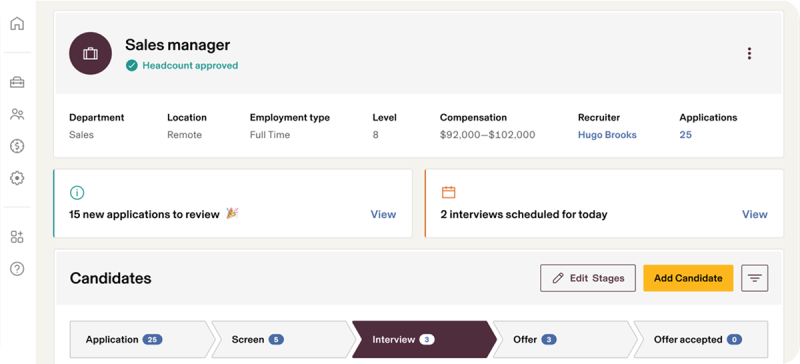
Key Features
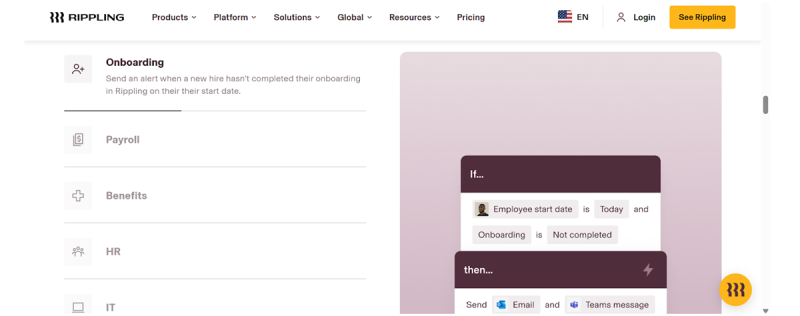
- Ship hardware, create accounts, set security policies, and disable access on exit from one screen
- Point-and-click reports, pivot tables, and visuals pull live data across HR, IT, and finance modules
- Connect Slack, QuickBooks, Jira, Salesforce, and more without middleware
- Hire and pay staff in 50 + countries from the same system, with automatic local tax filings
| Pros | Cons |
|---|---|
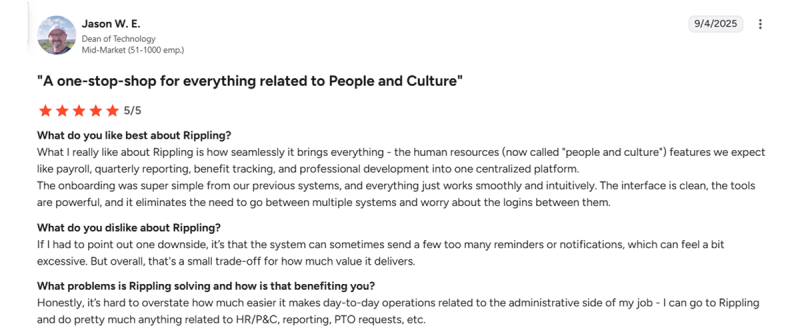
| A single source of truth eliminates data silos | Steep learning curve, feature depth demands admin training |
| Large integration marketplace keeps existing tech stack intact while adding new tools easily | Interface can feel overwhelming for teams coming from simpler tools |
| Modular design scales with growth, add only the apps you need, when you need them | Insurance integrations occasionally glitch, needing manual follow-up |
Who is it best for?
Best for growing SMB and mid-market companies (50- 1,000+ employees) that want a single system to automate HR, payroll, IT, and global workforce management without juggling multiple disconnected tools.
3. Deel
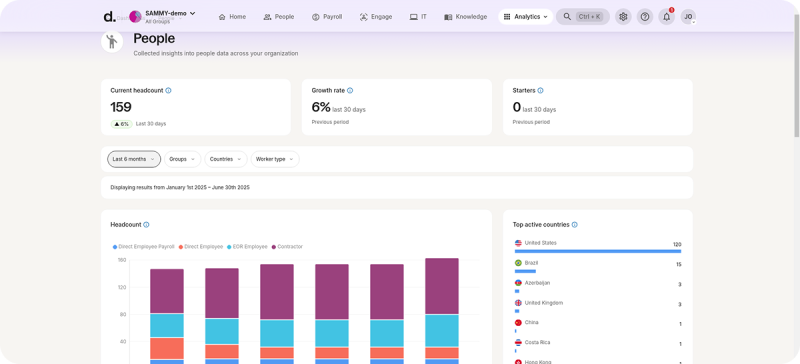
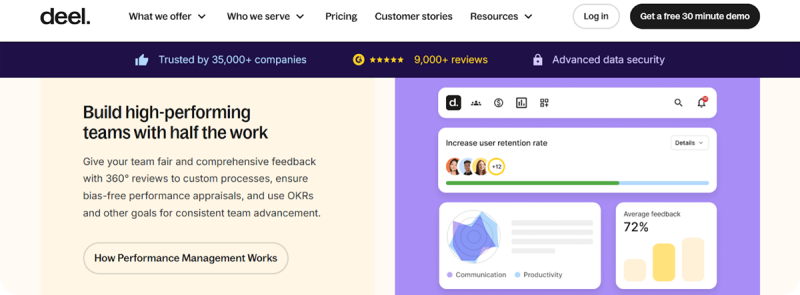
Deel is a global HR platform that lets companies hire, pay, and manage employees or contractors in 150-plus countries through a single system that handles payroll, contracts, and local compliance. Acting as the local Employer of Record, it enables businesses to onboard talent quickly without setting up their own foreign entities, while centralizing HR and payroll tasks in one dashboard.
Key Features
- Run one-click payroll in 150 + countries with automatic local tax withholding
- Hire full-time staff where you lack a legal entity, while Deel serves as the local employer
- Localized benefits administration provides health, pensions, equity, and perks that meet country-specific regulations
- Connect QuickBooks, NetSuite, Greenhouse, Slack, and pull real-time headcount and cost analytics
| Pros | Cons |
|---|---|
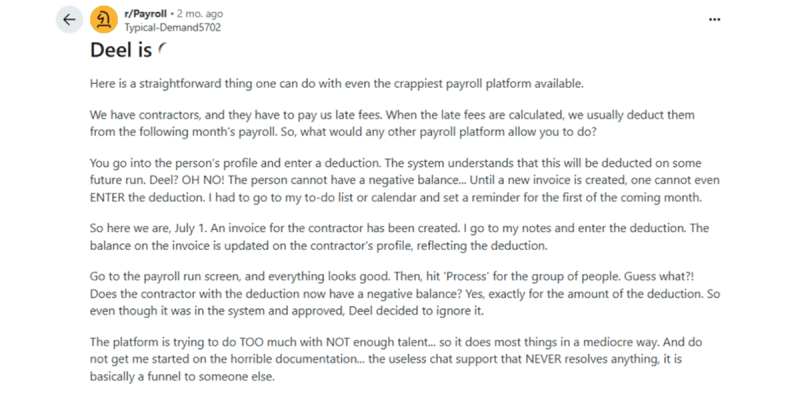
| Fast onboarding, employees can be contract-ready in as little as 24 hours | Higher per-employee cost than running payroll yourself in countries where you already have an entity |
| Automated compliance slashes legal risk in ever-changing labor markets | Currency-conversion spreads can erode take-home pay for certain corridors |
| Straightforward per-head pricing avoids surprises and scales predictably | Occasional payout delays reported by users in emerging-market banks |
| Built-in localized benefits boost EVP without separate brokers | Price increases as you layer add-ons like equity administration or hardware logistics |
Who is it best for?
High-growth companies (20-1,000 employees) that need to hire, pay, and retain talent in dozens of countries without building subsidiaries or wrestling with multi-country compliance on their own.
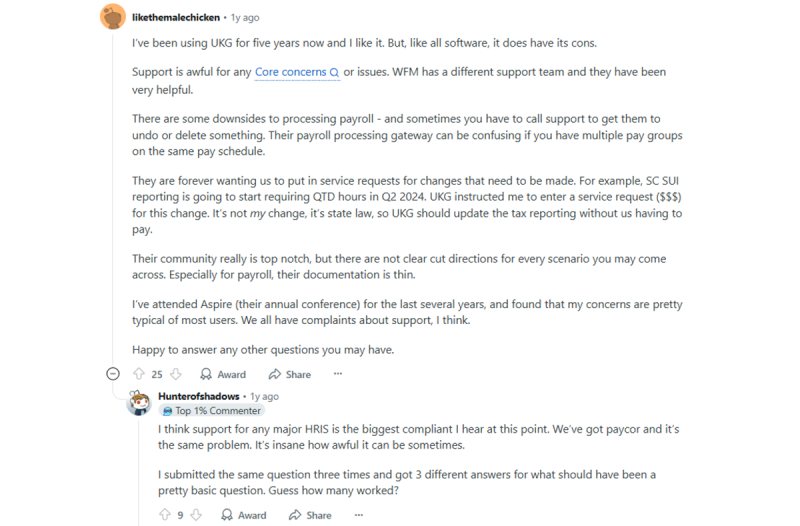
4. UKG
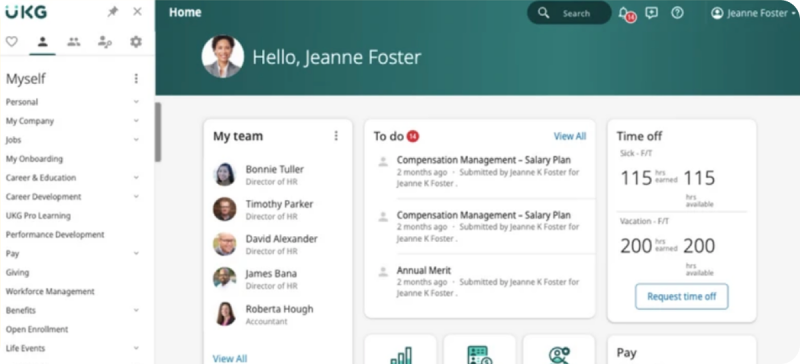
Born from the 2020 merger of Ultimate Software and Kronos, UKG focuses on large, compliance-heavy organisations that need deep labour-management controls, complex payroll rules, and AI-driven scheduling.
Key Features
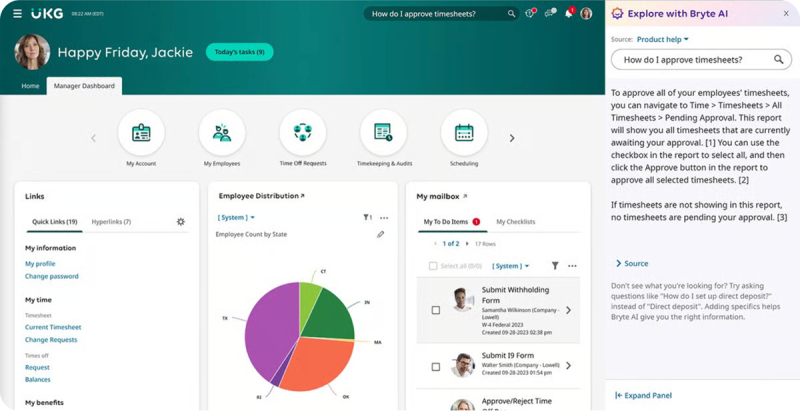
- Advanced time & attendance engine with biometrics, geofencing, and mobile punching
- AI-driven forecasting and scheduling that auto-predicts Labour demand and overtime
- A compliance manager who monitors federal, state, and union rules and flags violations
- People analytics library with pre-built dashboards for turnover, DE&I, and Labour cost
| Pros | Cons |
|---|---|
| Robust compliance automation lowers the risk of wage-and-hour violations | High subscription and implementation costs put it out of reach for small firms |
| Scalability supports tens of thousands of employees across multiple entities | Complex configuration requires dedicated IT/HRIS resources and lengthy roll-outs |
| AI scheduling improves coverage and employee satisfaction via fair shift distribution | User interface feels dated compared with newer, consumer-grade HR tools |
Who is it best for?
Large, multi-site enterprises (1,000 + staff) in highly regulated industries that need rigorous labour compliance, advanced scheduling and deep payroll/HR functionality in one scalable suite.
5. Paychex
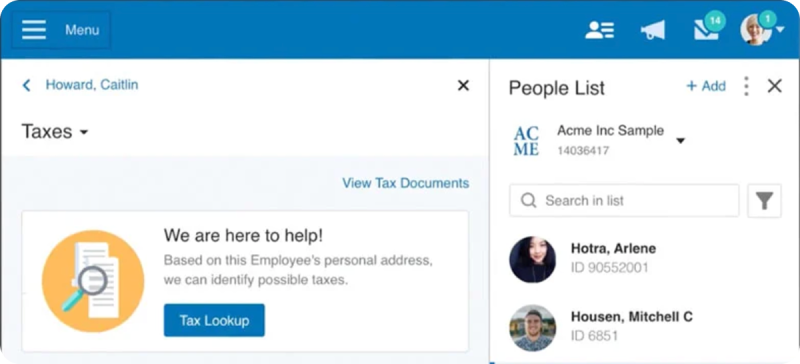
Built around their Paychex Flex system, it combines payroll processing, benefits administration, time tracking, and compliance management in one unified platform designed to serve everyone from small businesses hiring their first employee to large enterprises managing complex workforce needs.
Key Features
- Automated payroll processing with tax calculations, direct deposit, and employee self-service portal access
- Time and attendance tracking with biometric clocks, mobile apps, and overtime calculations
- Regulatory compliance automation, including tax filing, ACA reporting, and labor law updates
| Pros | Cons |
|---|---|
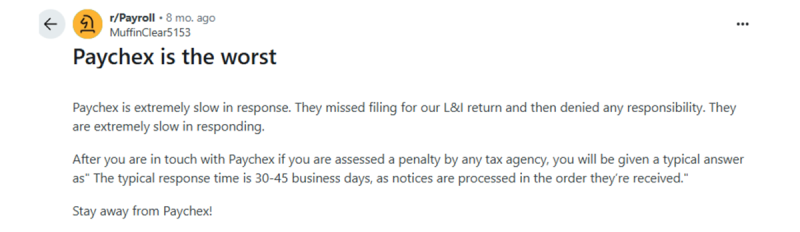
| Established reliability with 50+ years of payroll processing experience and proven track record | Custom pricing opacity requires sales calls to get actual costs, complicating budget planning |
| Scalable pricing model that grows with businesses from startups to large enterprises | Higher cost structure compared to newer, more affordable HR platforms targeting SMBs |
| A strong compliance framework keeps businesses current with federal, state, and local regulations | Traditional interface design feels dated compared to modern, consumer-grade HR software |
| Comprehensive solution eliminates the need for multiple vendor relationships across HR functions |
Who is it best for?
Established US businesses (10-1,000+ employees) that prioritize proven reliability, dedicated support, and comprehensive compliance over cutting-edge features or aggressive pricing.
6. BambooHR
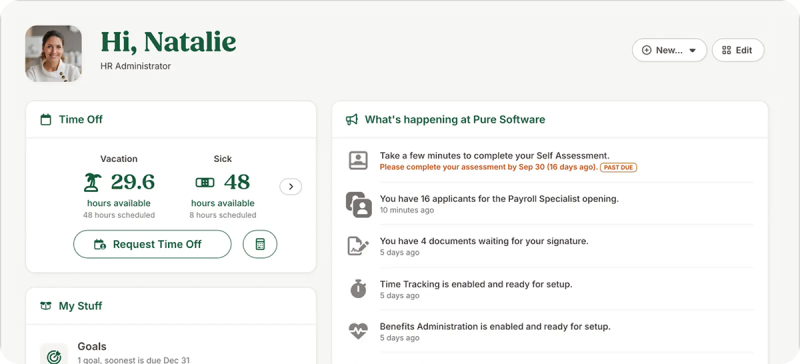
Known for its intuitive interface and employee-first design, BambooHR centralizes everything from recruiting and onboarding to performance management and time-off tracking in one cohesive platform that prioritizes ease of use over advanced customization.
Key Features
- Built-in applicant tracking system with job posting, resume parsing, and collaborative hiring workflows
- Time-off management with automatic accruals, approval workflows, and shared “Who’s Out” calendars
- HR reporting and analytics with 49 built-in reports and customizable dashboards for workforce insights
- Optional payroll and benefits add-ons with automatic tax filing and carrier integrations (US only)
| Pros | Cons |
|---|---|
| Excellent customer support with responsive, helpful service that users consistently praise | Pricing transparency issues require sales calls to get actual costs, complicating budget planning |
| Employee self-service capabilities reduce administrative burden on HR teams | Limited enterprise-grade features may not meet the needs of larger, more complex organizations |
| Flexible customization options allow tailoring fields, workflows, and access permissions to business needs | An add-on pricing model can inflate costs as businesses need time tracking, payroll, or benefits modules |
| Seamless onboarding experience automates new hire processes and reduces manual paperwork | US-only payroll and benefits limit international business capabilities |
Who is it best for?
Small to mid-sized US businesses (25-500 employees) that prioritize user-friendly design and comprehensive core HR functionality over advanced enterprise features or international capabilities.
Side-by-Side Feature Comparison Table
| Feature | Keka | Rippling | Deel | UKG | Paychex | BambooHR |
|---|---|---|---|---|---|---|
| Countries Supported | India/APAC + US-ready | 50+ (global) | 150+ (global) | 100+ (enterprise/global) | US-focused | US/UK focused |
| Payroll & Compliance | Full Indian/APAC + US tax filing | Global payroll + compliance automation | Global-first payroll & EOR | Enterprise-grade payroll & compliance | Strong US payroll & compliance | Add-on payroll (US only) |
| Performance Management | Goals, reviews, confidential 1:1s | Included but secondary to IT/ops | Basic reviews & feedback | Reviews, learning & succession planning | Limited | Reviews, goals & calibration |
| Employee Engagement | Pulse surveys, gamified attendance, transparent feedback | Trigger-based surveys, templates | Limited engagement | Surveys, feedback, comms suite | Basic tools | Surveys, onboarding, org health |
| Automation & AI | Setup wizards, workflows, automated reporting | Workflow builder, app provisioning | Payroll, contracts, visa automation | AI scheduling, compliance forecasting | Payroll/time tracking automation | Basic HR workflows |
| Employee Self-Service | Yes (pay, leave, docs, mobile-first) | Yes (HR + IT access) | Yes (employees + contractors) | Yes (pay, schedules, benefits) | Yes (pay stubs, tax forms, benefits) | Yes (time-off, onboarding, records) |
| Implementation Speed | Fast (2–4 weeks, guided setup) | 2–8 weeks depending on complexity | Varies; global setup can be complex | Long enterprise rollouts | Weeks depending on modules | Quick setup (days) |
| Mobile App Support | High-rated (4.7/5) | Good | Growing | Strong enterprise app | Good | Strong, user-friendly |
| Pricing Model | Transparent, affordable | Tiered, modular | Per-seat + EOR fees | Custom enterprise pricing | Tiered, opaque | Subscription + add-ons |
| Free Trial | Yes | No | No | No | No | Yes |
| User Ratings ([year]) | 4.7/5 | 3.9/5 | 4.2/5 | 4.0/5 | 3.8/5 | 4.5/5 |
| Best For | US SMBs with India/APAC teams, cost-conscious growth companies | SMBs & mid-market scaling globally with HR + IT | Remote-first, high-growth companies hiring in 150+ countries | Large enterprises in regulated industries | Established US SMBs prioritizing payroll & compliance | US/UK SMBs needing intuitive, people-first HR |
Why Keka is a Better Alternative to Personio
Employee-First Design Philosophy
Keka breaks away from traditional HR software that serves administrators at the expense of user experience. Built with employees in mind, the platform streamlines workflows and transforms complex tasks into simple, intuitive processes. This employee-centric approach drives higher adoption rates and reduces the training burden that typically accompanies HR system implementations.
Comprehensive All-in-One Platform
Keka eliminates the operational friction of managing multiple vendor relationships by consolidating payroll, time tracking, recruitment, performance management, and analytics into one unified system. This architectural advantage means data flows seamlessly between modules, eliminating manual synchronization and reducing errors that plague disconnected systems.
Superior Implementation Speed
Organizations can go live with Keka in 2-4 weeks, dramatically faster than traditional enterprise HR deployments. This rapid implementation timeline allows growing businesses to realize value immediately rather than waiting months for complex system configurations. The intuitive setup process requires minimal technical expertise, enabling HR teams to focus on strategic work instead of prolonged system administration.
Proven Cost Efficiency
Keka delivers measurable ROI through operational automation that eliminates manual administrative work. Users report saving 20+ hours monthly on routine tasks like payroll processing and compliance reporting. The platform’s unified approach also reduces the total cost of ownership by eliminating multiple software licenses, integration fees, and vendor management overhead.
Conclusion
Where other alternatives force trade-offs between functionality and simplicity, cost and capability, or features and user experience, Keka refuses to compromise. It’s the rare platform that gives you enterprise-grade automation without enterprise-level complexity.
Your next great hire shouldn’t wait for your HR platform to catch up. Your growing team shouldn’t suffer through outdated processes.