Somewhere in every organization right now, there is a version of this conversation happening.
Leadership asks why productivity numbers are not moving despite six months of AI tool rollouts. Meanwhile, team leaders start noticing that people seem more stressed. Strong performers first go silent and then quietly start looking elsewhere.
Any one of these moments looks small on its own. Stack them across a quarter and they start to look like a pattern nobody at the company has actually named yet.
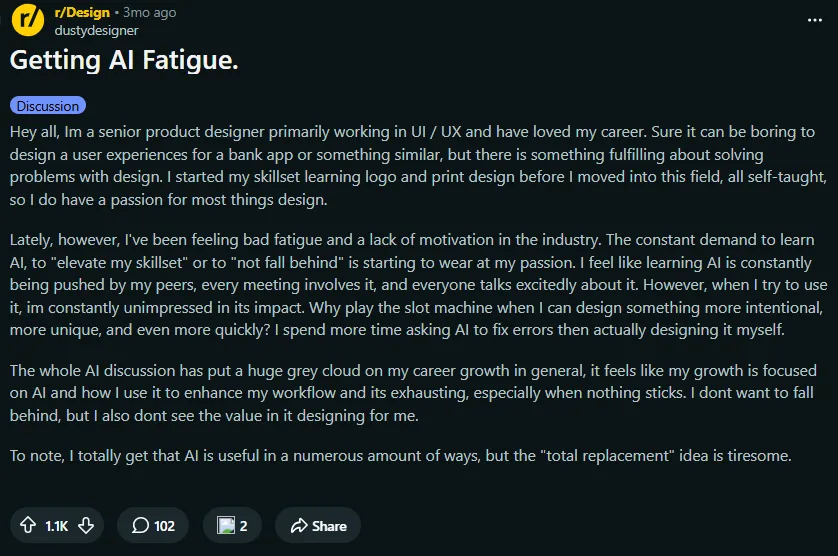
You can already see this showing up in online conversations. One Reddit thread stood out in particular.
Source: Reddit
A senior product designer tried AI, kept trying it, and found that, for their work, it felt slower and less precise than their own process. Yet the pressure to automate keeps growing. Suddenly every meeting, every peer conversation is anchored to AI with a constant low hum of “don’t fall behind.” Suddenly, career growth started feeling less about getting better at the craft and more about proving they use new tools.
This is AI fatigue. And it is showing up across functions, industries, and seniority levels. Engineers are worn down by constant prompt engineering. HR managers are stuck reviewing AI-generated job descriptions, policies, and employee communication that still need careful human oversight. Knowledge workers who hoped AI would reduce their workload are, in many cases, staying later than before.
Technology bought to cut work has, in plenty of cases, just added a second job on top of the first.
The Broken Promise
For most organizations, the promise of AI sounded almost magical. Remove the repetitive work, create more time, and people naturally become more productive.
That sequence has not played out.
Research from the Harvard Business Review found that after AI rollout, employees work at a faster pace and take on a broader scope of tasks. The result is not always more free time, but often longer workdays.
The Upwork AI-Enhanced Work Models study, which surveyed 2,500 workers across four countries, found that seventy-seven percent of employees using AI say it has increased their workload. Forty-seven percent said they do not know how to achieve the productivity gains their organizations expect from them.
The tools went live. The clarity around how to use them didn’t.
Most AI adoption follows the same pattern. Identify a tool, roll it out, track adoption metrics, move to the next one. What usually doesn’t get asked, before the rollout email goes out:
Those are operational questions. Almost no one answered them before the tools went live.
The result is that AI has been layered on top of existing work rather than used to restructure it. Employees are doing their original jobs and their AI jobs with added cognitive load and higher expectations.
“The bigger opportunity of AI adoption is not cost reduction but performance improvement, and companies focused on the former are missing the latter.” – Josh Bersin, HR Tech Europe 2026
Why AI Fatigue Is Growing
The symptoms are specific and worth naming directly. HR leaders can mistake them for general burnout or change resistance, but they have a more precise origin.
Tool sprawl: Zapier’s 2025 survey found that AI and app sprawl is limiting effective AI integration for roughly 70% of enterprises. The average knowledge worker is now managing multiple AI tools that do not connect to each other, each with its own interface, logic, and learning curve. The cognitive cost of switching between them is real and largely invisible.
Context switching: Every time an employee moves from their core task to a prompt, to an output review, to an edit, and back again, they lose concentration that does not return instantly. ActivTrak research tracking 164,000 employees found that focused, uninterrupted work dropped by 9% for AI users after rollout, while time on communication and administrative tools increased.
Unclear expectations: Gallup’s 2025 workplace study found that only 22% of employees say their organization has communicated a clear plan for integrating AI, and only 30% say there are formal guidelines or policies in place. Without clarity, employees fill the gap with anxiety. They over-use tools to appear current. They under-use them out of uncertainty. Both behaviours cost time.
Invisible reskilling: Nobody officially announced a reskilling programme. But employees are spending hours learning to prompt, reviewing AI output for accuracy, re-editing content that missed the brief, and experimenting with workflows that may or may not be retained. This is real work with no assigned time, no recognition, and no clear return.
Increased output pressure: Because AI theoretically speeds things up, the expected output volume has quietly increased. Wiley Workplace Intelligence research found that 96% of employees report some degree of stress about AI-related changes, and a significant portion cite pressure to produce more rather than produce differently as the primary driver.
Fragmented and duplicated work: When AI tools are adopted without governance, teams end up solving the same problems independently. One team builds a prompt library. Another team builds a different one. No one knows the other exists. Coordination breaks down, and duplication increases the friction it was meant to reduce.
Organizational change has always produced friction like this. What’s different now is six of these landing on the same team in the same quarter.
The Real Issue
AI fatigue has been framed as a technology adoption problem. The data tells a different story.
The organizations experiencing the most AI-related friction are the ones that introduced tools without redesigning the work around them. It is like putting a 1,000-horsepower Ferrari engine into a Toyota Prius.
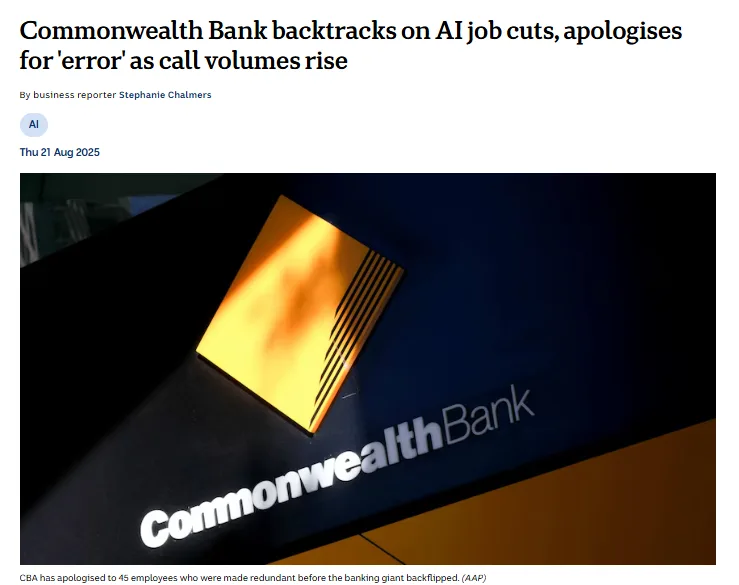
Take the example of Commonwealth Bank of Australia. The leadership rolled out an AI voice bot and laid off 45 customer service reps without redesigning the work. Call volumes surged instead of dropping, forcing overtime and team leaders to answer calls. Eventually, the bank was forced to rehire all 45 workers after a union investigation.
Source: ABC
Cases like this should change where HR leaders put their energy. A bit more training won’t fix it. Neither will a better tool. What most organizations have not done is ask the foundational question: what should work look like now that AI is part of it?
Answering it means touching governance, role design, performance metrics, how managers actually manage day to day. That’s HR and operations work, and almost nobody has started it.
“AI is not a technology transition. It is a business transformation and a human transformation happening at the same time, and organizations that don’t design for both will succeed at neither.” – Jason Averbook, Senior Partner, Mercer | Now to Next, April 2026
Tracking adoption rates, who uses which tool, how often, measures the wrong thing when the underlying work design has not changed. You can hit 100% adoption and still produce exactly the conditions driving fatigue today.
A Framework for Reducing AI Fatigue — The SCALE Model
Reducing AI fatigue does not require a transformation programme. It requires management discipline applied in five specific areas.
S — Simplify the tool environment: Before adding any new AI tool, take stock of what is already in use and what problems each one is actually solving. If the answer is unclear, that is useful information. The goal is fewer, better-integrated tools rather than comprehensive coverage. Nutanix’s guidance on managing enterprise AI sprawl recommends building a cross-functional inventory of AI tools, assessing risk and benefit, and progressively standardizing the stack.
C — Clarify what AI is for, at the team level: Employees need concrete answers to a simple question: in this role, what is AI used for, and what is it not used for. Gallup research shows employees are three times more likely to feel prepared to work with AI when leadership has communicated a clear plan. The barrier is organizational clarity, and that is something managers and HR can provide directly.
A — Adapt workflows deliberately: Introducing AI to a task without changing the surrounding workflow makes the task faster and the workflow busier. Map the actual sequence of work. Identify where AI fits, where it creates handoff confusion, and what steps can be removed rather than just accelerated. If there’s a real productivity gain in any of this, it comes from redesigning the workflow, not from the tool sitting inside it.
L — Lead with manager capability: Wiley’s research found that while 80% of employees feel generally supported by their managers, only 60% believe their managers know how to effectively integrate AI into team workflows. Managers need practical guidance on how to lead teams through AI change. Philosophy and vision are not enough. Concrete use cases, communication guidance, and space to experiment are.
E — Expand what you measure: Organizations monitoring only adoption rates and productivity numbers will miss fatigue until it becomes attrition. Add indicators that reflect how teams are experiencing the change, workload distribution, self-reported readiness, manager confidence, and retention signals in high-AI-use roles. Lockton’s framing is useful here: treat AI-induced burnout as an organizational risk that warrants the same monitoring rigour as any other operational metric.
What Happens When You Skip This
When AI adoption scales without operational discipline, the costs compound quietly.
Trust erodes first. Employees who feel set up to fail by unclear expectations start to disengage. They stop experimenting and start doing the minimum needed to appear compliant. The energy that genuine improvement requires disappears into defensive behaviour.
The next casualty is coordination. Without shared norms and governance, teams develop inconsistent practices. Outputs become harder to quality-check. Knowledge does not transfer. What looks like productivity at the individual level starts creating friction at the team level.
Culture shifts in ways that are difficult to reverse. The designer’s comment from the forum is worth returning to here. The exhaustion he describes is not about AI replacing him. It is about being managed through an accelerated change with no clear structure, no acknowledgment of the real cost, and no end point. When every meeting, every performance conversation, and every skills discussion centres on AI adoption, organizations can inadvertently communicate that tools matter more than the people using them.
“The challenge for leaders is to ensure that amid this transformation, organizations deliberately preserve the human experiences that are vital for true development and flourishing.” – Lynda Gratton, Professor of Management Practice, London Business School
Employees notice. They don’t say it out loud in the all-hands, but they notice.
And somewhere in all of that, the actual work gets worse. Speed of adoption is not a competitive advantage if it generates enough internal friction to slow down the work that actually matters.
Where this leaves HR leaders
The organizations that will use AI most effectively in the years ahead will be the ones that took time in 2026 to redesign work around what AI actually enables. That is a different task from buying better tools or running more training sessions.
As Microsoft’s 2026 Work Trends Index put it: “Access to AI won’t be the advantage for much longer. How the work is designed around it will be.”
Early movers got attention for adopting AI quickly. The next advantage goes to the organizations that figured out how to use it sustainably, without burning out the people who execute the strategy.
HR is positioned to lead that work. The questions that matter most right now are operational ones that other functions are not asking. What is the actual workload now? What are managers equipped to handle? What does performance mean when AI is part of the process? What are we genuinely asking people to carry?
In 2026, the organizations asking these questions seriously will be the ones that adapt to AI without exhausting the people behind the work.


 Login
 Payroll Suite
 HR Suite
 Talent Suite
 Project Services Suite