Login


Income Statement vs Profit and Loss: Are They the Same?



PRODUCTS
 Payroll Suite
 HR Suite
 Talent Suite
 Project Services Suite

Meet the platform tailored to your business
Core system of record
One platform for the entire employee journey

BY INDUSTRY
BY COMPANY SIZE
LEARN
EXPLORE KEKA
The difference between an income statement and a profit and loss statement is a matter of terminology, not accounting. Both refer to the same report showing revenue, expenses, and net profit over a period. In US accounting, “income statement” is used in formal reporting, while “P&L” is common in everyday business use. The structure is identical—the difference lies in context, not calculation.
Picture this: your accountant sends over the “income statement,” your bookkeeper references the “P&L,” and your investor asks for the “profit and loss report.” Three people, three different terms, and you are sitting there wondering if you have been looking at the wrong document this whole time.
You have not. They are all asking for the same thing.
The income statement and the profit and loss statement are the same financial report. The only real difference is the label at the top of the page, and that label changes depending on who is asking and why. Once you see that, the confusion disappears.
Short Answer: An income statement and a profit and loss (P&L) statement are the same financial report. The difference lies in terminology and context of use, not in what they calculate or show.
In this guide, we cover what each term actually means, where they show up in the real world, how the two compare side by side, and what every line item on these reports is telling you about your business.
Income Statement vs Profit and Loss: Key Takeaways
- They are the same report: An income statement and a profit and loss (P&L) statement show revenue, expenses, and profit or loss over a specific period.
- The difference is terminology: “Income statement” is used in formal reporting (GAAP, SEC filings), while “P&L” is common in day-to-day business use.
- Structure does not change: Both follow the same format—revenue, costs, expenses, and net income.
- Context matters: The term used depends on who is reading the report—investors vs internal teams.
- Focus on insights, not labels: What matters is understanding the numbers and using them to make better decisions.
Let’s get started.
Here is the truth that most accounting explainers bury three paragraphs in: from a pure accounting standpoint, there is no technical difference between an income statement and a profit and loss statement.
Both summarize a company’s revenues, costs, and resulting net income or net loss over a specific period, whether that is a month, a quarter, or a full year. The structure is identical regardless of what you call it: revenue at the top, expenses in the middle, and net income or loss at the bottom.
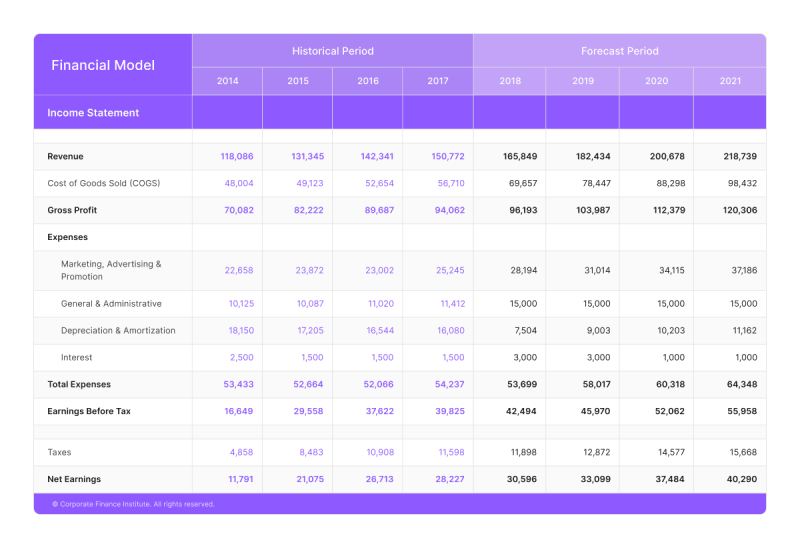
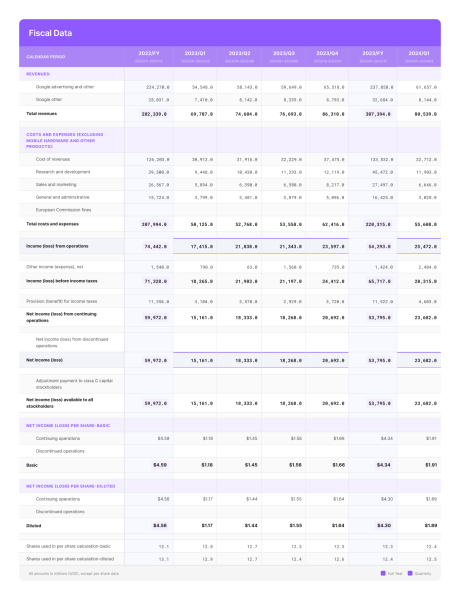
Where the terminology splits is really about the environment. Under US GAAP, the document is formally called an “income statement,” and that is the label you will find on SEC filings, 10-K reports, and audited financials. In the day-to-day world of small business, “P&L” is what tends to stick. It is shorter, more intuitive, and more common in most working business conversations.
So when someone asks for a profit and loss vs income statement comparison, the honest answer is that they are the same report, just dressed differently depending on the audience.
For example, a founder reviewing monthly performance might rely on a P&L during internal team discussions, while investors reviewing the same business will expect an income statement in formal financial reports. Same numbers, different rooms.
With that settled, here is where things get slightly more interesting: the context in which each term is used tells you a lot about the environment you are operating in.
The profit and loss statement vs income statement distinction is not a calculation difference. It is a context difference. Think of it less like two separate documents and more like two job titles for the same person: the work is identical, the nameplate changes depending on the office.
| Aspect | Income Statement | Profit and Loss (P&L) Statement |
| Terminology | Formal term in accounting standards, audited financials, and corporate reporting. | Everyday term used by small businesses, bookkeepers, and in many accounting tools. |
| Used in accounting | Standard label in GAAP/IFRS-aligned financial statements and SEC filings. | Same report, often referenced in internal management reports and small business accounting. |
| Reporting format | Commonly presented in a multi-step format with gross profit, operating income, and net income broken out. | May appear as single-step or multi-step depending on software or template, but follows the same logic. |
| Context of use | Used for investors, lenders, regulators, and formal financial analysis. | Used for day-to-day performance tracking, budgeting, and operational decision-making. |
| Audience | External stakeholders, corporate finance teams, auditors, and analysts. | Owners, managers, startup founders, and internal teams who want a quick view of profitability. |
The pattern is consistent: “income statement” travels in formal circles, “P&L” lives in operational ones. Neither is more accurate than the other.
When to use “income statement”: Preparing audited financials, filing with the SEC, presenting to institutional investors, or working inside a GAAP-compliant reporting framework. You will also see it referenced as a “statement of operations” or “earnings statement” in some corporate contexts.
When to use “P&L”: Running a monthly internal review, pulling a report from your accounting software, presenting to your team, or having a conversation with your accountant about how the business performed last quarter. This is the working language of most small business finance.
The numbers do not change. The context does.
Now that the terminology is clear, it is worth looking at what these reports actually contain, because that is where the real value sits.
Strip away the label entirely and what you are left with is a document that tells one continuous story: money comes in, costs go out, and what remains is either a profit or a loss. Here is how that story unfolds, step by step.
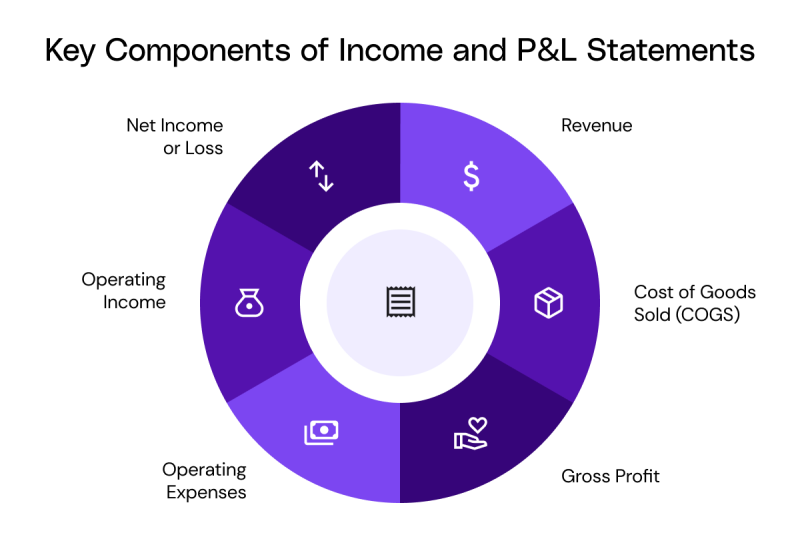
Revenue is where the story begins. It is the total amount your business earns from selling goods or services before any expenses are deducted. Most statements split this into operating revenue from core business activities and non-operating revenue such as interest or investment income.
Under the accrual method, revenue is recorded when it is earned, even if cash has not changed hands yet. Under the cash method, it is recorded only when payment is actually received. Which method your business uses shapes how your revenue line looks at any given point in time.
Right after revenue comes the first reality check: what did it actually cost to deliver what you sold? COGS captures the direct costs of producing your product or service, things like raw materials, manufacturing labor, or direct project wages. Subtract COGS from revenue and you get gross profit, which tells you whether your core business model is working before overhead even enters the picture.
For product-heavy or inventory-based businesses, tracking COGS carefully is not optional. It is the foundation of understanding margin, pricing power, and long-term scalability.
Gross profit is revenue minus COGS, and it answers one of the most important early questions in any business: is the core of what we do actually profitable, before we factor in rent, admin, and everything else? Founders and finance teams watch gross margin trends closely because they react quickly to pricing changes, supplier negotiations, and discounting decisions.
This is where the cost of keeping the lights on shows up. Operating expenses cover the indirect costs of running the business: salaries for non-production staff, rent, utilities, software subscriptions, marketing, and professional fees. These are often grouped under selling, general, and administrative expenses (SG&A).
Unlike COGS, operating expenses are not directly tied to producing each unit or delivering each service. But cut them too aggressively and the business starts to stall.
Operating income is gross profit minus operating expenses, and it tells you how profitable the core business is before interest, taxes, and one-off items enter the picture. It is a cleaner, more comparable number than net income, which is why analysts and investors often use it when benchmarking companies against each other in the same industry.
This is the number everyone scrolls to first: the bottom line. Net income is what remains after all expenses, including interest and taxes, have been subtracted from total revenue. If revenue and gains exceed all expenses and losses, the business made money. If not, it did not. This number feeds into tax filings, investor conversations, and every profitability ratio worth tracking.
With all the components clear, the next question is an easy one: if both reports contain the same information, how similar are they really?
By this point, the similarities should feel less like a list and more like a logical conclusion. If both reports are built from the same components and structured the same way, they are going to look identical. Here is what that means in practice.
Whether labeled an income statement or a P&L, the report tracks how revenue flows through costs and expenses to arrive at a net profit or loss. The math does not change based on what the document is called.
Each report is anchored to a defined time frame, monthly, quarterly, annually, or custom. That structure makes it easier to compare performance over time and catch trends before they become problems.
Revenue, COGS, gross profit, operating expenses, operating income, non-operating items, and net income all appear in the same order regardless of which term is on the header.
The income statement or P&L is one of three primary financial documents, alongside the balance sheet and cash flow statement, that together give a complete picture of a business’s financial health. You cannot fully understand one without the other two.
Go back to that opening scenario: your accountant, your bookkeeper, and your investor all using different terms for the same document. Now that you know what is actually going on, that situation feels a lot less like confusion and a lot more like three people speaking the same language in slightly different dialects.
When comparing income statement vs profit and loss, the difference comes down to context, not calculation. Both represent the same financial story. What changes is who is reading it and why.
For founders, finance teams, and small business owners, what matters is not the label at the top of the page. It is whether you are reading the report consistently, tracking trends over time, and using what it tells you to make better decisions. If you can read one, you can read the other. The terminology was never the hard part.
A profit and loss summary is a condensed version of a full income statement or P&L. Instead of listing every expense line, it rolls costs into broader categories for a faster read. The underlying data is the same; the summary just removes the granularity.
Yes. Both are the same financial report. “Income statement” is the formal GAAP term used in SEC filings and audited financials. “P&L” is what most small businesses, founders, and accounting tools use in everyday conversations. The structure and content are identical.
Most do. Small businesses default to “P&L” because that is the language used in tools like QuickBooks and most small business resources. It feels more natural in day-to-day conversations, even though it refers to the exact same document as an income statement.
A P&L statement shows total revenues, direct costs (COGS), operating expenses, and the resulting net profit or loss for a specific period. Many also include non-operating items like interest income, interest expense, and gains or losses from asset sales.
Subscribe to keep up with the latest strategic finance content.
Request a demo