Login


Actual Contribution Percentage (ACP) Test
Read Time: 10 Mins


PRODUCTS
 Payroll Suite
 HR Suite
 Talent Suite
 Project Services Suite
Meet the platform tailored to your business
Core system of record
One platform for the entire employee journey
How Srijan Technologies streamlined timesheets management with Keka
Read customer story
BY INDUSTRY
BY COMPANY SIZE
LEARN
EXPLORE KEKA
Navigate every labor law, wage regulation, and statutory requirement across all 28 states and 8 union territories without the legal headaches.
Learn More
The Actual Contribution Percentage (ACP) test is an annual non-discrimination evaluation used to ensure fairness in 401(k) and 403(b) plans. It checks that employer matching contributions and employee voluntary after-tax contributions are distributed equitably between Highly Compensated Employees (HCEs) and Non-highly Compensated Employees (NHCEs).
(Note: Highly Compensated Employees (HCEs) are the employees who either earned above a specific income level set by the IRS (e.g., $150,000) or own more than 5% of the company, whereas Non-Highly Compensated Employees (NHCEs) are the employees who do NOT meet the criteria to be considered HCEs, meaning they earn less than the set income level and do not own more than 5% of the company.)
This distinction is important for ensuring that retirement plans are not disproportionately favoring higher-paid employees over the broader workforce, complying with nondiscrimination rules.
The goal is to prevent a situation where the benefits for HCEs are disproportionately higher than NHCEs, thus promoting fairness in the retirement plan’s benefits distribution.
Simply put, it’s a yearly check to ensure that contributions to 401(k) and 403(b) plans are fair and don’t favor higher-paid employees more than lower-paid ones.
The ACP Test checks if employer contributions, such as matching or after-tax contributions, favor Highly Compensated Employees (HCEs) over Non-Highly Compensated Employees (NHCEs).
Here’s a quick breakdown:
1. Calculate Each Employee’s Contribution Ratio (ACR):
2. Average the ACRs:
3. The plan passes if:
To understand how the Actual Contribution Percentage (ACP) test is calculated, let’s consider a real-life scenario involving a fictional company, “TechSolutions Inc.”
This example will help illustrate the key concepts and calculations involved in the ACP test, along with related metrics like the Actual Contribution Percentage (ACP), Actual Contribution Test, Actual Deferral Percentage (ADP), and the ADP Test.
Actual Contribution Percentage (ACP)= Total Matching Contributions + Total After-Tax Contributions/Compensation ×100
Calculate the Average ACP for HCEs and NHCEs:
Compare the HCE Average ACP to the NHCE Average ACP:
The ACP measures the average rate of employer matching and/or after-tax contributions for Highly Compensated Employees (HCEs) compared to Non-Highly Compensated Employees (NHCEs).
Example Calculation:
1. HCEs:
2. NHCEs:
Calculations:
1. HCE ACP:
2. NHCE ACP:
The Actual Contribution Test compares the average ACP of HCEs to NHCEs to ensure fairness.
Add the ACRs for each group and divide by the number of employees.
1. HCEs:
2. NHCEs:
For HCEs:
Average ACP for HCEs: 3.00% + 3.00% + 3.00% / 3 = 3.00%
For NHCEs:
Average NHCE ACP = 3.00% + 0.00% + 3.00% + 3.00% / 4 = 2.25%
Test Results:
- HCE ACP: 3.00%
- NHCE ACP: 2.25%
- Comparison: HCE ACP is not more than 125% of NHCE ACP, nor is it more than 2 percentage points greater than NHCE ACP.
Test Pass/Fail:
Result: The test passes since 3.00% is within the allowed range compared to 2.25%.
The ADP measures the average rate of salary deferrals for HCEs compared to NHCEs.
The ADP measures the average rate of salary deferrals for HCEs and NHCEs
HCEs:
John:
Deferral: $18,500
Compensation: $275,000
18,500/275,000= 6.73%
Carolyn:
Deferral: $15,000
Compensation: $200,000
15,000/$200,000 = 7.50%
Steve:
Deferral: $12,500
Compensation: $125,000
12,500/125,000 = 10.00%
Average HCE ADP:
6.73% + 7.50% + 10.00% / 3 = 8.08%
NHCEs
Amanda:
Deferral: $12,000
Compensation: $100,000
12,000/100,000 = 12.00%
Mike:
Deferral: $0
Compensation: $50,000
0/50,000 = 0.00%
Lisa:
Deferral: $4,000
Compensation: $40,000
4,000/40,000 = 10.00%
Gary:
Deferral: $2,400
Compensation: $35,000
2,400/35,000= 6.86%
Average NHCE ADP:
12.00% + 0.00% + 10.00% + 6.86% /4 = 7.22%
Example Calculation:
1. HCEs:
2. NHCEs:
The ADP Test compares the average ADP of HCEs to NHCEs to ensure equitable participation.
To pass the ADP test, the plan must meet one of two conditions:
The average ADP of HCEs cannot exceed 125% of the average ADP of NHCEs
125% of NHCE ADP:
7.22% x 1.25 = 9.03%
In this case, the HCE ADP (8.08%) is below 9.03%, satisfying the requirement.
Alternatively, the HCE ADP cannot be more than 2 percentage points greater than the NHCE ADP, and the HCE ADP also cannot exceed 200% of the NHCE ADP
NHCE ADP + 2%
7.22% + 2.00% = 9.22%
200% of NHCE ADP
7.22% X 2 = 14.44%
The HCE ADP (8.08%) is below both 9.22% (the 2% rule) and 14.44% (the 200% rule), satisfying the requirement as well.
Test Results:
- HCE ADP: 8.08%
- NHCE ADP: 7.22%
- Comparison: HCE ADP is not more than 125% of NHCE ADP, nor is it more than 2 percentage points greater than NHCE ADP.
Test Pass/Fail:
Result: The test passes since 8.08% is within the allowed range compared to 7.22%.
In this example, TechSolutions Inc. successfully passes both the ACP and ADP tests, indicating that their 401(k) plan is compliant and equitably benefits both HCEs and NHCEs. Regularly performing these tests helps ensure that the plan remains fair and compliant with IRS regulations.
To pass the Actual Contribution Percentage (ACP) test and maintain 401(k) compliance, employers should follow these best practices:
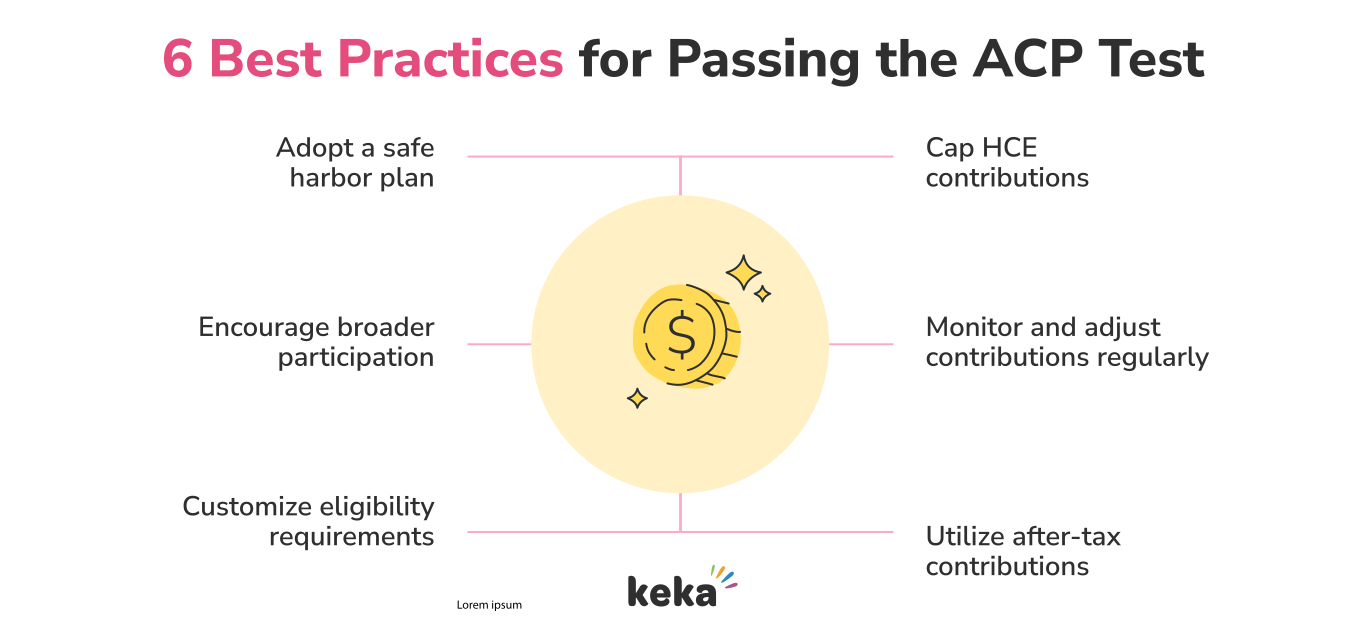
Safe Harbor Match: Ensure that your 401(k) plan meets the Safe Harbor matching requirements, which generally involve matching employee contributions up to a certain percentage of their salary.
(A Safe Harbor 401(k) plan makes it easier for employers to meet IRS rules by offering guaranteed contributions, like matching or fixed amounts, to every employee’s retirement account. This helps ensure fairness across the board, regardless of how much someone earns.)
Safe Harbor Non-Elective Contribution: Provide a non-elective contribution, where a fixed percentage of each employee’s salary is contributed to their 401(k) account, regardless of whether they contribute themselves.
Financial Education: Educate NHCEs about the benefits of retirement savings. The more they understand, the more likely they are to participate and contribute.
Automatic Enrollment: Use automatic enrollment with default contribution rates to increase NHCE participation. It’s an easy way to get more employees involved and balance contributions across the board.
Extended Eligibility: Think about extending the required employment period before employees can join the plan. This can help manage participation levels and keep things balanced.
Limit HCE Contributions: Set contribution limits for Highly Compensated Employees (HCEs) to help your plan meet nondiscrimination requirements and stay compliant.
Midyear Testing: Conduct midyear testing to catch any potential compliance issues early on. It’s better to spot problems sooner rather than later.
Plan Review: Regularly review how contributions are shaping up. This lets you make any necessary adjustments to keep everything on track.
After-Tax Contributions: Allowing after-tax contributions can help balance out your ACP test results and ensure your plan remains compliant.
If your plan fails the ACP test, taking the right corrective steps is crucial. Here’s a detailed guide on how to address the issue:
Taking prompt and appropriate corrective actions ensures your plan remains compliant and avoids potential IRS penalties.
The Actual Deferral Percentage (ADP) test compares how much Highly Compensated Employees (HCEs) and Non-Highly Compensated Employees (NHCEs) contribute to a retirement plan through salary deferrals, simply put, from their paychecks. It ensures that HCEs aren’t contributing disproportionately more than NHCEs by measuring the average deferral rates for both groups.
The Actual Contribution Percentage (ACP) test is similar but focuses on employer contributions, such as matching contributions or after-tax contributions. It ensures that the employer’s contributions benefit both HCEs and NHCEs fairly.
In short, the ADP test looks at employee deferrals, while the ACP test looks at employer contributions. Both tests are designed to prevent retirement plans from unfairly favoring HCEs over NHCEs.
Following are the key differences between the two:
| Aspect | ADP Test | ACP Test |
| Purpose | Ensures salary deferrals are distributed fairly between HCEs and NHCEs. | Ensures matching and after-tax contributions are distributed fairly between HCEs and NHCEs. |
| Focus | Average deferral percentages. | Average contribution percentages (including matching and after-tax). |
| Calculation | Average deferral percentage = Total deferrals / Compensation for each group. | Average contribution percentage = Total matching + after-tax contributions / Compensation for each group. |
| Comparison | HCE ADP vs. NHCE ADP. | HCE ACP vs. NHCE ACP. |
| Testing Methods | 1.25 Test: HCE ADP ≤ 125% of NHCE ADP.
2 + 2 Test: HCE ADP ≤ NHCE ADP + 2% and HCE ADP ≤ 2 × NHCE ADP. |
Same as ADP but for contributions (matching + after-tax). |
| Required For | All traditional 401(k) plans. | Only 401(k) plans with matching or after-tax contributions. |
| Common Correction Methods | – Refunds to HCEs.
– Retroactive Safe Harbor contributions. – Qualified Nonelective Contributions (QNECs) to NHCEs. |
– Refunds to HCEs.
– Retroactive Safe Harbor contributions. – QNECs to NHCEs. |
| Safe Harbor Impact | Automatically passes the ADP test if Safe Harbor contributions are made. | Automatically passes the ACP test if Safe Harbor contributions are made. |
| Plan Correction Deadline | Corrective actions must be taken within 12 months after the end of the plan year. | Corrective actions must be taken within 12 months after the end of the plan year. |
| Additional Details | – The ADP test checks how much employees are deferring from their salaries into the plan.
– Plans have flexibility in the testing method but must pass one of the tests. |
– The ACP test checks how much the employer is contributing in matches and after-tax contributions.
– Similar flexibility in testing methods as ADP. |
| Top-Heavy Plans | Not directly part of ADP but could affect the outcome; top-heavy plans require additional contributions. | Not directly part of ACP but could affect the outcome; top-heavy plans require additional contributions. |
Subscribe to keep up with the latest strategic finance content.
Request a demo